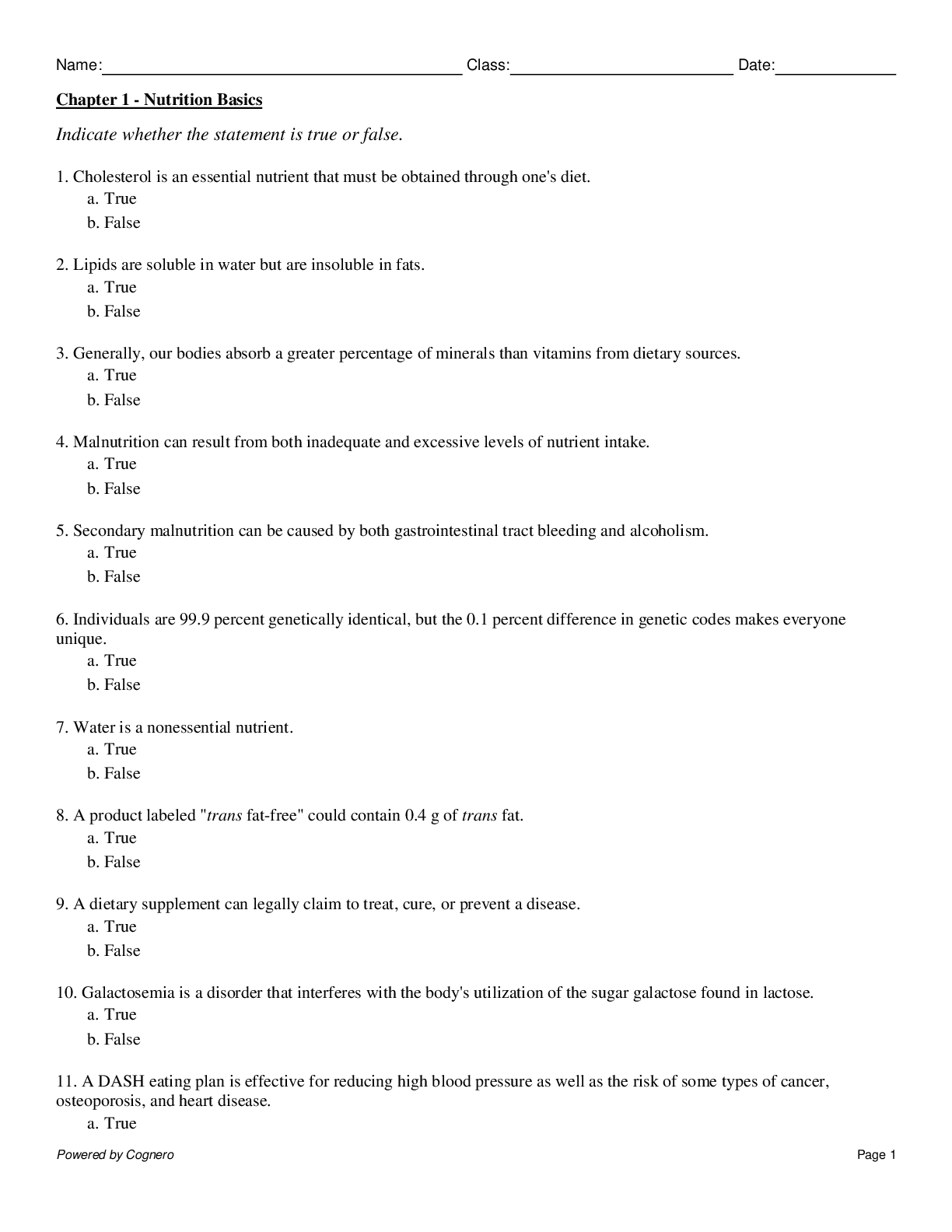
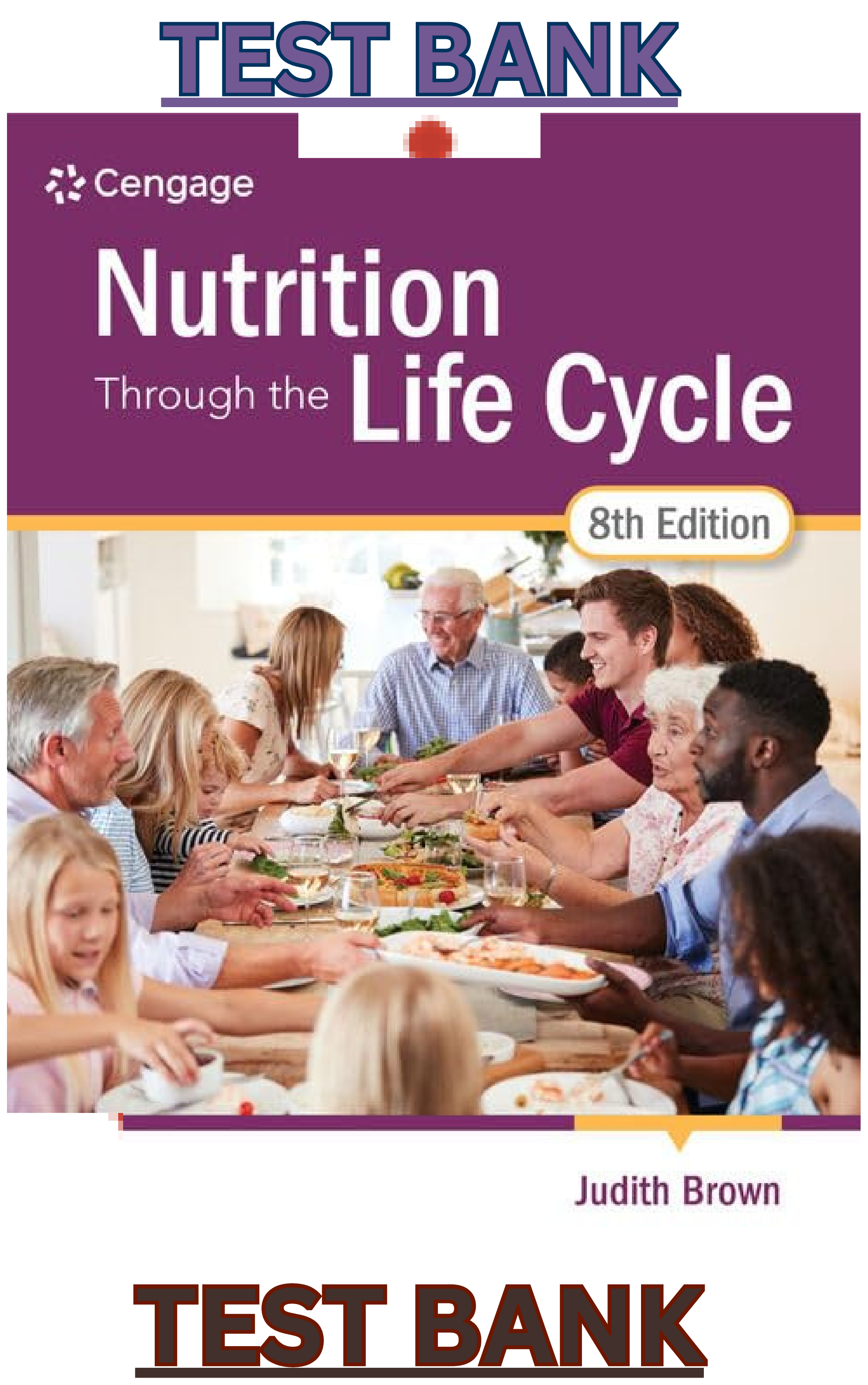
Test Bank for Nutrition Through the Life Cycle 8e Judith E. Brown-1. Individuals without risk factors for heart disease should limit cholesterol intake to no more than 300 milligrams a day.
a. True
b. False
ANSWER: Tr
...
Test Bank for Nutrition Through the Life Cycle 8e Judith E. Brown-1. Individuals without risk factors for heart disease should limit cholesterol intake to no more than 300 milligrams a day.
a. True
b. False
ANSWER: True
POINTS: 1
REFERENCES: Principles of the Science of Nutrition
QUESTION TYPE: True / False
HAS VARIABLES: False
LEARNING OBJECTIVES: NTLC.BRWN.24.1.1 - Understand the meaning of the nutrition concepts presented.
KEYWORDS: Bloom's: Understand
DATE CREATED: 11/29/2023 11:40 PM
DATE MODIFIED: 11/29/2023 11:42 PM
2. Which of the following diseases is characterized by high blood glucose levels?
a. type 2 diabetes
b. hypertension
c. stroke
d. Alzheimer’s disease
e. fatty liver disease
ANSWER: a
POINTS: 1
REFERENCES: Principles of the Science of Nutrition
QUESTION TYPE: Multiple Choice
HAS VARIABLES: False
LEARNING OBJECTIVES: NTLC.BRWN.24.1.1 - Understand the meaning of the nutrition concepts presented.
KEYWORDS: Bloom's: Understand
DATE CREATED: 11/29/2023 11:43 PM
DATE MODIFIED: 11/29/2023 11:44 PM
3. Which of the following statements depicts the progression of a micronutrient deficiency?
a. Physical signs develop before a decrease in tissue reserves.
b. Physical signs develop before a decrease in dietary intake.
c. Insufficient nutrient availability to cells occurs before physical signs develop.
d. Insufficient nutrient availability to cells occurs after physical signs develop.
e. Impaired cellular function occurs after physical signs develop.
ANSWER: c
POINTS: 1
REFERENCES: Principles of the Science of Nutrition
QUESTION TYPE: Multiple Choice
HAS VARIABLES: False
LEARNING OBJECTIVES: NTLC.BRWN.24.1.1 - Understand the meaning of the nutrition concepts presented.
KEYWORDS: Bloom's: Understand
DATE CREATED: 11/29/2023 11:48 PM
DATE MODIFIED: 11/29/2023 11:50 PM
Chapter 1
4. Malnutrition can result from both inadequate and excessive levels of nutrient intake.
a. True
b. False
ANSWER: True
POINTS: 1
REFERENCES: Principles of the Science of Nutrition
QUESTION TYPE: True / False
HAS VARIABLES: False
LEARNING OBJECTIVES: NTLC.BRWN.24.1.1 - Understand the meaning of the nutrition concepts presented.
KEYWORDS: Bloom's: Remember
DATE CREATED: 11/30/2023 12:04 AM
DATE MODIFIED: 11/30/2023 12:07 AM
5. Which of the following changes have been made to the nutrition facts panel?
a. Added sugars are now listed.
b. Poly-unsaturated fats are now listed.
c. Zinc is now listed.
d. Calories are now listed at the bottom of the panel.
e. Daily values are now listed on the left of each nutrient.
ANSWER: a
POINTS: 1
REFERENCES: Principles of the Science of Nutrition
QUESTION TYPE: Multiple Choice
HAS VARIABLES: False
LEARNING OBJECTIVES: NTLC.BRWN.24.1.2 - Read and understand the elements of nutrition labels; you will be able
to understand the nutritional value of most food products.
KEYWORDS: Bloom's: Understand
DATE CREATED: 11/30/2023 12:07 AM
DATE MODIFIED: 11/30/2023 12:12 AM
6. Healthy dietary patterns include:
a. refined grain products.
b. foods high in tropical oils.
c. processed foods high in sodium.
d. nuts with high amounts of omega-3 fatty acids.
e. sweetened teas.
ANSWER: d
POINTS: 1
REFERENCES: Principles of the Science of Nutrition
QUESTION TYPE: Multiple Choice
HAS VARIABLES: False
LEARNING OBJECTIVES: NTLC.BRWN.24.1.6 - Design a healthy dietary pattern.
KEYWORDS: Bloom's: Understand
Chapter 1
DATE CREATED: 11/30/2023 12:14 AM
DATE MODIFIED: 11/30/2023 12:19 AM
7. The four major components of an individual nutrition assessment conducted by a registered dietitian nutritionist
include:
a. physical, dietary, neurological, and biochemical assessment.
b. dietary, biochemical, neurological, and anthropometric assessment.
c. anthropometric, physical, neurological, and biochemical assessment.
d. neurological physical, dietary, and anthropometric assessment.
e. biochemical, physical, dietary, and anthropometric assessment.
ANSWER: e
POINTS: 1
REFERENCES: Principles of the Science of Nutrition
QUESTION TYPE: Multiple Choice
HAS VARIABLES: False
LEARNING OBJECTIVES: NTLC.BRWN.24.1.4 - Describe the components of individual level nutrition assessment.
KEYWORDS: Bloom's: Remember
DATE CREATED: 11/30/2023 12:20 AM
DATE MODIFIED: 11/30/2023 12:27 AM
8. Which of the following products could be labeled "trans fat-free"?
a. a cookie with 1.0 g of trans fat
b. a cookie with 0.4 g of trans fat
c. a cookie with 1.4 g of trans fat
d. a cookie with 2 g of trans fat
e. cookies can never be labeled as “trans fat-free”
ANSWER: b
POINTS: 1
REFERENCES: Nutrition Labeling
QUESTION TYPE: Multiple Choice
HAS VARIABLES: False
LEARNING OBJECTIVES: NTLC.BRWN.24.1.2 - Read and understand the elements of nutrition labels; you will be able
to understand the nutritional value of most food products.
KEYWORDS: Bloom's: Remember
DATE CREATED: 11/30/2023 12:32 AM
DATE MODIFIED: 11/30/2023 12:37 AM
9. A dietary supplement can legally claim to treat, cure, or prevent a disease.
a. True
b. False
ANSWER: False
POINTS: 1
REFERENCES: Nutrition Labeling
QUESTION TYPE: True / False
Chapter 1
HAS VARIABLES: False
LEARNING OBJECTIVES: NTLC.BRWN.24.1.2 - Read and understand the elements of nutrition labels; you will be able
to understand the nutritional value of most food products.
KEYWORDS: Bloom's: Remember
DATE CREATED: 11/30/2023 12:38 AM
DATE MODIFIED: 11/30/2023 12:40 AM
10. Galactosemia is a disorder that interferes with the body's utilization of the sugar galactose found in lactose.
a. True
b. False
ANSWER: True
POINTS: 1
REFERENCES: Principles of the Science of Nutrition
QUESTION TYPE: True / False
HAS VARIABLES: False
LEARNING OBJECTIVES: NTLC.BRWN.24.1.1 - Understand the meaning of the nutrition concepts presented.
KEYWORDS: Bloom's: Remember
DATE CREATED: 11/30/2023 12:54 AM
DATE MODIFIED: 11/30/2023 12:55 AM
11. A DASH eating plan is effective for reducing high blood pressure as well as the risk of some types of cancer,
osteoporosis, and heart disease.
a. True
b. False
ANSWER: True
POINTS: 1
REFERENCES: Nutrition and Health Guidelines for Americans
QUESTION TYPE: True / False
HAS VARIABLES: False
LEARNING OBJECTIVES: NTLC.BRWN.24.1.6 - Design a healthy dietary pattern.
KEYWORDS: Bloom's: Remember
DATE CREATED: 11/30/2023 1:02 AM
DATE MODIFIED: 11/30/2023 1:02 AM
12. What are the six categories of essential nutrients?
a. carbohydrates, alcohol, fats, proteins, vitamins, and minerals
b. carbohydrates, fiber, fats, proteins, vitamins, and minerals
c. carbohydrates, proteins, fats, minerals, water, and vitamins
d. carbohydrates, proteins, fiber, water, alcohol, and lipids
ANSWER: c
POINTS: 1
REFERENCES: Principles of the Science of Nutrition
QUESTION TYPE: Multiple Choice
HAS VARIABLES: False
Chapter 1
LEARNING OBJECTIVES: NTLC.BRWN.24.1.1 - Understand the meaning of the nutrition concepts presented.
KEYWORDS: Bloom's: Remember
DATE CREATED: 11/30/2023 1:04 AM
DATE MODIFIED: 11/30/2023 1:06 AM
13. Which of the following substances is an essential nutrient?
a. fiber
b. cholesterol
c. linoleic acid
d. vitamin D
e. creatine
ANSWER: c
POINTS: 1
REFERENCES: Principles of the Science of Nutrition
QUESTION TYPE: Multiple Choice
HAS VARIABLES: False
LEARNING OBJECTIVES: NTLC.BRWN.24.1.1 - Understand the meaning of the nutrition concepts presented.
KEYWORDS: Bloom's: Remember
DATE CREATED: 11/30/2023 1:16 AM
DATE MODIFIED: 11/30/2023 1:17 AM
14. A calorie is:
a. a measure of the amount of energy transferred from food to the body.
b. a measure of the amount of energy inside the body's fat cells.
c. a component of fats that is soluble in water.
d. a chemical substance that activates enzymes.
e. a measure of the extent to which blood glucose levels are raised by consumption of food.
ANSWER: a
POINTS: 1
REFERENCES: Principles of the Science of Nutrition
QUESTION TYPE: Multiple Choice
HAS VARIABLES: False
LEARNING OBJECTIVES: NTLC.BRWN.24.1.1 - Understand the meaning of the nutrition concepts presented.
KEYWORDS: Bloom's: Remember
DATE CREATED: 11/30/2023 1:19 AM
DATE MODIFIED: 11/30/2023 1:19 AM
15. Which of the following statements describes the primary function of ascorbic acid?
a. It is required for the conversion of homocysteine to methionine.
b. It participates in the regulation of gene expression.
c. It is required for the transport and metabolism of fat and cholesterol.
d. It acts as an antioxidant and is required for collagen synthesis.
e. It is required for normal red blood cell formation.
ANSWER: d
Chapter 1
POINTS: 1
REFERENCES: Principles of the Science of Nutrition
QUESTION TYPE: Multiple Choice
HAS VARIABLES: False
LEARNING OBJECTIVES: NTLC.BRWN.24.1.1 - Understand the meaning of the nutrition concepts presented.
KEYWORDS: Bloom's: Understand
DATE CREATED: 11/30/2023 1:22 AM
DATE MODIFIED: 11/30/2023 1:23 AM
16. The Estimated Average Requirement (EAR) refers to:
a. an intake level estimated to meet the nutrient needs of 98% of healthy people.
b. an intake value estimated to meet the nutrient needs of half the healthy individuals in a group.
c. upper limits of a nutrient estimated to be compatible with health.
d. standard levels of daily nutrient intake.
e. an estimated level of nutrient intake for unhealthy people.
ANSWER: b
POINTS: 1
REFERENCES: Principles of the Science of Nutrition
QUESTION TYPE: Multiple Choice
HAS VARIABLES: False
LEARNING OBJECTIVES: NTLC.BRWN.24.1.1 - Understand the meaning of the nutrition concepts presented.
KEYWORDS: Bloom's: Remember
DATE CREATED: 11/30/2023 1:24 AM
DATE MODIFIED: 11/30/2023 1:25 AM
17. Complex carbohydrates include:
a. glucose, glycogen, and most types of fiber.
b. glucose, sucrose, and fructose.
c. starches, glycogen, and most types of fiber.
d. starches, glucose, and sucrose.
e. starches, glycogen, and glucose.
ANSWER: c
POINTS: 1
REFERENCES: Principles of the Science of Nutrition
QUESTION TYPE: Multiple Choice
HAS VARIABLES: False
LEARNING OBJECTIVES: NTLC.BRWN.24.1.1 - Understand the meaning of the nutrition concepts presented.
KEYWORDS: Bloom's: Remember
DATE CREATED: 11/30/2023 1:30 AM
DATE MODIFIED: 11/30/2023 1:32 AM
18. Which of the following two monosaccharides are found in sucrose (table sugar)?
a. glucose and lactose
b. maltose and fructose
[Show More]


.png)



_compressed.png)
.png)
.png)


