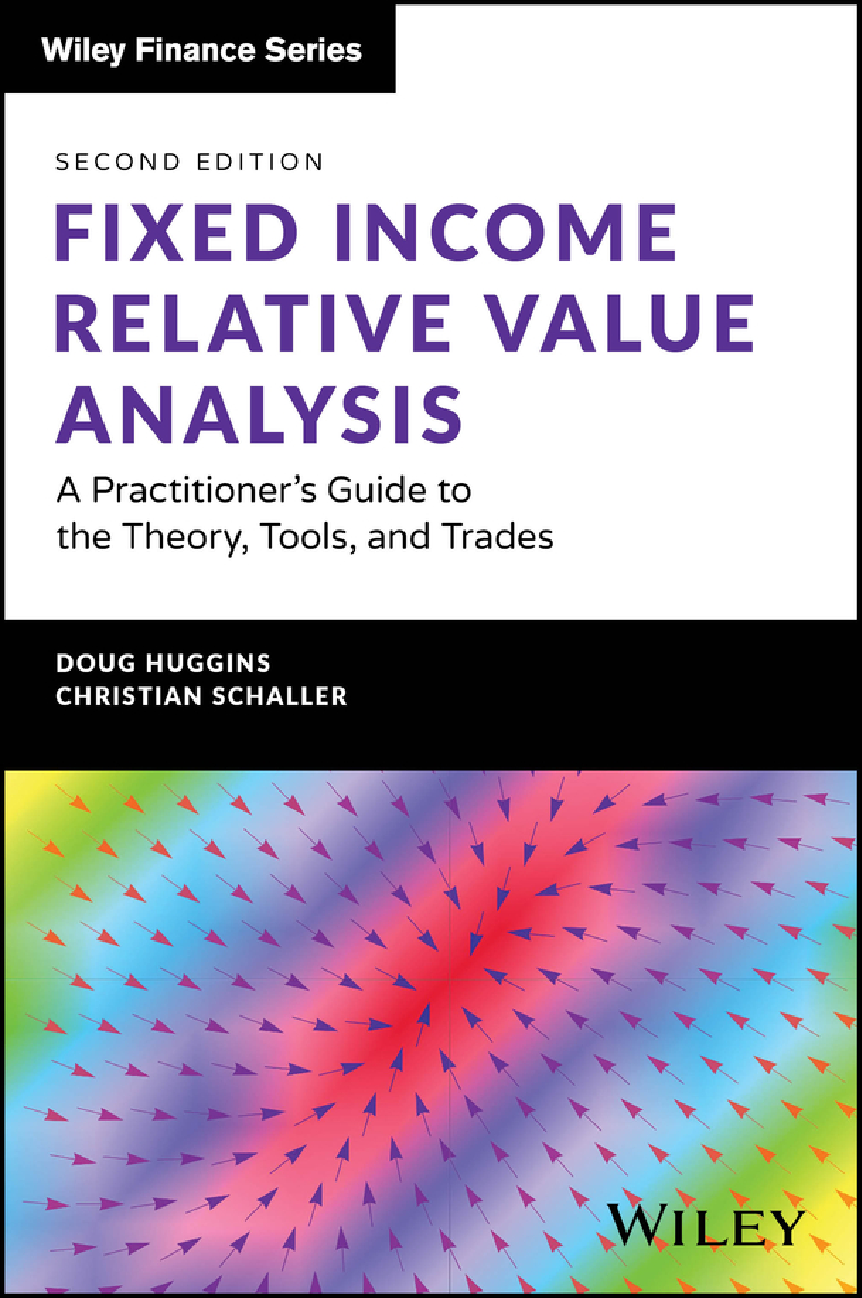
The second edition of Fixed Income Relative Value Analysis: A Practitioner's Guide to the Theory, Tools, and Trades (published by Wiley in April 2024) by Doug Huggins and Christian Schaller is an essential desk reference
...
The second edition of Fixed Income Relative Value Analysis: A Practitioner's Guide to the Theory, Tools, and Trades (published by Wiley in April 2024) by Doug Huggins and Christian Schaller is an essential desk reference for financial engineers, portfolio managers, traders, and quantitative analysts. It serves as a modern blueprint for mapping out, quantifying, and executing relative value trades across interest rate and debt markets. [1, 2, 3, 4, 5]Core Structural BreakdownThe text moves systematically through the mathematical foundation, financial variables, and specific trading frameworks: [1][Statistical Theory] ──> [Financial Tools] ──> [Trade Strategies] - Mean Reversion - Yield Curve Models - Swap Spreads - PCA Models - Curve Fitting - Basis & Options 1. Implement Statistical Foundations
- Mean Reversion Frameworks: Understand the mechanics of price convergence. The text expands on classic models by incorporating multivariate Ornstein-Uhlenbeck models to capture complex assets. [1, 2, 3]
- Principal Component Analysis (PCA): Explains how to decompose yield curve movements into three core components: shift (level), twist (slope), and bow (curvature). [1]
2. Master Post-Crisis Financial Models
- The SOFR Transition: The core update of the 2nd edition shifts analytical tools away from LIBOR to overnight reference rates like SOFR, showing how this alters the pricing of swap spreads. [1, 2]
- Fitted Curve Techniques: Methods to identify mispriced securities by building smooth theoretical zero-coupon curves from disparate government bonds. [1]
- Sovereign Risk Pricing: Integration of Credit Default Swaps (CDS) directly into yield curve analysis to model sovereign default probabilities. [1]
3. Execute Relative Value Trades
- Spread and Basis Trading: Structured mechanics for trading cash bonds against interest rate swaps or exploiting inefficiencies between differing floating-rate indices via basis swaps.
- Volatility and Delivery Options: Advanced modeling of the multi-factor delivery options embedded within bond futures contracts. [1, 2]
2nd Edition Updates vs. Original 1st EditionAnalytical Pillar [1, 2, 3, 4, 5, 7, 8, 9]1st Edition (2013) Focus2nd Edition (2024) UpdateReference BenchmarksLIBOR-centric pricing and swap modeling.SOFR and overnight reference rates.Macro EnvironmentStandard positive rate yield curves.Explores Zero-Interest Rate Policy (ZIRP) effects.Credit ConstraintsAssumed negligible G10 sovereign default risk.Accounts for heightened sovereign default risks.Statistical DepthStandard univariate mean reversion.Integrates multivariate Ornstein-Uhlenbeck models.Regulatory ImpactPre-Basel III execution landscapes.Addresses Basel III capital and balance sheet constraints.Key Blind Spots to Consider
- High Mathematical Barrier: The authors assume you already understand intermediate calculus, linear algebra, and basic stochastic processes. [1, 2]
- Execution Realities: While the text details optimal trade entry structures, transaction costs, execution slippage, and specific repo market funding squeezes must be factored in manually depending on your desk's clearing arrangements.
[Show More]
![Preview of [eTextBook] [PDF] Fixed Income Relative Value Analysis A Practitioner's Guide to the Theory Tools and Trades 2nd Edition](https://browseimages.nyc3.digitaloceanspaces.com/paper-images/2025/Jan/29/LetYLpIj2025-01-29-09-086799c5d25bab8.png)