https://www.coursehero.com/file/40945505/exam-two-study-guide-spring-2019-re-ordered-questionspdf/
☺
SOC 185
(exam two study guide spring
2020 re-ordered questions)
EXAM TWO
STUDY GUIDE
1. How do food systems shap
...
https://www.coursehero.com/file/40945505/exam-two-study-guide-spring-2019-re-ordered-questionspdf/
☺
SOC 185
(exam two study guide spring
2020 re-ordered questions)
EXAM TWO
STUDY GUIDE
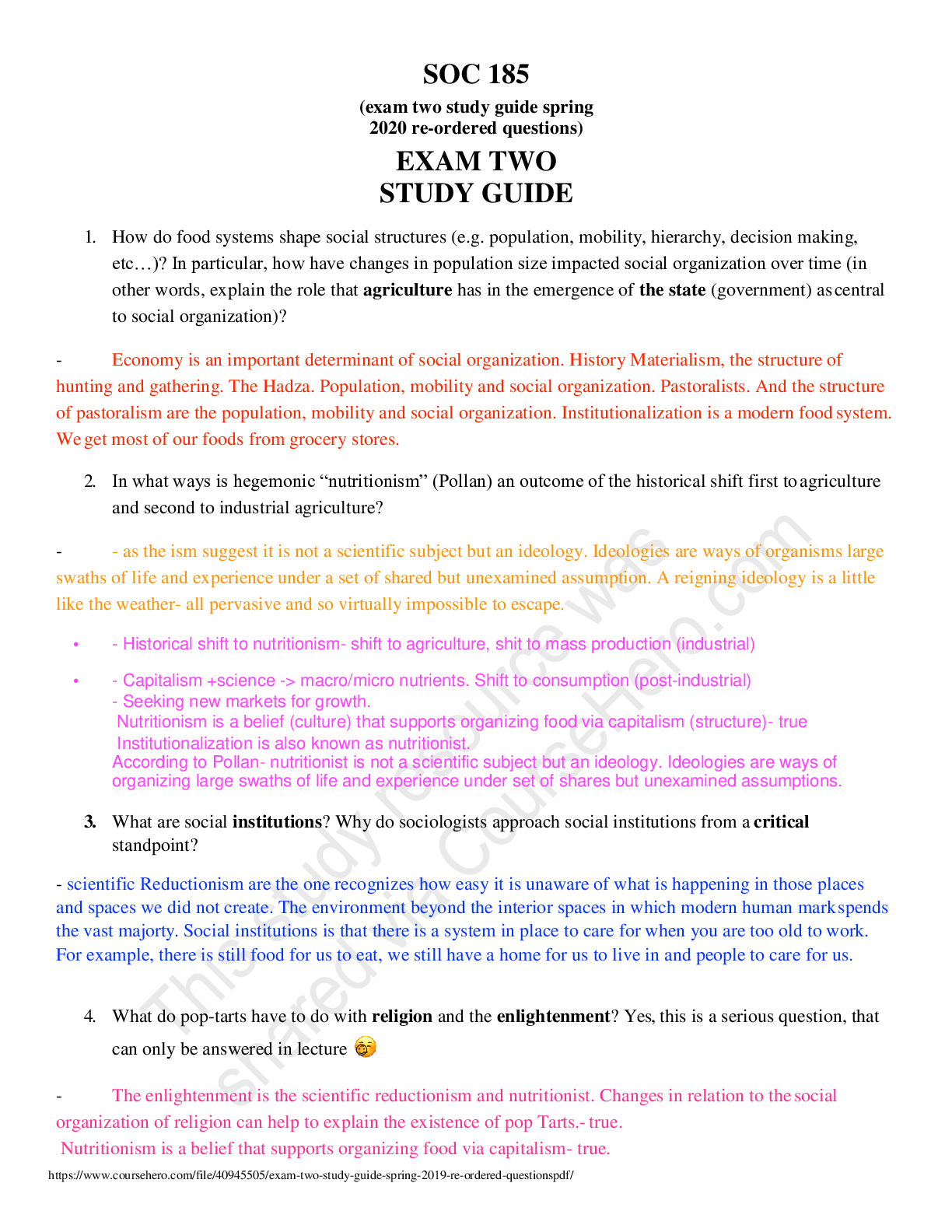
1. How do food systems shape social structures (e.g. population, mobility, hierarchy, decision making,
etc…)? In particular, how have changes in population size impacted social organization over time (in
other words, explain the role that agriculture has in the emergence of the state (government) ascentral
to social organization)?
- Economy is an important determinant of social organization. History Materialism, the structure of
hunting and gathering. The Hadza. Population, mobility and social organization. Pastoralists. And the structure
of pastoralism are the population, mobility and social organization. Institutionalization is a modern food system.
We get most of our foods from grocery stores.
2. In what ways is hegemonic “nutritionism” (Pollan) an outcome of the historical shift first to agriculture
and second to industrial agriculture?
- - as the ism suggest it is not a scientific subject but an ideology. Ideologies are ways of organisms large
swaths of life and experience under a set of shared but unexamined assumption. A reigning ideology is a little
like the weather- all pervasive and so virtually impossible to escape.
• - Historical shift to nutritionism- shift to agriculture, shit to mass production (industrial)
• - Capitalism +science -> macro/micro nutrients. Shift to consumption (post-industrial)
- Seeking new markets for growth.
Nutritionism is a belief (culture) that supports organizing food via capitalism (structure)- true
Institutionalization is also known as nutritionist.
According to Pollan- nutritionist is not a scientific subject but an ideology. Ideologies are ways of
organizing large swaths of life and experience under set of shares but unexamined assumptions.
3. What are social institutions? Why do sociologists approach social institutions from a critical
standpoint?
- scientific Reductionism are the one recognizes how easy it is unaware of what is happening in those places
and spaces we did not create. The environment beyond the interior spaces in which modern human markspends
the vast majorty. Social institutions is that there is a system in place to care for when you are too old to work.
For example, there is still food for us to eat, we still have a home for us to live in and people to care for us.
4. What do pop-tarts have to do with religion and the enlightenment? Yes, this is a serious question, that
can only be answered in lecture
- The enlightenment is the scientific reductionism and nutritionist. Changes in relation to the social
organization of religion can help to explain the existence of pop Tarts.- true.
Nutritionism is a belief that supports organizing food via capitalism- true.https://www.coursehero.com/file/40945505/exam-two-study-guide-spring-2019-re-ordered-questionspdf/
5. What are some key features (including economic and familial structures, such as “doing gender”) of
each economic time period:
Hunter/gatherer and Pastoralist
Agricultural
Industrialhttps://www.coursehero.com/file/40945505/exam-two-study-guide-spring-2019-re-ordered-questionspdf/
Post-industrial
- - feudalism, monarchy, subsistence agriculture, poly-reproductive, extended kinship, state church and
cultural tradition.
- Colonization and American industrial revolution and all the other revolution.
- Capitalist economy, Democratic government, open media system.
- Social institutions the economy, the family and the state is how society’s chosen institutional
mechanisms to organize socially necessary labor.
- To be critical, is to outright reject everything as bad- false.
6. What is the “aspiration gap” (Schor), where does it come from, and why is it a problem/concern?
- the aspiration gap between what people can afford and what they want. This has leaf to a decline in the
saving rate. School argues that this gap has been created by structural changes such as the decline of
community, growing inequality and increasing role of mass media, this makes it harder for people ro thinktheir
way out of consumerism. Aspiration gap is pressure to live a life no one can afford, pressure to have nice cars
have a big house. How we aspire to live is outside our economic capacity- Debt.
7. What are the social costs of “the new consumerism” (Schor)?
- - what we eat, what we war and what we buy. How we spend time with love ones and how we treat ourselves
and how we vote is the morality about how we feel about ourselves. Structure, culture, agency/actions,
consequences are the the sociology imagination. Socially not possible to keep up cost. Death, less savings, not
enough vacation, more 2nd and 3rd jobs, more overtime to revolt.
8. What are the 5 stages of the materials economy and what is planned and perceived obsolescence?
- five stages of materials economy is extraction, raw materials extraction for example iPhones is asmart
phone made by apple that combines an iPod, a tablet PC, a digital camera. The device includes internet
browsing and network capabiliy. iPhones are made in a factory and receives supplies from different countries
mainly from US and then manufacture in Taiwan.
- Production manufacturing, iPhones is Hon HAi Precisonn Industry. Iphones are produced in Mongolia, china,
Korea and Taiwan.
- Distribution - transportation, apple products are manufacture in china and other places. To transport the apple
product from china to somewhere such as US if would need to travel by sea, air or land.
- consumption - utilizrion reuse, purchased this product because we hear lots of good things about iPhone from
internet and social media and people.
- Disposal - disposal recycling, when the phone crash or something goes wrong and it fails at time. The
company can take it back and use the materials that are still good.
9. Why is our relationship to the materials economy a form of “dangerous dependency” (Scott)?
- well at present most of the raw materials aren’t in any way possibly going to be replaced in any human time
span. Steel one of the great building blocks of modern human comes from banded iron formations which were
laid down as a result of iron dish waters and first life time to evolve on Earth. Materials economy can leads to
the conclusion that an term made up for a people who buy lost of materials.
10. Describe how the classroom is representative of having become “habituated to social practices which
presuppose high carbon forms of producing such goods and services” (Urry 55).- There is growing recognition among corporations that climate change poses a considerable risk to there
bottom line. Climate change is a global matter. Habituated means that to accustom a person or things ro make
used to something.
11. What’s the problem with the nature versus nurture debate?
- The new consumerism and capitalist hegemony are the nutrtionism solves the problem of the fixed stomach.
Nature is what is grown naturally without any chemicals or any other substances. Nurture debate goes on and on
but still it is the fact that we have traits that are predetermine by our genes but we can still choose who we want
to be as we go on.
12. What is the “great chain of being” and how is it connected to climate change? How is the “great chain
of being” connected to colonization, white supremacy and patriarchy?
- The great chain of being held a central place in Western thought. It is connected to climate change is because
different areas have different kind of atmosphere and that is what makes all of the colonization connected. Itis
because not every colony or place can grow same kind of food or make every things. We need to be relied on
other for daily living. Which is what makes us all connected and all equal.
13. What is “indigenous realism” (Wildcat); what is “Ubuntu” (Mucina); and how do they [indigenous
realism and Ubuntu] compare to the “great chain of being”? And on that note, how does “habitus”
shape beliefs/ideology (i.e. different beliefs in regards to the accepting or rejecting climatescience)?
- indigenous realism is for the diversity of human culture. In those cultures that have focused upon the
intellect, development tools to explore the mystery of existence through science, depending our understanding
our live by using evolution of technology. Ubuntu is seen to be pointing to the values and principles that is
represents and our humanness and the value of community.
14. What is the relationship between Honduras, Guatemala, Costa Rica (as examples) and the United
States, as told through the lens of the United Fruit Company (Chiquita) and the Standard Fruit Company
(Dole)?
- - climate change is a change in climate that makes and destroyed the weather due to not caring for our
environment. Social organization is a structure of a culture or society in a constituted in a stabilized network of
rules of descent and residence. Social infrastructure is a subset of the infrastructure sector and typicallyincludes
assets that accommodate social services.
15. How is what we eat in the United States connected to the historical legacy of colonization?
- InAmerica beauty has become sometimes you drive to, and nature an either you ruthlessly subjugate it as
Tocks Dam and a million other people. They took all the trees put them them in a tree museum and they
changed all the people and a half to see them.
16. Why should we re-think our preference for cheap goods (like bananas and clothes, the examples from
Schor’s article)? What are the externalized costs, as exemplified by the lives of people in Rio Frio,
Costa Rica/
- we should re think about buying cheaper goods like cloths and stuff because they are made in and with lots od
harmful substances. Externalized costs are negative impact associated with economic transactions which
concern people outside of those transaction. It means that neither the buyer nor the seller beats the brunt costs.
htItpns:/c/wowsw ta.coRurisceahe,roi.tcoims/hfilae/r4d0e 94r55b0e5c/eaxaums-etwpo-estoudpyl-egulidive-isnprgingi-n20t1h9-ere-RoridoereFd-rqiuoesititonisspdmf/ore seller than the buyer in there.https://www.coursehero.com/file/40945505/exam-two-study-guide-spring-2019-re-ordered-questionspdf/
American companies opened operational in the production regions of central America. And established
plantation agriculture, relying on exploited labor.
17. How is Mickey Mouse’s image on pineapple and banana stickers connected to both the “new
consumerism” (Schor) and “nutritionism” (Pollan)?
- Rio frio meets the new consumerism(schor) and nutritionist (pollan) one aspect of recent consumer history that
has not been sufficiently addressed is the growth of what it is called excess consumption. The consumption that
is triggered by declines in the prices of goods and commodities caused by particular organization of global
political economy. The political economy of banana production is relatively well known, however it may be
worth reviewing it briefly.
18. What is environmental racism, and what is the relationship between historical racial segregation,as
described by Coates, and current dynamics of what sociologists call “environmental racism”?
- environmental racism is basically about the placement of people into environmental hazards areas with high
number of minority individual or economically destitute population. It seems that a disproportionate number of
people who live in environmentally hazardous areas are either minority groups or people of low sociecomical
status. Racial segregation is the practice of restricting people to certain circumscribed areas of residence or to
separate institution and facilities on based of race.
19. What does it mean to say that some diseases are specific to Western civilization, as Pollan does?
- western civilization is a catchall to refer to the many cultures of European heritage that share common cultural
ideals, philosophical foundations and ancestral beliefs. The idea is that these cultures all have a common
heritage which has been important in the development of each.
20. What are the implications of organizing food via capitalism? In what ways is capitalism shaping our
health, given the impact of the having solved the “problem of the fixed stomach” (Pollan)?
- capitalism has existed for a long time and has contributed to global expression. Capitalism is the food makes
them eat junk food. Food system’s failure to advance human health, environment health or social justice andthe
connections between food crisis and it is because of the mass production and the unhealthy food is way cheeper
than the regular healthy food.
21. What is the relationship between climate change and social organization? In particular, what are the
current concerns regarding social infrastructure and climate change (primarily but not exclusively) in
the global South?
- climate change is a change in climate that makes and destroyed the weather due to not caring for our
environment. Social organization is a structure of a culture or society in a constituted in a stabilized network of
rules of descent and residence. Social infrastructure is a subset of the infrastructure sector and typicallyincludes
assets that accommodate social services.
22. What is the treadmill of production?
- dominant political and economical system of industrial societies. The concept of the treadmill visualized a
political-economy. Native tribes across the American West have been and continue to be subjected to significant
amount of radioactive and other hazardous waste as a result of living near nuclear test sites.
23. What are food deserts/swamps? What is the relationship between food insecurity and social change?https://www.coursehero.com/file/40945505/exam-two-study-guide-spring-2019-re-ordered-questionspdf/
- Activist are trying to prove more food choices for people in poor communication. Food insecurity refers to
lack of access to enough good, healthy and culturally appropriate food. Social change refers to a change of
mechanisms within a social structure. Social changes is characterized by changes such as result of behavior,
values, social organization and cultural symbols.
24. How does social policy/organization shape migration? How is climate change impacting migration?
- climate change can impact migration because weather can have an impact on the the country. For example no
one would want to migrate in Antartica because it is so cold. You can not grow and food, not have a safe place
to stay because of all the wild life that exists there.
25. What is the failure/tragedy of the commons?
- the tragedy of the commons is used to describe the failure of a shared resource system if individual users are
only thinking about their particular needs. The shared resources become overused, leading to their collapse.
[Show More]




.png)





 (Diane Pacitti etc.png)