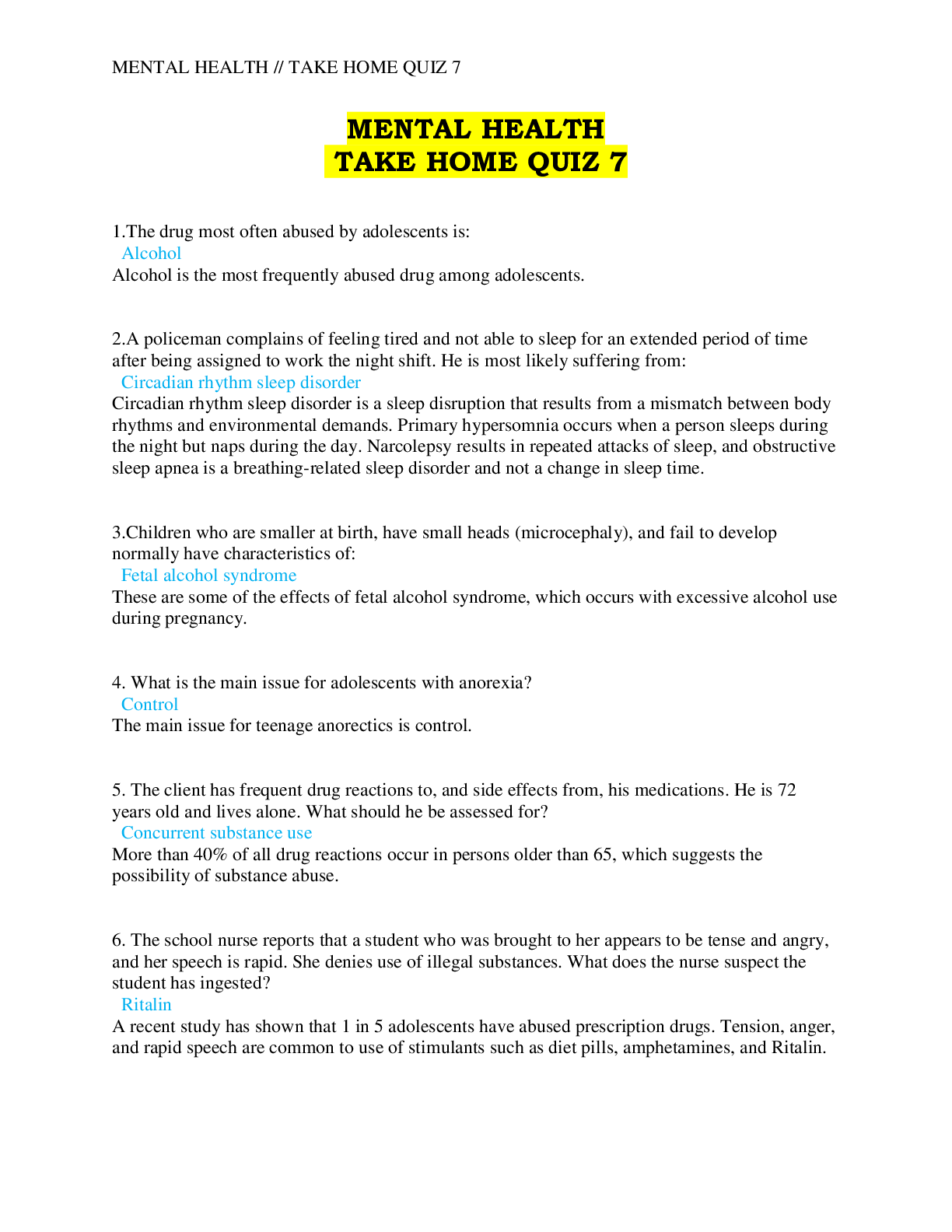
MENTAL HEALTH // TAKE HOME QUIZ 7
1.The drug most often abused by adolescents is:
Alcohol
Alcohol is the most frequently abused drug among adolescents.
2.A policeman complains of feeling tired and not able
...
MENTAL HEALTH // TAKE HOME QUIZ 7
1.The drug most often abused by adolescents is:
Alcohol
Alcohol is the most frequently abused drug among adolescents.
2.A policeman complains of feeling tired and not able to sleep for an extended period of time after being assigned to work the night shift. He is most likely suffering from:
Circadian rhythm sleep disorder
Circadian rhythm sleep disorder is a sleep disruption that results from a mismatch between body rhythms and environmental demands. Primary hypersomnia occurs when a person sleeps during the night but naps during the day. Narcolepsy results in repeated attacks of sleep, and obstructive sleep apnea is a breathing-related sleep disorder and not a change in sleep time.
3.Children who are smaller at birth, have small heads (microcephaly), and fail to develop normally have characteristics of:
Fetal alcohol syndrome
These are some of the effects of fetal alcohol syndrome, which occurs with excessive alcohol use during pregnancy.
4. What is the main issue for adolescents with anorexia?
Control
The main issue for teenage anorectics is control.
5. The client has frequent drug reactions to, and side effects from, his medications. He is 72 years old and lives alone. What should he be assessed for?
Concurrent substance use
More than 40% of all drug reactions occur in persons older than 65, which suggests the possibility of substance abuse.
6. The school nurse reports that a student who was brought to her appears to be tense and angry, and her speech is rapid. She denies use of illegal substances. What does the nurse suspect the student has ingested?
Ritalin
A recent study has shown that 1 in 5 adolescents have abused prescription drugs. Tension, anger, and rapid speech are common to use of stimulants such as diet pills, amphetamines, and Ritalin.
7.A client is hospitalized for detoxification. A potentially serious complication of detoxification is which of the following?
Seizure
A potential fatal complication of detoxification is seizure activity.
8. Sleep disorders that are characterized by abnormal behavioral or physical events during sleep are called:
Parasomnias
Sleep disorders characterized by abnormal behavioral or physical events during sleep are called parasomnias and are caused by inappropriate activation of certain centers of the brain that control physical and emotional functions. Insomnia is the inability to fall asleep; dyssomnias are sleep disorders characterized by abnormal amounts, quality, or timing of sleep; and hypersomnia is an abnormally increased amount of sleep.
9. Sleep terrors usually occur only once a night, during stages 3 and 4 of NREM sleep. They are often accompanied by which physical sign?
Intense stress
Sleep terrors often are accompanied by physical signs of intense stress, such as increased heart rate, respirations, and muscle tone.
10. One begins to prefer being high to other activities during which stage of addiction?
The early stage Correct
These behaviors are typically seen in the early stage of addiction. Tolerance to the substance develops in the middle stage. The late stage is also known as the chronic stage, in which the need for the substance causes loss of control over one’s behavior.
11. Which of the following are interventions included in the plan of care for an individual with substance abuse? (Select all that apply)
Meet physical needs during detoxification Correct
Teach client about the negative effects of the disease Correct
Focus on client’s weaknesses to encourage client to change
Ignore physical symptoms of dependence and withdrawal to ensure the individual will rehabilitate
Encourage client to focus on present and future, not only the past Correct
Monitor the effects of therapies prescribed to control substance use Correct
The most important intervention for clients with substance-related problems is to act as a therapeutic agent. Other interventions are designed to meet physical needs, especially during detoxification. Monitor effects of therapies; teach about the disease and its progression; help clients problem-solve; and encourage the client’s family and significant others to become involved. Focusing on the client’s weaknesses does not give the client a sense of hope.
12. Abused substances are those chemicals that alter the person’s perception by affecting the:
Central nervous system
Abused substances are chemicals that affect the central nervous system (CNS). They often enhance or depress moods or emotions.
13. A person has drunk a large amount of alcohol over a short time. Which of the following can result from ingesting a large amount of alcohol?
Cardiac dysrhythmias
Large doses of alcohol can affect the pumping action of the heart, resulting in cardiac dysrhythmias.
14.A female client presents with serious fluid and electrolyte imbalances as well as eroded teeth enamel. Though she is an average weight, she claims that she is overweight. This client is most likely suffering from ________.
Bulimia
Bulimia is a disorder of binge eating and the use of inappropriate methods to prevent weight gain.
15.__________ is the drug of choice in the treatment of heroin addiction to ease the effects of withdrawal from the drug.
Methadone
It is important to monitor clients who are taking methadone because it can become addicting itself.
16. Before treatment of an addiction can actually begin, many persons first must go through the process of removing the substance from their bodies under medical supervision. This is known as:
Detoxification
Before treatment actually can begin, many persons first must go through detoxification, the process of withdrawing from a substance under medical supervision. Abstinence refers to not engaging in an activity; withdrawal refers to the signs and symptoms experienced when an individual stops taking a substance that he or she is dependent on; and intoxication is a state of behavioral or psychological change that results from exposure to a chemical.
17. It is important for the nurse to ensure that the client understands the physical reactions associated with drinking alcohol while taking disulfiram (Antabuse). Which of the following are reactions that may result from ingesting alcohol while taking Antabuse? (Select all that apply.)
Double vision
Headache Correct
High blood pressure
Blurred vision Correct
Chills
Vomiting Correct
Nausea Correct
Headache, blurred vision, nausea, and vomiting occur with concomitant use of alcohol and Antabuse. Additional reactions include flushing and low blood pressure.
18.The persistent eating of nonfood items such as clay, laundry starch, insects, leaves, or pebbles that lasts for longer than 1 month is called:
Pica
Pica is the persistent eating of nonfood items that lasts for longer than 1 month and often is associated with a severe vitamin or mineral deficiency. Bulimia refers to an eating disorder that is commonly characterized by bingeing and purging; rumination is a rare disorder that refers to regurgitation and rechewing of food; and regurgitation refers to partially digested food brought up into the mouth.
19.The inability to fall asleep or stay asleep is called:
Insomnia
Insomnia is a disorder of falling asleep or sustaining sound sleep. Narcolepsy refers to a condition in which an individual repeatedly experiences periods of sleep, regardless of activity or the situation; hypersomnia refers to prolonged sleep episodes; and nocturnal myoclonus refers to an individual who moves limbs involuntarily during sleep and has symptoms or problems related to this movement.
20. Which of the following conditions are eating disorders? (Select all that apply.)
Binge eating Correct
Pica Correct
Hypersomnia
Nocturnal myoclonus
Cataplexy
Purging Correct
These are types of eating disorders. The other options describe sleeping disorders.
21. Which are signs and symptoms most commonly associated with heroin use? (Select all that apply.)
Drowsiness Correct
Clammy skin
Euphoria Correct
Watery eyes
Sweating
Constricted pupils Correct
These are common signs and symptoms of heroin use. Watery eyes and sweating are characteristic of heroin withdrawal, and clammy skin is seen most commonly with heroin overdose.
22. A nonpracticing alcoholic is taking disulfiram (Antabuse) for the treatment of substance addiction. If the medication is taken with alcohol, which of the following reactions may occur?
Low blood pressure
Low blood pressure may occur if disulfiram (Antabuse) is taken with alcohol.
23. A female client with anorexia nervosa and a cardiac condition was prescribed an antidepressant before she regained weight during her treatment course. The nurse should be aware of the possibility of which condition in this client?
Low serum potassium level
The client has a history of a cardiac problems and has anorexia, which puts her at risk for low serum potassium when an antidepressant is initiated.
24. A young white female has recurrent binging episodes often triggered by stress. The nurse should suspect which of the following disorders?
Bulimia
Bulimia often is found in young, white women, and binge eating is characteristic of bulimia.
25. Which of the following is associated with heroin use?
Constricted pupils
Constricted pupils are associated with heroin use.
26. A client becomes antagonistic and emotional after consuming a large amount of alcohol. This client is ________.
Intoxicated
Intoxication is defined as a state of maladaptive behavioral or psychological changes that results from exposure to certain chemicals.
27. A male client takes ibuprofen twice a day, every day, for his arthritis. He becomes very anxious when he does not take his normal doses. This client is experiencing:
Psychological tolerance
Because ibuprofen is not a chemical that causes physical dependency, this client is experiencing psychological tolerance. Physical tolerance occurs when an individual’s body has adjusted to living and functioning with the substance in the system; substance dependency refers to the need to take a substance to prevent withdrawal symptoms; and early-stage addiction is characterized by an individual who is enjoying the effects of the substance.
28. When the body physically needs or is dependent on a substance, the individual is said to be __________ to the substance.
Addicted
This is the definition of addiction.
29. A client has developed a high tolerance for cocaine. The need for the substance encompasses every waking hour, and without it, life is miserable. The client is in what stage of addiction?
Chronic stage
During the chronic stage, tolerance for the substance usually is high and all energy is focused on obtaining and using the substance.
30.ID: A disorder that interrupts normal sleep patterns and is characterized by repeated, brief jerks of the arms and legs that occur every 20 to 60 seconds during the beginning of sleep is called:
Nocturnal myoclonus
Nocturnal myoclonus consists of repeated, brief jerks, most often in the legs, that occur at the beginning of sleep and disrupt the normal sleep pattern. These movements generally decrease during stage 4 NREM sleep.
31. The classic description of a person with anorexia nervosa is which of the following?
A female who is ambitious and hyperactive
The classic description is a tense hyperactive female who thinks, talks, and walks rapidly and who also is ambitious and driven to perfection.
32.Which are key features of anorexia nervosa? (Select all that apply.)
Excessive laxative use
Introverted personality Correct
Severe weight loss Correct
Hunger is denied Correct
Purging
These are some of the key features of anorexia nervosa. Excessive laxative use and purging are characteristic of bulimia.
33. For a substance-related disorder to be diagnosed, the pattern of substance use must lead to:
Significantly impaired functioning and distress
The pattern of substance use must be disabling and must lead to significantly impaired functioning and distress. The person must demonstrate signs of tolerance, withdrawal, and dependence.
34.The death rate from anorexia is higher than any other mental illness. Death usually results from which of the following? (Select all that apply.)
Electrolyte imbalances Correct
Diabetes
Dehydration Correct
Suicide Correct
Loss of critical muscle mass Correct
The mortality rate for anorexia due to complications of starvation, cardiac arrest, or suicide is approximately 5% per decade of follow-up. Death usually results from dehydration, loss of critical muscle mass, electrolyte imbalances, or suicide, due to the fact that often clients are not seen by health professionals until the disorder has resulted in some physical problems.
35. What are the criteria for the diagnosis of bulimia? (Select all that apply.)
Excessive emphasis placed on body shape and weight Correct
Occasional episodes of binge eating
Refusal to maintain body weight that is more than 15% below normal
Eating binges at least twice per week for at least 3 months Correct
These are two of the four criteria for the diagnosis of bulimia. Bulimia criteria include recurring episodes of binge eating rather than only occasional episodes; refusal to maintain body weight that is more than 15% below normal is a criterion for the diagnosis of anorexia nervosa.
36. The nurse should suspect which of the following if a child has fetal alcohol syndrome (FAS)?
Intellectual impairment
Central nervous system effects of FAS include mental retardation and irritability. Also, intellectual impairment and poor judgment are common to children of alcoholic mothers.
37.Significant complications such as sudden death due to cardiac dysrhythmia or respiratory depression are associated with the use of:
Inhalants
Significant complications of inhalant use include sudden death caused by cardiac dysrhythmia and respiratory depression. Inhalant use is most prevalent in adolescents and young adults.
38. The collection of perceptions, thoughts, feelings, and behaviors that relate to one’s size and appearance is called:
Body image
This is the definition of body image.
39.__________ is a processed stimulant that reaches the brain immediately and produces an intense but short-lived high.
Crack
Crack is processed cocaine that is extremely addicting because of the immediate high. Cocaine is a natural stimulant. Heroin is an opioid, which is a central nervous system depressant.
40.With children younger than 12 years of age, drug abuse:
Occurs more often than is suspected
The number of admissions of children younger than 12 to substance treatment units is increasing.
41. The main active ingredient in coffee, black teas, most cola drinks, and many other bottled beverages that stimulates the nervous system, relieves fatigue, increases alertness, and increases the body’s metabolic rate is:
Caffeine
Caffeine is the main active ingredient in coffee, black teas, most cola drinks, and many other bottled beverages.
42.Which disorder is associated with persons with a body weight that is normal or even slightly above average?
Bulimia
Often, a bulimic has a body weight that is normal or even slightly above average. Pica is a disorder in which the individual is eating abnormal substances. Obese individuals are above normal weight, and individuals with anorexia nervosa have less than normal weight.
43.Which of the following persons is said to have a dual diagnosis?
The young adult suffering from psychosis who smokes marijuana regularly
People with serious mental illness who also are addicted to or use chemicals are said to have a dual diagnosis. It is estimated that as many as 75% of the mentally ill population have a dual diagnosis.
44. The use of cocaine is higher in which group of people?
African Americans
The use of cocaine is higher among African Americans.
45.The main focus of medical management for anorexia is to:
Encourage the client to eat voluntarily
The main focus is to encourage the client to consume food voluntarily because this will allow for continued normal food consumption. Too rapid weight gain will lead to a feeling of loss of control, which could induce inappropriate eating behaviors again. Teaching appropriate food choices and keeping the client from developing additional problems occur as a part of the psychological management of the disorder.
46. Although all age groups can be affected, sleep disorders occur most frequently in:
Older adulthood
Sleep disorders occur more frequently in older adults.
47.The nurse who is caring for a 23-year-old client with bulimia knows that the most common method of purging to monitor this client for is:
Vomiting
Vomiting and the use of diuretics and laxatives are the most common methods of purging. Less often used are enemas and syrup of ipecac. Starvation is a typical behavior of anorexia nervosa.
48. Which of the following is considered the most serious complication of anorexia nervosa?
Suicide
The mortality rate for anorexia due to complications of starvation, cardiac arrest, or suicide is substantial.
49. Which of the following persons is most likely a candidate for primary hypersomnia?
An 18-year-old college student whose mother complains he sleeps all night and still naps during the day
Primary hypersomnia begins between 15 and 30 years of age. Nighttime sleep may last from 8 to 12 hours and daytime naps may last for more than 1 hour, not caused by any other physical or mental health disorder.
50. The family of a 35-year-old alcoholic who refuses to seek treatment reaches out to the community health center for assistance. Which organization should the nurse refer them to for counseling?
Al-Anon
It is important to provide support for the family and refer them to group counseling. Al-Anon is a self-help group for families of alcoholics. Alcoholics Anonymous is a self-help group for alcoholics. Families Anonymous is a self-help group for parents, relatives, and friends of drug addicts, and Narcotics Anonymous is a self-help group for individuals recovering from drug abuse.
51.The first step in the treatment of sleep disorders is to:
Teach prevention
The first step in the treatment of sleep disorders is to teach prevention. Giving the client hypnotics is a last resort because these substances can be habit forming and/or may affect the quality of sleep; evaluating sleeping patterns is a diagnostic tool; and teaching clients to retire early may not be feasible.
52. The nurse should suspect which of the following disorders when a person snores loudly, has disrupted sleep, and has excessive daytime sleepiness?
Obstructive sleep apnea
Obstructive sleep apnea is a disorder in which a partially obstructed upper airway causes periods of apnea that repeatedly awaken the individual.
53.A drug that is taken daily to help reduce the desire for alcohol is:
Disulfiram (Antabuse)
Disulfiram (Antabuse) is a medication that is taken daily by recovering alcoholics because it causes a very unpleasant physical reaction when combined with alcohol.
54. The nurse assessing a newborn shortly after delivery notes that the infant is very jittery, irritable, and has a high-pitched cry. The nurse suspects that the mother took which substance during pregnancy?
Cocaine
Infants who were exposed to cocaine in utero have sleeping and eating problems, unusual levels of irritability, and high-pitched cries.
55. A nurse should suspect which of the following behaviors when presented with a young woman who frequently vomits and uses laxatives?
Purging
Purging is an attempt to rid the gastrointestinal tract and body of unwanted food. The most common purging behaviors are vomiting and the use of diuretics and laxatives.
56. The breathing in of volatile substances has become popular with adolescents and young adults because such inhalants are (Select all that apply):
Illegal
Expensive
Inexpensive Correct
Easily obtained Correct
Harmless
Undetectable in the body
Legal Correct
Reasons that adolescents and young adults abuse inhalants include the legality of the substances, their inexpensiveness, and how easily they can be obtained.
57.A teenager is noted to have a heightened awareness of reality, feelings of depersonalization, unpredictable and sometimes violent behavior, and flashbacks. The nurse suspects that the teenager is taking which of the following chemicals?
Phencyclidine (PCP)
PCP is a hallucinogen that may cause profound mind-expanding experiences to “bad trips” in which dangerous reactions occur.
58.The medical term for a sleep test is __________.
Polysomnogram
This test involves measurements of brain wave activity, muscle movement, and eye movement during sleep.
59. Which of the following improves the sleeping patterns of older adults with dementia?
Morning bright light therapy
Morning bright light therapy will help to reestablish natural biological rhythms.
60.Trends that have contributed to the recent increase in eating disorders in the United States include a(n):
Focus on being thin as a measure of attractiveness
In most modern societies, a high value is placed on a slim body.
61.A client with a diagnosis of anorexia is admitted to an inpatient setting. Which therapeutic intervention is used with caution prior to stabilization and weight gain?
Administering antidepressants
Administering antidepressants to clients with anorexia before they regain weight may be hazardous if the individual has a history of cardiac problems or presently has a low serum potassium level. Be sure to check the laboratory results of clients with eating disorders.
[Show More]

![Preview of [eBook] [PDF] Clinical Nursing Calculations 3rd Edition By Susan Sienkiewicz, Sandra Meg](https://browseimages.nyc3.digitaloceanspaces.com/paper-images/2025/Jul/04/4jF14r9I2025-07-04-05-586867ec3011731.png)





 (Diane Pacitti etc.png)