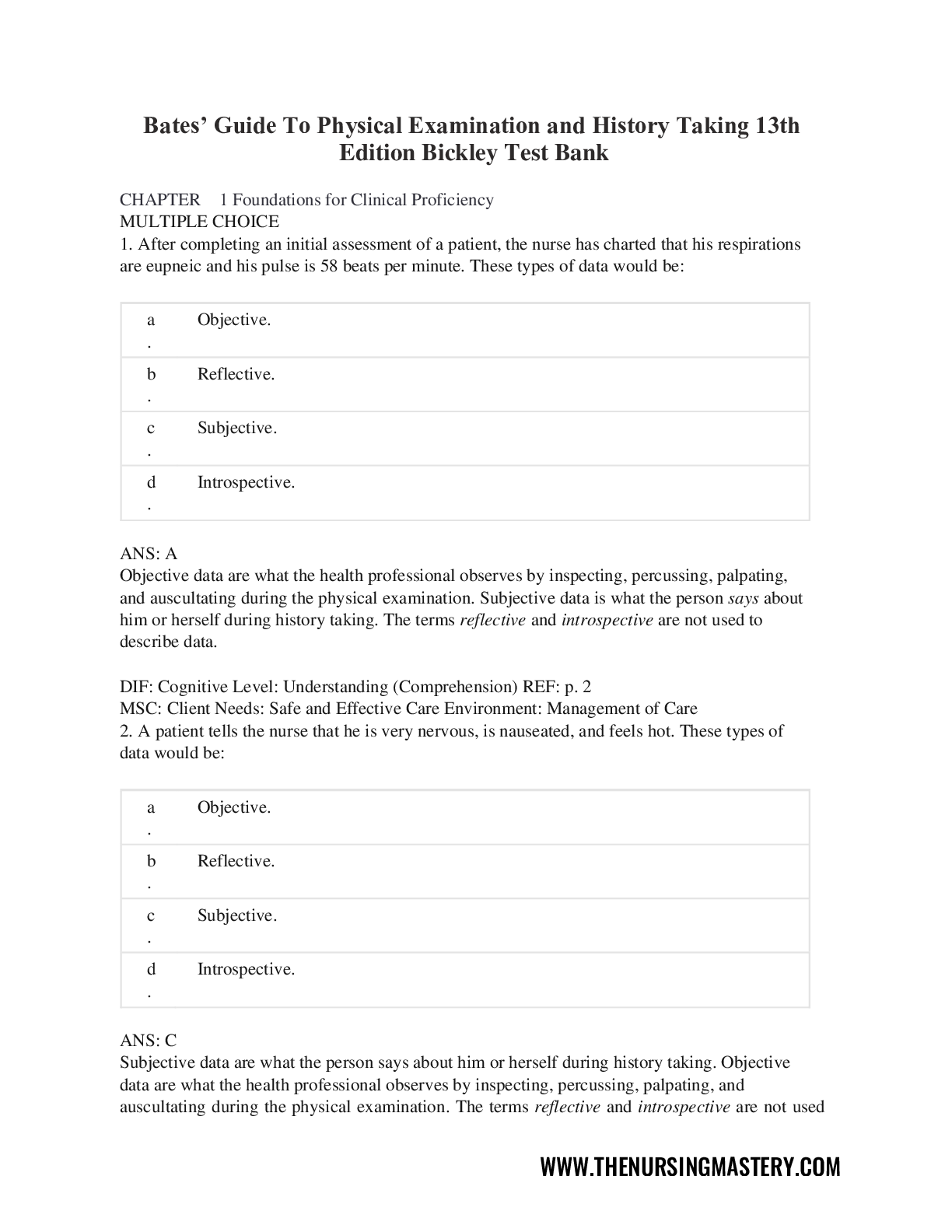
1. A client on 2 gm/hr of magnesium sulfate has decreased deep tendon reflexes. Identify the priority
nursing assessment to ensure client safety.
a. Assess uterine contractions continuously.
b. Assess fetal heart rate
...
1. A client on 2 gm/hr of magnesium sulfate has decreased deep tendon reflexes. Identify the priority
nursing assessment to ensure client safety.
a. Assess uterine contractions continuously.
b. Assess fetal heart rate continuously.
c. Assess urinary output.
d. Assess respiratory rate.
2. A pregnant client with a history of multiple sexual partners is at highest risk for which of the
following complications:
a. Premature rupture of membranes
b. Gestational diabetes
c. Ectopic pregnancy
d. Pregnancy-induced hypertension
3. Identify the hallmark of placenta previa that differentiates it from abruptio placenta.
a. Sudden onset of painless vaginal bleeding
b. Board-like abdomen with severe pain
c. Sudden onset of bright red vaginal bleeding
d. Severe vaginal pain with bright red bleeding
4. Which of the following assessments would indicate instability in the client hospitalized for placenta
previa?
a. BP <90/60 mm/Hg, Pulse <60 BPM or >120 BPM
b. FHR moderate variability without accelerations
c. Dark brown vaginal discharge when voiding
d. Oral temperature of 99.9F
5. During pregnancy, poorly controlled asthma can place the fetus at risk for:
a. Hyperglycemia
b. IUGR
c. Hypoglycemia
d. Macrosomia
6. Which of the following nursing diagnoses is of highest priority for a client with an ectopic pregnancy
who has developed disseminated intravascular coagulation (DIC)?
a. Risk for deficient fluid volume
b. Risk for family process interrupted
c. Risk for disturbed identity
d. High risk for injury
7. Which of the following laboratory values is most concerning in a client with pregnancy-induced
hypertension?
a. Total urine protein of 200
[Show More]








![Preview of NURS1150 PHARMACOLOGY EXAM 3[QUESTIONS AND ANSWERS ]LATEST 2020/2021]](https://scholarfriends.com/storage/docx (1) (2).png)
![Preview of FISDAP Medical Questions with Answers[2022 ]graded A+)](https://scholarfriends.com/storage/FISDAP_Medical_Questions_with_Answers.png)
](https://scholarfriends.com/storage/EMT_Final (3).png)
![Preview of NURS 6501N Final Exam 1 (with Complete solution ]](https://scholarfriends.com/storage/NURS_6501N_Final_Exam_1__August_2020___100_out_of_100_.png)