1. A nurse is teaching a client who has a family history of colorectal cancer. To help mitigate
this risk, which of the following dietary alterations should the nurse recommend?
2. A home health nurse is assigned to
...
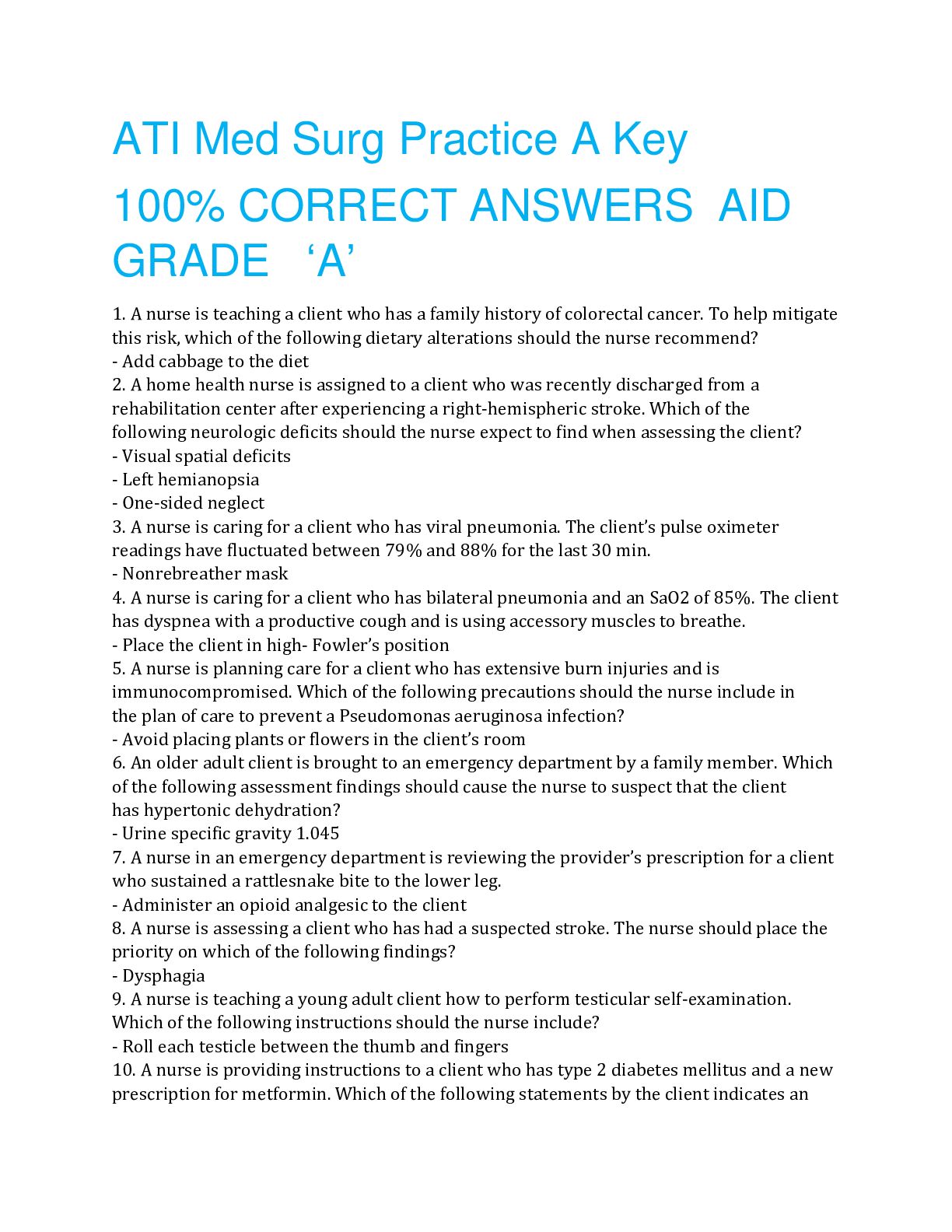
1. A nurse is teaching a client who has a family history of colorectal cancer. To help mitigate
this risk, which of the following dietary alterations should the nurse recommend?
2. A home health nurse is assigned to a client who was recently discharged from a
rehabilitation center after experiencing a right-hemispheric stroke. Which of the
following neurologic deficits should the nurse expect to find when assessing the client
3. A nurse is caring for a client who has viral pneumonia. The client’s pulse oximeter
readings have fluctuated between 79% and 88% for the last 30 min.
4. A nurse is caring for a client who has bilateral pneumonia and an SaO2 of 85%. The client
has dyspnea with a productive cough and is using accessory muscles to breathe.
5. A nurse is planning care for a client who has extensive burn injuries and is
immunocompromised. Which of the following precautions should the nurse include in
the plan of care to prevent a Pseudomonas aeruginosa infection?
6. An older adult client is brought to an emergency department by a family member. Which
of the following assessment findings should cause the nurse to suspect that the client
has hypertonic dehydration?
7. A nurse in an emergency department is reviewing the provider’s prescription for a client
who sustained a rattlesnake bite to the lower leg.
8. A nurse is assessing a client who has had a suspected stroke. The nurse should place the
priority on which of the following findings?
9. A nurse is teaching a young adult client how to perform testicular self-examination.
Which of the following instructions should the nurse include?
10. A nurse is providing instructions to a client who has type 2 diabetes mellitus and a new
prescription for metformin. Which of the following statements by the client indicates an
11. A nurse is teaching a client who has venous insufficiency about self-care. Which of the
following statements should the nurse identify as an indication that the client
understands the teaching?
12. A nurse is assessing a client who has acute cholecystitis. Which of the following findings
is the nurse’s priority?
13. A nurse is reviewing the health record of a client who is scheduled for allergy skin
testing. The nurse should postpone the testing and report to the provider which of the
following findings?
14. A nurse is caring for a group of clients. The nurse should plan to make a referral to
physical therapy for which of the following clients?
15. A nurse is caring for a client who has diabetic ketoacidosis (DKA). Which for the following
16. A nurse is planning teaching for a client who has bladder cancer and is to undergo a
cutaneous diversion procedure to establish a ureterostomy. Which of the following
statements should the nurse include in the teaching?
17. A nurse is providing teaching for a female client who has recurrent urinary tract
infections. Which of the following information should the nurse include in the teaching?
- Void before and after intercourse.
19. A nurse is caring for a client who is 12 hr postoperative following a total hip arthroplasty.
20. A nurse in a provider’s office is assessing a client who has migraine headaches and is
taking feverfew to prevent headaches. The nurse should identify that which of the
following client medications interacts with feverfew
21. A nurse is caring for a client who has pancreatitis. The nurse should expect which of the
following laboratory results to be below the expected reference range?
22. A nurse is providing discharge instructions to a client following an upper gastrointestinal
series with barium contrast. Which of the following information should the nurse
provide?
23. A nurse is assessing a client who had extracorporeal shock wave lithotripsy (ESWL) 6 hr
ago. Which of the following findings should the nurse expect?
24. A nurse is assessing a group of clients for indications of role changes. The nurse should
identify that which of the following clients is at risk for experiencing a role change?
25. A nurse is caring for a client who has a new diagnosis of hyperthyroidism. Which of the
following is the priority assessment finding that the nurse should report to the provider?
26. A nurse is providing discharge instructions to a client who has a partial-thickness burn on
the hand. Which of the following instructions should the nurse include?
NURSING SURGICAL N
ATI MedSurg Practice A Key
[Show More]