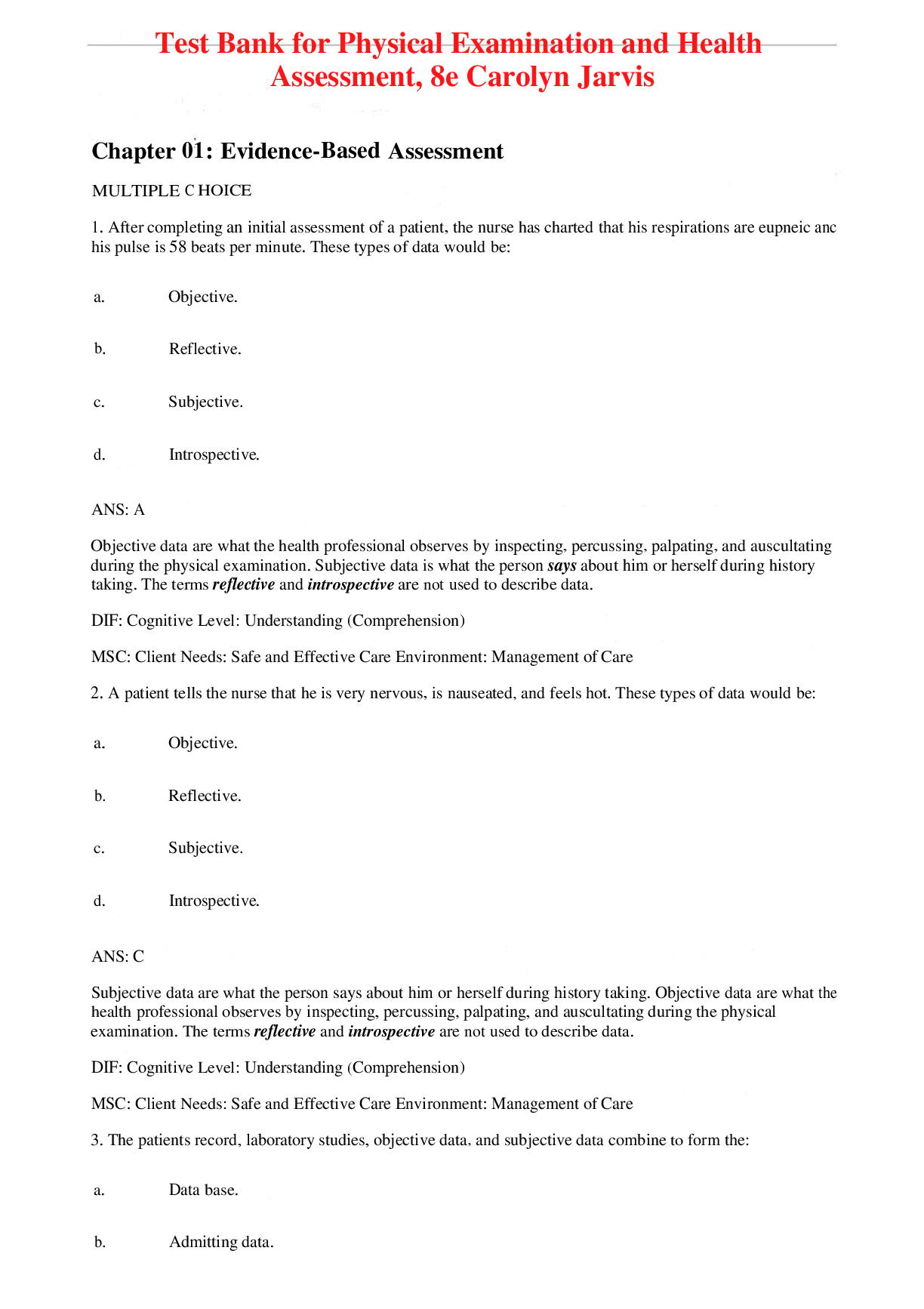
Subjective vs objective data
Subjective/symptom - What patient says about themselves
Objective/sign – observed when inspecting, percussing, palpating and auscultating patient during physical exam
Diagnostic reasoning
...
Subjective vs objective data
Subjective/symptom - What patient says about themselves
Objective/sign – observed when inspecting, percussing, palpating and auscultating patient during physical exam
Diagnostic reasoning
Attend to initially available cues
Formulate diagnostic hypotheses
Gather data relative to tentative hypotheses
Evaluate each hypothesis with new data collect to arrive at final diagnosis
Nursing process
ADOPIE
Assessment, diagnosis, outcome identification, planning, implementation and evaluation
Critical thinking skills
Identifying assumptions, organized approach, validation, normal and abnormal, inferences or drawing valid conclusions, clustering related cues, relevance, inconsistencies, identify patters, missing information, health promotion, risk diagnosis, set priorities, collaborative problems, outcomes, interventions, evaluation and corrective thinking, comprehensive plan of care.
4 types of data collecting
Episodic or problem centered data base
Follow up data base
Emergency data base
Complete and total health data base
Health and illness
Health is a balance of a person is a complex interlaced phenomenon, within physical, mental and spiritual nature
Illness is a loss of that person’s balance
Difference between culture, norms, social learning, religion, ethnicity and spirituality.
Cross culture model of health care is a holistic model.
Hot and cold theory of illness vs yin/yang theory.
Naturalistic – forces of nature must be kept in balance. Yin and yang, hot and cold.
Transcultural expression of pain.
Pain has been found to be a highly personal experience, depending on cultural learning, the meaning of the situation and other factors unique to the person.
Purpose of health history
Biographical data
Source of history
Reason for seeking care
Present health or history of present illness
Past health
Family health
Review of systems
Function assessment including activities of daily living (ADL)
PQRSTU
Provocative or palliative
Quality or quantity
Region or radiation
Severity scale 1-10
Timing or onset
Understand patient’s perception of problem
Purpose of the CAGE test
Cut, annoyed, guilty and eye opener
4 questions in regards to alcohol addiction
Purpose of functional assessment
Self-esteem, self-concept
Activity and exercise
Sleep and rest
Nutrition and elimination
Interpersonal relationships
Coping and stress management
Personal habits
Illicit or street drugs
Environment and work hazards
Intimate partner violence
Occupational health
Review of systems contains what type of info
General overall health state, skin, hair, eyes, ears, nose and sinuses, mouth and throat, neck breast, axilla, respiratory system, cardiovascular, peripheral vascular, gastrointestinal, unitary, male and female genital system, sexual health, skeletal muscle, neurologic, hematologic and endocrine system.
Health promotion practices across the life span
General health in past 5 years
Accidents or injuries, serious or chronic illnesses, hospitalizations, operations
Last examination
Obstetric status
Verbal vs nonverbal behavior
Verbal
Empathy
Clarification
Confrontation
Interpretation
Explanation
Summary
Nonverbal
Vocal cues: pitch, tone, and quality of voice, including moaning, crying, and groaning
Action cues: posture, facial expression, and gestures
Object cues: clothing, jewelry, and hairstyles
Personal space: interpersonal transactions and care of belongings
Touch: involves use of personal space and action
Physical environment of interview
Is a external factor, that makes patients feel more comfortable if they have privacy.
Techniques of communication
Communication is behavior, conscious and unconscious, verbal and nonverbal
All behavior has meaning
Body language: posture, gestures, facial expression, eye contact, foot tapping, touch, even where you place your chair
Open ended vs closed ended questions
Open ended
Ask for narrative responses
State topic only in general terms
Use them in the following situations:
To begin interview
To introduce a new section of questions
Whenever the patient introduces a new topic
Closed ended
Ask for specific information
Elicit short one- or two-word answers, a yes or no answer, or a forced choice
Use them in the following situations:
After opening narrative to fill in details person may have left out
When you need many specific facts about past health problems or during review of systems
To move the interview along
People with special needs
Hearing impaired
Acutely ill
Under influence of street drugs or alcohol
Those who must be asked personal questions
[Show More]







![Preview of AORN PERIOP 101 FINAL EXAM 2026 QUESTIONS AND VERIFIED ANSWERS [LATEST UPDATE]](https://browseimages.nyc3.digitaloceanspaces.com/paper-images/2026/04/07/sGJvJ3aH2026-04-07-04-5869d464cbba16f.png)

_removed.png)


