BMGT 341 Final Exam | Q & A (Complete Solutions) Everyone at the St. Louis offices of Dominique Marceau Cosmetics, from the president to the lowest salesperson, came to the company holiday party—all except for Melanie
...
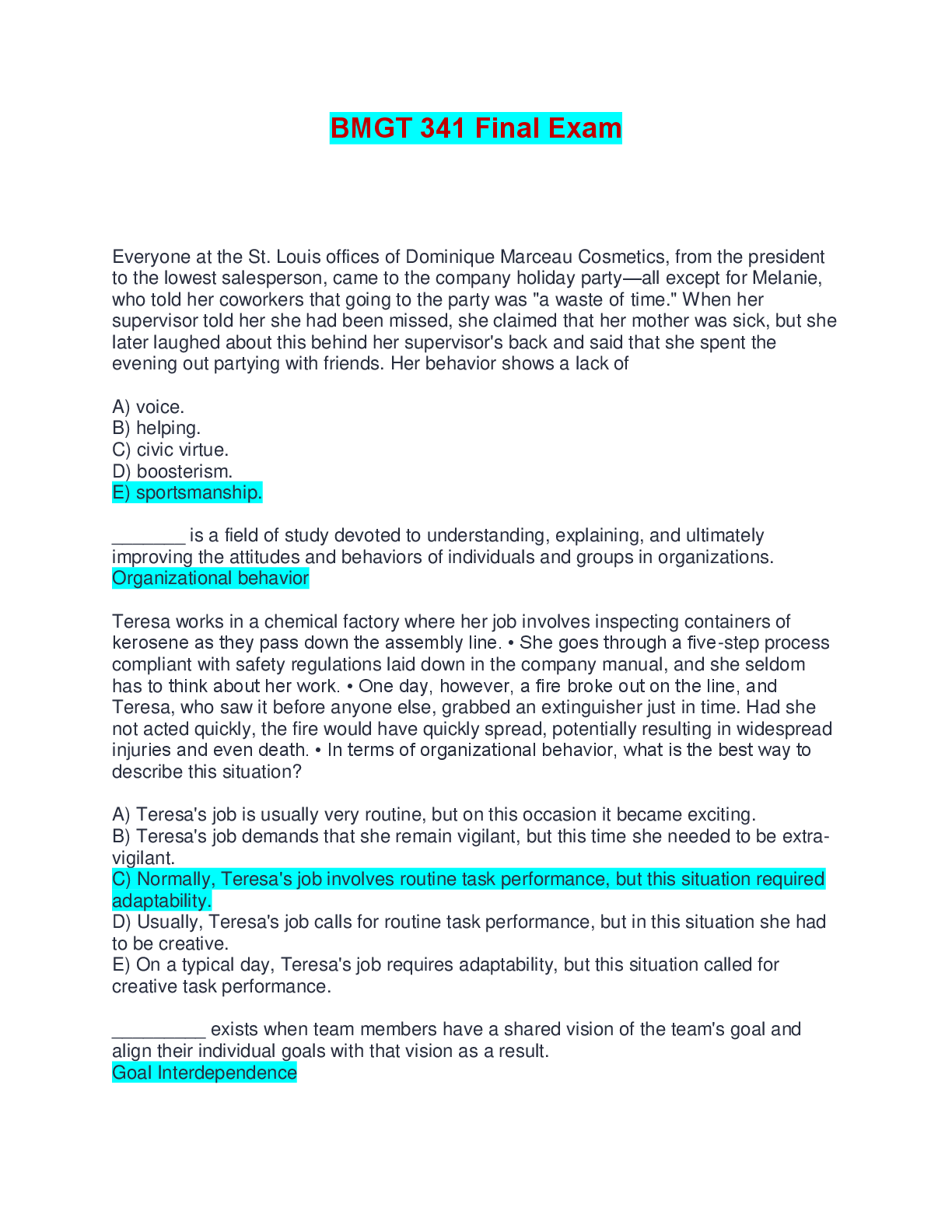
BMGT 341 Final Exam | Q & A (Complete Solutions) Everyone at the St. Louis offices of Dominique Marceau Cosmetics, from the president to the lowest salesperson, came to the company holiday party—all except for Melanie, who told her coworkers that going to the party was "a waste of time." When her supervisor told her she had been missed, she claimed that her mother was sick, but she later laughed about this behind her supervisor's back and said that she spent the evening out partying with friends. Her behavior shows a lack of A) voice. B) helping. C) civic virtue. D) boosterism. E) sportsmanship. _______ is a field of study devoted to understanding, explaining, and ultimately improving the attitudes and behaviors of individuals and groups in organizations. Organizational behavior Teresa works in a chemical factory where her job involves inspecting containers of kerosene as they pass down the assembly line. • She goes through a five-step process compliant with safety regulations laid down in the company manual, and she seldom has to think about her work. • One day, however, a fire broke out on the line, and Teresa, who saw it before anyone else, grabbed an extinguisher just in time. Had she not acted quickly, the fire would have quickly spread, potentially resulting in widespread injuries and even death. • In terms of organizational behavior, what is the best way to describe this situation? A) Teresa's job is usually very routine, but on this occasion it became exciting. B) Teresa's job demands that she remain vigilant, but this time she needed to be extra-vigilant. C) Normally, Teresa's job involves routine task performance, but this situation required adaptability. D) Usually, Teresa's job calls for routine task performance, but in this situation she had to be creative. E) On a typical day, Teresa's job requires adaptability, but this situation called for creative task performance. _________ exists when team members have a shared vision of the team's goal and align their individual goals with that vision as a result. Goal Interdependence Everyone at the St. Louis offices of Dominique Marceau Cosmetics, from the president to the lowest salesperson, came to the company holiday party—all except for Melanie, who told her coworkers that going to the party was "a waste of time." When her supervisor told her she had been missed, she claimed that her mother was sick, but she later laughed about this behind her supervisor's back and said that she spent the evening out partying with friends. Her behavior shows a lack of A) voice. B) helping. C) civic virtue. D) boosterism. E) sportsmanship. As the manager of the local Express Package Services, a retail shipping facility, DeAnna is evaluating the employees who work at the counter. She looks at such factors as positive or negative customer comments about each employee, their sales relative to those of their coworkers, the amount of time they spend with each customer, and so forth. DeAnna is evaluating each of these employees in terms of their A) task performance. B) job performance. C) citizenship behavior. D) counterproductive behavior. E) courtesy. A desire on the part of an employee to remain a member of an organization because of an emotional attachment to, and involvement with, that organization. You stay because you want to. What would you feel if you left anyway? Affective Commitment A desire on the part of an employee to remain a member of an organization because of an awareness of the costs associated with leaving it You stay because you need to. What would you feel if you left anyway? Continuance Commitment A desire on the part of an employee to remain a member of an organization because of a feeling of obligation You stay because you ought to. What would you feel if you left anyway? Normative Commitment Hector works as an assistant coach for the Boise Geysers in the U.S. Basketball Association. Recently, he was offered the position of head coaching duties with the Boulder Mountain Goats. Though their offer was very attractive, and it would have been a huge career move for Hector, he declined the offer. He felt it was with Geysers that he had learned and developed as a coach and that staying with the team was the right thing to do. This is an example of ________ commitment. A) continuance B) intuitive C) evaluative D) normative E) affective Mohammed's company recently began offering a series of free leadership seminars aimed at helping lower-level employees enter a management track. It has been very successful, and Mohammed's department manager remarks to his colleague that he has seen a marked increase in ________ among the employees who have taken it. A) employee retention B) affective commitment C) perceptions of support D) normative commitment E) continuance commitment High organizational commitment = Stars in high task performance Citizens in low task performance Low organizational commitment = Lone wolves in high ask performance Apathetic in low task performance Priya is sitting at her desk. On her computer screen are several documents for a project that she is supposed to have finished by 2:00 p.m. She is staring at the screen and has her hand on her mouse, but she is thinking about the after-work party she has been invited to. Her colleague Damien walks by and snaps his fingers. "Earth to Priya!" he says. Priya is engaged in, A) exit. B) satisficing. C) looking busy. D) daydreaming. E) moonlighting. ________ is an intentional desire on the part of employees to appear like they are working, even when they are not performing work tasks. A) Looking busy B) Moonlighting C) Daydreaming D) Socializing E) Cyberloafing A pleasurable emotional state resulting from the appraisal of one's job or job experiences. Based on how you think about your job and how you feel about your job. Job Satisfaction Dissatisfaction = (Vwant - Vhave) x (Vimportance) Value Fulfillment Formula Job satisfaction depends on whether you perceive that your job supplies the things that you value. Value-percept theory Saki, Jake, and Tamar have different ideas about what makes a job satisfying. They all work for a nonprofit relief agency and travel to areas where disasters have occurred to render assistance to victims. The pay is not high, and there can be extreme health risks because contagious diseases often break out in disaster zones due to the resulting poor sanitation. Their coworkers are friendly, intelligent, and generally nice. Saki feels strongly that she wants to be able to make a difference and help people when they are in trouble. Jake worries deeply about expenses. He has a large load of student debt to pay off, and his wife is expecting their second child. Tamar tolerates teamwork but isn't thrilled by it, and she also has mild anxiety about germs Which of the following statements is most likely true? A) Saki has the highest level of job satisfaction. B) They all have essentially equal levels of job satisfaction. C) None of them are likely to have high job satisfaction. D) Jake has the highest job satisfaction. E) Tamar has the lowest job satisfaction. Saki, Jake, and Tamar have different ideas about what makes a job satisfying. They all work for a nonprofit relief agency and travel to areas where disasters have occurred to render assistance to victims. The pay is not high, and there can be extreme health risks because contagious diseases often break out in disaster zones due to the resulting poor sanitation. Their coworkers are friendly, intelligent, and generally nice. Saki feels strongly that she wants to be able to make a difference and help people when they are in trouble. Jake worries deeply about expenses. He has a large load of student debt to pay off, and his wife is expecting their second child. Tamar tolerates teamwork but isn't thrilled by it, and she also has mild anxiety about germs Which of the following statements is most likely true? A) Jake most likely has the lowest job satisfaction. B) Saki most likely has the lowest job satisfaction. C) Jake most likely has the highest job satisfaction. D) Tamar most likely has the highest job satisfaction. E) Tamar most likely has the lowest job satisfaction. Job Characteristics Theory Jobs are more enjoyable when work tasks are challenging and fulfilling. Characteristics that make some jobs more rewarding than others: Variety, Identity, Significance, Autonomy, Feedback Which of the following is true regarding value-percept theory? A) Value-percept theory describes the central characteristics of intrinsically satisfying jobs. B) Value-percept theory implies that perceptions of the work environment are unrelated to job satisfaction. C) Value-percept theory suggests that people evaluate job satisfaction according to specific "facets" of the job. D) Value-percept theory suggests that satisfied employees are becoming more and more rare. E) Value-percept theory implies that moral causes and gaining fame and prestige are relevant in all jobs. According to the value-percept theory, the relation between dissatisfaction, value (importance), and value (want) is given by the following: A) Dissatisfaction = (Vwant - Vperceive) × (Vimportance) B) Dissatisfaction = (Vwant - Vhave)/(Vimportance) C) Dissatisfaction = (Vwant - Vhave)^(Vimportance) D) Dissatisfaction = (Vwant - Vhave) × (Vimportance) E) Dissatisfaction = (Vwant - Vperceive)/(Vimportance) According to the job characteristics theory, the degree to which the job provides freedom, independence, and discretion to the individual performing the work is known as A) feedback. B) significance. C) meaningfulness of work. D) autonomy. E) identity. Stress Definition: A psychological response to demands where there is something at stake and where coping with the demands taxes or exceeds a person's capacity or resources. Stressors = Demands Strain = Negative outcomes Nobuko is a customer service representative at Call Center Central. She thought a job answering phones all day would be easy, and at first it seemed to be. But over time, the large daily call volume and number of angry or aggressive callers made her edgy, and she found herself being short with customers for no reason. She started having muscle spasms and began to get headaches while at work. Nobuko's physical symptoms are examples of A) poor decision-making. B) personality quirks. C) stress reduction. D) stressors. E) strains. Transactional Theory of Stress The transactional theory of stress explains how stressors are perceived and appraised, as well as how people respond to those perceptions and appraisals. Judy has just started a new job as a checker at Farmer's Grocery. It is her first job after graduating from high school, and she hopes to save enough money in the first year to be able to move in with her boyfriend. In her first week, she befriends two other new checkers, Silvio and Natasha, and she finds the majority of customers to be polite and sociable. At the end of her first week on the job, she checks the upcoming week's work schedule only to discover that she is scheduled to have Tuesday and Friday off instead of Wednesday and Thursday as she requested. She is disappointed because her boyfriend has Wednesdays and Thursdays off from his job as a waiter, and their conflicting schedules means she will not be able to see him much. The next week, she finds that she has Tuesday and Saturday off, despite once again requesting Wednesday and Thursday off. The week after that, she finds herself feeling anxious about going into the break room because she is reluctant to find out if her days off are again different from what she requested. According to what you know about the transactional theory of stress, what will be the next step Judy takes? A) to ignore the problem and see if her boyfriend can get his work schedule changed to match hers B) to call in sick on the days she wants to have off and try to pick up extra shifts to make up the difference C) to confront her manager and demand that her schedule match the schedule she has requested, or else she will quit D) to decide that no job is worth that kind of hassle and immediately look for a new job that offers a more desirable, fixed schedule E) to realize the importance of spending time with her boyfriend and understand that a variable work schedule will negatively impact her personal life ________ are stressful demands that are perceived as opportunities for learning, growth, and achievement. A) Challenge stressors B) Daily hassles C) Role conflicts D) Hindrance stressors E) Work-family conflicts ________ are stressful demands that are perceived as hindering progress toward personal accomplishments or goal attainment. A) Role stressors B) Time pressures C) Psychological stressors D) Hindrance stressors E) Work complexities Which of these is a work hindrance stressor? A) family time demands B) work-family conflict C) benign job demands D) financial uncertainty E) role overload Angela is working as the head of sales at Blue Mountain Cola. Her work requires her to travel extensively and meet customers in various countries. However, Angela's role also requires her to mentor several sales representatives who work under her and keep track of their progress. Because Angela stays away from her office most of the time, she finds it difficult to manage both types of work responsibilities. Angela faces which of the following challenges? A) role complexities B) role conflict C) role penetration D) role ambiguity E) role enrichment Kwame, Rosalinda, and Sven work at Security First Trust and National Reserve, a medium-sized bank with 240 branches in eight states. Kwame works as a teller. Rosalinda works as one of five regional supervisors, each of whom is expected to supervise a team of tellers. Kwame recently received instructions from his supervisor that all tellers will be evaluated on the number of people they assist at their window per day. Serving more customers means higher performance effectiveness. However, Kwame is also expected to follow the bank's number-one goal of customer satisfaction. Rosalinda is facing her own challenges. Two of the regional supervisors suddenly left the bank for other opportunities, resulting in a significant increase in work responsibility and time pressure for Rosalinda and the remaining two supervisors. Just two days before the two regional supervisors quit, the bank hired Sven as a supervisor trainee. With the bank suddenly short-handed, Sven was asked to take up all the responsibilities of a regional supervisor. He has been given very few instructions or guidelines about how things are supposed to be done. Instead, the bank expects him to learn on the job. Sven is encountering stress resulting from A) work complexity. B) role conflict. C) role ambiguity. D) negative life events. E) daily hassles. Coping strategies can be viewed as either ________ focused. A) problem or emotion B) behavior or cognition C) positively or negatively D) work or nonwork E) personally or organizationally Alisha and Carolina work at the Flash-Frozen Vegetables factory. The company is short-staffed, and the employees are finding it difficult to meet the daily production requirements. Both Alisha and Carolina are facing time pressures in their respective departments. Alisha decides to work longer hours to meet the deadline, whereas Carolina tries to distance herself from her problems at work by thinking about the positive things in her life. Which of these coping strategies is Carolina utilizing? A) social support B) problem-focused behavior coping C) emotion-focused cognitive coping D) instrumental support E) behavior coping Charene is a product development manager for Unique Automotive Accessories. When she was first hired, she proved herself to be one of the most productive new employees. Lately, Charene's supervisor, Ivan, has noticed that her productivity is slipping from its previous high point. Whenever Ivan stays late at the office, he sees that Charene is always at her desk, eating take-out, and she is always the first to arrive in the morning. He also observes that her e-mail replies are often time-stamped on the weekend. Ivan decides to hire Charene an assistant to ease her workload and improve her work-life balance. Ivan's approach to alleviating Charene's stressors is an example of A) burnout. B) cognitive coping. C) emotional support. D) instrumental support. E) organizational cohesion. Mohammed, who managed an IT department at the corporate headquarters of the retail clothing chain Real Cheap Shirts, noticed one of his best technicians, Mia, was often coming in late, and when she was on time, she was distracted and harried. She occasionally ran diagnostic tests on the wrong systems or lost focus when presenting her weekly recap reports to the team. Mohammed asked if something was going on, and Mia admitted that her grandfather, whom she lived with, was showing signs of dementia, and she was trying her best to care for him alone, but it was hard to do that and commit 100 percent to her work duties. Mohammed proposed to alter Mia's work requirements such that she could work whatever hours she wanted to, including some telecommuting from home, as long as she completed her assigned tasks by the end of each week. Mia smiled when she heard this and was grateful that her boss was so understanding. In allowing Mia to have altered work hours, Mohammed was utilizing A) cognitive coping. B) personal instruction. C) supportive practices. D) training interventions. E) organizational flexibility. Motivation A set of energetic forces that originate within and outside an employee that initiates work-related effort and determines its direction, intensity, and persistence • What do you do? direction • How hard do you do it? intensity • How long do you do it? Persistence Wallace just got a new batch of articles to edit. He is enthused about starting something new. He decides to put all other distractions aside and focus on this task. He gets a great deal done, but after three hours, he is ready for something else. Deciding to quit after a few hours demonstrates the effect of Wallace's motivation on his ________ of effort. A) sincerity B) direction C) intensity D) persistence E) expectancy Expectancy Theory Expectancy theory describes the cognitive process that employees go through to make choices among different voluntary responses Employee behavior is directed toward pleasure and away from pain or, more generally, toward certain outcomes and away from others. Expectancy theory focuses on describing A) How goals are the primary drivers of the intensity and persistence of effort. B) the type of rewards people get from outside forces, such as wages and vacations. C) a form of intrinsic motivation in which merely performing the work tasks serves as its own reward. D) how employees create a "mental ledger" of the outcomes (or rewards) they get from their job duties. E) the cognitive process that employees go through to make choices among different voluntary responses. Motivation is fostered when the employee believes three things That effort will result in performance That performance will result in outcomes That those outcomes will be valuable Alvin is the leader of a team of counselors at a camp for recovering addicts. He and his team have been asked to implement a new program, which on the surface looks much more difficult than what they have been doing. Before the program begins, Alvin feels he needs to give his team a speech to help motivate them for the upcoming challenge. What is the first thing Alvin should do in his speech? A) remind the team of how they worked hard to successfully overcome challenges in the past B) admit that he is not completely sure the project can be done with existing staff numbers C) tell them that he will be watching them carefully for any failure to follow procedure D) express that he has a great deal of anxiety about taking on such a huge endeavor E) tell the team they may get a raise if everything goes well for a few weeks Which of the following scenarios demonstrates how workers determine efficacy levels through vicarious experiences? A) Sal looks at his diploma from a prestigious university and realizes he is very smart. B) Reno pats Ed on the back and tells him he is making great progress on his design project. C) Butch compares the salary he has just been offered to the salary he made at his previous job. D) Bill, just named sales manager, asks Fred what his job was like when he was the sales manager. E) Linda, who has a tight deadline to meet, ranks her tasks by urgency in the hopes that this will keep her on track. Evander has been asked to lead a team of educators. He is afraid his employees will not take him seriously because he is a nice guy, and he is nervous that his supervisors will see him as weak and ineffective. He is also excited by some great ideas he has for how to improve educational delivery methods that he knows will work. Evander's efficacy is moderated by his fears and anxieties, as well as his pride and enthusiasm, which are all examples of A) emotional cues. B) instrumentality. C) verbal persuasion. D) vicarious experiences. E) past accomplishments. Employees at Carpet Lot were given a survey about the workplace. One of the questions asked them about their wages. Which of the following respondents gave a response that shows a belief in a high level of instrumentality at Carpet Lot? A) Leah, who said most people get raises because they are related to someone B) Irvin, who said wages are determined by employee job performance C) LaShawn, who said that the highest wages go to dishonest people D) Skylar, who said that most people are paid based on seniority E) Marti, who said that wages should be the same for everyone Goal Setting Theory Motivation is fostered when employees are given specific and difficult goals rather than no goals, easy goals, or "do your best" goals. Research shows that challenging and specific goals are more effective than general "do your best" goals. SMART "SMART" is a good acronym for remembering the characteristics of effective goals. "SMART" goals are Specific, Measurable, Attainable, Relevant, and Time Oriented. The "A" in the S.M.A.R.T. goals acronym stands for A) affordable. B) ability. C) achievable. D) aspire. E) assess. Bill lays out a goal for Larry, the head of his printing department. He wants Larry to print exactly 500,000 books, which will be tracked by the counter on the book binding machine. Bill knows Larry can do this because they have printed that many books before. What does Bill need to add to make this a S.M.A.R.T. goal? A) a list of suggested ways to improve efficiency B) a deadline for when the books should be printed C) the promise of a monetary bonus for making the goal D) the contact information for the authors whose books will be printed E) a sample book so Larry can see what the finished product looks like Equity Theory Motivation is maximized when an employee's ratio of "outcomes" to "inputs" matches those of some "comparison other." Thus motivation also depends on the outcomes received by other employees. Noticing her reduced performance at work, Sabrina enrolled herself for training sessions offered by the company and saw her productivity improve. This helped restore her balance of comparison ratios. Prior to enrolling in the training session, Sabrina was most likely experiencing A) overreward inequity. B) self-efficacy. C) cognitive distortion. D) expectancy. E) underreward inequity. Trust willing to be vulnerable Risk actually becoming vulnerable Trust Propensity A general expectation that the words, promises, and statements of individuals and groups can be relied upon The characteristics of a trustee that inspire trust are Ability, Benevolence, and Integrity When trust is rooted in a rational assessment of the authority's trustworthiness, it is called ________ trust. A) disposition-based B) affect-based C) cognition-based D) power-based E) feeling-based Raheem recently hired a new assistant, Cathy. At his office, he often receives confidential letters and documents regarding work, as well as some personal mail, including financial statements. As Raheem often spends much of his day in meetings, he has asked Cathy to collect his mail and leave it on his desk to sort through later. When Cathy gives him the mail, Raheem trusts that she has not stolen or opened any of it. Raheem has a high degree of A) cognition-based trust. B) power-based trust. C) moral awareness. D) trust propensity. E) gullibility. Just a week into their new jobs in the marketing and advertising division of a cell phone company, Alexa, Nigel, and Laraine were given the task of creating an advertising campaign for the company's new phone. Alexa and Nigel are having a lot of trouble coming up with anything creative, so when Laraine volunteers to take over, they readily agree. Although they know little about Laraine's skills in this area, they believe she will do a good job. Which of the following is true with regard to Alexa and Nigel? A) They use a rational assessment to arrive at the conclusion that Laraine will do a good job. B) They exhibit a high degree of trustworthiness in executing the job they were given. C) Nigel presently shares a mentor-protégé relationship with Laraine. D) They have a high degree of disposition-based trust. E) They have a high level of cognition-based trust. Manuela and Noor were incensed when their company decided to get rid of its onsite childcare center and expand its gym and sports facilities instead. They find it outrageous that the company did not factor its employees' wants and needs into its decision, especially given the fact that 47 percent of its employees have children still living at home. Manuela and Noor feel that ________ justice was not served. A) distributive B) procedural C) interpersonal D) informational E) adaptive ________ reflects the degree to which the behaviors of an authority are in accordance with generally accepted moral norms. A) Ethics B) Justice C) Competence D) Trust E) Morality ________ is the third step in the four-component model of ethical decision making and reflects an authority's degree of commitment to the moral course of action. A) Moral attentiveness B) Moral awareness C) Moral intensity D) Moral judgment E) Moral intent Employees learn two types of knowledge: Explicit - easy to communicate and teach Tacit - more difficult to communicate; gained with experience Wes's employer has established a course of learning for him. From the standpoint of organizational behavior, this is particularly important because learning will help him to A) find other employment. B) make more money at his job. C) move up the corporate ladder. D) become a better decision maker. E) take greater authority in group situations. True learning only occurs when A) negative behaviors are unlearned over time. B) novices distinguish themselves from experts. C) employees are assigned larger responsibilities. D) changes in behavior become relatively permanent. E) employees avoid mimicking the behaviors of experts. In her job as a research analyst for a stock brokerage, Caroline spends a lot of time at her computer. Today her boss told her, "Find out everything you can about the textile industry in the Philippines," and she immediately sat down and typed a few words into a search engine. Soon she had a dossier on the subject, gleaned from her research on the Internet. The information Caroline acquired in this way is an example of ________ knowledge. A) tacit B) explicit C) intuitive D) heuristic E) distinctive When employees observe the actions of others, learn from what they observe, and then repeat what they have observed, they are engaging in A) learning orientation. B) behavioral modeling. C) positive reinforcement. D) communities of practice. E) performance-prove orientation. Tracy and Tonya's business has enjoyed enormous growth, and they are not sure how to handle the growing list of back orders, so they sit down together to figure out what they should do. First they list the important criteria involved, then they write down all possible solutions. Having done so, they evaluate these alternatives against the criteria they have established, and after a great deal of discussion, they choose an alternative that they believe will yield the best results. Lastly, having made a decision, they set out to implement it. This is an example of A) intuition. B) bounded rationality. C) communities of practice. D) performance-prove orientation. E) the rational decision-making model. The concept of bounded rationality suggests that we are likely to A) not have the ability or resources to process all available information and alternatives to make an optimal decision. B) evaluate all alternatives simultaneously. C) pick the alternative that minimizes value. D) use accurate information to evaluate alternatives. E) develop an exhaustive list of alternatives to consider as solutions. ________ defines the tendency of people to see their environment only as it affects them and as it is consistent with their expectations. A) Social identity theory B) Selective perception C) Self-serving bias D) Projection bias E) Consensus Personality traits are a function of both your A) values and beliefs. B) beliefs and environment. C) environment and genes. D) genes and perceptions. E) culture and beliefs. Which of the following is a dimension of the Big Five taxonomy? A) integrity B) motivation C) extraversion D) veiled purpose E) locus of control Herb's office is impeccably organized. Herb always shows up on time and can be counted to volunteer when someone is needed to go above and beyond usual duties. Herb says he will run the company someday, and he is willing to put in as many hours and as much suffering as it takes to get there. Herb exemplifies the personality trait of A) neuroticism. B) extraversion. C) agreeableness. D) conscientiousness. E) openness to experience. The Source, an engineering company, introduced a 360-degree feedback system. Lou, who was being considered for a promotion, was described as eager to learn and innovate. Isaac was appreciated for his meticulous and organized work and was the one the team could depend on during crunch time. Gloria's ability to be cooperative, accommodating, and sociable to customers who had grievances was well acknowledged in the feedback. In the context of the Big Five taxonomy, the personality dimension ________ best describes Lou. A) intuition B) agreeableness C) neuroticism D) conscientiousness E) openness to experience Compton and Lula are successful stockbrokers working with the Market Beat Brokerage firm. Before buying a company's stock, Compton reviews the company's reports and past data. Lula, on the other hand, buys stock based on speculation. According to the Myers-Briggs Type Indicator, the ________ type best describes Compton, and the ________ type best describes Lula. A) feeling; thinking B) sensing; intuition C) perceiving; judging
[Show More]