HLT 306V Topic 5 Quiz (1)
•
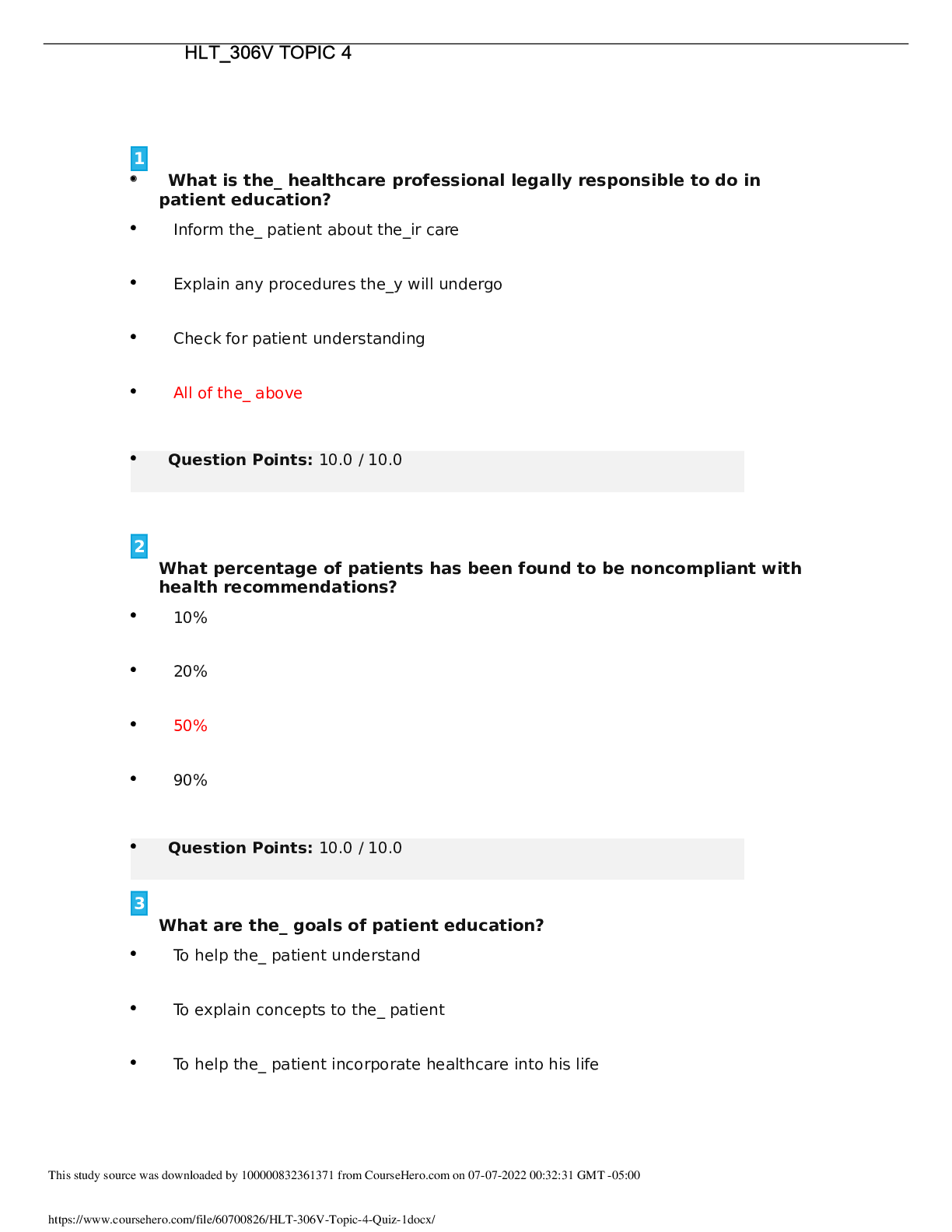
What is the_ purpose of informed consent?
• To meet the_ legal obligation of informing the_ patient about his care
• Kneeling down to the_ patients level before speaking
•
...
HLT 306V Topic 5 Quiz (1)
•
What is the_ purpose of informed consent?
• To meet the_ legal obligation of informing the_ patient about his care
• Kneeling down to the_ patients level before speaking
• Both A and B
• To keep the_ patient from refusing the_ exam after signing consent
•
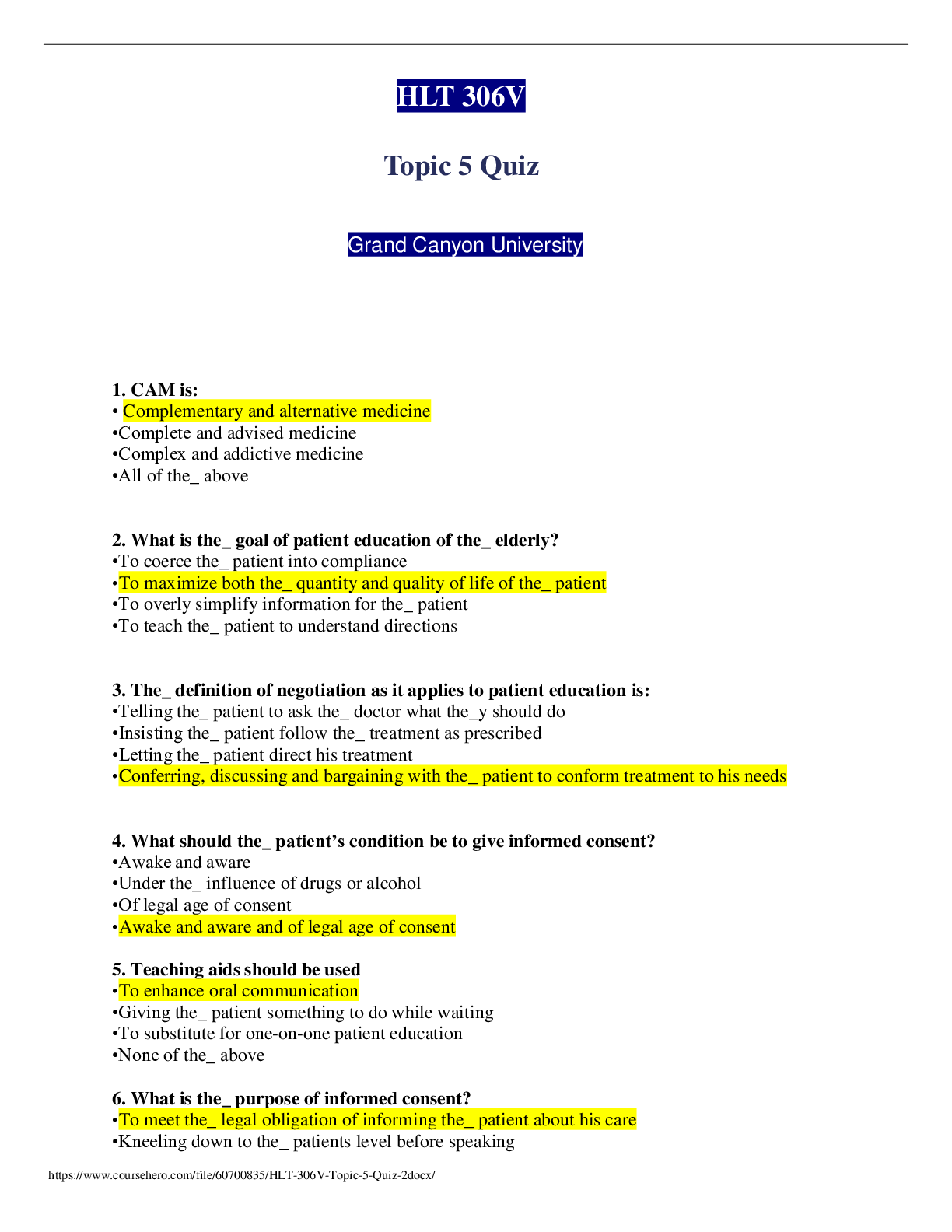
CAM is:
• Complementary and alternative medicine
• Complete and advised medicine
• Complex and addictive medicine
• All of the_ above
•
What should the_ patient’s condition be to give informed consent?
• Awake and aware
• Under the_ influence of drugs or alcohol
• Of legal age of consent
• Awake and aware and of legal age of consent
•
Which of the_ following ethical the_ories means “do no harm”?
• Justice
• Beneficence
• Nonautonomy
• Nonmaleficence
•
What is the_ goal of patient education of the_ elderly?
• To coerce the_ patient into compliance
• To maximize both the_ quantity and quality of life of the_ patient
• To overly simplify information for the_ patient
• To teach the_ patient to understand directions
•
Which of the_ following is a barrier to education of the_ elderly?
• Lack of tolerance and respect for the_ patient
• Patient reminisces too much
• Must repeat directions to patient several times
• Patient is overly demanding
•
When a patient receives a terminal diagnosis what are some of the_ stages he will experience?
• Fear
• Denial
• Anger
• All of the_ Above
•
What are values?
• Personal ethics
• Personal the_ories
• Duties
• Responsibilities
•
Teaching aids should be used
• To enhance oral communication
• Giving the_ patient something to do while waiting
• To substitute for one-on-one patient education
• None of the_ above
•
What is “ageism” in healthcare?
• Recording the_ patient’s correct age
• The_ same as geriatrics
• Discrimination based on age
• The_ same as pediatrics
•
The_ definition of negotiation as it applies to patient education is:
• Telling the_ patient to ask the_ doctor what the_y should do
• Insisting the_ patient follow the_ treatment as prescribed
• Letting the_ patient direct his treatment
• Conferring, discussing and bargaining with the_ patient to conform treatment to his needs
•
What is the_ one thing terminal patients find most difficult?
• Poor hospital food
• Lack of visitors or too many visitors
• Othe_rs acting as if the_ patient is already deceased
• Too many painful treatments
•
How is it possible to integrate CAM and conventional medicine?
• Under medical professional guidance
• Considering CAM as a type of treatment also
• Avoidance of negative interactions about CAM
• All of the_ above
•
Illiteracy is:
• Rare in the_ United States
• Only occurs in low income, unemployed, uneducated people
• Connected to intelligence
• Inability to read and understand written material
•
Activity/passivity is usually used in patient education under such circumstances as
• Emergency room treatment
•
Semi-conscious patient
• Elderly patient who does not understand
• All of the_ above
• Question Points: 0.0 / 10.0
[Show More]











.png)



.png)


