Solution Manual for Understanding Business Ethics 3rd Edition Peter A. Stanwick, Sarah D. Stanwick-The purpose of this chapter is to give the students a broad overview of the theoretical foundation
that supports ethical
...
Solution Manual for Understanding Business Ethics 3rd Edition Peter A. Stanwick, Sarah D. Stanwick-The purpose of this chapter is to give the students a broad overview of the theoretical foundation
that supports ethical decision-making. It is from this theoretical grounding that the students can
understand how their decisions related to ethical issues can impact not only themselves but
others as well. In addition, this chapter introduces the structure of the textbook which allows the
instructor to also explain his or her structure for the class.
Key Learning Points
There are a number of key learning points which can be accomplished when this chapter is
presented to your students. These learning points include:
1. The chapter introduces the student to the concepts of ethics and business ethics.
2. Ethics is a complex concept to describe. Different philosophies have used different theories in
order to help explain and guide ethical behavior.
3. Although some of the theories presented in this chapter were developed over two thousand
years ago, they are appropriate and applicable to today‟s business environment.
4. This chapter demonstrates that the eight underlying principles presented in the Global
Business Standards Codex are interrelated with each other as well as with the major
philosophical theories related to ethics.
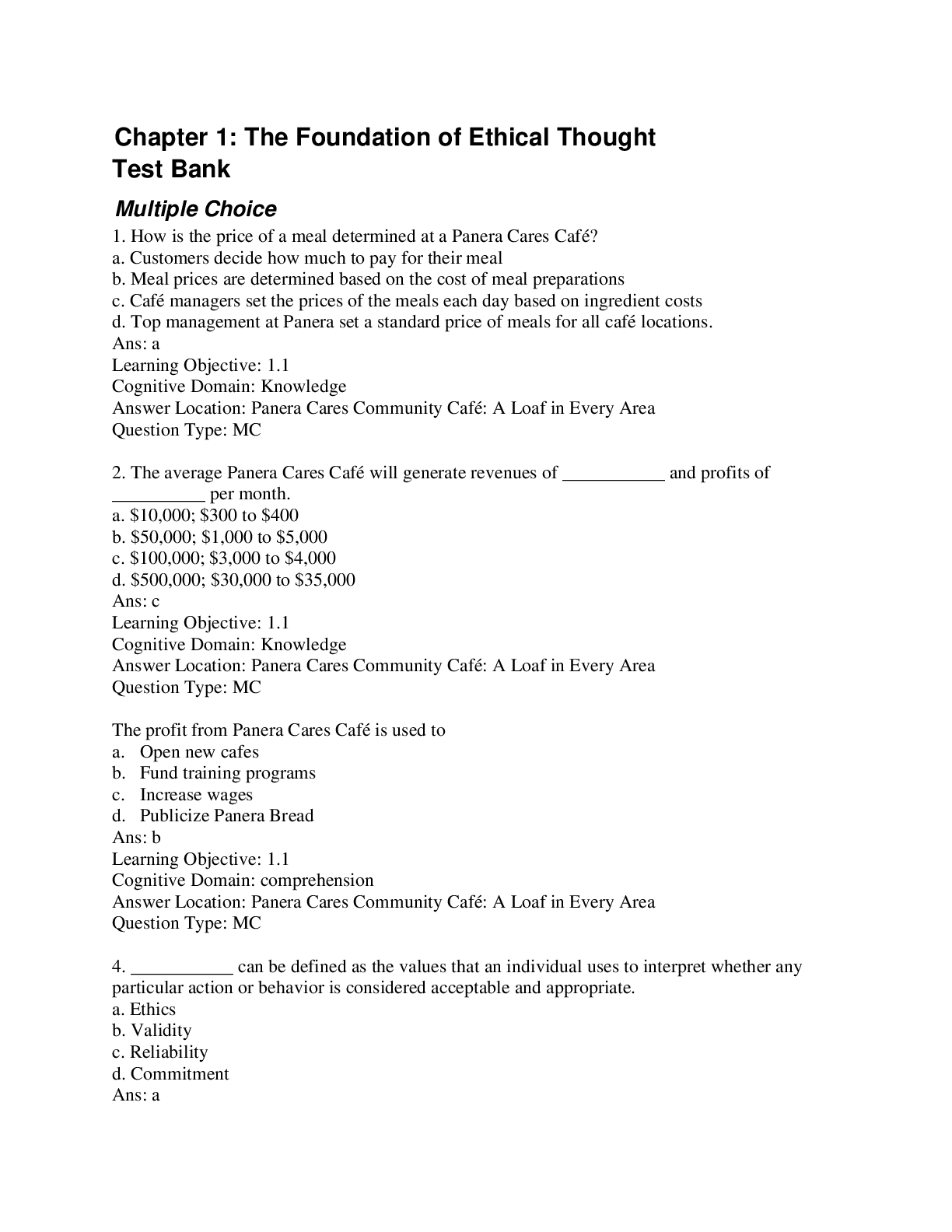
5. “Panera Cares Community cafes: A Loaf in Every Arm” demonstrates how one company can
address the needs of many stakeholders.
6. Sir Nicholas Winton: A True Humanitarian demonstrates that one person can have an impact
on many others by doing “the right thing” even at great personal risk.
Panera Cares Community Cafes: A Loaf in Every Arm
The opening vignette highlights how one company, Panera Bread, has developed an outreach
program of providing food for which the customers will pay only what they can. If the customer
does not have any money, they can donate 1 hour of volunteer work in exchange for the meal.
An interesting fact is that 60 percent of the customers pay the retail value, 20 percent pay below
the retail value, and 20 percent pay above the retail value of the meal.
1. Ask the class how many of them have volunteered for a nonprofit organization.
Follow up with those who respond positively by asking them why they volunteered. An
additional follow-up question would be to ask if those same students would consider
volunteering in the future.
2. How does Panera Bread satisfy the demands of the stockholders by potentially “giving away”
food and profits?
It could be argued that Panera Bread has an enlightened stakeholder perspective to address the
needs of its customers. Not only does this program support those in need in the local
communities but it sends a message to all of Panera‟s stakeholders that it is interested in serving
their needs. Furthermore, the long-term financial benefit of this program could be that as those
customers increase their standard of living, they can afford to pay the full price of the meal and
will have become brand loyal to Panera Bread due to this program.
3. Would this type of program work for other restaurants?
It is expected that this could create a lively discussion in the class. For those who agree that it
could be transferred to other restaurants, the argument could be that the underlying philosophy of
the program is to support those people in the local community who have food security issues.
Therefore, it should be applicable in any type of food service. For those who say no, it could be
argued that Panera Bread probably has higher profit margins on its food than other type of quick
service restaurants. Therefore, other fast-food restaurants such as McDonalds and Burger King
do not have the flexibility to offer their food at “below cost”.
Definition of Ethics and Business Ethics
To introduce the concepts of Ethics and Business Ethics to the students in the classroom, a good
starting discussion point would be to ask the students what kind of ethical dilemmas they have
faced in the past. A follow-up discussion point would be to ask them what type of ethical
dilemmas they think they will face in their jobs after they have graduated.
The Role of Morals
It is important for students to understand the three components of morals: individual principles,
individual character, and the consequences of the actions. Due to the multifaceted nature of
morals, the students need to realize that they may have ethical principles but if their character
ignores or down plays the significance of the consequences, “ethical” people can do “unethical”
actions. Therefore, the Greed is Good example from the movie Wall Street is a good visual
example to highlight this potential conflict. Gordon Gekko believes that he has moral principles,
but based on his unethical character and his disregard for the consequences of his actions, he
does unethical activities.
Is Greed Good?
During this discussion, playing the Greed is Good clip from the movie “Wall Street”
(https://www.youtube.com/watch?v=6Da1tDKFfno) will enhance this argument. As they are
watching the clip, ask the students to observe how the shareholders emotions shift during the
speech to no longer supporting management‟s position on the acquisition to supporting Gordon
Gekko‟s proposal. This discussion could also address the issue of a charismatic leader. Gordon
Gekko is very charismatic and therefore makes his ideas much more convincing whether they are
ethical or not.
[Show More]



.png)