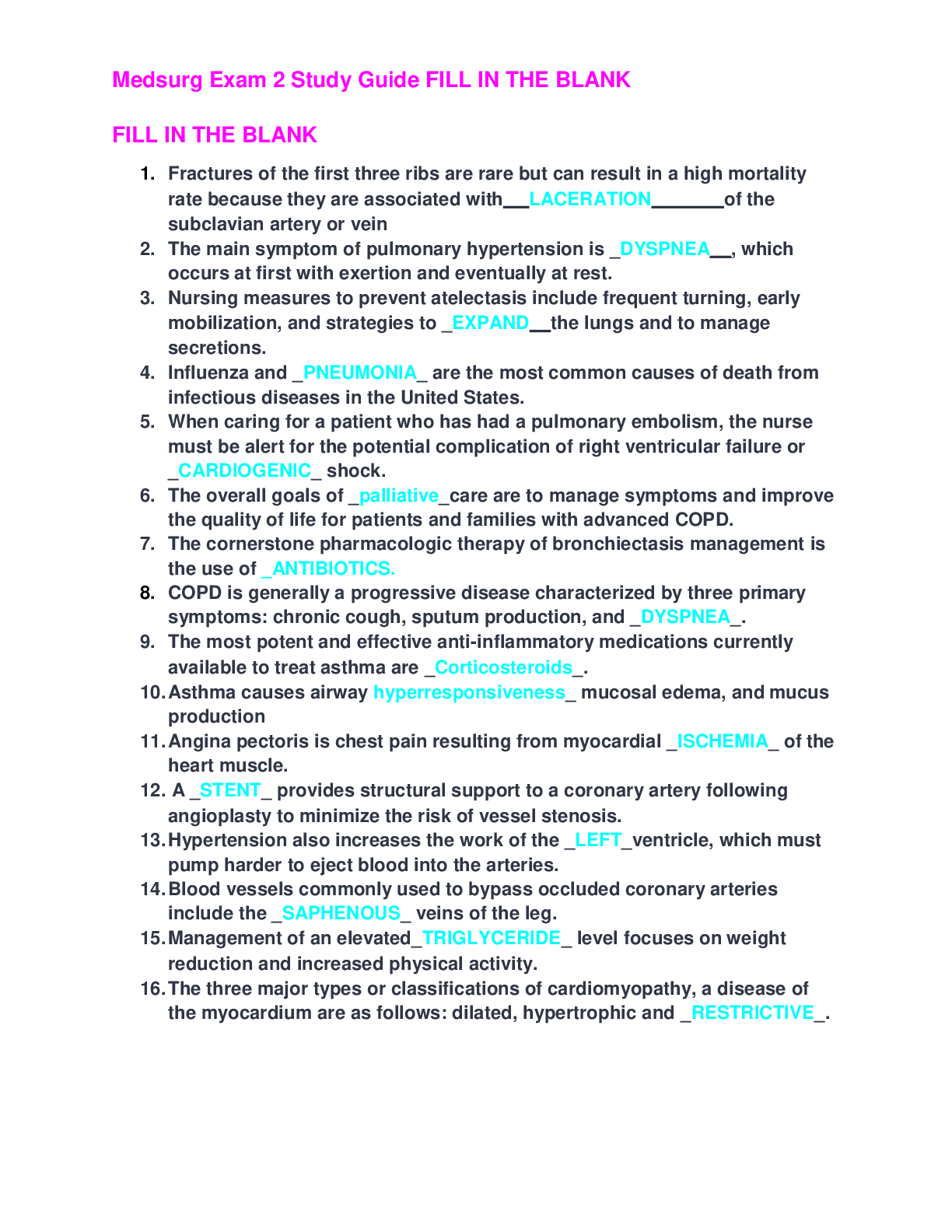
FILL IN THE BLANK
1. Fractures of the first three ribs are rare but can result in a high mortality rate because they are associated with of the subclavian artery or vein
2. The main symptom of pulmonary hypertension
...
FILL IN THE BLANK
1. Fractures of the first three ribs are rare but can result in a high mortality rate because they are associated with of the subclavian artery or vein
2. The main symptom of pulmonary hypertension is _ , which occurs at first with exertion and eventually at rest.
3. Nursing measures to prevent atelectasis include frequent turning, early mobilization, and strategies to _ the lungs and to manage secretions.
4. Influenza and _ _ are the most common causes of death from infectious diseases in the United States.
5. When caring for a patient who has had a pulmonary embolism, the nurse must be alert for the potential complication of right ventricular failure or
_ _ shock.
6. The overall goals of _ _care are to manage symptoms and improve the quality of life for patients and families with advanced COPD.
7. The cornerstone pharmacologic therapy of bronchiectasis management is the use of _
8. COPD is generally a progressive disease characterized by three primary symptoms: chronic cough, sputum production, and _ _.
9. The most potent and effective anti-inflammatory medications currently available to treat asthma are _ _.
10. Asthma causes airway _ mucosal edema, and mucus
production
11. Angina pectoris is chest pain resulting from myocardial _ _ of the heart muscle.
12. A _ _ provides structural support to a coronary artery following angioplasty to minimize the risk of vessel stenosis.
13. Hypertension also increases the work of the _ _ventricle, which must
pump harder to eject blood into the arteries.
14. Blood vessels commonly used to bypass occluded coronary arteries include the _ _ veins of the leg.
15. Management of an elevated_ _ level focuses on weight reduction and increased physical activity.
16. The three major types or classifications of cardiomyopathy, a disease of
the myocardium are as follows: dilated, hypertrophic and _ _.
17. Because HF is a complex and progressive condition, patients are at risk for many complications, including acute decompensated HF,
_ _, kidney disease, and life-threatening dysrhythmias.
18. Pulmonary edema can also develop slowly, especially when it is caused by
_ _ disorders such as kidney disease and other conditions that cause fluid overload.
19. _ _ causes myocardial dysfunction in heart failure because it deprives heart cells of oxygen and causes cellular damage.
20. Left-sided heart failure refers to failure of the left ventricle, which results in
_ _ congestion.
21. Disseminated intravascular coagulation (DIC) is characterized by a process of inflammation and _ _ within the vasculature.
22. The most common symptom and complication of anemia is _ _ which has the greatest negative impact on a patient's level of functioning.
23. _ _ is a genetic condition in which excess iron, absorbed from the GI tract, is deposited in various body organs.
24. A patient with neutropenia is at an increased risk for _ _,which increases proportionately with the decrease in the neutrophil count.
25. Patients with _ _ anemia develop a smooth sore red tongue.
26. Nursing interventions for the patient with acute leukemia should focus on assisting the patient to establish a balance between_
_because fatigue and deconditioning are common symptoms of the disease.
27. An older adult with a chief complaint of _ _ and an elevated total protein level should be evaluated for multiple myeloma.
28. The diagnosis of Hodgkin lymphoma is made by means of an excisional lymph node biopsy and the finding of the_ _cell.
29. Two primary complications seen in acute myeloid leukemia (AML), bleeding and _ _ are the major causes of death for these patients.
30. Common symptoms seen in polycythemia vera include a ruddy complexion and _ _ from increased blood volume and viscosity.
31. Immune deficiency disorders may be caused by a defect in, or a deficiency of, phagocytic cells, B lymphocytes, T lymphocytes, or the
_ _ system.
32. Nursing management of a patient who requires immunosuppression must include use of _ _ precautions when providing care to prevent infection.
33. _ _ is a clinical syndrome that is characterized by a progressive decline in cognitive, behavioral, and motor functions as a direct result of HIV infection.
34. Antiretroviral medications as post-exposure prophylaxis for health care workers are started within__hours of exposure.
35. A common complication of stage 3 HIV infection, _ _, is defined as a loss of more than 10% of one's body weight over a 30 day timeframe.
36. _ _, which is released by mast cells, is a primary chemical mediator of hypersensitivity that acts within about 15 minutes after antigen contact.
37. _ _ is a type I hypersensitive allergic reaction of the skin characterized by the sudden appearance of pinkish, edematous elevations that vary in size and shape, itch, and cause local discomfort.
38. The major class of medications prescribed for the symptomatic relief of allergic rhinitis is _ _.
39. The most severe hypersensitivity reaction is _ _, an
unanticipated allergic reaction often accompanied by hypotension, bronchospasm, and cardiovascular collapse in severe cases.
40. The patient at risk for an anaphylactic response to an allergen should be instructed to carry an emergency kit containing_ _ at all times.
41. The autoimmune reaction that causes rheumatoid arthritis originates in the
_ _ tissue.
42. _ _ a noninflammatory degenerative disorder of the joints, which is the most common form of joint disease, is routinely referred to as degenerative joint disease.
43. Three distinct characteristics of the pathophysiology of rheumatic diseases are inflammation, autoimmunity, and _ _.
44. Patients with systemic lupus erythematosus (SLE) are likely to manifest a
_ _-shaped rash across the bridge of the nose and cheeks.
45. The major goal when caring for a patient with rheumatic disease is _
[Show More]





.png)
.png)
.png)