HERE ARE SAMPLE QUESTIONS AND ANSWERS CONTAINED IN THE FIRST 50 PAGES ALONE.
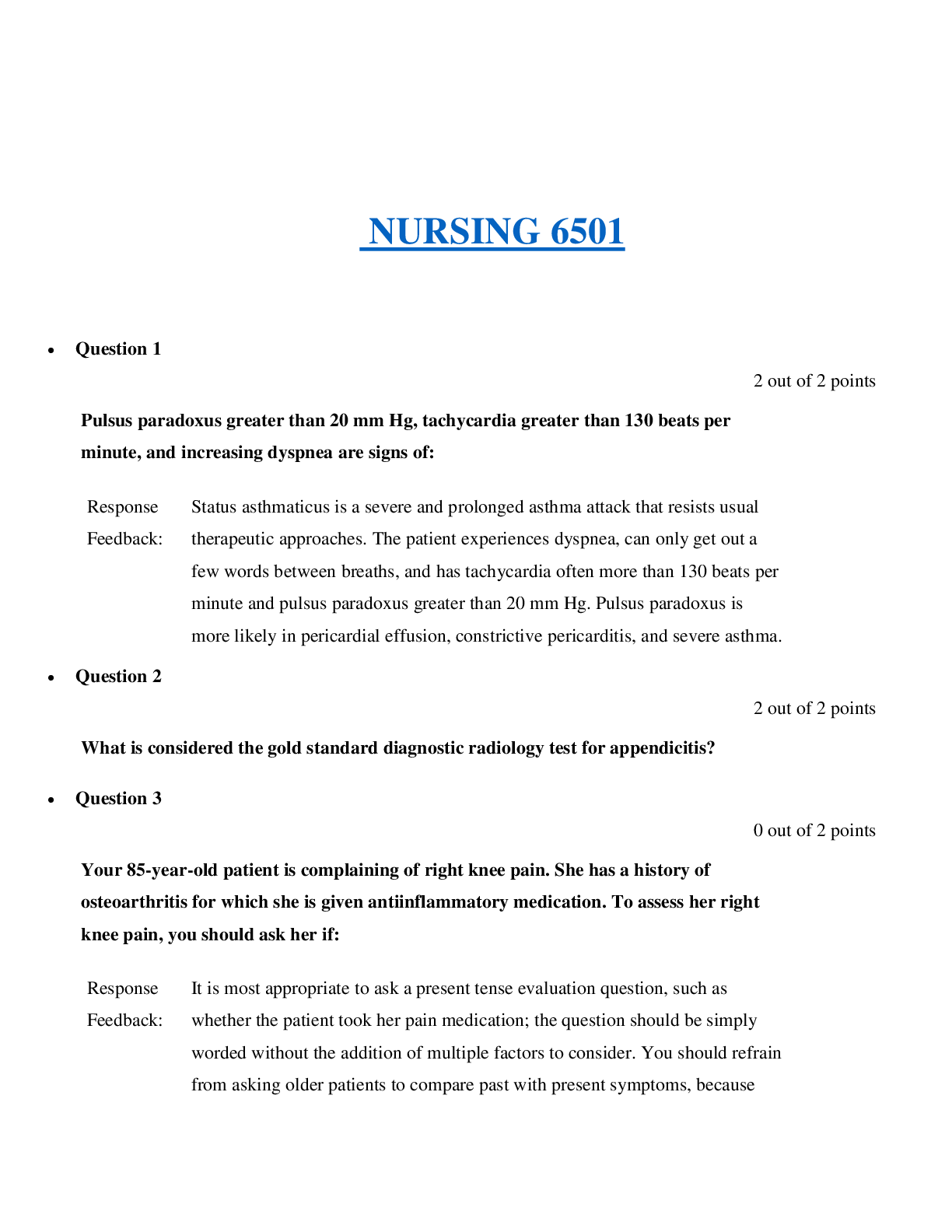
6501 FINAL TEST PREP
CHAPTER 32
1. A nurse recalls the major hormonal determinant of sexual differentiation in utero is:
a.
Estrogen
b.
...
HERE ARE SAMPLE QUESTIONS AND ANSWERS CONTAINED IN THE FIRST 50 PAGES ALONE.
6501 FINAL TEST PREP
CHAPTER 32
1. A nurse recalls the major hormonal determinant of sexual differentiation in utero is:
a.
Estrogen
b.
Progesterone
c.
Growth hormone
d.
Testosterone
d
2. A nurse is preparing to teach about puberty. Which information should the nurse
include? One substance associated with puberty in males and females is the
hormone:
a.
Follicle-stimulating hormone (FSH)
b.
Luteinizing hormone (LH)
c.
Leptin
d.
Estrogen
c
3. A nurse is discussing female anatomy. Which body structure contains the openings to
the vagina and urinary meatus?
a.
Vestibule
b.
Mons pubis
c.
Introitus
d.
Perineal body
a
4. While preparing to teach the staff about female anatomy, which information should
be included? During the years that a woman is more likely to be sexually active, the
vagina mucosa is protected from infection by:
a.
Presence of autoantibodies
b.
An acidic pH
c.
bLow estrogen levels
d.
Douching
5. When a staff member asks the nurse what the thick middle layer of the uterine wall is
called, what is the nurse's best response? The:
a.
Epithelial layer
b.
Endometrium
c.
Myometrium
d.
Perimetrium
c
6. A nurse recalls the _____ is lined with columnar epithelial cells.
a.
Perimetrium
b.
Endocervical canal
c.
Myometrium
d.
Vagina
b
7. A nurse is preparing to teach about female anatomy. Which information should the
nurse include? The female erectile organ that secretes smegma is called the:
a.
Introitus
b.
Bartholin glands
c.
Clitoris
d.
Labia minora
c
8. A nurse is teaching about the menstrual cycle. Spinnbarkeit mucus is present during
which stage of the menstrual cycle?
a.
Follicular
b.
Ovulation
c.
Luteal
d.
Menstrual
b9. When the nurse describes the duct that carries the ovum from the ovary to the
uterus, what is the nurse discussing? The:
a.
Isthmus
b.
Corpus
c.
Endocervical canal
d.
Fallopian tube
d
10. A nurse is teaching the staff about female hormones. Which hormone promotes the
formation of channels in the mucus of the cervical os to facilitate sperm movement
into the uterus?
a.
LH
b.
FSH
c.
Progesterone
d.
Estrogen
d
11. When a patient who is trying to get pregnant asks where the usual site of fertilization
is, how should the nurse respond? The:
a.
Uterus
b.
Fimbriae
c.
Ampulla of the fallopian tubes
d.
Os of the fallopian tubes
c
12. A nurse is teaching about the female anatomy. Which information should the nurse
include? Cells of the ____ have receptors for gonadotropins.
a.
Uterus
b.
Breast
c.
Ovary
d.
Vagina
c
13. The nurse is preparing to teach the staff about female anatomy. Which information bshould the nurse include? The ova are contained within the ovarian:
a.
Corpus luteum
b.
Follicle
c.
Stroma
d.
Infundibulum
14. Which information indicates the nurse has a good understanding of female anatomy?
Having ejected a mature ovum, the ovarian follicle then develops into:
a.
An atretic follicle
b.
A theca cell
c.
A corpus luteum
d.
Scar tissue
c
15. When a staff member asks the nurse what is the most potent of the following
estrogens, what is the nurse's best response? It is:
a.
Estradiol
b.
Testosterone
c.
Estrone
d.
Estriol
a
16. Which information indicates the nurse has a good understanding of progesterone?
Progesterone is primarily secreted by the:
a.
Follicle
b.
Corpus luteum
c.
Granulose cells
d.
Anterior pituitary
b
17. A 56-year-old female is in menopause. She has ovarian failure. While checking the lab
results, which of the following will the nurse find?
a.
aIncreased FSH
b.
Increased estrogen
c.
Decreased GnRH
d.
Decreased LH
18. Progesterone is often referred to as "the hormone of pregnancy," and the patient
asks what this phrase means. How should the nurse respond? Progesterone is the
hormone of pregnancy because it:
a.
Stimulates lactation
b.
Increases ciliary action in the fallopian tubes
c.
Thins the endometrium
d.
Prevents smooth muscle contraction of the uterus
d
19. When the nurse is teaching about the menstrual cycle, which information should be
included? Menstruation is followed by the _____ phase of the menstrual cycle.
a.
Follicular
b.
Luteal
c.
Secretory
d.
Ischemic
a
20. Which information indicates the nurse has a good understanding of the menstrual
cycle? When estrogen and progesterone levels drop, the endometrium enters the
_____ phase.
a.
Proliferative
b.
Luteal
c.
Menstrual
d.
Recovery
c
21. A staff member asks the nurse when ovulation occurs. What is the nurse's best
response? During the menstrual cycle, ovulation occurs when:
a.
bThere is a gradual decrease in estrogen levels.
b.
Inhibin B sharply spikes.
c.
A surge in progesterone occurs.
d.
Activin is released.
22. A nurse remembers the LH surge transforms granulosa cells into:
a.
Theca cells
b.
Corpus luteal cells
c.
Ova
d.
Fibroblasts
b
23. A nurse is teaching about female hormones. Which information should the nurse
include? Endometrial thickening during the proliferative phase is stimulated by
increased levels of:
a.
Estrogen
b.
Progesterone
c.
FSH
d.
Inhibin
a
24. A student asks the instructor which of the following hormones stimulates follicular
maturation. How should the instructor respond?
a.
Activin
b.
Inhibin
c.
LH
d.
Follistatin
a
25. Changes in the cervical mucus can be used to identify the periods in which a female is
most fertile. How should the nurse describe cervical mucus during ovulation?
a.
Blood-tinged
b.
dThin and watery
c.
Absent
d.
Abundant and elastic
26. A clinician is preparing to teach about spermatogenesis. Which information should
the clinician include? Spermatogenesis occurs in the:
a.
Epididymis
b.
Inguinal canals
c.
Seminiferous tubules
d.
Vas deferens
c
27. When a nurse is describing the male anatomy, which paired glands lie posterior to
the urinary bladder in the male?
a.
Seminal vesicles
b.
Prostate glands
c.
Cowper glands
d.
Parabladder glands
a
28. A patient asks the nurse what is the most sensitive area of the penis. What is the
nurse's best answer? The area of the penis with the most nerve endings is the:
a.
Foreskin
b.
Glans
c.
Corpora cavernosa
d.
Corpus spongiosum
b
29. What term should the nurse use when discussing male sex hormones collectively?
a.
Gonadotropins
b.
Testosterones
c.
Catabolic steroids
dd.
Androgens
30. When discussing the difference between male and female sex hormones, which
information should the nurse include? The major difference between male and
female sex hormone production is that:
a.
LH has no apparent action in the male.
b.
Sex hormone production in the male is relatively constant.
c.
Estrogen is not produced in the male.
d.
In the male, GnRH does not cause the release of FSH.
b
31. A nursing student asks the nurse where the glands of Montgomery are located. How
should the nurse reply? The glands of Montgomery are located in the:
a.
Testes
b.
Breasts
c.
Uterus
d.
Vagina
b
32. When a staff member asks which structure secretes glucose-rich fluid into the
semen, how should the nurse respond?
a.
Seminal vesicles
b.
Ejaculatory duct
c.
Prostate gland
d.
Cowper gland
a
33. When a teenager asks what makes the breast grow, what is the nurse's best
response? The hormone that promotes breast development during puberty is:
a.
Progesterone
b.
Prolactin
c.
Oxytocin
d.
dEstradiol
34. When a breastfeeding mom asks what causes letdown, which information should
the nurse give the patient? The hormone that plays a role in breast milk ejection
(letdown) during lactation is:
a.
Cortisol
b.
Prolactin
c.
Oxytocin
d.
Progesterone
c
35. While speaking to a group of older males, which information should the nurse
share? The following is a normal characteristic of aging and the male
reproductive system:
a.
Changes in libido are not related to health status.
b.
Tissue responsiveness to testosterone is increased.
c.
Testicles will hypertrophy.
d.
Refractory time after ejaculation is prolonged.
d
36. The nurse is discussing information about menopause with an older woman.
Which of the following characteristics are associated with declining ovarian
function with age? (Select all that apply.)
a.
Vasomotor flush
b.
Decline in bone mass
c.
Decreased risk of coronary disease
d.
Atrophy of the uterus
e.
Dysfunctional uterine bleeding
a,b,d,e
37. A 25-year-old female has a menstrual cycle of 28 days' duration and asks the
nurse what day of the cycle will ovulation occur. The nurse responds that
ovulation will occur on day _____.
14
CHAPTER 33
1. The descent of the bladder and the anterior vaginal wall into the Cystocelevaginal canal is called a _____.
2. Which of the following signs is usually the first clinical manifestation
of breast cancer?
a painless lump
3. A 35-year-old nonpregnant female presents with breast discharge
and is diagnosed with galactorrhea. The condition is most likely
caused by _____.
Prolactin
imbalance
4. During a routine pelvic exam, a 34-year-old female is found to have
an ovarian cyst containing skin, hair, cartilage, and bone. This cyst is
classified as a _____ cyst.
Dermoid
5. A 35-year-old female is diagnosed with ovarian cancer. CT scan
reveals that the cancer is limited to the ovaries. It would be
classified as stage _____.
I
6. A 21-year-old female is infected with human papillomavirus (HPV)
following unprotected sexual intercourse with a male she recently
met. She is now at higher risk of developing which of the following
cancers?
cervical
7. A 25-year-old female presents with amenorrhea and hirsutism and
is diagnosed with polycystic ovary syndrome (PCOS). Lab testing will
most likely reveal _____.
Hyperinsulinemia
8. The most commonly occurring cancer of the female reproductive
tract is _____ cancer.
Endometrial
9. A 38-year-old female was recently diagnosed with cancer. She learns
that her mother almost miscarried while pregnant with her and was
given diethylstilbestrol (DES) to prevent it. Which of the following
cancers does she most likely have?
Vaginal
10. A 20-year-old female presents with pelvic and back pain severe
enough to miss work beginning with the onset of menses. Physical
examination supports the diagnosis of primary dysmenorrhea. The
most likely cause of her condition is _____.
elevated
prostaglandins
11. An 18-year-old female is diagnosed with dysmenorrhea. Which of
the following symptoms will she most likely experience?
Painful
menstruation
12. A 30-year-old female with newly diagnosed polycystic ovary
syndrome (PCOS) is being counseled by her OB-GYN. The physician
indicates that this condition often results in _____.
Infertility
13. A 40-year-old female presents with cramping and excessive vaginal
bleeding. Ultrasound reveals benign uterine tumors in the smooth
muscle cells of the myometrium. These tumors are commonly called
_____.
Leiomyomas
14. A 23-year-old sexually active female presents with white copious Candida albicansdischarge and itch and is diagnosed with yeast vaginitis. This
condition is caused by overgrowth of which micro-organism?
15. A 35-year-old female is diagnosed with endometriosis. Suppressing
which of the following would be the most appropriate medical
treatment for this disease?
Ovulation
16. The nurse would anticipate the treatment for pelvic organ prolapse
to be _____.
A pessary
CHAPTER 34
1. A 21-year-old presents with inflammation of the testes and is
diagnosed with orchitis. What is the most likely cause of his
symptoms?
A. Herpes virus.
B. Escherichia coli.
C. Mumps.
D. Cytomegalovirus.
C. Mumps
2. A common complaint from men with mild to moderate benign
prostatic hypertrophy (BPH) is _____.
A. Decreased urinary stream.
B. Infertility.
C. Sexual dysfunction.
D. Prostatodynia.
A. Decreased urinary
stream
3. A 30-year-old presents with penile tenderness and discharge
while the physical examination reveals that his foreskin cannot
be retracted back of the glans penis. This assessment data is
consistent with what condition?
A. Paraphimosis.
B. Phimosis.
C. Peyronie disease.
D. Priapism.
B. Phimosis
4. A 35-year-old presents with symptomology that is associated
with syphilis. What organism is responsible for the
development of syphilis?
A. Treponema pallidum.
B. Chlamydia trachomatis.
C. Neisseria gonorrhoeae.
D. Haemophilus ducreyi.
A. Treponema pallidum5. _____ is an inflammation of the glans penis.
A. Phimosis.
B. Balanitis.
C. Priapism.
D. Hydrocele.
B. Balanitis
6. Cryptorchidism can be defined as _____.
A. A normal development state of the testes.
B. An abnormal state in which the testes are overdeveloped.
C. Lack of a scrotum.
D. Problems with testicular descent.
D. Problems with
testicular descent
7. A 38-year-old presents reporting difficulty having sexual
intercourse because his penis bends during erection. What term
describes this condition?
A. Phimosis.
B. Cryptorchidism.
C. Paraphimosis.
D. Peyronie disease.
D. Peyronie disease
8. An example of a parasitic sexually transmitted infection (STI)
that is transmitted through close skin-to-skin contact is _____.
A. Chlamydia.
B Syphilis.
C. Scabies.
D. Gardnerella.
C. Scabies
9. A 25-year-old sexually active male presents with urethritis and
epididymitis, and is diagnosed with the most common bacterial
STI in the United States. What is this infection?
A. Gonorrhea.
B. Syphilis.
C. Chlamydia.
D. Herpes.
C. Chlamydia
10. Symptoms of acute bacterial prostatitis are similar to symptoms
of _____.
A. Prostate cancer.
B. Benign prostatic hypertrophy (BPH).
C. Urinary tract infection (UTI).
D. Epididymitis.
C. Urinary tract
infection (UTI)11. An important factor in the development of benign prostatic
hypertrophy (BPH) among Americans is _____.
A. Recurrent prostatitis.
B. A diet high in fat.
C. Cigarette smoking.
D. Increased age.
D. Increased age
12. In the majority of cases delayed puberty is due to _____.
A. A disruption in the hypothalamus.
B. A disruption in the pituitary.
C. Slow maturation
D. Ambiguity in sex determination.
C. Slow maturation
13. The patient's medication has a side effect of gynecomastia.
The nurse would respond that gynecomastia is _____.
A. Lack of breast development in women.
B. Overdevelopment of breast tissue in males.
C. A type of breast cancer.
D. Inflammation of the mammary glands.
B. Overdevelopment of
breast tissue in males
Question 1
1 out of 1 points
A 15-year-old female presents with flank pain, irritability, malaise, and
fever. Tests reveal glomerulonephritis. When the parents ask what could
have caused this, how should the nurse respond?
Selected
Answer:
a.
Poststreptococcal
infection
Correct
Answer:
a.
Poststreptococcal
infection
Question 2
1 out of 1 points
When a child is admitted with acute renal failure, a clinician realizes the
most common cause of acute renal failure is:
Selected
Answer:
d.
Hemolytic uremic syndrome
(HUS)
Correct
Answer:
d.
Hemolytic uremic syndrome
(HUS) Question 3
1 out of 1 points
A 35-year-old hypertensive male begins taking a diuretic. Which of the
following common side effects of this medication should the nurse
monitor?
Selected
Answer:
a.
Hypokalem
ia
Correct
Answer:
a.
Hypokalem
ia
Question 4
1 out of 1 points
A 30-year-old male is demonstrating hematuria with red blood cell casts
and proteinuria exceeding 3 to 5 g/day, with albumin being the major
protein. The most probable diagnosis the nurse will see documented on
the chart is:
Selected
Answer:
c.
Acute
glomerulonephritis
Correct
Answer:
c.
Acute
glomerulonephritis
Question 5
1 out of 1 points
A 7-year-old male presents to his primary care provider for incontinence.
His mother indicates that he has never been continent. Which of the
following is the most likely diagnosis the nurse will observe on the chart?
Selected
Answer:
c.
Primary
enuresis
Correct
Answer:
c.
Primary
enuresis
Question 6
1 out of 1 points
A 5-year-old male was diagnosed with glomerulonephritis. History reveals
that he had an infection 3 weeks before the onset of this condition. The
infection was most likely located in the:
Selected
Answer:
c.
Respiratory
tractCorrect
Answer:
c.
Respiratory
tract
Question 7
1 out of 1 points
A 42-year-old female is diagnosed with chronic renal failure, and the nurse
is discussing dietary treatment. Which information indicates the nurse
understands dietary regimen? Treatment includes restricting:
Selected
Answer:
c.
Protein
s
Correct
Answer:
c.
Protein
s
Question 8
1 out of 1 points
A urologist is discussing the phagocytic cells that lie between the layers of
the renal corpuscle. What is the urologist describing?
Selected
Answer:
c.
Mesangial
cells
Correct
Answer:
c.
Mesangial
cells
Question 9
1 out of 1 points
When a newborn is admitted with urinary tract infections (UTIs), which type of infection
will the nurse look for in the newborn?
Selected
Answer:
b.
Infections caused by bacteria from the
gastrointestinal (GI) tract
Correct
Answer:
b.
Infections caused by bacteria from the
gastrointestinal (GI) tract
Question 10
1 out of 1 points
A nurse is reviewing urinalysis results and notices glucose is present in the
urine. A nurse realizes glucose will be excreted in the urine when:
Selected
Answer:
b.
The carrier molecules have reached their
maximumCorrect
Answer:
b.
The carrier molecules have reached their
maximum
Question 11
1 out of 1 points
A 25-year-old female presents with burning urination. She was diagnosed
with a urinary tract infection. When the nurse checks the culture results,
which of the following organisms is most likely infecting her urinary tract?
Selected
Answer:
d.
Escherichia
coli
Correct
Answer:
d.
Escherichia
coli
Question 12
1 out of 1 points
A 45-year-old female presents with hypertension, anorexia, nausea and
vomiting, and anemia. She is diagnosed with chronic renal failure. When
the patient asks what caused this anemia, how should the nurse respond?
Your anemia is caused by:
Selected
Answer:
b.
Inadequate production of
erythropoietin
Correct
Answer:
b.
Inadequate production of
erythropoietin
Question 13
1 out of 1 points
A 35-year-old female was severely burned and is hospitalized. She is now
suffering from acute tubular necrosis (ATN). Which of the following is the
most likely diagnosis the nurse will observe on the chart?
Selected
Answer:
b.
Intraren
al
Correct
Answer:
b.
Intraren
al
Question 14
1 out of 1 points
A nurse is preparing to teach about the loop of Henle. Which information
should be included? The descending segment of the loop of Henle
primarily allows for:Selected
Answer:
d.
Water
reabsorption
Correct
Answer:
d.
Water
reabsorption
Question 15
1 out of 1 points
Anemia accompanies chronic renal failure because of:
Selected
Answer:
c.
Inadequate production of
erythropoietin
Correct
Answer:
c.
Inadequate production of
erythropoietin
Question 16
1 out of 1 points
A 3-year-old female presents with recurrent urinary tract infections (UTIs),
fever, poor growth and development, and feeding problems. Tests reveal a
retrograde flow of urine from the urinary bladder into the ureters. When
giving report to the oncoming shift, the nurse will call this condition:
Selected
Answer:
a.
Vesicoureteral reflux
(VUR)
Correct
Answer:
a.
Vesicoureteral reflux
(VUR)
Question 17
1 out of 1 points
A 42-year-old male is involved in a motor vehicle accident during which he
loses a lot of blood. The nurse realizes he is in acute renal failure caused
by:
Selected
Answer:
c.
Inadequate renal blood
flow
Correct
Answer:
c.
Inadequate renal blood
flow
Question 18
1 out of 1 points
While turning a patient with chronic renal failure, which principle should
the nurse recall? Bone fractures are a risk factor in chronic renal failurebecause:
Selected
Answer:
c.
The kidneys fail to activate
vitamin D.
Correct
Answer:
c.
The kidneys fail to activate
vitamin D.
Question 19
1 out of 1 points
While planning care for a patient who has acute pyelonephritis. A nurse
recalls the most common condition associated with the development of
acute pyelonephritis is:
Selected
Answer:
c.
Urinary tract
obstruction
Correct
Answer:
c.
Urinary tract
obstruction
Question 20
1 out of 1 points
A 75-year-old male reports to his primary care provider loss of urine with
cough, sneezing, or laughing. Which of the following is the most likely
diagnosis the nurse will observe on the chart?
Selected
Answer:
b.
Stress
incontinence
Correct
Answer:
b.
Stress
incontinence
Question 21
1 out of 1 points
A 2-year-old male is diagnosed with Wilms tumor. Which of the following
clinical conditions is often associated with this disease?
Selected
Answer:
b.
Aniridi
a
Correct
Answer:
b.
Aniridi
a
Question 22
1 out of 1 points
When the nurse is discussing the sodium-sensing cells of the glomerulus,what term should the nurse use?
Selected
Answer:
b.
Macula
densa
Correct
Answer:
b.
Macula
densa
Question 23
1 out of 1 points
When describing the male urinary anatomy, which information should the
nurse include? The portion of the male urethra that is closest to the
bladder is the _____ portion.
Selected
Answer:
b.
Prostati
c
Correct
Answer:
b.
Prostati
c
Question 24
1 out of 1 points
If a nurse wants to obtain the best estimate of renal function, which test
should the nurse monitor?
Selected
Answer:
a.
Glomerular filtration rate
(GFR)
Correct
Answer:
a.
Glomerular filtration rate
(GFR)
Question 25
1 out of 1 points
A nurse observes on the chart that a patient is admitted with Wilms
tumors. A nurse knows the tumors are found in the:
Selected
Answer:
a.
Kidney
s
Correct
Answer:
a.
Kidney
s
Question 26
1 out of 1 points
On average the kidneys receive approximately _____ of the cardiac output.Selected
Answer:
c.
20% to
25%
Correct
Answer:
c.
20% to
25%
Question 27
1 out of 1 points
The urologist is teaching about the nephrons that determine the
concentration of the urine. The urologist is discussing the _____ nephrons.
Selected
Answer:
a.
Juxtamedull
ary
Correct
Answer:
a.
Juxtamedull
ary
Question 28
1 out of 1 points
A 27-year-old male has a severe kidney obstruction leading to removal of
the affected kidney. Which of the following would the nurse expect to
occur?
Selected
Answer:
b.
Compensatory hypertrophy of the
remaining kidney
Correct
Answer:
b.
Compensatory hypertrophy of the
remaining kidney
Question 29
1 out of 1 points
A 55-year-old male presents reporting urinary retention. Tests reveal that
he has a lower urinary tract obstruction. Which of the following is of most
concern to the nurse?
Selected
Answer:
b.
Formation of renal
calculi
Correct
Answer:
b.
Formation of renal
calculi
Question 30
1 out of 1 points
A 19-year-old female was involved in a motor vehicle accident during
which she sustained a closed head injury. She is now experiencing detrusorsphincter dyssynergia. Which of the following is the most beneficial
medication treatment?
Selected
Answer:
a.
Alpha
blocker
Correct
Answer:
a.
Alpha
blocker
Question 31
1 out of 1 points
A 6-year-old male is experiencing urine reflux from the urinary bladder into
a grossly dilated ureter and calyces. He was diagnosed with vesicoureteral
reflux. This condition would be graded:
Selected
Answer:
d.
IV
Correct
Answer:
d.
IV
Question 32
1 out of 1 points
Which of the following clusters of symptoms would make a clinician
suspect a child has developed glomerulonephritis?
Selected
Answer:
d.
Gross hematuria, flank pain, and
hypertension
Correct
Answer:
d.
Gross hematuria, flank pain, and
hypertension
Question 33
1 out of 1 points
A 25-year-old female is diagnosed with urinary tract obstruction. While
planning care, the nurse realizes that the patient is expected to have
hydronephrosis and a decreased glomerular filtration rate caused by:
Selected
Answer:
c.
dilation of the renal pelvis and calyces proximal to a
blockage.
Correct
Answer:
c.
dilation of the renal pelvis and calyces proximal to a
blockage.
Question 34
1 out of 1 points
A nurse is describing the trigone. Which information should be included?
The trigone is defined as:Selected
Answer:
c.
A triangular area between the openings of the two ureters
and the urethra
Correct
Answer:
c.
A triangular area between the openings of the two ureters
and the urethra
Question 35
1 out of 1 points
A 29-year-old female presents with cloudy urine, flank pain, hematuria,
and fever. Which of the following does the nurse suspect the patient is
most likely experiencing?
Selected
Answer:
a.
Acute
cystitis
Correct
Answer:
a.
Acute
cystitis
Question 36
1 out of 1 points
While planning care for a patient with renal calculi, the nurse remembers
the most important factor in renal calculus formation is:
Selected
Answer:
a.
urine
pH.
Correct
Answer:
a.
urine
pH.
Question 37
1 out of 1 points
A 56-year-old male presents with flank pain and polyuria. Tests reveal that
he has an enlarged prostate. Which of the following types of renal failure
should the nurse monitor for as it is the most likely to occur?
Selected
Answer:
d.
Postren
al
Correct
Answer:
d.
Postren
al
Question 38
1 out of 1 points
A 24-year-old female is diagnosed with renal calculus that is causing
obstruction. Which of the following symptoms would she most likelyexperience?
Selected
Answer:
b.
Hematur
ia
Correct
Answer:
b.
Hematur
ia
Question 39
1 out of 1 points
A 60-year-old male is diagnosed with renal failure. While the nurse is
reviewing lab results, which of the following lab values would be most
consistent with this diagnosis?
Selected
Answer:
a.
Elevated plasma creatinine
level
Correct
Answer:
a.
Elevated plasma creatinine
level
Question 40
1 out of 1 points
A 30-year-old male is demonstrating hematuria with red blood cell casts
and proteinuria exceeding 3 to 5 g/day, with albumin being the major
protein. The most probable diagnosis the nurse will see documented on
the chart is:
Selected
Answer:
c.
Acute
glomerulonephritis
Correct
Answer:
c.
Acute
glomerulonephritis
Thursday, November 16, 2017 10:12:25 PM EST
NURS 6501 Week 10 Quiz
Question 1
1 out of 1 points
A 4-year-old male is diagnosed with nephrotic syndrome. Which of the following
assessment findings accompanies this condition?
Selected
Answer:
a.
Proteinuria
Correct a.Answer: Proteinuria
Question 2
1 out of 1 points
A 25-year-old female is diagnosed with urinary tract obstruction. While planning care,
the nurse realizes that the patient is expected to have hydronephrosis and a
decreased glomerular filtration rate caused by:
Selected
Answer:
c.
dilation of the renal pelvis and calyces proximal to a blockage.
Correct
Answer:
c.
dilation of the renal pelvis and calyces proximal to a blockage.
Question 3
1 out of 1 points
When a patient’s renal system secretes rennin, what effect will that cause in the
body? It causes the direct activation of:
Selected
Answer:
a.
Angiotensin I
Correct
Answer:
a.
Angiotensin I
Question 4
1 out of 1 points
When the nurse discusses the glomerulus and Bowman capsule together, it is
referred to as the renal:
Selected
Answer:
a.
Corpuscle
Correct
Answer:
a.
Corpuscle
Question 5
1 out of 1 points
A 2-year-old male is diagnosed with Wilms tumor. Which of the following clinical
conditions is often associated with this disease?
Selected
Answer:
b.
Aniridia
Correct
Answer:
b.
Aniridia
Question 6
1 out of 1 points
A 45-year-old female presents with hypertension, anorexia, nausea and vomiting, and
anemia. She is diagnosed with chronic renal failure. When the patient asks what
caused this anemia, how should the nurse respond? Your anemia is caused by:Selected
Answer:
b.
Inadequate production of erythropoietin
Correct
Answer:
b.
Inadequate production of erythropoietin
Question 7
1 out of 1 points
A nurse observes on the chart that a patient is admitted with Wilms tumors. A nurse
knows the tumors are found in the:
Selected
Answer:
a.
Kidneys
Correct
Answer:
a.
Kidneys
Question 8
1 out of 1 points
On average the kidneys receive approximately _____ of the cardiac output.
Selected
Answer:
c.
20% to 25%
Correct
Answer:
c.
20% to 25%
Question 9
1 out of 1 points
A 5-year-old male was diagnosed with glomerulonephritis. History reveals that he had
an infection 3 weeks before the onset of this condition. The infection was most likely
located in the:
Selected
Answer:
c.
Respiratory tract
Correct
Answer:
c.
Respiratory tract
Question 10
1 out of 1 points
When a child is admitted with acute renal failure, a clinician realizes the most
common cause of acute renal failure is:
Selected
Answer:
d.
Hemolytic uremic syndrome
(HUS)
Correct
Answer:
d.
Hemolytic uremic syndrome
(HUS)
Question 111 out of 1 points
A nurse is reviewing urinalysis results and notices glucose is present in the urine. A
nurse realizes glucose will be excreted in the urine when:
Selected
Answer:
b.
The carrier molecules have reached their maximum
Correct
Answer:
b.
The carrier molecules have reached their maximum
Question 12
1 out of 1 points
Which of the following clusters of symptoms would make a clinician suspect a child
has developed glomerulonephritis?
Selected
Answer:
d.
Gross hematuria, flank pain, and
hypertension
Correct
Answer:
d.
Gross hematuria, flank pain, and
hypertension
Question 13
1 out of 1 points
A 3-year-old female presents with recurrent urinary tract infections (UTIs), fever, poor
growth and development, and feeding problems. Tests reveal a retrograde flow of
urine from the urinary bladder into the ureters. When giving report to the oncoming
shift, the nurse will call this condition:
Selected
Answer:
a.
Vesicoureteral reflux (VUR)
Correct
Answer:
a.
Vesicoureteral reflux (VUR)
Question 14
1 out of 1 points
While planning care for a patient with renal calculi, the nurse remembers the most
important factor in renal calculus formation is:
Selected
Answer:
a.
urine pH.
Correct
Answer:
a.
urine pH.
Question 15
1 out of 1 points
A urologist is discussing the phagocytic cells that lie between the layers of the renal
corpuscle. What is the urologist describing?Selected
Answer:
c.
Mesangial cells
Correct
Answer:
c.
Mesangial cells
Question 16
1 out of 1 points
A nurse is preparing to teach about the loop of Henle. Which information should be
included? The descending segment of the loop of Henle primarily allows for:
Selected
Answer:
d.
Water reabsorption
Correct
Answer:
d.
Water reabsorption
Question 17
1 out of 1 points
When a newborn is admitted with urinary tract infections (UTIs), which type of infection
will the nurse look for in the newborn?
Selected
Answer:
b.
Infections caused by bacteria from the
gastrointestinal (GI) tract
Correct
Answer:
b.
Infections caused by bacteria from the
gastrointestinal (GI) tract
Question 18
1 out of 1 points
A 30-year-old male is demonstrating hematuria with red blood cell casts and
proteinuria exceeding 3 to 5 g/day, with albumin being the major protein. The most
probable diagnosis the nurse will see documented on the chart is:
Selected
Answer:
c.
Acute glomerulonephritis
Correct
Answer:
c.
Acute glomerulonephritis
Question 19
1 out of 1 points
A 42-year-old male is involved in a motor vehicle accident during which he loses a lot
of blood. The nurse realizes he is in acute renal failure caused by:
Selected
Answer:
c.
Inadequate renal blood
flow
Correct c.Answer: Inadequate renal blood
flow
Question 20
1 out of 1 points
A 27-year-old male has a severe kidney obstruction leading to removal of the affected
kidney. Which of the following would the nurse expect to occur?
Selected
Answer:
b.
Compensatory hypertrophy of the remaining
kidney
Correct
Answer:
b.
Compensatory hypertrophy of the remaining
kidney
Question 21
1 out of 1 points
When describing the male urinary anatomy, which information should the nurse
include? The portion of the male urethra that is closest to the bladder is the _____
portion.
Selected
Answer:
b.
Prostatic
Correct
Answer:
b.
Prostatic
Question 22
1 out of 1 points
When the nurse is discussing the sodium-sensing cells of the glomerulus, what term
should the nurse use?
Selected
Answer:
b.
Macula densa
Correct
Answer:
b.
Macula densa
Question 23
1 out of 1 points
A 7-year-old male presents to his primary care provider for incontinence. His mother
indicates that he has never been continent. Which of the following is the most likely
diagnosis the nurse will observe on the chart?
Selected
Answer:
c.
Primary enuresis
Correct
Answer:
c.
Primary enuresis
Question 241 out of 1 points
A 29-year-old female presents with cloudy urine, flank pain, hematuria, and fever.
Which of the following does the nurse suspect the patient is most likely experiencing?
Selected
Answer:
a.
Acute cystitis
Correct
Answer:
a.
Acute cystitis
Question 25
1 out of 1 points
A 30-year-old male is demonstrating hematuria with red blood cell casts and
proteinuria exceeding 3 to 5 g/day, with albumin being the major protein. The most
probable diagnosis the nurse will see documented on the chart is:
Selected
Answer:
c.
Acute glomerulonephritis
Correct
Answer:
c.
Acute glomerulonephritis
Question 26
1 out of 1 points
A 24-year-old female is diagnosed with renal calculus that is causing obstruction.
Which of the following symptoms would she most likely experience?
Selected
Answer:
b.
Hematuria
Correct
Answer:
b.
Hematuria
Question 27
1 out of 1 points
Anemia accompanies chronic renal failure because of:
Selected
Answer:
c.
Inadequate production of erythropoietin
Correct
Answer:
c.
Inadequate production of erythropoietin
Question 28
1 out of 1 points
A 25-year-old female presents with burning urination. She was diagnosed with a
urinary tract infection. When the nurse checks the culture results, which of the
following organisms is most likely infecting her urinary tract?
Selected
Answer:
d.
Escherichia
coliCorrect
Answer:
d.
Escherichia
coli
Question 29
1 out of 1 points
A 15-year-old male was diagnosed with pharyngitis. Eight days later he developed acute
glomerulonephritis. While reviewing the culture results, which of the following is the most
likely cause of this disease?
Selected
Answer:
d.
Group A ß-hemolytic
streptococcus
Correct
Answer:
d.
Group A ß-hemolytic
streptococcus
Question 30
1 out of 1 points
A 55-year-old male presents reporting urinary retention. Tests reveal that he has a
lower urinary tract obstruction. Which of the following is of most concern to the
nurse?
Selected
Answer:
b.
Formation of renal calculi
Correct
Answer:
b.
Formation of renal calculi
Question 31
1 out of 1 points
A 42-year-old female is diagnosed with chronic renal failure, and the nurse is
discussing dietary treatment. Which information indicates the nurse understands
dietary regimen? Treatment includes restricting:
Selected
Answer:
c.
Proteins
Correct
Answer:
c.
Proteins
Question 32
1 out of 1 points
A 75-year-old male reports to his primary care provider loss of urine with cough,
sneezing, or laughing. Which of the following is the most likely diagnosis the nurse
will observe on the chart?
Selected
Answer:
b.
Stress incontinence
Correct b.Answer: Stress incontinence
Question 33
1 out of 1 points
When a nurse is checking the urinalysis, plasma proteins should be absent from the
urine because:
Selected
Answer:
d.
The negative charge of the glomerular filtration membrane repels the
plasma proteins.
Correct
Answer:
d.
The negative charge of the glomerular filtration membrane repels the
plasma proteins.
Question 34
1 out of 1 points
A 6-year-old male is experiencing urine reflux from the urinary bladder into a grossly
dilated ureter and calyces. He was diagnosed with vesicoureteral reflux. This
condition would be graded:
Selected
Answer:
d.
IV
Correct
Answer:
d.
IV
Question 35
1 out of 1 points
If a nurse wants to obtain the best estimate of renal function, which test should the
nurse monitor?
Selected
Answer:
a.
Glomerular filtration rate (GFR)
Correct
Answer:
a.
Glomerular filtration rate (GFR)
Question 36
1 out of 1 points
A nurse is describing the trigone. Which information should be included? The trigone
is defined as:
Selected
Answer:
c.
A triangular area between the openings of the two ureters and the
urethra
Correct
Answer:
c.
A triangular area between the openings of the two ureters and the
urethra
Question 371 out of 1 points
When a nurse is preparing to teach about urine, which information should the nurse
include? Just before entering the ureter, urine passes through the:
Selected
Answer:
b.
Renal pelvis
Correct
Answer:
b.
Renal pelvis
Question 38
1 out of 1 points
A 15-year-old female presents with flank pain, irritability, malaise, and fever. Tests
reveal glomerulonephritis. When the parents ask what could have caused this, how
should the nurse respond?
Selected
Answer:
a.
Poststreptococcal infection
Correct
Answer:
a.
Poststreptococcal infection
Question 39
1 out of 1 points
The urologist is teaching about the nephrons that determine the concentration of the
urine. The urologist is discussing the _____ nephrons.
Selected
Answer:
a.
Juxtamedullary
Correct
Answer:
a.
Juxtamedullary
Question 40
1 out of 1 points
A 35-year-old female was severely burned and is hospitalized. She is now suffering
from acute tubular necrosis (ATN). Which of the following is the most likely diagnosis
the nurse will observe on the chart?
Selected
Answer:
b.
Intrarena
l
Correct
Answer:
b.
Intrarena
l
Question 41
NURS 6501 WEEK 9 Quiz
Question 21 out of 1 points
When insulin binds to its receptors on muscle cells, an increase in glucose uptake by
the muscle cells occurs. This is an example of a _____ effect by a hormone.
Selected
Answer:
d.
Direct
Correct
Answer:
d.
Direct
Question 3
1 out of 1 points
If the patient has a problem with the pineal gland, which substance would the nurse
monitor?
Selected
Answer:
a.
Melatonin
Correct
Answer:
a.
Melatonin
Question 4
1 out of 1 points
A 12-year-old male is newly diagnosed with type 1 DM. Which of the following tests
should the nurse prepare the patient to best confirm the diagnosis?
Selected
Answer:
a.
Fasting plasma glucose levels
Correct
Answer:
a.
Fasting plasma glucose levels
Question 5
1 out of 1 points
A 30-year-old male presents to his primary care provider reporting visual
disturbances. CT reveals a pituitary tumor and lab tests reveal elevated prolactin. He
is diagnosed with prolactinoma. Which of the following treatments would the nurse
help implement?
Selected
Answer:
a.
Dopaminergic agonists
Correct
Answer:
a.
Dopaminergic agonists
Question 6
1 out of 1 points
If a patient had a problem with the hypothalamus, which of the following hormones would
be affected?
Selected
Answer:
c.
ACTH
Correct
Answer:
c.
ACT
H
Question 7
1 out of 1 points
A 30-year-old male is diagnosed with a hormone-secreting tumor of the pancreas
alpha cells. Which of the following would the nurse expect to be most likely increased
in this patient?
Selected
Answer:
b.
Glucagon
Correct
Answer:
b.
Glucagon
Question 8
1 out of 1 points
A 35-year-old female took corticosteroid therapy for several months. Which of the
following would the nurse expect to find?
Selected
Answer:
d.
Type 2 DM
Correct
Answer:
d.
Type 2 DM
Question 9
1 out of 1 points
While planning care for a patient from general anesthesia, which principle should the
nurse remember? A side effect of some general anesthetic agents is _____ diabetes
insipidus.
Selected
Answer:
b.
Nephrogeni
c
Correct
Answer:
b.
Nephrogeni
c
Question 10
1 out of 1 points
A patient wants to know what can cause ACTH to be released. How should the nurse
respond?
Selected
Answer:
d.
Acute stressors
Correct
Answer:
d.
Acute stressors Question 11
1 out of 1 points
When a nurse is assessing the physical features of individuals with Cushing
syndrome, these findings will include:
Selected
Answer:
b.
Truncal obesity and moon face
Correct
Answer:
b.
Truncal obesity and moon face
Question 12
1 out of 1 points
A patient wants to know why ADH is important in the body. What is the nurse’s best
response? ADH is important in:
Selected
Answer:
a.
The body’s water balance and urine concentration
Correct
Answer:
a.
The body’s water balance and urine concentration
Question 13
1 out of 1 points
A 25-year-old male presents to his primary care provider reporting changes in facial
features. CT scan reveals a mass on the anterior pituitary, and lab tests reveal
severely elevated growth hormone (GH). Which of the following would the nurse also
expect to find?
Selected
Answer:
c.
Sexual dysfunction
Correct
Answer:
c.
Sexual dysfunction
Question 14
1 out of 1 points
An endocrinologist isolated a new hormone and found it to be a water-soluble amine.
Which of the following is most like this new hormone?
Selected
Answer:
d.
Epinephrin
e
Correct
Answer:
d.
Epinephrin
e
Question 15
1 out of 1 points
A nurse is teaching a patient about insulin. Which information should the nurse
include? Insulin is primarily regulated by:Selected
Answer:
b.
Serum glucose levels
Correct
Answer:
b.
Serum glucose levels
Question 16
1 out of 1 points
A 39-year-old female just had a baby. Which hormone will prevent excessive uterine
bleeding?
Selected
Answer:
d.
Oxytocin
Correct
Answer:
d.
Oxytocin
Question 17
1 out of 1 points
A 19-year-old female with type 1 DM was admitted to the hospital with the following
lab values: serum glucose 500 mg/dl (high), urine glucose and ketones 4+ (high), and
arterial pH 7.20 (low). Her parents state that she has been sick with the “flu” for a
week. Which of the following statements best explains her acidotic state?
Selected
Answer:
d.
Insulin deficiency promotes lipid metabolism and ketone formation.
Correct
Answer:
d.
Insulin deficiency promotes lipid metabolism and ketone formation.
Question 18
1 out of 1 points
A nurse recalls insulin has an effect on which of the following groups of electrolytes?
Selected
Answer:
d.
Potassium, magnesium,
phosphate
Correct
Answer:
d.
Potassium, magnesium,
phosphate
Question 19
1 out of 1 points
A 44-year-old patient with pulmonary tuberculosis (lung infection) is evaluated for
SIADH. Which of the following assessment findings would be expected in this
patient?
Selected
Answer:
d.
Concentrated urine
Correct d.Answer: Concentrated urine
Question 20
1 out of 1 points
What common neurologic disturbances should the nurse assess for in a patient with a
pituitary adenoma?
Selected
Answer:
b.
Visual disturbances
Correct
Answer:
b.
Visual disturbances
Question 21
1 out of 1 points
When a patient wants to know what most commonly causes hypoparathyroidism, how
should the nurse reply? It is most commonly caused by:
Selected
Answer:
c.
Parathyroid gland injury
Correct
Answer:
c.
Parathyroid gland injury
Question 22
1 out of 1 points
A 3-year-old male was diagnosed with congenital hypothyroidism. The parents ask
the nurse if left untreated what will happen. What is the nurse’s best response? If left
untreated, the child would have:
Selected
Answer:
a.
Mental retardation and stunted growth
Correct
Answer:
a.
Mental retardation and stunted growth
Question 23
1 out of 1 points
A 45-year-old female has elevated thyroxine production. Which of the following would
accompany this condition?
Selected
Answer:
d.
Decreased thyroid-stimulating hormone (TSH)
Correct
Answer:
d.
Decreased thyroid-stimulating hormone (TSH)
Question 24
1 out of 1 points
A 12-year-old female is newly diagnosed with type 1 DM. When the parents ask what
causes this, what is the nurse’s best response?Selected
Answer:
c.
Immune destruction of the pancreas
Correct
Answer:
c.
Immune destruction of the pancreas
Question 25
1 out of 1 points
A 22-year-old male is admitted to the intensive care unit with a closed head injury
sustained in a motorcycle accident. The injury has caused severe damage to the
posterior pituitary. Which of the following complications should the nurse anticipate?
Selected
Answer:
b.
Dehydration from
polyuria
Correct
Answer:
b.
Dehydration from
polyuria
Question 26
1 out of 1 points
A 40-year-old male undergoes surgery for a PTH-secreting tumor in which the
parathyroid is removed. Which of the following would the nurse expect following
surgery?
Selected
Answer:
c.
Decreased calcium reabsorption in the kidney
Correct
Answer:
c.
Decreased calcium reabsorption in the kidney
Question 27
1 out of 1 points
A 50-year-old female presents with lightheadedness and overall abnormal feelings.
Hyperaldosteronism is diagnosed. Which of the following symptoms would the nurse
expect?
Selected
Answer:
c.
Hypokalemia
Correct
Answer:
c.
Hypokalemia
Question 28
1 out of 1 points
While planning care for a patient with hypothyroidism, which principle should the
nurse remember? The basal metabolic rate is unusually _____ with hypothyroidism.
Selected
Answer:
b.
LowCorrect
Answer:
b.
Low
Question 29
1 out of 1 points
A 50-year-old male patient is deficient in ADH production. Which of the following
assessment findings would the nurse expect to find?
Selected
Answer:
c.
ADH is decreased by changes in intravascular
volume
Correct
Answer:
c.
ADH is decreased by changes in intravascular
volume
Question 30
1 out of 1 points
A 35-year-old female with Graves disease is admitted to a medical-surgical unit.
While the nurse is reviewing the lab tests, which results would the nurse expect to
find?
Selected
Answer:
a.
High levels of circulating thyroid-stimulating
antibodies
Correct
Answer:
a.
High levels of circulating thyroid-stimulating
antibodies
Question 31
1 out of 1 points
A 54-year-old patient with pulmonary tuberculosis (lung infection) is evaluated for
syndrome of inappropriate ADH secretion (SIADH). Which of the following electrolyte
imbalances would be expected in this patient?
Selected
Answer:
a.
Hyponatremia
Correct
Answer:
a.
Hyponatremia
Question 32
1 out of 1 points
Visual disturbances are a common occurrence in patients with untreated Graves
disease. The endocrinologist explains to the patient that the main cause of these
complications is:
Selected
Answer:
b.
Orbital edema and protrusion of the eyeballCorrect
Answer:
b.
Orbital edema and protrusion of the eyeball
Question 33
1 out of 1 points
A 50-year-old male patient presents with polyuria and extreme thirst. He was given
exogenous ADH. For which of the following conditions would this treatment be
effective?
Selected
Answer:
a.
Neurogenic diabetes insipidus
Correct
Answer:
a.
Neurogenic diabetes insipidus
Question 34
1 out of 1 points
A 15-year-old female presents with breast discharge, dysmenorrhea, and excessive
excitability. Tests reveal that all her pituitary hormones are elevated. What does the
nurse suspect as the most likely cause for these assessment findings?
Selected
Answer:
a.
A pituitary adenoma
Correct
Answer:
a.
A pituitary adenoma
Question 35
1 out of 1 points
A 25-year-old male presents with fatigue, constipation, and sexual dysfunction. Tests
reveal all pituitary hormones are normal and no masses are present. The nurse
suspects the most likely cause of his symptoms is a dysfunction in the:
Selected
Answer:
d.
Pituitary stalk
Correct
Answer:
d.
Pituitary stalk
Question 36
1 out of 1 points
A student asks the instructor which of the following is the most potent naturally
occurring glucocorticoid. How should the instructor respond?
Selected
Answer:
c.
Cortisol
Correct
Answer:
c.
CortisolNURS 6501 WEEK 8 Quiz
Question 2
1 out of 1 points
Prolonged diarrhea is more serious in children than adults because:
Selected
Answer:
b.
Fluid reserves are lower in children.
Correct
Answer:
b.
Fluid reserves are lower in children.
Question 3
1 out of 1 points
Which of the following symptoms would help a health care provider distinguish
between ulcerative colitis and Crohn disease?
Selected
Answer:
d.
Malabsorption
Correct
Answer:
d.
Malabsorption
Question 4
1 out of 1 points
The most common disorder associated with upper GI bleeding is:
Selected
Answer:
c.
Esophageal varices
Correct
Answer:
c.
Esophageal varices
Question 5
1 out of 1 points
When an infant has increased bilirubin production and impaired hepatic excretion of
bilirubin, what does the nurse suspect is occurring in the patient?
Selected
Answer:
b.
Physiologic jaundice
Correct
Answer:
b.
Physiologic jaundice
Question 6
1 out of 1 points
An 8-week-old female is diagnosed with a congenital heart disease and Down
syndrome. Her parents report that she has difficulty defecating. X-ray reveals
anorectal malformation that causes complete obstruction often referred to as:
Selected
Answer:
b.
Imperforate anusCorrect
Answer:
b.
Imperforate anus
Question 7
1 out of 1 points
A 40-year-old female presents complaining of pain near the midline in the
epigastrium. Assuming the pain is caused by a stimulus acting on an abdominal
organ, the pain felt is classified as:
Selected
Answer:
a.
Visceral
Correct
Answer:
a.
Visceral
Question 8
1 out of 1 points
A 40-year-old male develops an intestinal obstruction related to protrusion of the
intestine through the inguinal ring. This condition is referred to as:
Selected
Answer:
c.
A hernia
Correct
Answer:
c.
A hernia
Question 9
1 out of 1 points
Manifestations associated with hepatic encephalopathy from chronic liver disease are
the result of:
Selected
Answer:
c.
Impaired ammonia metabolism
Correct
Answer:
c.
Impaired ammonia metabolism
Question 10
1 out of 1 points
A 60-year-old male is diagnosed with cancer of the esophagus. Which of the following
factors most likely contributed to his disease?
Selected
Answer:
a.
Reflux esophagitis
Correct
Answer:
a.
Reflux esophagitis
Question 11
1 out of 1 points
The most common cause of chronic vascular insufficiency among the elderly is:Selected
Answer:
d.
Atherosclerosis
Correct
Answer:
d.
Atherosclerosis
Question 12
1 out of 1 points
The most common clinical manifestation of portal hypertension is _____ bleeding.
Selected
Answer:
c.
Esophageal
Correct
Answer:
c.
Esophageal
Question 13
1 out of 1 points
A 27-year-old male presents with fever, GI bleeding, hepatomegaly, and transient joint
pain. He reports that as a child he received blood transfusions following a motor
vehicle accident. He also indicates he was vaccinated against hepatitis B. Which of
the following types of hepatitis does the clinician think he most likely has?
Selected
Answer:
c.
C
Correct
Answer:
c.
C
Question 14
1 out of 1 points
A 6-month-old male infant is brought to the ER after the sudden development of
abdominal pain, irritability, and vomiting followed by passing of “currant jelly” stool.
Ultrasound reveals intestinal obstruction in which the ileum collapsed through the
ileocecal valve and invaginated into the large intestine. This type of obstruction is
referred to as:
Selected
Answer:
c.
Intussusception
Correct
Answer:
c.
Intussusception
Question 15
1 out of 1 points
Early identification and treatment for metabolic disorders is important because:
Selected
Answer:
a.
Permanent damage to vital organs can be prevented.
Correct
Answer:
a.
Permanent damage to vital organs can be prevented. Question 16
1 out of 1 points
A 55-year-old female has general symptoms of gallstones but is also jaundiced. IV
cholangiography would most likely reveal that the gallstones are obstructing the:
Selected
Answer:
c.
Cystic
duct
Correct
Answer:
c.
Cystic
duct
Question 17
1 out of 1 points
The primary complication of enterocolitis associated with Hirschsprung disease is
related to which finding?
Selected
Answer:
a.
Fecal impaction
Correct
Answer:
a.
Fecal impaction
Question 18
1 out of 1 points
A 24-year-old male who sustained a head injury and fractured femur develops a
stress ulcer. A common clinical manifestation of this ulcer is:
Selected
Answer:
b.
Bleeding
Correct
Answer:
b.
Bleeding
Question 19
1 out of 1 points
A 60-year-old male presents with GI bleeding and abdominal pain. He reports that he
takes NSAIDs daily to prevent heart attack. Tests reveal that he has a peptic ulcer.
The most likely cause of this disease is:
Selected
Answer:
c.
Inhibiting mucosal prostaglandin synthesis
Correct
Answer:
c.
Inhibiting mucosal prostaglandin synthesis
Question 20
1 out of 1 points
A 10-month-old is brought to the pediatrician by the mother who states the baby has
been experiencing colicky pain followed by vomiting, sweating, nausea, and irritability.
Testing reveals a condition in which one part of the intestine telescopes into another. Fromwhich type of intestinal obstruction is he suffering?
Selected
Answer:
d.
Intussuscepti
on
Correct
Answer:
d.
Intussuscepti
on
Question 21
1 out of 1 points
Acute pancreatitis often manifests with pain to which of the following regions?
Selected
Answer:
c.
Epigastric
Correct
Answer:
c.
Epigastric
Question 22
1 out of 1 points
The exocrine portion of the pancreas contains:
Selected
Answer:
c.
Ducts
Correct
Answer:
c.
Ducts
Question 23
1 out of 1 points
A 22-year-old male underwent brain surgery to remove a tumor. Following surgery, he
experienced a peptic ulcer. His ulcer is referred to as a(n) _____ ulcer.
Selected
Answer:
b.
Cushing
Correct
Answer:
b.
Cushing
Question 24
1 out of 1 points
In alcoholic cirrhosis, hepatocellular damage is caused by:
Selected
Answer:
a.
Acetaldehyde accumulation
Correct
Answer:
a.
Acetaldehyde accumulation
Question 25
1 out of 1 pointsA 16-year-old female presents with abdominal pain in the right lower quadrant.
Physical examination reveals rebound tenderness and a low-grade fever. A possible
diagnosis would be:
Selected
Answer:
c.
Appendicitis
Correct
Answer:
c.
Appendicitis
Question 26
1 out of 1 points
Reflux esophagitis is defined as a(n):
Selected
Answer:
b.
Inflammatory response to gastroesophageal reflux
Correct
Answer:
b.
Inflammatory response to gastroesophageal reflux
Question 27
1 out of 1 points
Outbreaks of hepatitis _____ often occur in young children attending day care
centers and can be attributed to poor hand washing.
Selected
Answer:
a.
A
Correct
Answer:
a.
A
Question 28
1 out of 1 points
Chronic gastritis is classified according to the:
Selected
Answer:
b.
Location of
lesions
Correct
Answer:
b.
Location of
lesions
Question 29
1 out of 1 points
A 50-year-old male is experiencing reflux of chyme from the stomach. He is
diagnosed with gastroesophageal reflux. This condition is caused by:
Selected
Answer:
c.
Loss of muscle tone at the lower esophageal sphincter
Correct
Answer:
c.
Loss of muscle tone at the lower esophageal sphincter Question 30
1 out of 1 points
Where does the nurse expect the obstruction to be in a patient with extrahepatic
portal hypertension?
Selected
Answer:
c.
Hepatic portal vein
Correct
Answer:
c.
Hepatic portal vein
Question 31
1 out of 1 points
A 45-year-old male complains of heartburn after eating and difficulty swallowing. He
probably has:
Selected
Answer:
d.
Hiatal hernia
Correct
Answer:
d.
Hiatal hernia
Question 32
1 out of 1 points
A 55-year-old male died in a motor vehicle accident. Autopsy revealed an enlarged
liver caused by fatty infiltration, testicular atrophy, and mild jaundice secondary to
cirrhosis. The most likely cause of his condition is:
Selected
Answer:
c.
Alcoholism
Correct
Answer:
c.
Alcoholism
Question 33
1 out of 1 points
Which of the following characteristics is associated with an acute occlusion of
mesenteric blood flow to the small intestine?
Selected
Answer:
a.
Often precipitated by an embolism
Correct
Answer:
a.
Often precipitated by an embolism
Question 34
1 out of 1 points
A 13-year-old female confides to her mother that she binge eats and induces vomiting
to prevent weight gain. This disease is referred to as:
Selected
Answer:
b.
Bulimia nervosaCorrect
Answer:
b.
Bulimia nervosa
Question 35
1 out of 1 points
An 8-week-old male was recently diagnosed with cystic fibrosis. Which of the
following digestive alterations would be expected?
Selected
Answer:
d.
Malabsorption
Correct
Answer:
d.
Malabsorption
Question 36
0 out of 1 points
For the patient experiencing esophageal reflux, the nurse would expect which
sphincter to be malfunctioning?
Selected
Answer:
a.
Pyloric
Correct
Answer:
b.
Lower esophageal
Course NURS-6501N-36,Advanced Pathophysiology.2018 Summer Qtr
Test Quiz - Week 11
Status Completed
Attempt Score 40 out of 40 points
Time Elapsed 35 minutes out of 45 minutes
Instructions Please answer each question below and click Submit when you have
completed the Quiz.
Results
Displayed
Submitted Answers, Correct Answers, Feedback
Question 1
0 out of 0 points
When completing this quiz, did you comply with Code of Conduct including the expectations
for academic integrity?
Selected Answer:
Yes
Correct Answer:
Yes
Question 2
1 out of 1 pointsA 20-year-old female presents with pelvic and back pain severe enough to miss work. She
reports that the pain occurs with the onset of menses. Physical examination fails to find
pelvic pathology. The most likely cause of her condition is:
Selected Answer: c.
Elevated prostaglandins
Correct Answer: c.
Elevated prostaglandins
Question 3
1 out of 1 points
Which of the following signs is usually the first clinical manifestation of breast cancer?
Selected Answer: d.
A painless lump
Correct Answer: d.
A painless lump
Question 4
1 out of 1 points
A 21-year-old female is infected with human papillomavirus (HPV) following unprotected
sexual intercourse with a male she recently met. She is now at higher risk of developing
which of the following cancers?
Selected Answer: a.
Cervical
Correct Answer: a.
Cervical
Question 5
1 out of 1 points
A 25-year-old sexually active female presents with urethritis, dysuria, and cervical discharge.
She is diagnosed with the most common bacteria STI in the United States. The student would
identify this infection is due to:
Selected Answer: c.
Chlamydi
a
Correct Answer: c.
Chlamydi
a
Question 6
1 out of 1 points
A 23-year-old sexually active female presents with white copious discharge and itch. She is
diagnosed with yeast vaginitis caused by overgrowth of which microorganism?Selected Answer: c.
Candida
albicans
Correct Answer: c.
Candida
albicans
Question 7
1 out of 1 points
When the nurse describes the duct that carries the ovum from the ovary to the uterus, what
is the nurse discussing? The:
Selected Answer: d.
Fallopian tube
Correct Answer: d.
Fallopian tube
Question 8
1 out of 1 points
A 30-year-old male presents with penile tenderness and discharge. Physical examination
reveals that his foreskin cannot be retracted back over the glans penis. He is suffering from:
Selected Answer: b.
Phimosis
Correct Answer: b.
Phimosis
Question 9
1 out of 1 points
A 21-year-old male presents with inflammation of the testes. He has a high fever and edema
and redness of the testes. Which organism is the most likely the cause of his symptoms?
Selected Answer: c.
Mumps
Correct Answer: c.
Mumps
Question 10
1 out of 1 points
A 38-year-old female was recently diagnosed with cancer. She learns that her mother almost
miscarried while pregnant with her and was given diethylstilbestrol (DES) to prevent it. Which
of the following cancers does she most likely have?
Selected Answer: b.
Vaginal
Correct Answer: b.Vaginal
Question 11
1 out of 1 points
The most commonly occurring cancer of the female reproductive tract is _____ cancer.
Selected Answer: a.
Cervical
Correct Answer: a.
[Show More]




.png)

x.png)

![Preview of NUR2488 / NUR 2488 Exam 2 Study Guide [In Class Review] : Mental Health Nursing - Rasmuss](https://scholarfriends.com/storage/Mental Health Exam 2 Study Guide [In class review] MY21.png)












ddtete3.png)