NR503: Mid-term study guide
Week 1 Summary & Key points:
1. It is vital to connect social justice theory to advocacy, health disparities and to outcomes.
2. How are outcomes determined?
3. Where can morbidity, mortal
...
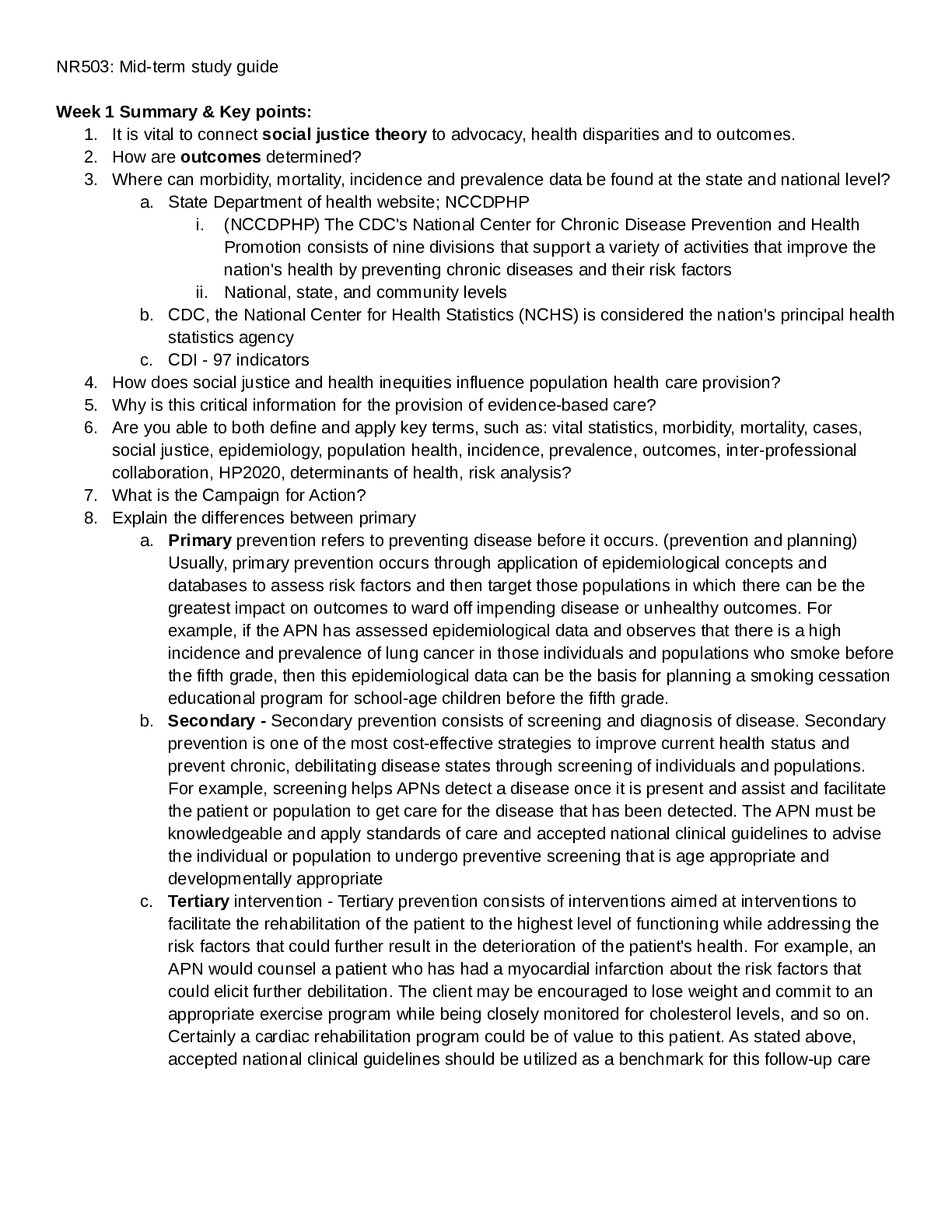
NR503: Mid-term study guide
Week 1 Summary & Key points:
1. It is vital to connect social justice theory to advocacy, health disparities and to outcomes.
2. How are outcomes determined?
3. Where can morbidity, mortality, incidence and prevalence data be found at the state and national level?
a. State Department of health website; NCCDPHP
i. (NCCDPHP) The CDC's National Center for Chronic Disease Prevention and Health
Promotion consists of nine divisions that support a variety of activities that improve the
nation's health by preventing chronic diseases and their risk factors
ii. National, state, and community levels
b. CDC, the National Center for Health Statistics (NCHS) is considered the nation's principal health
statistics agency
c. CDI - 97 indicators
4. How does social justice and health inequities influence population health care provision?
5. Why is this critical information for the provision of evidence-based care?
6. Are you able to both define and apply key terms, such as: vital statistics, morbidity, mortality, cases,
social justice, epidemiology, population health, incidence, prevalence, outcomes, inter-professional
collaboration, HP2020, determinants of health, risk analysis?
7. What is the Campaign for Action?
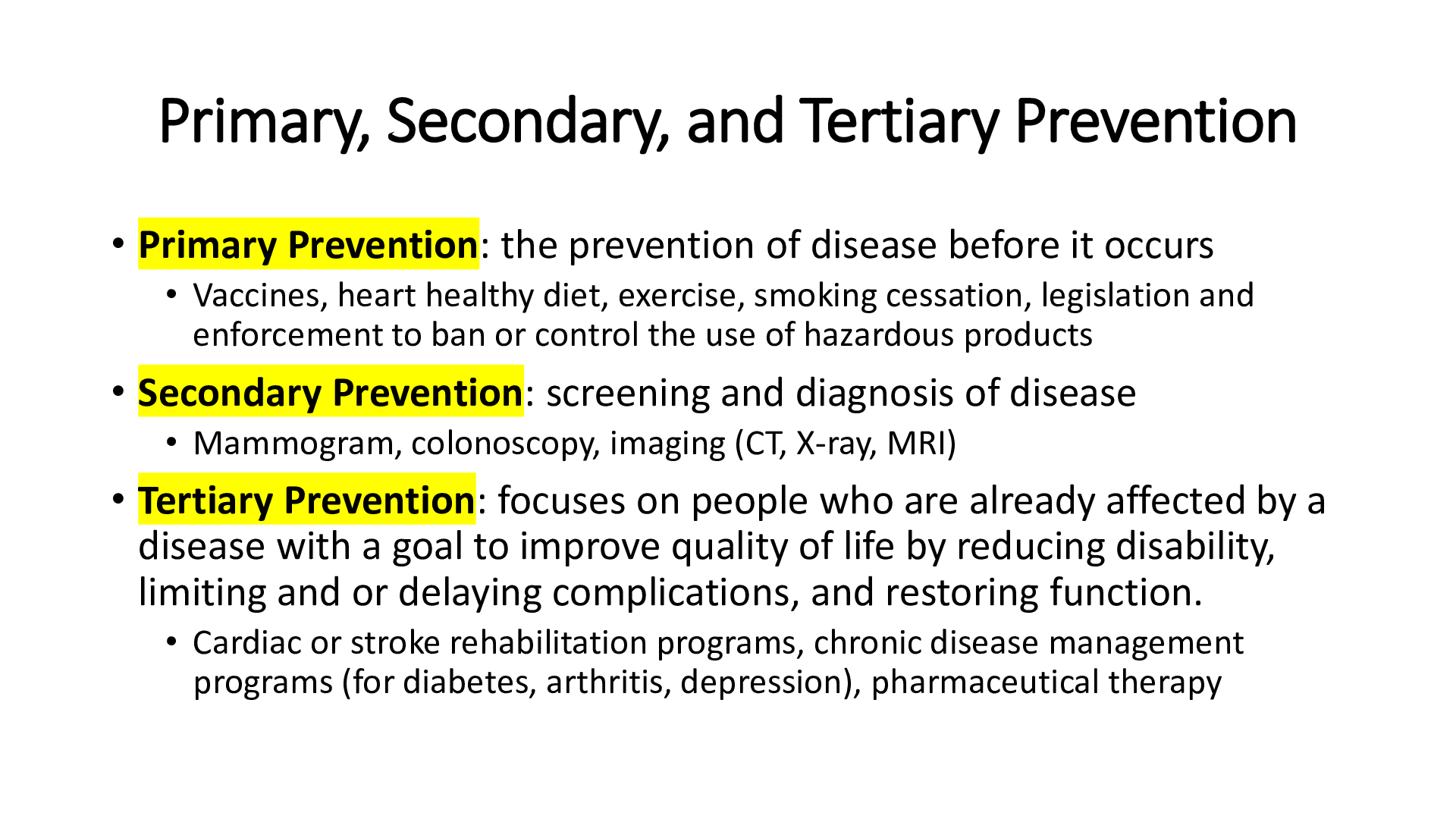
8. Explain the differences between primary
a. Primary prevention refers to preventing disease before it occurs. (prevention and planning)
Usually, primary prevention occurs through application of epidemiological concepts and
databases to assess risk factors and then target those populations in which there can be the
greatest impact on outcomes to ward off impending disease or unhealthy outcomes. For
example, if the APN has assessed epidemiological data and observes that there is a high
incidence and prevalence of lung cancer in those individuals and populations who smoke before
the fifth grade, then this epidemiological data can be the basis for planning a smoking cessation
educational program for school-age children before the fifth grade.
b. Secondary - Secondary prevention consists of screening and diagnosis of disease. Secondary
prevention is one of the most cost-effective strategies to improve current health status and
prevent chronic, debilitating disease states through screening of individuals and populations.
For example, screening helps APNs detect a disease once it is present and assist and facilitate
the patient or population to get care for the disease that has been detected. The APN must be
knowledgeable and apply standards of care and accepted national clinical guidelines to advise
the individual or population to undergo preventive screening that is age appropriate and
developmentally appropriate
c. Tertiary intervention - Tertiary prevention consists of interventions aimed at interventions to
facilitate the rehabilitation of the patient to the highest level of functioning while addressing the
risk factors that could further result in the deterioration of the patient's health. For example, an
APN would counsel a patient who has had a myocardial infarction about the risk factors that
could elicit further debilitation. The client may be encouraged to lose weight and commit to an
appropriate exercise program while being closely monitored for cholesterol levels, and so on.
Certainly a cardiac rehabilitation program could be of value to this patient. As stated above,
accepted national clinical guidelines should be utilized as a benchmark for this follow-up care
Week 2 Summary & Key points:
1. In conclusion, the control of infectious disease presents a challenge to the APN on many fronts. The
ability to provide effective population-based interventions, in addition to fulfilling legal obligations, can
have a profound positive impact on the nation's health.
2. Screening/diagnostic tools are often created for population specific use; for instance, gender, age,
culture.
3. Screening/diagnostic tools should be tested and have available statistics that speak to their specificity,
sensitivity, and positive predictive value.
4. Descriptive epidemiology: Did you see this definition on the CDC web site ...these elements connect to
understanding causation:
5. https://www.cdc.gov/ophss/csels/dsepd/ss1978/lesson1/section6.html (Links to an external site.)Links
to an external site.
6. The 5W's of descriptive epidemiology:
a. What = health issue of concern
b. Who = person
c. Where = place
d. When = time
e. Why/how = causes, risk factors, modes of transmission
7. Is screening a tertiary intervention? If yes, why, if not, what is it?
8. How does a provider determine the usefulness, appropriateness, of a screening test? Where
would a NP look to find a screening test? What determines if a screening test should be used?
9. Can you explain what "descriptive epidemiology" means? What is the purpose? How is it
used?
10.How are causation and descriptive epidemiology related, how do they work together to aid
evidence-based care?
11.What does "causation" mean? Can you relate causation to primary, secondary and tertiary
interventions?
Week 3 Summary & Key points:
(Review Table 4.2 in your text on strengths and weaknesses of study designs. For example, what is the best fit
for studying association? Which study is typically least expensive and shorter? What are study methods?)
1. The Randomized Control Trial is the gold standard for research, and it utilizes intervention testing.
2. Case-control designs
3. Cohort study designs
Consider, recruitment methods, costs of study, retrospective versus prospective analysis results, bias
(systematic errors (information bias, etc.), errors (random and systematic), data collection, causality, scientific
misconduct (fraud). (See table 4.2 in your text on strengths and weaknesses of study designs.)
1. What is a case-control study and how does it differ (or how is it the same) as the cohort study
design?
2. Can you talk about the ways bias shows up in a study design (such as, selection bias) etc.?
3. What is different in a randomized control trial than, for instance, a case-control study (or a
cohort study)? What does it mean to show a causal relationship?
4. What is each type of study used for, its purpose, and its outcomes? How are the outcomes
different in each study design? Measured?
5. What is an intervention group? Where is it found?
6. Can you explain a retrospective versus a prospective study design? What are the pros and
cons of each?
7. How are groups selected for each of the study designs?
8. What is meant by "scientific misconduct"?
[Show More]