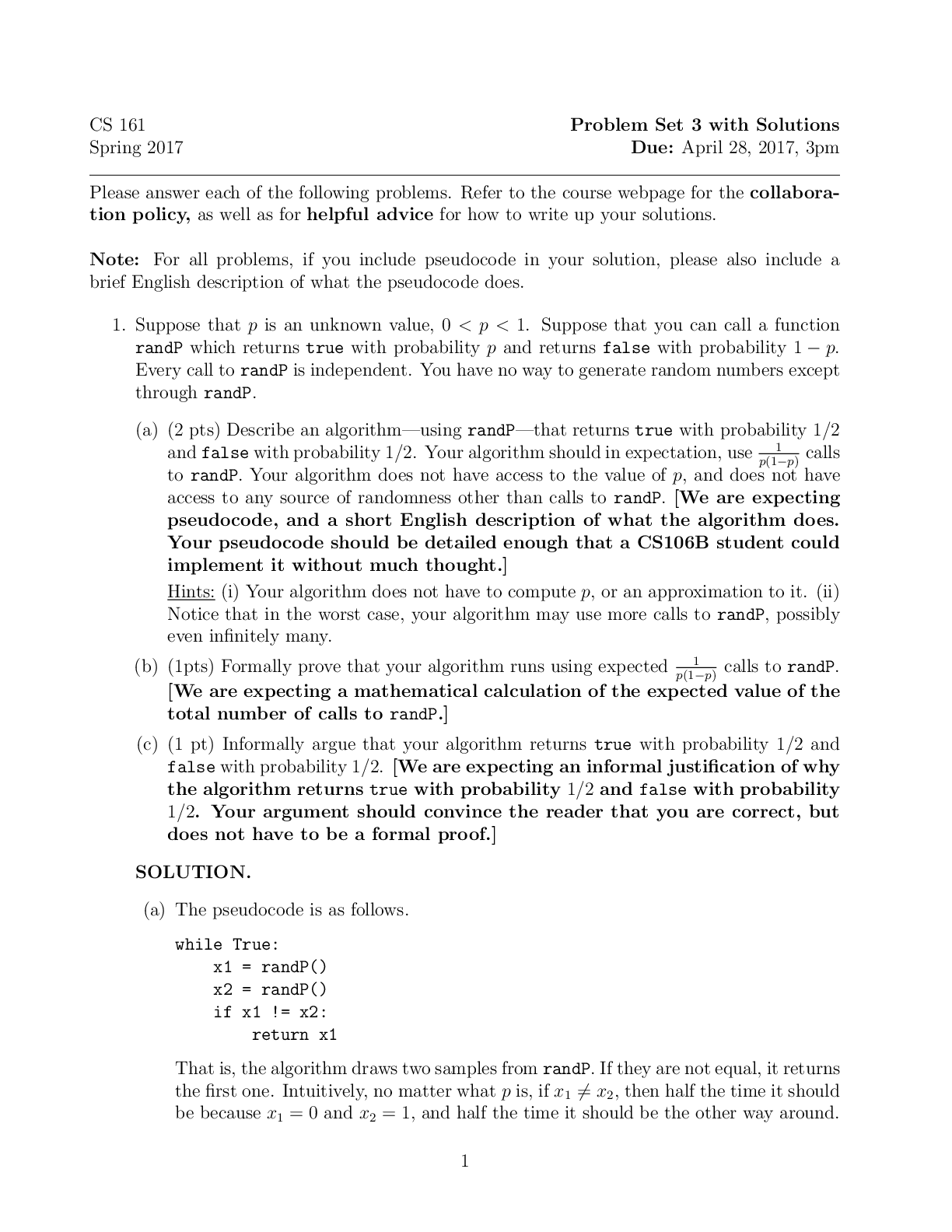
CS 161 Problem Set 3 with Solutions
Spring 2017 Due: April 28, 2017, 3pm
Please answer each of the following problems. Refer to the course webpage for the collaboration policy, as well as for helpful advice for how to
...
CS 161 Problem Set 3 with Solutions
Spring 2017 Due: April 28, 2017, 3pm
Please answer each of the following problems. Refer to the course webpage for the collaboration policy, as well as for helpful advice for how to write up your solutions.
Note: For all problems, if you include pseudocode in your solution, please also include a
brief English description of what the pseudocode does.
1. Suppose that p is an unknown value, 0 < p < 1. Suppose that you can call a function
randP which returns true with probability p and returns false with probability 1 − p.
Every call to randP is independent. You have no way to generate random numbers except
through randP.
(a) (2 pts) Describe an algorithm|using randP|that returns true with probability 1=2
and false with probability 1=2. Your algorithm should in expectation, use 1
p(1−p) calls
to randP. Your algorithm does not have access to the value of p, and does not have
access to any source of randomness other than calls to randP. [We are expecting
pseudocode, and a short English description of what the algorithm does.
Your pseudocode should be detailed enough that a CS106B student could
implement it without much thought.]
Hints: (i) Your algorithm does not have to compute p, or an approximation to it. (ii)
Notice that in the worst case, your algorithm may use more calls to randP, possibly
even infinitely many.
(b) (1pts) Formally prove that your algorithm runs using expected 1
p(1−p) calls to randP.
[We are expecting a mathematical calculation of the expected value of the
total number of calls to randP.]
(c) (1 pt) Informally argue that your algorithm returns true with probability 1=2 and
false with probability 1=2. [We are expecting an informal justification of why
the algorithm returns true with probability 1=2 and false with probability
1=2. Your argument should convince the reader that you are correct, but
does not have to be a formal proof.]
SOLUTION.
(a) The pseudocode is as follows.
while True:
x1 = randP()
x2 = randP()
if x1 != x2:
return x1
That is, the algorithm draws two samples from randP. If they are not equal, it returns
the first one. Intuitively, no matter what p is, if x1 6= x2, then half the time it should
be because x1 = 0 and x2 = 1, and half the time it should be the other way around.
[Show More]