NUR 4455 Module 3 NCLEX Answers/ Rationale 1. The nurse is assigned to care for a patient who is in early labor. When collecting data from the patient, which should the nurse check first? a. Baseline fetal heart rate b.
...
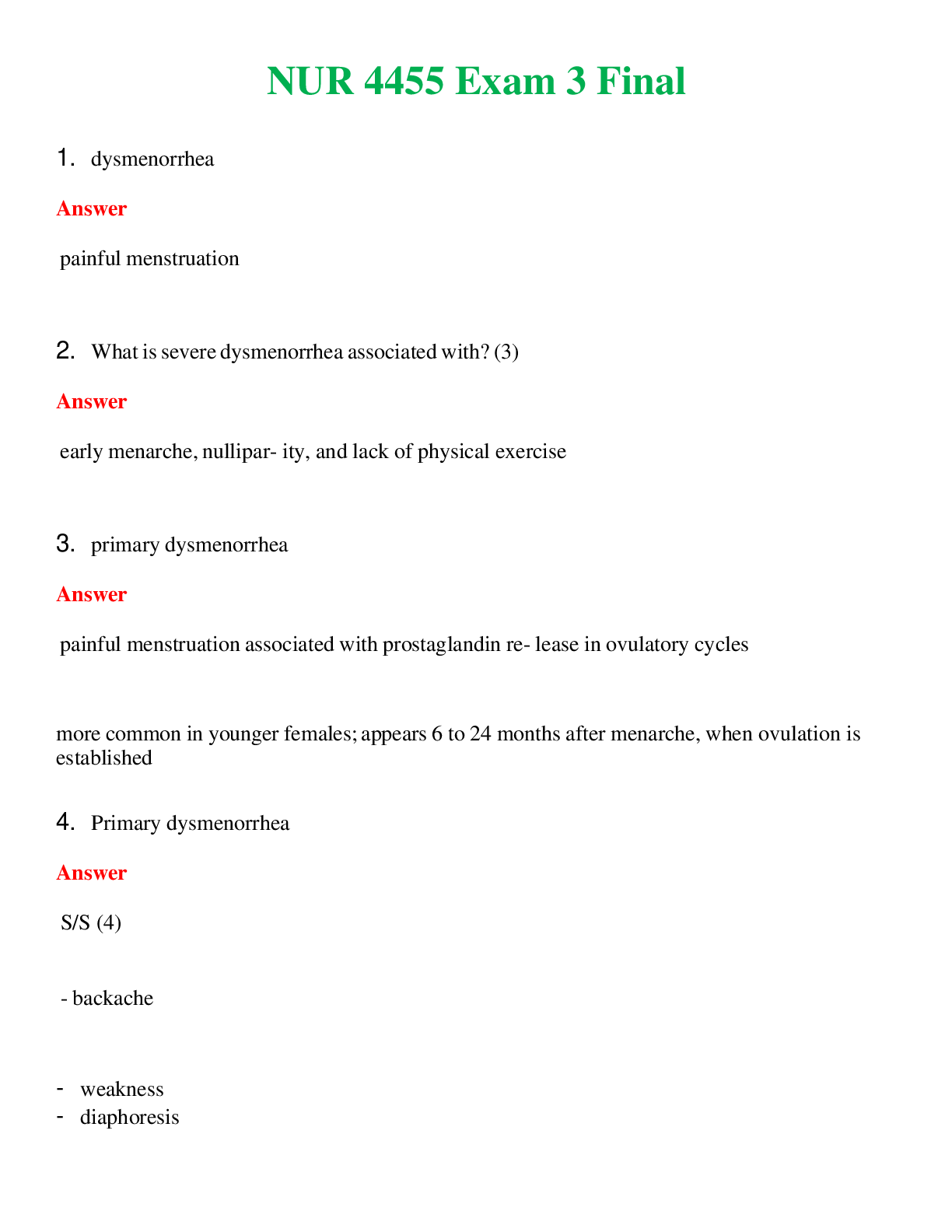
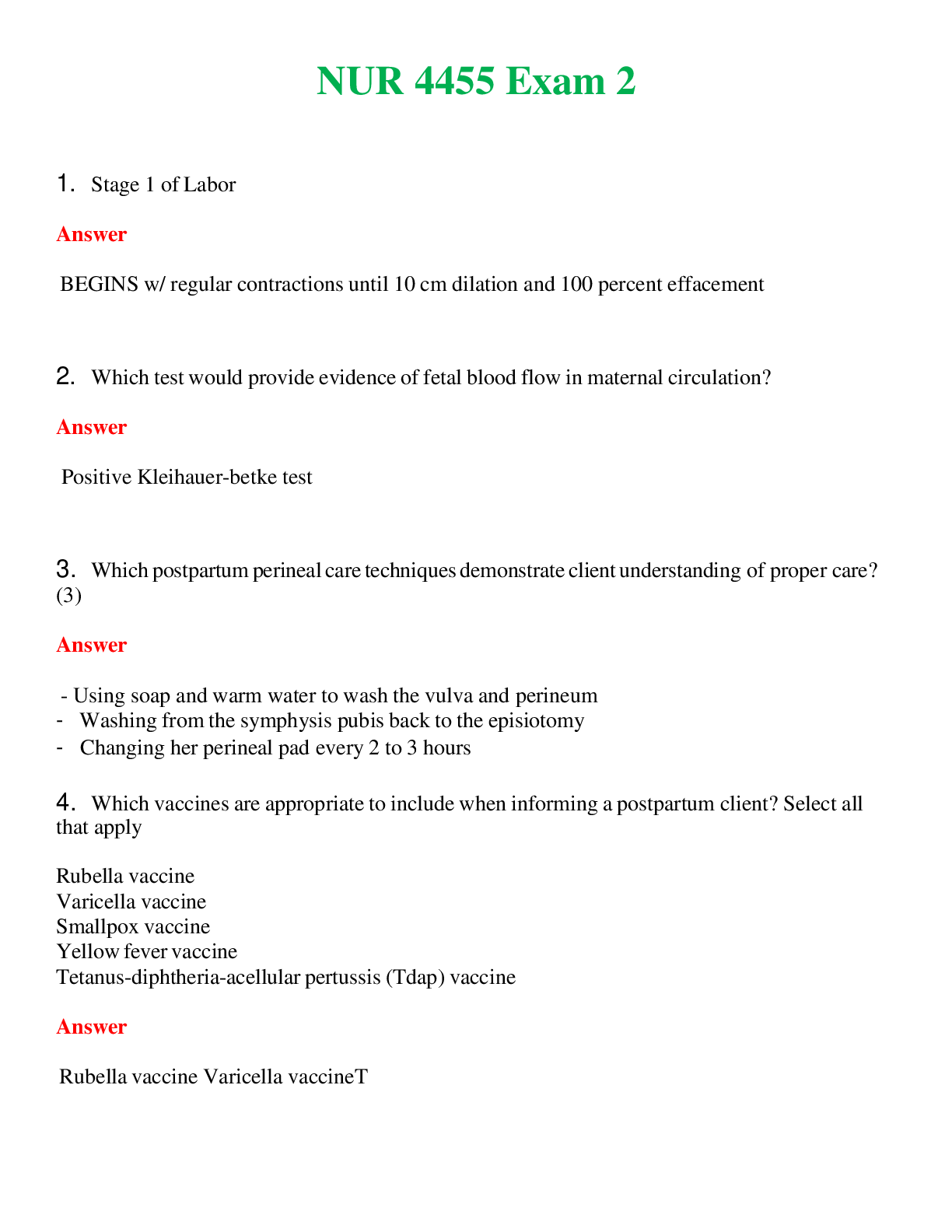
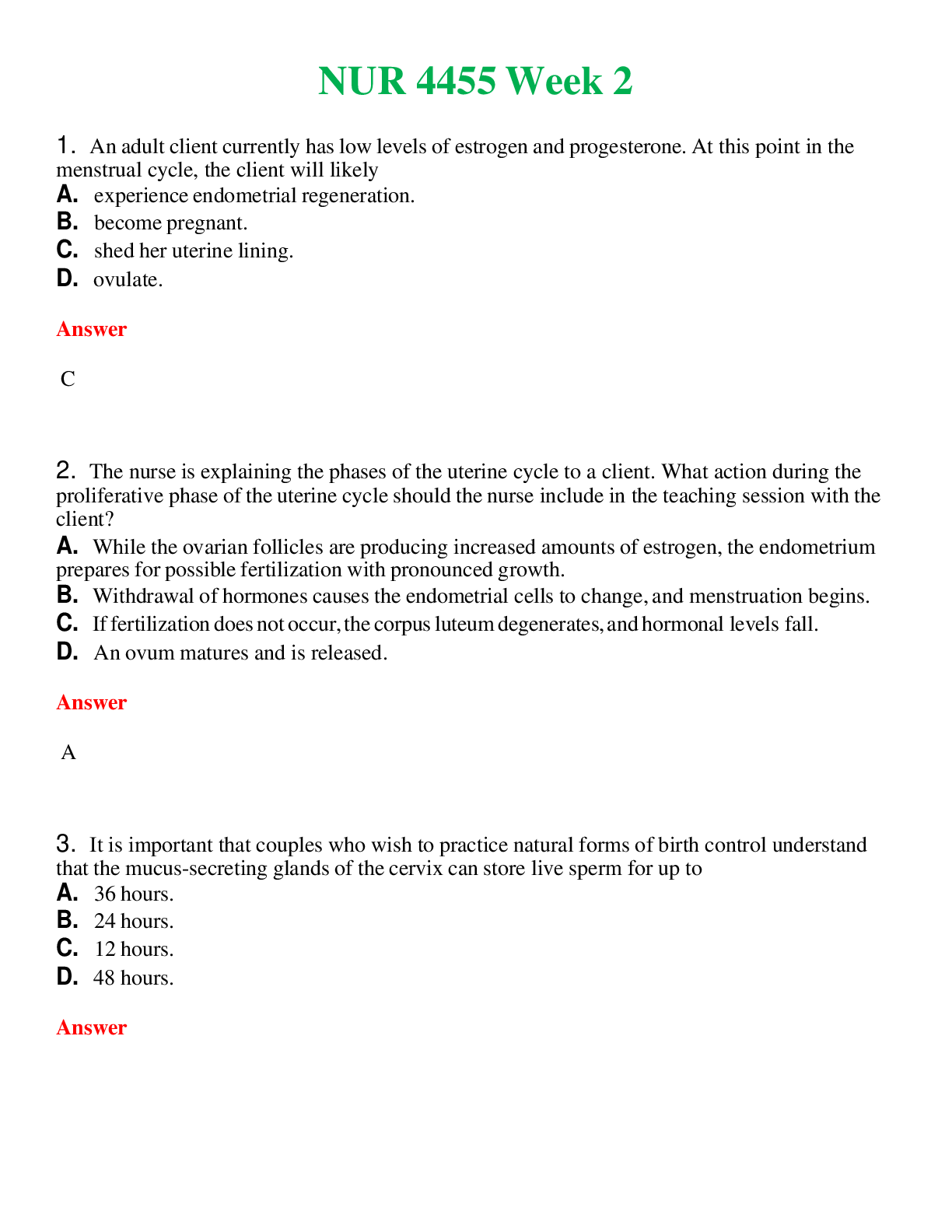
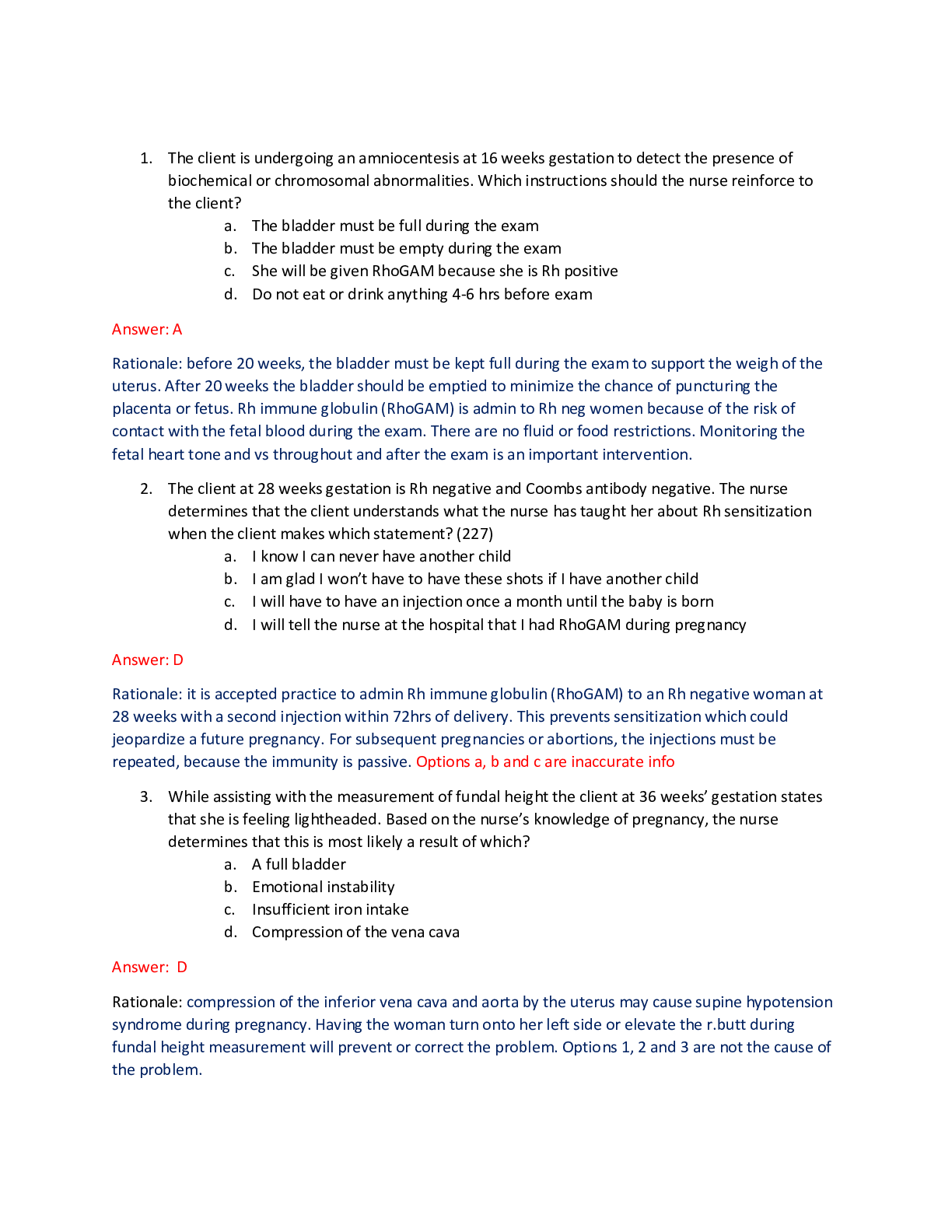
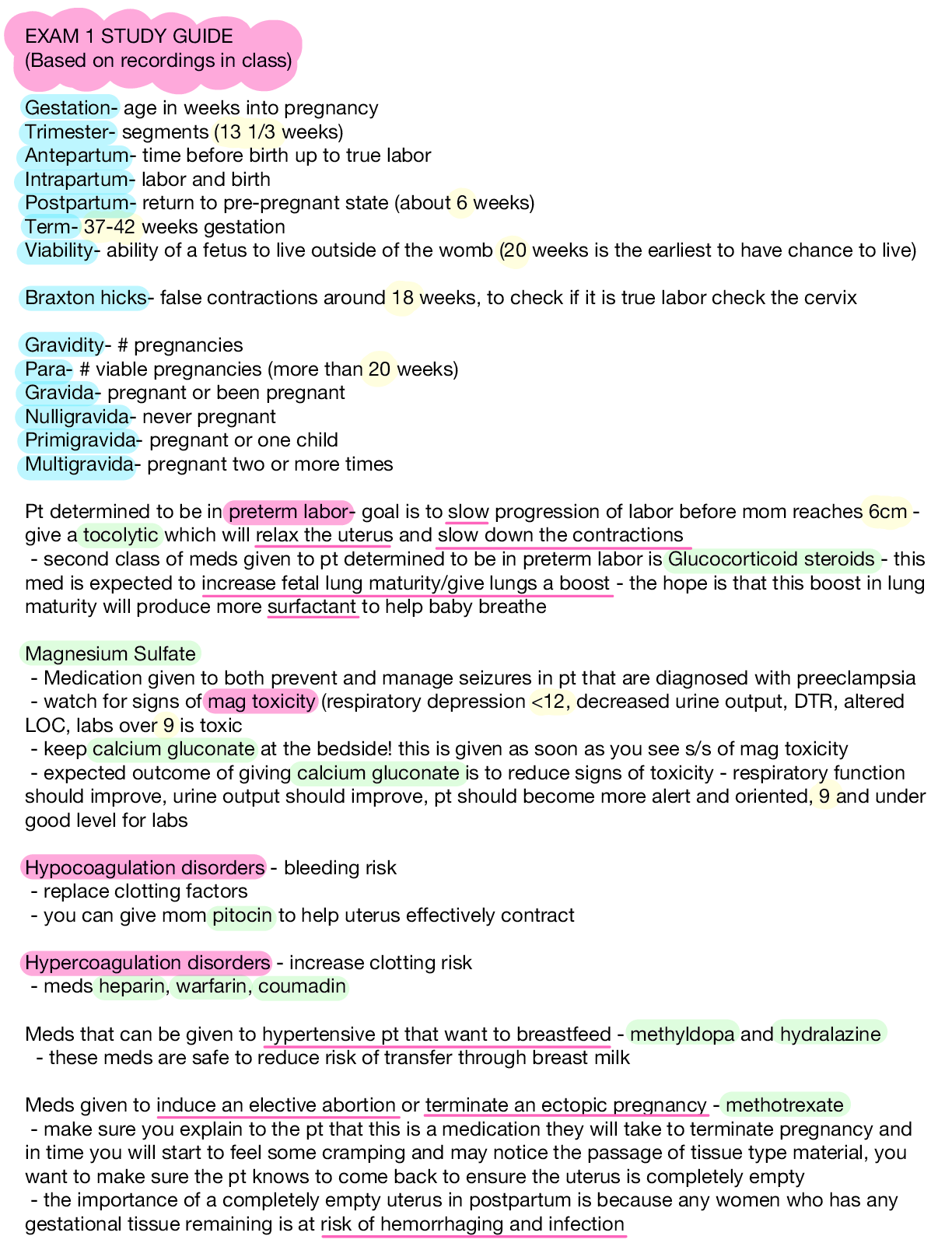
NUR 4455 Module 3 NCLEX Answers/ Rationale 1. The nurse is assigned to care for a patient who is in early labor. When collecting data from the patient, which should the nurse check first? a. Baseline fetal heart rate b. Intensity of contractions c. Maternal bp d. Freq. of contractions 2. Leopold’s maneuvers will be performed on a pregnant patient. The patient asks the nurse about the procedure. Which information should the nurse provide to the patient about Leopold’s maneuvers? A. The maneuvers measure the height of the maternal fundus B. The maneuvers determine the “lie” and attitude of the fetus C. The maneuvers are systematic method for palpating the fetus through the maternal back D. The maneuvers are a systematic method for palpating the fetus through the maternal abdominal wall 3. The nurse is caring for a patient who is in labor. The nurse rechecks the clients blood pressure and notes that it has dropped. To decrease the incidence of supine hypotension, the nurse should encourage the client to remain in which position? a. Squatting b. Side lying c. Tailor sitting d. Semi-fowlers After a precipitous delivery the nurse note the new mother is passive and only touches her newborn briefly with her fingertips. The nurse should do what to help the women process what has happened a. Encourage the mother to breastfeed soon after birth b. Support the mother in her reaction to the newborn c. Tell the mother that it is important to hold the baby d. Document a complete account of the mothers reaction in the birth record 4. A primigravida’s membrane rupture spontaneously. Which actions should the nurse take first? a. Determine the fetal heart rate b. Prepare for immediate delivery c. Monitor contractions pattern d. Note the amount color and odor of the amniotic fluid 5. After the client vaginally delivers a viable newborn, the nurse sees the umbilical cord lengthen and observes a spurt of blood from the vagina. The nurse recognizes these findings as signs of which condition a. Uterine atony b. Placenta previa c. Abruptio placentae d. Placental separation 6. The nurse is assigned to assist with caring for a client who has been admitted to the labor unit. The client is 9cm dilated and is experiencing precipitous labor. Which is the priority nursing intervention? a. Prepare for oxytocin infusion b. Keep the patient in a side lying position c. Prepare the client for epidural anesthesia d. Encourage the client to start pushing with the contractions The client is admitted to the labor suite complaining of painless vaginal bleeding. The nurse assists with the examination of the client, knowing that which routine labor procedure is contraindicated? e. Leopold’s maneuvers f. A manual pelvic examination g. Hemoglobin and hematocrit evaluation h. External electronic fetal heart rate monitoring 1. A nurse is caring for an older adult client who has type 2 diabetes mellitus and reports difficulty following the diet and remembering to take the prescribed medication. Which of the following actions should the nurse take to promote client adherence to the treatment plan? (select all that apply) a) Ask the dietitian to assist with meal planning. The nurse provides resources to strengthen coping abilities by asking the dietitian to assist the client with meal planning. This will improve client adherence. b) Contact the clients support system. With the client's consent, the nurse can contact members of the clients support system and encourage the client to use this support during times of illness and stress to improve compliance. c) Tell the client he should follow the providers instructions. Telling the client he should follow the providers instructions will not likely improve the client's adherence to the treatment plan. The nurse should determine why the client is not following the treatment plan. d) Encourage the use of daily medication dispenser. The nurse encourages the use of a daily medication dispenser to reduce health risks and improve medication adherence by the client. e) Provide educational materials for home use. The nurse provides educational materials to the client to improve health awareness and reduce health risks after discharge. 2) A nurse in a health care clinic is evaluating the level of wellness for clients using the Illness-Wellness Continuum tool. The nurse should identify which of the following clients as being at the center of the continuum? a) A college student who has influenza b) An older adult who has a new diagnosis of type 2 diabetes mellitus c) A new mother who has a urinary tract infection d) A young male client who has a long history of well-controlled rheumatoid arthritis 3) A nurse is evaluating clients at a health fair for modifiable variables affecting health and wellness. The nurse should identify which of the following variables as modifiable? (select all that apply) a) Smoking on social occasions The nurse identifies smoking as a modifiable variable that a client can change. The nurse should provide the client with educational materials and information on smoking cessation. b) BMI of 28 c) Alopecia d) Trisomy e) History of reflux 4) A nurse is caring for a client who has just told she has breast cancer. The nurse evaluates the client's response. Which of the following statements by the client reflects a negative response to illness? a) “I have no family history of breast cancer.” b) “I need a second opinion. There is no lump.” The nurse should identify this statement as an indication of denial, which is a negative response to illness. Other factors that can influence the response to illness include physical changes, self-perception, and cultural beliefs. c) “I am glad we live in the city near several large hospitals.” d) “I will schedule surgery next week, over the holidays.” 5) A nurse on a medical-surgical unit is caring for a group of clients. The nurse should notify the rapid response team for which of the following clients? a) Client who has an ulceration on the right heel whose blood glucose is 300mg/dL b) Client who reports right calf pain and shortness of breath c) Client who has blood on a pressure dressing in the femoral area following cardiac catherization d) Client who has dark red colorization on the left toes and absent pedal pulse 6) A nurse is caring for a client who has ingested a toxic agent. Which of the following actions should the nurse plan to take? (select all that apply) a) Induce vomiting. b) Instill activated charcoal. c) Perform a gastric lavage with aspiration. d) Administer syrup of ipecac. e) Ensure the client has IV fluids infused. 7) A nurse at a rural community clinic is caring for a client who fell through the ice on a pond, is unresponsive, and is breathing slowly. Which of the following actions should the nurse take? (select all that apply) a) Remove wet clothing b) Maintain normal room temperature c) Apply warm blankets d) Apply a heat lamp e) Ensure the client has warmed IV fluids infused 8) A nurse encounters an unresponsive client during a walk. The client's partner states, “He was pulling weeds in the yard and slumped to the ground.” which of the following techniques should the nurse use to open the client's airway? a) Head-tilt/chin-lift b) Modified jaw thrust c) Hyperextension of the head d) Flexion of the head Henry, N. E., & Holman, H. C. (2017). PN Adult Medical Surgical Nursing (10.0 ed.). Assessment Technologies Institute, LLC. Nadia: 1. A client that attends group sessions at an outpatient mental health clinic has difficulty staying seated because of the constant pain in his lower back. He interrupts the person sitting next to him often when he sighs, whimpers, and cuts him off to talk about the pain. The client begs his daughter to come pick him up because he cannot tolerate being seated for a long time. The nurse observes this as what kind of behavior? a. Opioid intoxication b.Marijuana intoxication c. Somatization d.Hypomania i. RATIONAL: Somatization is when a person has recurring, intense, and multiple complaints about somatic pain. This pain can be real and intense where it interferes with someone’s daily life. It is classified as a mental health disorder. 2. What is an example of an abstract question to ask a client? a. Tell me about what you did last summer? b.What is your favorite beach get away c. How are beach’s and springs similar? d.How is a poodle similar to a greyhound? i. RATIONAL: An abstract question is one that does not include or require the here and now. A person who thinks about dogs in general verses a particular dog is more of an abstractive thinker. 3. According to Maslow’s Hierarchy of needs what is the correct order? a. Self-actualization, esteem needs, belongingness and love need, safety needs, and physiological needs. b.Esteem needs, self-actualization, belongingness and love needs, safety needs, and physiological needs c. Esteem needs, self-actualization, belongingness and love needs, physiological needs, and safety needs 4. What task can a nurse delegate to an assistive personal? a. Feeding a client with aspiration precautions? b.Reinforcing teaching about a gluten free diet c. Reapplying a condom catheter d.Applying a sterile dressing i. RATIONAL: An assistive personal cannot teach, or apply. The AP cannot feed someone who had high precautions and is unstable. If the patient was stable with no precautions the AP would be able to feed but not in this case. The AP can perform non- invasive procedures such as reapplying a condom catheter. Only RN’s can teach and lpn’s can reinforce teaching. 5. What client statement represents an understanding of their newly diagnosed condition of Type 2 Diabetes? a. “My body’s cells are resistant to insulin.” b.“By body is resistant to glucose absorption” c. “My pancreas is not producing insulin as it should.” d.My spleen is not producing insulin as it should.” 6. A nurse is caring for a client who has schizophrenia. The client spends a great deal of time repeating rhyming syllables such as, "Me, see, bee, tree,." The nurse recognizes that the client is demonstrating which of the following positive manifestations of schizophrenia? a. Repetition b.Ritualistic communication c. Clang association d.Rhyming syndrome though the words may not logically go together. 7. What is an adverse effect of benzodiazepine for a client with anxiety that the nurse should monitor for? a. Pressured speech b.Delusions c. seizures d.Dizziness 8. A nurse hears a newly licensed nurse discussing a client's hallucinations in the hallway with another nurse. Which of the following actions should the nurse take first? a. Tell the nurses their conversation is not appropriate and can violate HIPPA b.Ignore them and go about your rounds c. Tell the patient that their rights have been violated d.Write an incident repot 1. Under which circumstance may a nurse communicate medical information without the client’s consent? A When certifying the client’s absence from work. B When requested by the client’s family. C When treating the client with a sexually transmitted disease. D When ordered by another physician. 2. A 22-year-old client is brought to the emergency department with his fiancée after being involved in a serious motor vehicle accident. His Glasgow Coma Scale score is 7 and he demonstrates evidence of decorticate posturing. Which of the following is appropriate for obtaining permission to place a catheter for intracranial pressure (ICP) monitoring? A The nurse will obtain a signed consent from the client’s fiancée because he is of legal age and they are engaged to be married. B The physician will get a consultation from another physician and proceed with placement of the ICP catheter until the family arrives to sign the consent. C Two nurses will receive a verbal consent by telephone from the client’s next of kin before inserting the catheter. D The physician will document the emergency nature of the client’s condition and that an ICP catheter for monitoring was placed without a consent. 3. During the health history interview, which of the following strategies is the most effective for the nurse to use to help clients feel that they have an active role in their health care? A. Ask clients to complete a questionnaire. B Provide clients with written instructions. C Ask clients for their description of events and for their views concerning past medical care. D Ask clients if they have any questions. 4. A client with severe major depression states, “My heart has stopped and my blood is black ash.” The nurse interprets this statement to be evidence of which of the following? A. Hallucination. B. Illusion. C. Delusion. D. Paranoia. 5. A client with a fractured leg has been instructed to ambulate without weight bearing on the affected leg. The nurse evaluates that the client is ambulating correctly if she uses which of the following crutch walking gaits? A. Two point gait. B. Four point gait. C. Three point gait. D. Swing to gait. 6. A client with bipolar 1 disorder has been prescribed olanzapine (Zyprexa) 5 mg two times a day and lamotrigine (Lamictal) 25 mg two times a day. Which of the following adverse effects should the nurse report to the physician immediately? Select all that apply. A. Rash. B. Nausea. C. Sedation. D. Hyperthermia. 7. A multigravid client at 34 weeks’ gestation who is leaking amniotic fluid has just been hospitalized with a diagnosis of preterm premature rupture of membranes and preterm labor. The client’s contractions are 20 minutes apart, lasting 20 to 30 seconds. Her cervix is dilated to 2 cm. The nurse reviews the physician orders (see chart). Which of the following orders should the nurse initiate first? A. Initiate fetal and contraction monitoring. B. Start the intravenous infusion. C. Obtain the urine specimen. D. Administer betamethasone. 8. A client takes hydrochlorothiazide (HCTZ) for treatment of essential hypertension. The nurse should instruct the client to report which of the following? Select all that apply. A. Muscle twitching. B. Abdominal cramping. C. Diarrhea. D. Confusion. The nurse is assisting with developing a plan of care for the client with multiple myeloma. Which is a priority nursing intervention for this client? 1. Encouraging fluids 2. Providing frequent oral care 3. Coughing and deep breathing 4. Monitoring the red blood cell count The nurse is reviewing the laboratory results of a client with leukemia who has received a regimen of chemotherapy. Which laboratory finding would provide information about the massive cell destruction that occurs with the chemotherapy? 1. Anemia 2. Decreased platelets 3. Increased uric acid level 4. Decreased leukocyte count The client is receiving external radiation to the neck for cancer of the larynx. The nurse monitors the client knowing that which is the most likely side/adverse effect of the external radiation? 1. Dyspnea 2. Diarrhea 3. Sore throat 4. Constipation The nurse is reinforcing instructions to a client receiving external radiation therapy. The nurse determines that the client needs further teaching if the client states an intention to take which action? 1. Eat a high-protein diet. 2. Avoid exposure to sunlight. 3. Wash the skin with a mild soap and pat it dry. 4. Apply pressure on the radiated area to prevent bleeding. The nurse provides skin care instructions to the client who is receiving external radiation therapy. Which statement by the client indicates the need for further teaching? 1. “I will handle the area gently.” 2. “I will wear loose-fitting clothing.” 3. “I will avoid the use of deodorants.” 4. “I will limit sun exposure to 1 hour daily.” The client is hospitalized for the insertion of an internal cervical radiation implant. While giving care, the nurse finds the radiation implant in the bed. Which is the immediate nursing action? 1. Call the health care provider (HCP). 2. Reinsert the implant into the vagina. 3. Pick up the implant with gloved hands and flush it down the toilet. 4. Pick up the implant with long-handled forceps and place into a lead container. The client is admitted to the hospital with a diagnosis of suspected Hodgkin’s disease. Which finding should the nurse most likely expect to find documented in the client’s record? 1. Fatigue 2. Weakness 3. Weight gain 4. Enlarged lymph nodes When reviewing the health care record of a client with ovarian cancer, the nurse recognizes which sign/symptom as being a typical manifestation of the disease? 1. Diarrhea 2. Hypermenorrhea 3. Abnormal bleeding 4. Abdominal distention Stephanie: A client with congestive heart failure has been receiving Digoxin (lanoxin). Which finding indicates that the medication is having a desired effect? A. Increased urinary output B. Stabilized weight C. Improved appetite D. Increased pedal edema 2. Which play activity is best suited to the gross motor skills of the toddler? A. Coloring book and crayons B. Ball C. Building cubes D. Swing set 3. A client is admitted with suspected abdominal aortic aneurysm (AAA). A common complaint of the client with an abdominal aortic aneurysm is: A. Loss of sensation in the lower extremities B. Back pain that lessens when standing C. Decreased urinary output D. Pulsations in the periumbilical area 4. A client with iron-deficiency anemia is taking an oral iron supplement. The nurse should tell the client to take the medication with: A. Orange juice B. Water only C. Milk D. Apple juice 5. A client is admitted with burns of the right arm, chest, and head. According to the Rule of Nines, the percent of burn injury is: A. 18% B. 27% C. 36% D. 45% 6. Which statement best describes the difference between the pain of angina and the pain of myocardial infarction? A. Pain associated with angina is relieved by rest. B. Pain associated with myocardial infarction is always more severe. C. Pain associated with angina is confined to the chest area. D. Pain associated with myocardial infarction is referred to the left arm. 7. The physician has ordered cortisporin ear drops for a 2-year-old. To administer the ear drops, the nurse should: A. Pull the ear down and back B. Pull the ear straight out C. Pull the ear up and back D. Leave the ear undisturbed 8. The nurse is caring for a client with a history of diverticulitis. The client complains of abdominal pain, fever, and diarrhea. Which food was responsible for the client's symptoms? A. Mashed potatoes B. Steamed carrots C. Baked fish D. Whole-grain cereal 1. The transition phase of the first stage of labor can be identified by which finding? a. Effacement of the cervix b. Cervical dealation of 3 cm c. Cervical dilation of 8 to 10 cm d. The woman is sociable and excited about labor 2. The client is being scheduled for a positron emission tomography (PET) scan. The nurse should plan to provide which explanation to the client? A. “ The test uses magnetic fields to produce images” B. “the test provides cross-sectional views of the brain” C. “ The test uses a small amount of radioactive material” D. “the test views bones of the skull, nasal sinuses, and vertebrae. 3. The nurse newly employed in the acute care setting understands that relationship-based nursing is focused on which specific purpose? a. Keeping the nurse at the bedside b. Accountability for specific tasks c. Caring for clients by geographically d. Delegated tasks rather than the total client 4. The nurse is preparing a client for discharge and is performing variance analysis on a client. The nurse notes that the client is being discharged earlier than anticipated The nurse understands that this client outcome is characteristic of which type of variance a. Positive b. Negative c. Unchanged d. Unexpected 5. The nurse understands that an amniocentesis can be performed by which gestational? a. 8 weeks b. 10 weeks c. 12 weeks d. 14 weeks 6. The nurse understands that chorionic villus sampling (CVS) is performed ideally between which weeks of gestational age? a. 5 and 8 weeks b. 10 and 13 weeks c. 15 and 18 weeks d. 20 and 23 weeks 7. A client arrives at the birthing center in active labor. Her membranes are still intact and the nurse midwife prepares to perform amniotomy. The nurse who is assisting the nurse midwife understands that the fetus must be at which station for this procedure to be performed? a. O station b. -1 station c. -2 station d. -3 station 8. The nurse prepares to check the fetal heart beat using a doppler ultrasound knowing that the fetal heart beat can first be heard with this device at which gestational week? a. 5 b. 12 c. 16 d. 20 The nurse arrives at work and is told to report (float) to the pediatric unit for the day because the unit is understaffed and needs additional nurses to care for the clients. The nurse has never worked a pediatric unit. Which of the following is the appropriate nursing action? a. Call the hospital lawyer b. Call the nursing supervisor c. Refuse to float to the pediatric unit d. Report to the pediatric unit and identify tasks that can be safely performed 2. The nurse is recording a nursing hands-off (end of shift) report for a client. Which information needs to be included? a. As-needed medications given that shift b. Normal vital signs that have been normal since admission c. All of the test and treatments that client has had since admission d. Total number of scheduled medications that the client received on that shift 3. A client is receiving a continuous intravenous infusion of heparin sodium to treat deep vein thrombosis. The clients activated partial thromboplastin (aPTT) time is 65 seconds. The licensed practical nurse reviews the laboratory results with the registered nurse, anticipating which action is needed? a. Discontinuing the heparin infusion b. Increasing the rate of heparin infusion c. Decreasing the rate of heparin infusion d. Leaving the rate of heparin infusion as is 4. A hospitalized client is a lacto-vegetarian. Which food item should the nurse remove from the tray? a. Eggs b. Milk c. Cheese d. Broccoli 5. The nurse is providing dietary instructions to a client with gout. The nurse should avoid with of the following items? a. Scallops b. Chocolate c. Cornbread d. Macaroni products 6. A client who was receiving a blood transfusion has experienced a transfusion reaction. The nurse sends the blood bag that was used for the client to which area? a. The pharmacy b. The laboratory c. The blood bank d. The risk-management department 7. The nurse learns in report that a client is experiencing Cheyne-Stokes respirations. Based on this data which is most appropriate for the nurse to take initially. a. Listen to the client’s heart sounds b. Determine whether the client has a pulse deficit c. Instruct the client to use an incentive spirometer d. Determine the client’s ability to follow verbal commands 8. The nurse enters a client’s room and finds that the waste bucket is on fire. The nurse quickly assists the client out of the room. Which is the next nursing action? a. Call for help b. Extinguish the fire c. Activate the alarm d. Confine the fire by closing the room door 1. Which of the following nursing actions has the HIGHEST priority for a teenager admitted with burns to 50% of his body? A. Counseling regarding problems of body image B. Maintain airborne precautions C. Maintain aseptic technique during procedures D. Encourage peers to visit on a regular basis. C. correct–safety is a priority for the client who is at high risk for infection 2. The home health care nurse is caring for a 30-year-old woman with type I diabetes mellitus. The client has been maintained on a regimen of NPH and regular insulin and a 1,800-calorie diabetic diet with normal blood sugar levels. Morning self-monitoring blood sugar (SMBG) readings the past two days were 205 mg/dL and 233 mg/dL. The nurse expects the physician to A. reduce the client’s diet to 1,500 calorie ADA B. order 3 additional units of NPH insulin at 10 PM C. order an additional 10 units of regular insulin at 8 PM D. eliminate the client’s bedtime snack. 3. After sustaining a closed head injury and numerous lacerations and abrasions to the face and neck, a five-year-old child is admitted to the emergency room. The client is unconscious and has minimal response to noxious stimuli. Which of the following assessments, if observed by the nurse three hours after admission, should be reported to the physician? A. The client has slight edema of the eyelids B. There is clear fluid draining from the client’s right ear C. There is some bleeding from the child’s lacerations D. The client withdraws in response to painful stimuli. B. correct–indicates a rupture of meninges and presents a potential complication of meningitis 4. A psychiatric nurse is assigned to conduct an admission nursing history on a new client. The admission should include which of the following? A. The nurse’s opinion regarding the mental and emotional status of the client B. Data addressing the client’s emotional state C. Data that address a biopsychosocial approach, including a family system assessment D. Specific data detailing the client’s mental status 5. Prochlorperazine maleate (Compazine) 10 mg IM has been ordered for a client. The client is also to receive Stadol 2 mg IM. Before administering these medications, the nurse should A. obtain respirations and temperature B. dilute with 9 ml of NS C. draw the medications in separate syringes D. verify the route of administration. 6. The nurse is caring for clients in the student health center. A client confides to the nurse that the client’s boyfriend informed her that he tested positive for hepatitis B. Which of the following responses by the nurse is BEST? A. “That must have been a real shock to you.” B. “You should be tested for hepatitis B.” C. “You’ll receive the hepatitis B immune globulin (HBIG).” D. “Have you had unprotected sex with your boyfriend?” 7. A young adult patient constantly seeks attention from the nurses, stomping away from the nurses’ station and pouting when her requests are refused. Which of the following responses by the nurse is MOST appropriate? A. Have the patient establish trust with one staff person with whom therapeutic interventions should occur. B. Give the patient unsolicited attention when she is not exhibiting the unacceptable behaviors C. Ignore the patient when she exhibits attention-seeking behavior D. Rotate the staff so the patient will learn to relate to more than one nurse. 8. After abdominal surgery, a client has a nasogastric tube attached to low suctioning. The client becomes nauseated, and the nurse observes a decrease in the flow of gastric secretions. Which of the following nursing interventions would be MOST appropriate? A. Irrigate the nasogastric tube with distilled water B. Aspirate the gastric contents with a syringe C. Administer an antiemetic medicine D. Insert a new nasogastric tube.
[Show More]