*NURSING > STUDY GUIDE > N5315 / N5315 Advanced Pathophysiology Module 5 Study Guide (Latest Update) - University of Texas at (All)
N5315 / N5315 Advanced Pathophysiology Module 5 Study Guide (Latest Update) - University of Texas at Arlington
Document Content and Description Below
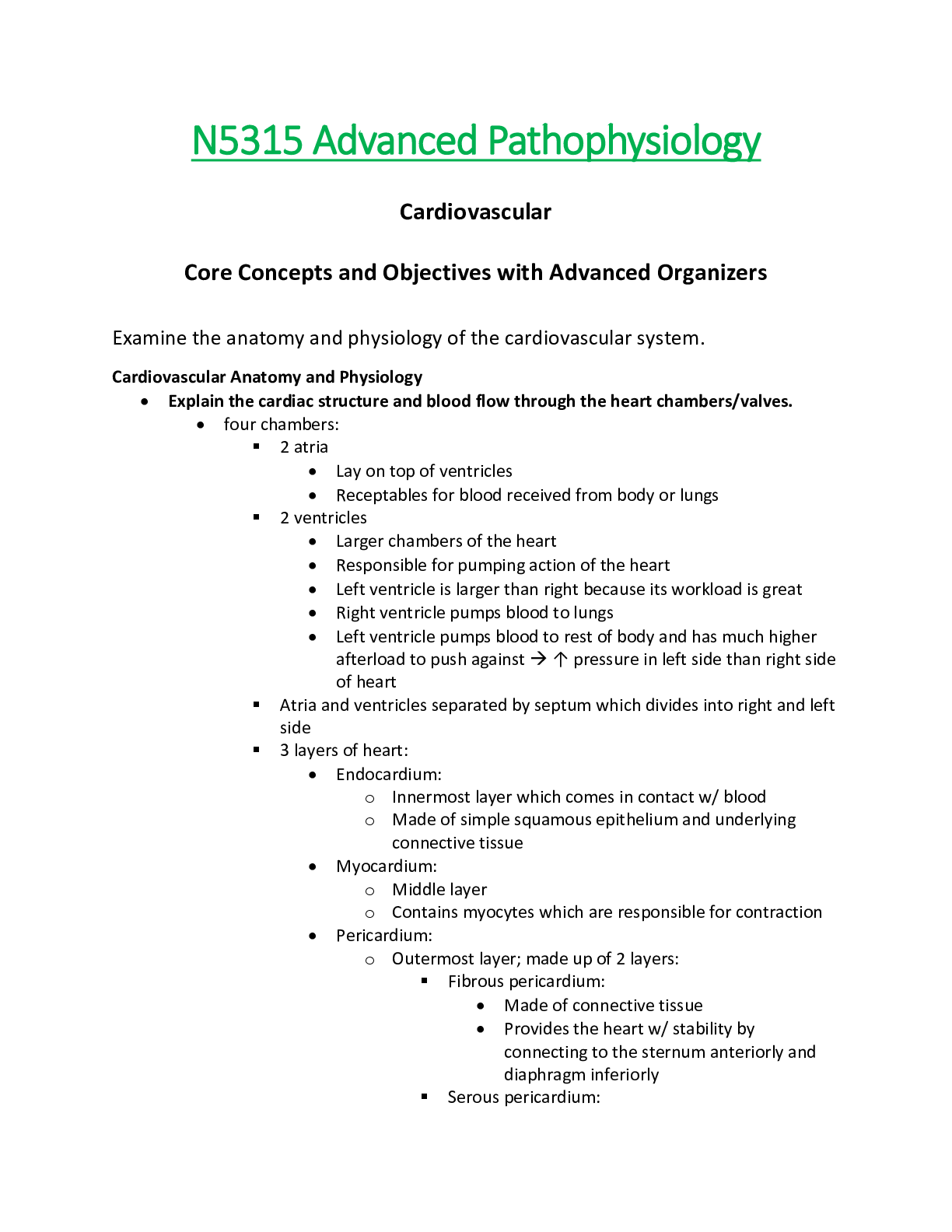
N5315 Advanced Pathophysiology Module 5 Study Guide Cardiovascular - Core Concepts and Objectives with Advanced Organizers Examine the anatomy and physiology of the cardiovascular system. Car ... diovascular Anatomy and Physiology • Explain the cardiac structure and blood flow through the heart chambers/valves. • four chambers: 2 atria • Lay on top of ventricles • Receptables for blood received from body or lungs 2 ventricles • Larger chambers of the heart • Responsible for pumping action of the heart • Left ventricle is larger than right because its workload is great • Right ventricle pumps blood to lungs • Left ventricle pumps blood to rest of body and has much higher afterload to push against ↑ pressure in left side than right side of heart Atria and ventricles separated by septum which divides into right and left side 3 layers of heart: • Endocardium: o Innermost layer which comes in contact w/ blood o Made of simple squamous epithelium and underlying connective tissue • Myocardium: o Middle layer o Contains myocytes which are responsible for contraction • Pericardium: o Outermost layer; made up of 2 layers: Fibrous pericardium: • Made of connective tissue • Provides the heart w/ stability by connecting to the sternum anteriorly and diaphragm inferiorly Serous pericardium: • Made up of 2 layers: o Epicardium (visceral layer): Lays directly over heart Contains coronary artery o Parietal layer: Lays above epicardium and underneath fibrous pericardium • Blood flow: 1. deoxygenated blood enters R atrium from body 2. blood travels from R atrium through tricuspid valve to R ventricle 3. blood travel from R ventricle through pulmonic valve into pulmonary artery (only artery in body which carries deoxygenated blood) into lungs 4. blood goes to alveoli gas exchange 5. oxygenated blood enters pulmonary vein and is delivered to L atrium 6. blood travels from L atrium through mitral valve into L ventricle 7. blood travels from L ventricle through aortic valve into aorta 8. blood travels from aorta to the rest of the body to deliver O2 and nutrients • Describe which coronary arteries provide blood to which part of the heart. • L coronary artery branches off into: L anterior descending artery supplies blood to anterior 2/3rd of intraventricular septum, anterior papillary muscles, and anterior surface of L ventricle • Coronary artery occlusion occurs most commonly in LAD L marginal artery (obtuse marginal artery) supplies blood to the L ventricle, mostly anterior side L circumflex artery supplies blood to lateral and posterior walls of L ventricle and L atrium • Second most common site for coronary artery occlusion • R coronary artery branches off into: R coronary artery supplies blood to SA and AV nodes in R atrium and both ventricles; supplies more blood to R ventricle • Second most common site for coronary artery occlusion R marginal artery supplies blood to anterior and posterior portions of R ventricle Posterior descending artery (interventricular artery) supplies blood to posterior 1/3rd of interventricular septum, posterior wall of both ventricles, and posteromedial papillary muscles • Coronary arterial blood supply can be right or left dominant, but right is most common (85%) R dominant: posterior descending artery arises from the R coronary artery [Show More]
Last updated: 3 years ago
Preview 1 out of 31 pages
Buy this document to get the full access instantly
Instant Download Access after purchase
Buy NowInstant download
We Accept:

Reviews( 0 )
$7.00
Can't find what you want? Try our AI powered Search
Document information
Connected school, study & course
About the document
Uploaded On
Apr 02, 2021
Number of pages
31
Written in
All

Additional information
This document has been written for:
Uploaded
Apr 02, 2021
Downloads
0
Views
66