NR 511 Week 8 Exam
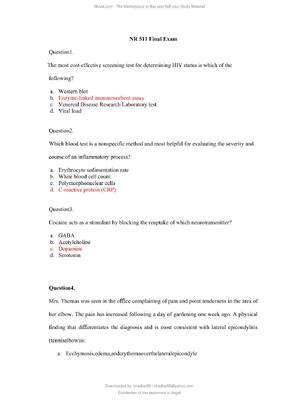
Question 1. The most cost-effective screening test for determining
HIV status is which of the following?
Student Answer: Western blot
Enzyme-linked immunosorbent assay Venereal Disease Research
...
NR 511 Week 8 Exam
Question 1. The most cost-effective screening test for determining
HIV status is which of the following?
Student Answer: Western blot
Enzyme-linked immunosorbent assay Venereal Disease Research Laboratory test Viral load
Points Received: 0 of 2
Comments:
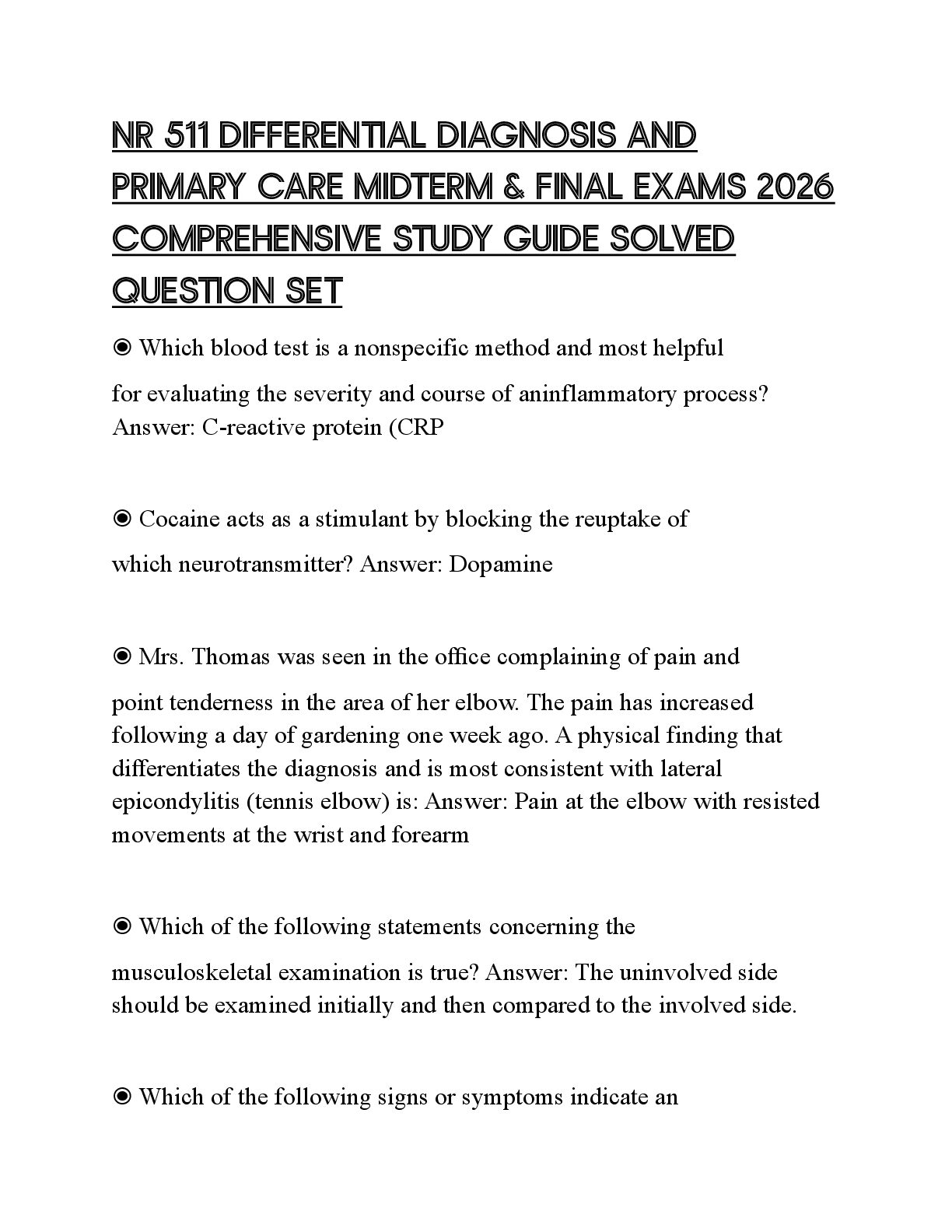
Question 2.Question : Which blood test is a nonspecific method and most helpful
for evaluating the severity and course of an inflammatory process?
Student Answer: Erythrocyte sedimentation rate
White blood cell count Polymorphonuclear cells
C-reactive protein (CRP)
Points Received: 0 of 2
Comments:
Question 3.Question : Cocaine acts as a stimulant by blocking the reuptake of
which neurotransmitter?
Student Answer: GABA Acetylcholine Dopamine Serotonin
Points Received: 0 of 2
Comments:
Question 4.Question : Mrs. Thomas was seen in the office complaining of pain and
point tenderness in the area of her elbow. The pain has increased following a day of gardening one week ago. A physical finding that differentiates the diagnosis and is most consistent with lateral epicondylitis (tennis elbow) is:
Student Answer: Ecchymosis, edema, and erythema over the
lateral epicondyle
Pain at the elbow with resisted movements at the wrist and forearm
Inability to supinate and pronate the arm
Inability to flex or extend the elbow against resistance Points Received: 2 of 2
Comments:
Question 5.Question : Which of the following statements concerning the
musculoskeletal examination is true?
Student Answer: The uninvolved side should be examined initially and then compared to the involved side.
The part of the body that is causing the patient pain should be examined first.
When possible, the patient should not be asked to perform active range-of-motion (ROM) exercises to avoid causing pain.
Radiographs should always be obtained prior to examination so as not to cause further injury to the patient.
Points Received: (not graded)
Comments:
Question 6.Question : Which of the following signs or symptoms indicate an
inflammatory etiology to musculoskeletal pain?
Student Answer: Decreased C-reactive protein
Hyperalbuminemia Morning stiffness Weight gain
Points Received: (not graded)
Comments:
Question 7.Question : Which causes the greatest percentage of mammalian bites?
Student Answer: Dogs Cats
Humans Rodents
Points Received: (not graded)
Comments:
Question 8.Question : A 48-year-old woman is seen in the clinic with complaints of
prolonged heavy menstrual periods. She is pale and states she can no longer exercise. Pelvic exam reveals a single, very large mass. Which of the following diagnostic tests should the clinician order first?
Student Answer: Transvaginal ultrasound
Endometrial biopsy MRI
Abdominal computed tomography scan Points Received: (not graded)
Comments:
Question 9.Question : A diabetic patient asks the clinician why he needs to check
his blood sugar at home even when he feels good. Which of the following responses would be most appropriate?
Student Answer: "Control of glucose will help postpone or delay
complications."
"Regularly checking blood sugar will help establish a routine."
"Monitoring glucose will promote a sense of control." All of the above
Points Received: (not graded)
Comments:
Question 10.Question : A 25-year-old patient presents to the clinic with fatigue, cold
intolerance, weight gain, and constipation for the past 3 months. On physical examination, the clinician notices a sinus bradycardia; muscular stiffness; coarse, dry hair; and a delay in relaxation in deep tendon reflexes. Which of the following tests should be ordered next?
Student Answer: Serum calcium TSH Electrolytes
Urine specific gravity Points Received: (not graded) Comments:
Question 11.Question : Which of the following medications for type 2 diabetes
mellitus should not be prescribed during pregnancy?
Student Answer: Insulin Metformin Glucotrol Precose
Points Received: (not graded)
Comments:
Question 12.Question : During a DRE on a 75-year-old man, the clinician suspects
the patient has prostate cancer. What physical finding should make the clinician suspicious?
Student Answer: An enlarged rubbery gland
A hard irregular gland A tender gland
A boggy gland Points Received: (not graded) Comments:
Question 13.Question : Eddie, age 4, presents to the ED with a live insect trapped in
his ear canal causing a lot of distress. What should be your first step?
Student Answer: Remove the insect with tweezers.
Immobilize the insect with 2% lidocaine. Sedate Eddie with diazepam.
Shine a light in the ear for the insect to "find its way out." Points Received: (not graded)
Comments:
Question 14.Question : What is the most common cause of microcytic anemia?
Student Answer: Anemia of chronic disease
Sideroblastic anemia Iron-deficiency anemia Thalassemia
Points Received: (not graded)
Comments:
Question 15.Question : An 82-year-old man is seen in the primary care office with
complaints of dribbling urine and difficulty starting his stream. Which of the following should be included in the list of differential diagnoses?
Student Answer: Benign prostatic hyperplasia (BPH)
Parkinson's disease Prostate cancer
All of the above Points Received: (not graded) Comments:
Question 16.Question : Early rheumatoid disease is characterized by:
Student Answer: Pain and swelling in both small and large
peripheral joints
Rigid joints with diminished range of motion Joint swelling and immobility on rising
A cardiac rub or pulmonary friction rub Points Received: (not graded)
Comments:
Question 17.Question : A 70-year-old female has fallen 2 weeks ago and developed immediate pain in her left wrist. She thought she just bruised it but is worried because it has not improved. She has used Tylenol® and ice at home, and that has helped slightly. You examine her and find she has moderate swelling and ecchymosis but no overtly obvious deformity.
Her ROM is uncomfortable and severely diminished due to the pain. No crepitus is heard or felt. Her fingers are warm; her pulse is strong; and capillary refill is less than 2 seconds. What should you do?
Student Answer: Make an immediate referral for an orthopedic
evaluation without further assessment.
Tell her that it takes time for these bruises to improve, so she should be patient.
Obtain a wrist x-ray and place her wrist in a splint or
prescribe a splint.
Send her to the emergency room for reduction of this obvious wrist fracture.
Points Received: (not graded)
Comments:
Question 18.Question : The criteria for diagnosing generalized anxiety disorder in
the American Psychiatric Association's Diagnostic and Statistical Manual of Mental Disorders, 5th edition (text revision) state that excessive worry or apprehension must be present more days than not for at least:
Student Answer: 1 month 3
months 6 months
12 months Points Received: (not graded) Comments:
Question 19.Question : A 60-year-old man presents with an enlarged scrotum. The
clinician uses a penlight to transilluminate the scrotum. In a patient with a hydrocele, what would the clinician expect to find?
Student Answer: The scrotum will be dark.
The scrotum will appear light pink or yellow. The scrotum will appear milky white.
The internal structures will be clearly visible.
Points Received: (not graded)
Comments:
Question 20.Question : According to Kübler-Ross, the stages of grief occur in which
order?
Student Answer: Anger, denial, depression, bargaining, acceptance
Anger, denial, bargaining, acceptance, depression Denial, anger, depression, bargaining, acceptance Denial, anger, bargaining, depression, acceptance
Points Received: (not graded)
Comments:
Question 21.Question : Reuben, age 24, has HIV and just had a routine viral load
test done. The results show a falling viral load. What does this indicate?
Student Answer: A favorable prognostic trend
Disease progression
The need to be more aggressive with Reuben's medications
The eradication of the HIV Points Received: (not graded)
Comments:
Question 22.Question : The exanthem of Lyme disease is: Student Answer: Erythema infectiosum
Laterothoracic exanthem Erythema migrans Morbilli exanthem
Points Received: (not graded)
Comments:
Question 23.Question : You have detected the presence of crepitus on examination
of a patient with a musculoskeletal complaint. Additionally, there is limited range of motion (ROM) with both active and passive movement. These findings suggest that the origin of the musculoskeletal complaint is:
Student Answer: Articular Inflammatory Nonarticular A and B
Points Received: (not graded)
Comments:
Question 24.Question : What is the recommended daily calcium intake for adults
over the age of 50 with low bone mass?
Student Answer: 1,200 mg/day 1,000
mg/day 1,300 mg/day
1,500
mg/day Points Received: (not graded) Comments:
Question 25.Question : When assessing a woman for infertility, which of the
following tests should be done first?
Student Answer: Analysis of partner's sperm
Magnetic resonance imaging (MRI) Hysterosalpingogram
Estrogen level Points Received: (not graded) Comments:
Question 26.Question : Which type of burn injury results in destruction of the
epidermis with most of the dermis, yet the epidermal cells lining hair follicles and sweat glands remain intact?
Student Answer: Superficial burns
Superficial partial-thickness burns Deep partial-thickness burns
Full-thickness burns Points Received: (not graded) Comments:
Question 27.Question : A 23-year-old sexually active woman presents for her first
Pap smear. Her history includes nulligravida, age at first intercourse 14, and more than 10 sexual partners. Which of the following conditions should the clinician be particularly alert for during her examination?
Student Answer: Human papillomavirus (HPV)
Endometrial hyperplasia Vagismus
Polycystic ovarian syndrome Points Received: (not graded) Comments:
Question 28.Question : As a rule of thumb, the estimated level of hematocrit is how
many times the value of the hemoglobin?
Student Answer: Two Three Four Five
Points Received: (not graded)
Comments:
Question 29.Question : Sam is a 25-year-old who has been diagnosed with low
back strain based on his history of localized low back pain and muscle spasm along with a normal neurological examination. As the clinician, you explain to Sam that low back pain is a diagnosis of exclusion. Which of the following
symptoms would alert the clinician to the more serious finding of a herniated nucleus pulposus or ruptured disc?
Student Answer: Morning stiffness and limited mobility of the lumbar spine
Unilateral radicular pain symptoms that extend below the knee and are equal to or greater than the back pain
Fever, chills, and elevated erythrocyte sedimentation rate
Pathologic fractures, severe night pain, weight loss, and fatigue
Points Received: (not graded)
Comments:
Question 30.Question : A 30-year-old man is seen with a chief complaint of loss of
libido. Which of the following laboratory tests would help establish a diagnosis?
Student Answer: Testosterone level Prostate-specific antigen
Nocturnal penile tumescence and rigidity Prolactin level
Points Received: (not graded)
Comments:
Question 31.Question : The clinician prescribes glipizide (Glucotrol) for a diabetic
patient. Which statement made by the patient would indicate that your teaching has been effective?
Student Answer: "I'll take my pill at least 30 minutes before breakfast."
"I'll take my Glucotrol before bedtime."
"It is important to take my medication right after I eat." "Since I only like to eat two meals a day, I can take the pill
between my meals." Points Received: (not graded)
Comments:
Question 32.Question : In the United States, what is the second most common
connective tissue disease and the most destructive to the joints?
Student Answer: Osteoarthritis
Systemic lupus erythematosus (SLE) Rheumatoid arthritis Sjögren's
syndrome Points Received: (not graded) Comments:
Question 33.Question : The effectiveness of benzodiazepines in treating anxiety
disorders suggests that which of the following neurotransmitters plays a role in anxiety?
Student Answer: Acetylcholine
Gamma-aminobutyric acid (GABA) Dopamine
Serotonin Points Received: (not graded) Comments:
Question 34.Question : A 14-year-old male is seen with complaints of severe
testicular pain. The clinician suspects testicular torsion. Which of the following is the appropriate action?
Student Answer: Refer to a urologist immediately.
Obtain a computed tomography (CT) scan. Instruct the patient to elevate the scrotum. Prescribe ibuprofen.
Points Received: (not graded)
Comments:
Question 35.Question : Which of the following medications can cause
hyperglycemia?
Student Answer: Prednisone Metformin Synthroid Cephalexin
Points Received: (not graded)
Comments:
Question 36.Question : During treatment for anaphylaxis, what site is used for
the initial injection of epinephrine?
Student Answer: IV
Abdomen
Upper lateral thigh Deltoid
Points Received: (not graded)
Comments:
Question 37.Question : It is important to educate patients with depression and their
family members about reporting signs of increasing depression and suicidal thoughts. This is especially true
during which time period?
Student Answer: Before the initiation of treatment
1 to 2 weeks after the initiation of treatment When switching to a different medication
1 to 2 weeks after tapering off medications
Points Received: (not graded)
Comments:
Question 38.Question : What is the most common cause of secondary amenorrhea?
Student Answer: Pregnancy
Pituitary dysfunction Inadequate estrogen levels Genetic disorders
Points Received: (not graded)
Comments:
Question 39.Question : Which of the following is the only drug for bulimia approved
by the U.S. Food and Drug Administration?
Student Answer: Sertraline Fluoxetine Citoprolam Imipramine
Points Received: (not graded)
Comments:
Question 40.Question : The goals of the 15-minute hour approach include: Student Answer: Enhance self-esteem, expand behavioral repertoire,
prevent dire consequences, and reestablish premorbid
levels of functioning
Emerge with a higher level of functioning and commitment to long-term psychotherapy Accept need for antidepressant therapy and
psychiatric referral; share concerns with primary care clinician
Improve family functioning and sexual performance as well as accept need for antidepressant medication
Points Received: (not graded)
Comments:
Question 41.Question : John is a 16-year-old boy who presents to the emergency
room after hurting his knee in a football game. He described twisting his knee and then being unable to extend it
completely. John tells the clinician that he heard a pop when the injury occurred and has been experiencing localized pain. The clinician suspects a meniscal tear. Which test would be most appropriate to assess for the presence of a meniscal tear?
Student Answer: Valgus stress test
McMurray circumduction test Lachman test
Varus stress test Points Received:(not graded) Comments:
Question 42.Question : The cardinal subjective symptom of sickle cell crisis is which of the following?
Student Answer: Pain Nausea
Light-headedness Palpitations
Points Received: (not graded)
Comments:
Question 43.Question : A 25-year-old woman is seen in the clinic complaining of
painful menstruation. Which of the following pelvic pathologies is the most common cause of dysmenorrhea?
Student Answer: Pelvic inflammatory disease
Endometriosis
Sexually transmitted infections Ovarian cyst
Points Received: (not graded)
Comments:
Question 44.Question : Which arthropod bite can contain cytotoxic and hemolytic toxins that may destroy tissue?
Student Answer: Tick
Brown recluse spider Wasp
Stinging caterpillar Points Received: (not graded) Comments:
Question 45.Question : Janet is a 30-year-old who has recently been diagnosed with
a herniated disc at the level of L5-S1. She is currently in the emergency room with suspicion of cauda equina compression. Which of the following is a sign or symptom of cauda equina compression?
Student Answer: Gastrocnemius weakness
A reduced or absent ankle reflex Numbness in the lateral foot
Paresthesia of the perineum and buttocks Points Received: (not graded) Comments:
Question 46.Question : A 21-year-old woman is seen in the clinic requesting birth
control pills. Which of the following tests is essential before prescribing any oral contraceptive?
Student Answer: Pregnancy test
Complete blood cell count Thyroid-stimulating hormone Urine dip for protein
Points Received: (not graded)
Comments:
Question 47.Question : A patient with type 2 diabetes comes to the clinic after
reading about metformin in a magazine. Which of the following conditions that the patient also has would be a contraindication to taking metformin?
Student Answer: Ketoacidosis Cirrhosis
Hypoglycemic episodes All of the above
Points Received: (not graded)
Comments:
Question 48.Question : The clinician has chosen to prescribe an SSRI instead of a
tricyclic antidepressant (TCA) for a patient fitting the diagnostic criteria for depression. Which of the following is not true concerning SSRIs in comparison to tricyclic antidepressants?
Student Answer: SSRIs are more effective than TCAs.
SSRIs take less time to work than TCAs.
SSRIs have a more favorable side-effect profile than TCAs.
SSRIs are not lethal in overdose.
Points Received: (not graded)
Comments:
Question 49.Question : Which type of bone marrow transplant is obtained from an
identical twin?
Student Answer: Autogenic Autologous Allogeneic Syngeneic
Points Received: (not graded)
Comments:
Question 50.Question : Pink, cherry red tissues and skin may result from which type
of poisoning?
Student Answer: Arsenic Lead
Carbon monoxide Strychnine
Points Received: (not graded)
Comments:
Question 51.Question : Basic human needs are identified as: Student Answer: Autonomy and feeling valued by others
Exhilaration and productivity Spirituality
Career success and material rewards Points Received: (not graded)
Comments:
Question 52.Question : The clinician sees a patient who is 5 feet tall and weighs 150
pounds. How would the clinician classify this patient?
Student Answer: Overweight Mild obesity
Moderate obesity Morbid obesity
Points Received: (not graded)
Comments:
Question 53.Question : A 22-year-old male is seen in the clinic because he found a
hard lump in his testicle when performing testicular self-
examination (TSE). Which of the following should be included in the list of differential diagnoses?
Student Answer: Testicular cancer Inguinal hernia Varicocele
All of the above Points Received: (not graded) Comments:
Question 54.Question : What is the treatment of choice for a patient diagnosed with
testicular cancer?
Student Answer: Radical orchidectomy
Lumpectomy Radiation implants All of the above
Points Received: (not graded)
Comments:
Question 55.Question : Which method is used to remove heavy metals, such as
lead, that are ingested as poisons?
Student Answer: Chelation Dialysis Gastric lavage Bowel
irrigation Points Received: (not graded) Comments:
Question 56.Question : A 58-year-old woman presents with a breast mass. Which of
the following responses by the clinician would be most appropriate?
Student Answer: "It is probably just a cyst because that is the most
common breast mass."
"We will order a mammogram and ultrasound to help establish a diagnosis."
"We will go ahead and schedule you for a biopsy because that is the only way to know for sure."
"Because your lump is painful, it is most likely not cancer."
Points Received: (not graded)
Comments:
Question 57.Question : A 36-year-old woman is seen with complaints of vaginal
itching, burning, and discharge. On potassium hydroxide (KOH) wet mount of vaginal discharge, the clinician notices hyphae. Which of the following treatments would be appropriate?
Student Answer: Fluconazole
Estrogen vaginal cream Metronidazole Doxycycline
Points Received: (not graded)
Comments:
Question 58.Question : The clinician has instructed Sam, a 25-year-old patient with
low back strain, to use NSAIDs to manage his symptoms of pain and discomfort. Which of the following statements would be most appropriate when teaching Sam about the use of NSAIDs?
Student Answer: "You should start with the lowest dose that is effective in managing your pain, because long-term use of NSAIDs can result in gastrointestinal (GI) disorders such as ulcers and hemorrhage."
"You should start with the lowest dose that is effective in managing your pain to avoid developing tolerance to the medication."
"You should take the maximum recommended dose of NSAIDs so that you will not need to take narcotics to control your pain."
"It is important to take NSAIDs on an empty stomach in order to increase absorption."
Points Received: (not graded)
Comments:
Question 59.Question : A history of overuse or excessive force, as opposed to a fall,
hyperextension, or the twisting of a joint, is more likely related to which musculoskeletal injury?
Student Answer: A sprain A strain
A partial fracture A fracture
Points Received: (not graded)
Comments:
Question 60.Question : Which type of heat-related illness involves a core body
temperature of at least 104.9°F, acute mental status
changes, absent sweat, and tachypnea?
Student Answer: Heat cramps Heat syncope
Heat exhaustion Heat stroke
Points Received: (not graded)
Comments:
Question 61.Question : Which of the following may be used to evaluate a person's
suicide risk?
Student Answer: CAGE SANE
SAD PERSONAS DIGFAST
Points Received: (not graded)
Comments:
Question 62.Question : One of the initial steps in assessing patients with
musculoskeletal complaints is to determine whether the complaint is articular or nonarticular in origin. Which of the following is an example of an articular structure?
Student Answer: Bone
Synovium Tendons Fascia
Points Received: (not graded)
Comments:
Question 63.Question : After returning from visiting his grandchildren in England,
George, age 59, complains of a flulike illness, including fever, chills, and myalgia. He reports having discovered a rash or red spot that grew in size on his right leg.
What disease are you considering?
Student Answer: A viral syndrome Lyme disease
Rocky Mountain spotted fever Relapsing fever
Points Received: (not graded)
Comments:
Question 64.Question : A patient is diagnosed with hypothyroidism. Which of the
following electrocardiogram changes should the clinician expect as a manifestation of the disease?
Student Answer: Sinus bradycardia Atrial fibrillation
Supraventricular tachycardia U waves
Points Received: (not graded)
Comments:
Question 65.Question : Which of the following tests is essential for a 46-year-old
woman who the clinician suspects is perimenopausal?
Student Answer: Pregnancy Estrogen level Progesterone level LH level
Points Received: (not graded)
Comments:
Question 66.Question : After 6 months of Synthroid therapy, the clinician should
expect which of the following in the repeat thyroid studies?
Student Answer: Elevated TSH Normal TSH Low TSH
Undetectable TSH Points Received: (not graded) Comments:
Question 67.Question : A patient is 66 inches in height, weighing 200 pounds, and
newly diagnosed with type 2 diabetes mellitus (DM). Her fasting plasma glucose level is 215 mg/dL. What is the best initial treatment?
Student Answer: No treatment at this time
Diet and exercise for 6-week trial Diet, exercise, and oral medication Diet, exercise, and exogenous insulin
Points Received: (not graded)
Comments:
Question 68.Question : Which of the following should be considered in a patient
presenting with erectile dysfunction?
Student Answer: Diabetes mellitus
Hypertension Atherosclerosis All of the above
Points Received: (not graded)
Comments:
Question 69.Question : Mrs. Anderson is a 35-year-old woman who has been
recently diagnosed with carpal tunnel syndrome. She has two young children and asks the clinician what the chances are that they also will develop carpal tunnel syndrome.
Which of the following responses would be correct regarding the risk of developing carpal tunnel syndrome?
Student Answer: Carpal tunnel syndrome commonly occurs in families.
Genetic factors are thought to account for about one- half the risk of developing carpal tunnel.
Only people with occupations that require repeated flexion extension of the wrist, use of hand tools that require forceful gripping, or use of hand tools that vibrate are at risk for developing carpal tunnel.
An underlying musculoskeletal disorder must be present for a person to develop carpal tunnel.
Carpal tunnel syndrome only occurs in the presence of a hormonal imbalance.
Points Received: (not graded)
Comments:
Question 70.Question : A 20-year-old woman is seen in the clinic because her
boyfriend was found to have gonorrhea. Which of the following is the treatment of choice for gonorrhea?
Student Answer: Ceftriaxone Doxycycline Acyclovir Metronidazole
Points Received: (not graded)
Comments:
Question 71.Question : Which of the following statements is true regarding the
treatment of carpal tunnel syndrome?
Student Answer: The goal of treatment is to prevent flexion and
extension movements of the wrist.
Splints are used in carpal tunnel syndrome, because they allow for free movement of the fingers and thumb while
maintaining the wrist in a neutral position.
Corticosteroid injections are discouraged in the treatment of carpal tunnel syndrome because of the risks for median nerve damage, scarring, and infection.
All of the above Points Received: (not graded) Comments:
Question 72.Question : Mr. S presents in the clinic with pain, tenderness, erythema,
and swelling of his left great toe. The clinician suspects acute gout. Which of the following should the clinician expect in the initial test results for this patient?
Student Answer: Elevated uric acid level
Elevated blood urea nitrogen Decreased urine pH Decreased C-reactive protein
Points Received: (not graded)
Comments:
Question 73.Question : Which of the following data is indicative of testicular torsion?
Student Answer: Absent cremasteric reflex
Pain relieved on testicular elevation Testicle very low in the scrotum Swollen scrotum with "red dot sign"
Points Received: (not graded)
Comments:
Question 74.Question : A patient with type 2 diabetes asks the clinician why she
needs to exercise. In order to answer her, the clinician must understand that exercise has what effect on the patient with type 2 diabetes?
Student Answer: Reduces postprandial blood glucose
Reduces triglycerides and increases high- density lipoprotein (HDL)
Reduces total cholesterol
All of the above Points Received: (not graded) Comments:
Question 75.Question : A 26-year-old woman is seen with complaints of irregular
vaginal bleeding. Which of the following tests should be the
first priority?
Student Answer: Pregnancy test Pelvic ultrasound Endometrial biopsy Platelet count
Points Received: (not graded)
Comments:
Question 76.Question : What is the most common cause of generalized
musculoskeletal pain in women ages 20 to 55?
Student Answer: Chronic fatigue syndrome
(CFS) Anemia
Fibromyalgia syndrome (FMS) Sports-related injuries
Points Received: (not graded)
Comments:
Question 77.Question : If the international normalized ratio (INR) result is above the
therapeutic range in a patient with atrial fibrillation on warfarin, what might the clinician do?
Student Answer: Stop the warfarin for 1 week, and then repeat the INR.
Withhold one or more days of anticoagulant therapy. Restart therapy at a lower dose immediately.
The prothrombin time and INR should be reevaluated within 1 month of the dosage adjustments.
Points Received: (not graded)
Comments:
Question 78.Question : A 32-year-old woman is seen in the clinic because she has
been unable to get pregnant after 12 months of unprotected sex. In order to determine the cause of the infertility, the clinician should question her about which of these possible causes?
Student Answer: Pelvic inflammatory disease
Oral contraceptive use for 15 years Early menarche
Diet high in soy protein Points Received: (not graded) Comments:
Question 79.Question : Which of the following statements concerning the treatment
of fibromyalgia syndrome is true?
Student Answer: There is currently no cure for the disorder;
however, patients should be made aware that symptom relief is possible.
Treatment is directed toward controlling discomfort, improving sleep, and maintaining function.
Fibromyalgia syndrome can be difficult to manage, requiring a variety of approaches and multiple medications. All of the above
Points Received: (not graded)
Comments:
Question 80.Question : The clinician should prescribe an antibiotic that covers
which of these organisms for a patient with acute prostatitis?
Student Answer: Gram-positive cocci
Gram-negative cocci Gram-positive bacillus Gram-negative bacillus
Points Received: (not graded)
Comments:
Question 81.Question : Which household solution should be used to clean a
bathroom if sharing with a friend who has HIV?
Student Answer: 100% bleach
50% bleach and 50% vinegar Nine parts H2O to one part bleach
The friend must have his or her own bathroom.
Points Received: (not graded)
Comments:
Question 82.Question : Sandra is 42 years old and has just been diagnosed with
leukemia. She is complaining of bone and joint pain. Which type of leukemia is most likely the culprit?
Student Answer: Acute lymphocytic leukemia
Acute myelogenous leukemia Chronic myelogenous leukemia Chronic lymphocytic leukemia
Points Received: (not graded)
Comments:
Question 83.Question : Which of the following is identified as an eating disorder in
which a person craves food substitutes, such as clay, ice chips, and cotton, and is considered an objective finding associated with severe iron deficiency?
Student Answer: Ferritin
Porter's syndrome Hypochromasia Pica
Points Received: (not graded)
Comments:
Question 84.Question : The clinician suspects that a client seen in the office has
hyperthyroidism. Which of the following tests should the clinician order on the initial visit?
Student Answer: High sensitivity thyroid-stimulating hormone (TSH) and free T4
Free T4 and serum calcium Free T3 and T4
TSH and thyroxin antibodies Points Received: (not graded) Comments:
Question 85.Question : The clinician has been doing diabetic teaching for a patient
with type 1 diabetes. Which of the following statements by the patient would indicate that teaching has been effective?
Student Answer: "As long as I don't need glasses, I don't have to
worry about going blind."
"I know I need to have my eyes checked every year." "My optometrist checks my eyes."
"I will see my eye doctor when my vision gets blurry." Points Received: (not graded)
Comments:
Question 86.Question : Triggering factors for acute exacerbations of which of the
following conditions include exposure to ultraviolet (UV)- B and UV-A rays?
Student Answer: Rheumatoid arthritis
Scleroderma SLE
Sjögren's syndrome Points Received: (not graded) Comments:
Question 87.Question : Which of the following characteristics separates anaphylaxis
from a vasovagal reaction?
Student Answer: Bradycardia
Extreme diaphoresis
Severe bronchoconstriction Hypotension
Points Received: (not graded)
Comments:
Question 88.Question : Mr. Jackson is a 65-year-old man recently diagnosed with
osteoarthritis. The clinician has explained to Mr. Jackson that the goals for managing osteoarthritis include controlling pain, maximizing functional independence and mobility, minimizing disability, and preserving quality of life. Mr.
Jackson explains to the clinician that his first choice would be to use complementary therapies to control his condition and asks what therapies are most effective in treating osteoarthritis. What would be the most appropriate response from the clinician?
Student Answer: "Complementary therapies should be considered only if surgical interventions are not successful."
"I am unfamiliar with the available complementary therapies for osteoarthritis and prefer to discuss more mainstream treatments, such as NSAIDs and physical therapy, to manage your condition."
"I would be happy to discuss all the treatment options available to you. Complementary therapies, such as acupuncture, acupressure, and tai-chi, are being studied for use in the treatment of osteoarthritis and have shown promise when used with standard medical therapy."
"It would be crazy to use complementary therapies to treat such a serious condition."
Points Received: (not graded)
Comments:
Question 89.Question : One benefit of motivational interviewing (MI) is:
Student Answer: It assumes that ambivalence is a normal part of
the change process.
It can be utilized during routine office visits.
It is a therapeutic technique which is not necessarily time intensive.
All are benefits of MI. Points Received: (not graded)
Comments:
Question 90.Question : What percentage of burns is involved using the rule of nines if both front legs are burned?
Student Answer: 9%
18%
24%
36%
Points Received: (not graded)
Comments:
Question 91.Question : Women are at the highest risk for developing postpartum
depression for up to how long after childbirth?
Student Answer: 2
weeks 1 month
3 months
6 months Points Received: (not graded) Comments:
Question 92.Question : Which statement about HIV postexposure prophylaxis (PEP)
for health-care workers is the most accurate?
Student Answer: PEP should be started within hours of exposure.
PEP should be started within 72 hours of exposure.
Renal and hepatic function tests should be done 6 weeks after beginning PEP.
PEP will prevent potential hepatitis C infection if present.
Points Received: (not graded)
Comments:
Question 93.Question : The clinician is caring for Diane, a 22-year-old woman who
presents with an injured ankle. Diane asks the clinician if she will need an x-ray. The clinician explains to Diane that an x- ray is not always necessary for an injured ankle and that the decision to obtain radiographs is dependent on the examination and Diane's description of her injury. Which of the following clues in Diane's examination or history would alert the clinician to the need for obtaining radiographs?
Student Answer: Inability to bear weight immediately after the injury
Development of marked ankle swelling and discoloration
after the injury
Crepitation with palpation or movement of the ankle
All of the above Points Received: (not graded) Comments:
Question 94.Question : A vegetarian patient with gout asks the clinician about food
he should avoid. The clinician should advise the patient to avoid which of the following foods?
Student Answer: Rice Carrots
Spinach Potatoes
Points Received: (not graded)
Comments:
Question 95.Question : A patient with a basilar skull fracture may experience an
impaired downward gaze or diplopia from which affected cranial nerve?
Student Answer: CN II CN III CN IV CN V
Points Received: (not graded)
Comments:
Question 96.Question : A patient presents to the clinician after experiencing four
episodes in the last month of sweating, palpitations, chest pain, nausea, and shaking. Each episode lasted about 10 minutes. The patient is now becoming very fearful of future events and has been reluctant to leave the house. The clinician suspects panic disorder but wants to rule out any possible medical causes. Which of the following medical conditions can mimic the symptoms of a panic attack?
Student Answer: Pheochromocytoma
Hyperthyroidism
Cardiac arrhythmias All of the above
Points Received: (not graded)
Comments:
Question 97.Question : Which test is used to confirm a diagnosis of epididymitis?
Student Answer: Urinalysis
Gram stain of urethral discharge
Complete blood cell count with differential Ultrasound of the scrotum
Points Received: (not graded)
Comments:
Question 98.Question : BATHEing the patient refers to:
Student Answer: A technique used in primary care to get the patient to accept the need for psychological or psychiatric referral
A technique used to facilitate cultural understanding
A technique used to perform psychotherapy
A technique that is a quick screen for psychiatric issues and interventions for psychological problems
Points Received: (not graded)
Comments:
Question 99.Question : BATHEing the patient is an advanced practice nursing
intervention that allows the practitioner to:
Student Answer: Develop a therapeutic relationship without "owning" the patient's problem
Conduct psychological counseling within the context of the primary care encounter
Focus on the "process" and not the assessment Make the patient and family happier
Points Received: (not graded)
Comments:
Question 100.Question : A 45-year-old woman is seen in the clinic with abnormal
uterine bleeding and pain during intercourse. The clinician should consider which of the following diagnoses?
Student Answer: Leiomyoma Pregnancy Ovarian cancer All of the above
Points Received: (not graded)
Comments:
* Times are displayed in (GMT-07:00) Mountain Time (US & Canada)
[Show More]








.png)