Biology > Lab Report > BIOLOGY 111Unicellular Organisims(answers in red) (All)
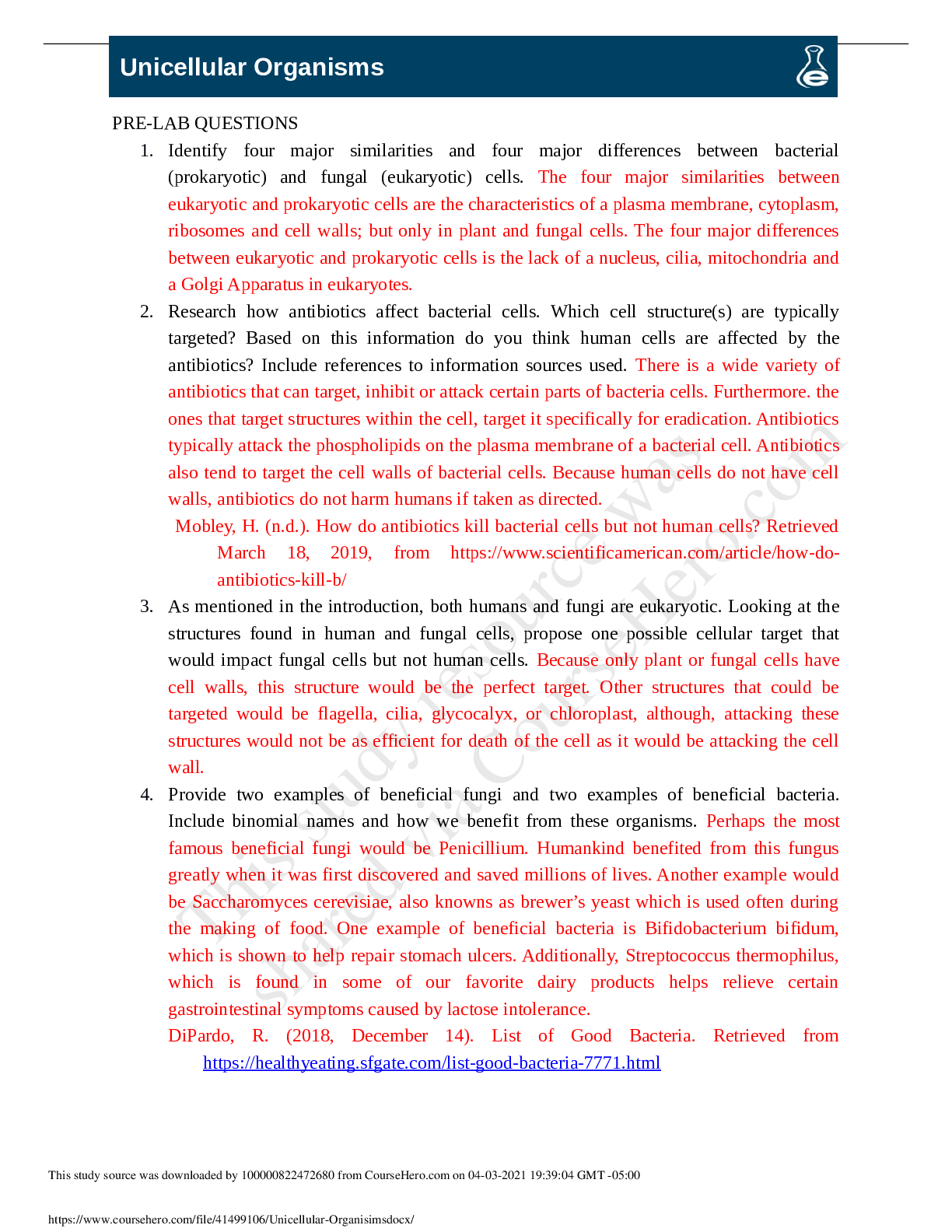
BIOLOGY 111Unicellular Organisims(answers in red)
Document Content and Description Below
Last updated: 4 years ago
Preview 1 out of 9 pages
Instant download
Buy this Document to get the Full Access Instantly
Provided by Students Who Aced it
We Verify Document Content to Gurantee Accuracy
Reviews( 0 )
Document information
Connected school, study & course
About the document
Uploaded On
Apr 04, 2021
Number of pages
9
Written in
All

Additional information
This document has been written for:
Uploaded
Apr 04, 2021
Downloads
0
Views
122
Topic Tags
Recommended For You
Get more on Lab Report »
Test Bank for Biology The Core 3rd Edition By Eric Simon (All...

Test Bank for Biology (2024 Release) By Sylvia Mader, Michael...
Test Bank for Biofluid Mechanics An Introduction to Fluid Mech...
Test Bank for Biological Anthropology Concepts and Connections...
Test Bank for Biological Psychology 14th Edition By James Kala...
Test Bank for Biological Science 5th Edition By Scott Freeman...
Test Bank for Biological Science 6th Edition By Scott Freeman...
Test Bank for Biological Science 2nd Canadian Edition By Scott...
Test Bank for Biological Science 3rd Canadian Edition By Scott...
Test Bank for Biology 4th Edition By Robert Brooker Eric Widma...
Test Bank for Biology 5th Edition By Robert Brooker, Eric Widm...
Test Bank for Biology 11th Edition By Peter Raven, George John...
Solutions Manual for Biology Concepts and Applications without...
Test Bank for Biology Concepts and Applications 10th Edition B...
Test Bank for Biology Concepts and Investigations 2nd Edition...
Test Bank for Biology 3rd Edition By Robert Brooker Eric Widma...
Test Bank for Biology 8th Edition By Eldra Solomon Linda Berg...
Test Bank for Biology 10th Edition By Raven Johnson Kenneth Jo...
Solutions Manual for Biology 10th Edition By Raven Johnson Ken...
.png)