Fundamentals ATI Final Exam
Trust vs. Mistrust
- Infancy (0-1)
A sense of trust requires a feeling of physical comfort & minimal amount of fear about the future. Infant's basic needs are met by responsive, sensitiv
...
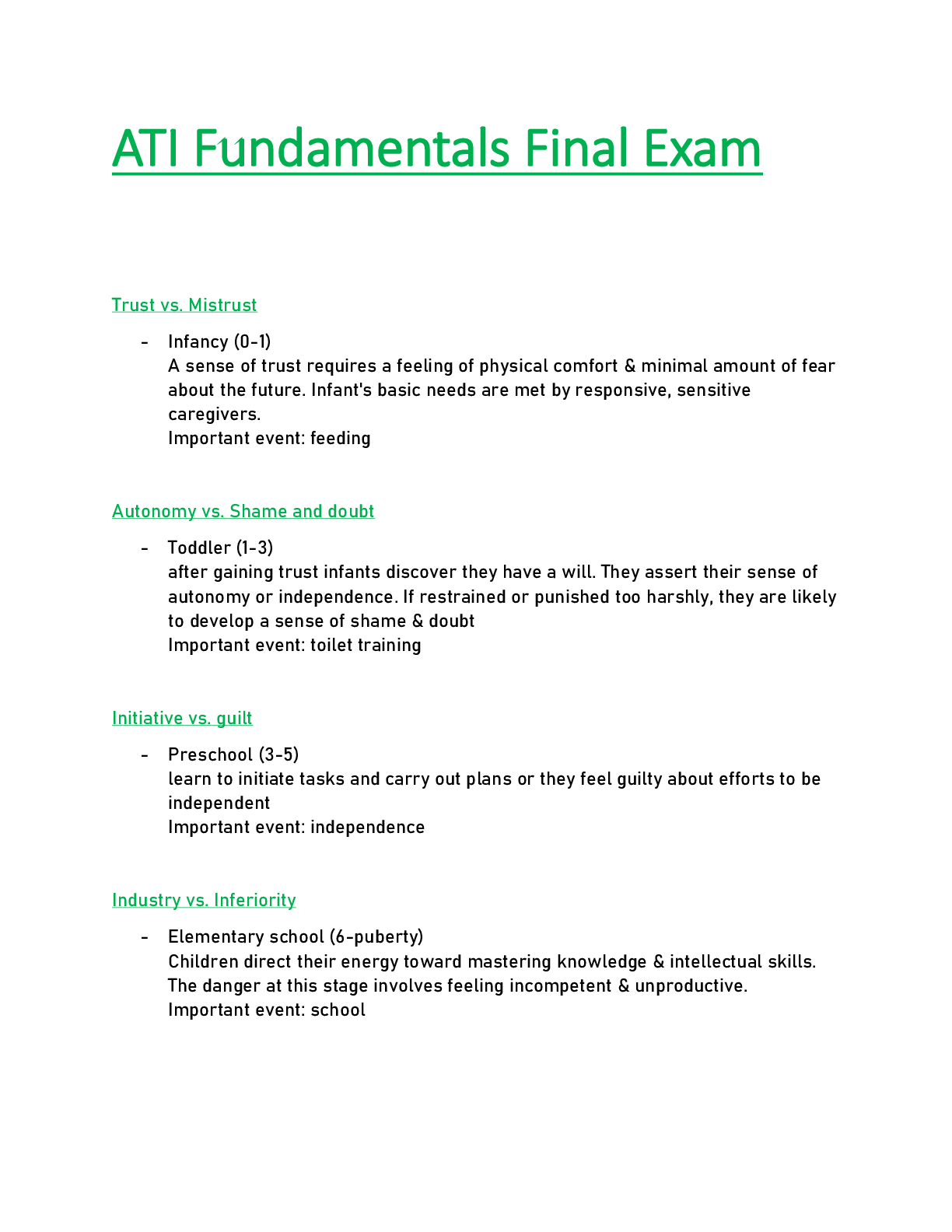
Fundamentals ATI Final Exam
Trust vs. Mistrust
- Infancy (0-1)
A sense of trust requires a feeling of physical comfort & minimal amount of fear about the future. Infant's basic needs are met by responsive, sensitive caregivers.
Important event: feeding
Autonomy vs. Shame and doubt
- Toddler (1-3)
after gaining trust infants discover they have a will. They assert their sense of autonomy or independence. If restrained or punished too harshly, they are likely to develop a sense of shame & doubt
Important event: toilet training
Initiative vs. guilt
- Preschool (3-5)
learn to initiate tasks and carry out plans or they feel guilty about efforts to be independent
Important event: independence
Industry vs. Inferiority
- Elementary school (6-puberty)
Children direct their energy toward mastering knowledge & intellectual skills. The danger at this stage involves feeling incompetent & unproductive.
Important event: school
Identity vs. Role confusion
- Adolescence (teens-20s)
Teenagers work at refining a sense of self by testing roles and then integrating them in form a single identity or become confused about who they are
Important event: peer relationships
Intimacy vs. Isolation
- Young adulthood (20s-early 40s)
Young adults struggle to from close relationships and to gain the capacity for intimate love, or they feel socially isolated
Important event: love relationships
Generatively vs. Stagnation
- Middle adulthood (40s-60s)
The middle-aged discover a sense of contributing to the world usually through family and work, or they feel a lack of purpose
Important event: parenthood
Integrity vs. despair
- Late adulthood (late 60s and up)
When reflecting on his or her life the older adult may feel a sense of satisfaction or failure
Important event: reflection on/acceptance of one’s life
A nurse is evaluating teaching on a client who has a new RX for a sequential compression device. Which of the following client statements should indicate the client understands?
A. "This device will keep me from getting sores on my skin."
B. "This thing will keep the blood pumping through my leg."
C. "With this thing on, my leg muscles wont get weak."
D. "This device is going to keep my joints in good shape."
A nurse is instructing a client who has an injury to the left lower extremity about the use of a cane. Which of the following instructions should the nurse include? (SATA)
A. hold cane to right side
B. keep 2 points of support on floor
C. place cane 38 cm(15in) in front of feet before advancing
D. after advancing care, more weaker leg forward
E. advance stronger leg so that it aligns with the cane
A nurse in a provider's office is preparing to assess a young adult male client's musculoskeletal system as part of a comprehensive physical examination. Which of the following findings should the nurse expect? (SATA)
A. Concave thoracic spine posteriorly
B. Exaggerated lumbar curvature
C. Concave lumbar spine posteriorly
D. Exaggerated thoracic curvature
E. Muscles slightly larger on his dominant side
A nurse is assessing a client's neurosensory system. To evaluate stereognosis, she should ask the client to close his eyes and identify which of the following items?
A. A word she whispers 30 cm from his ear
B. A number she traces on the palm of his hand
C. The vibration of a tuning fork she places on his foot
D. A familiar object she places in his hand
A nurse is caring for a client who reports pain with internal rotation of her right shoulder. The nurse should identify that this discomfort can affect the clients ability to perform which of the following activities?
A. Mopping her floors
B. Brushing the back of her hair
C. Fastening her bra being her back
D. Reaching into a cabinet above her sink
A nurse is performing a neurosensory examination for a client. Which of the following assessments should the nurse perform to test the client's balance? (SATA)
A. Romberg test
B. Heel-to-toe walk
C. Snellen test
D. Spinal accessory function
E. Rosenbaum test
A nurse is collecting data from an older adult client as part of a neurosensory examination. Which of the following findings should the nurse expect as changes associated with aging? (SATA)
A. Slower light touch sensation
B. Some vision and hearing decline
C. Slower fine finger movement
D. Some short-term memory decline
E. Slower superficial pain sensation
When entering a client's room to change a surgical dressing, a nurse notes that the client is coughing and sneezing. Which of the following actions should the nurse take when preparing the sterile field?
A. keep the sterile field at least 6 ft away from the client's bedside.
B. instruct the client to refrain from coughing and sneezing during the dressing change.
C. place a mask on the client to limit the spread of micro-organisms into the surgical wound.
D. keep a box of facial tissues nearby for the client to use during the dressing change.
[Show More]










.png)
.png)