ATI Mental Health Final Quiz (aka Quiz 3)
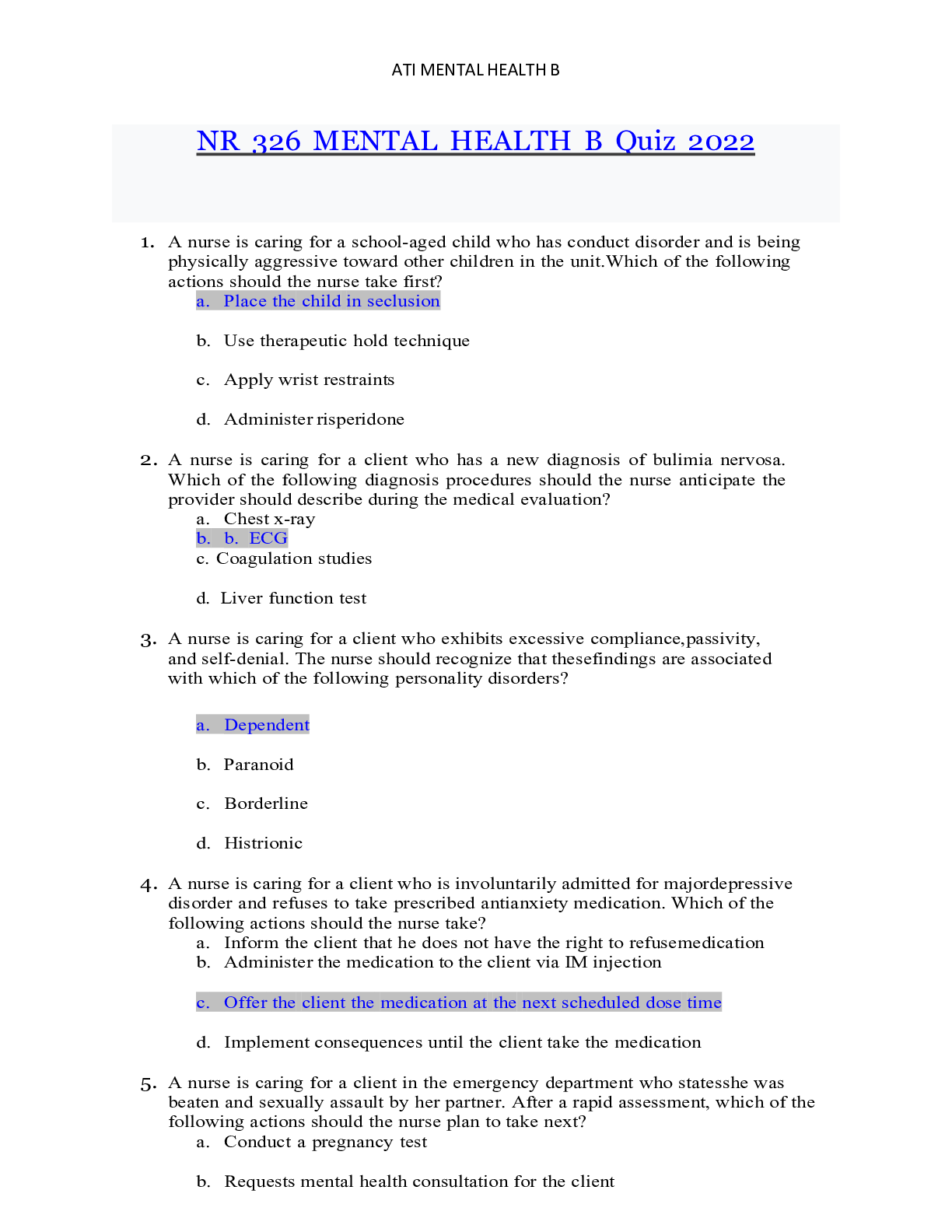
1. A nurse is planning care for a client who has borderline personality disorder who self-mutilates. Which
of the following test approaches should the nurse plan to take?
a. R
...
ATI Mental Health Final Quiz (aka Quiz 3)
1. A nurse is planning care for a client who has borderline personality disorder who self-mutilates. Which
of the following test approaches should the nurse plan to take?
a. Restrict participation in group therapy sessions.
The nurse should encourage the client who has borderline personality disorder to participate in
group therapy sessions to encourage appropriate interaction with other clients.
b. Establish consequences for self-mutilation.
The nurse should respond to self-mutilation with a neutral affect and encourage the client to write
down feelings that occurred leading up to the incident.
c. Maintain close observation of the client.
Clients who have borderline personality disorder are at risk for self-harm during times
of increased anxiety. Maintaining close observation reduces the client's risk of injury.
d. Provide an unstructured environment.
Providing an unstructured environment for a client who has borderline personality disorder is not
an effective treatment approach because it does not provide a safe environment to protect the
client from impulsive and self-injurious behavior.
2. A nurse is assessing a client who has Stage 4 Alzheimer's disease. Which of the following findings
should the nurse expect?
a. The client requires assistance with eating.
The nurse should expect the client who has Stage 4 Alzheimer’s disease to still have the ability to
eat without assistance. Clients who have Alzheimer’s disease maintain this ability until Stage 7.
b. The client independently manages personal finances.
The nurse should expect the client who has Stage 4 Alzheimer’s disease to have difficulty
performing complex tasks, such as managing personal finances.
c. The client has bladder incontinence.
The nurse should expect the client who has Stage 4 Alzheimer’s disease to be able to use the
toilet independently. Clients who have Alzheimer’s disease maintain continence until Stage 6.
d. The client is able to identify the names of family members.
The nurse should expect the client who has Stage 4 Alzheimer’s disease to recognize and
identify family members. Clients who have Alzheimer’s disease maintain this ability until Stage 6.
3. A nurse is caring for a client who reports that the television set in the room is really a two-way radio and
states, "voices are coming from the TV and everything we say in the room is being recorded." Which of
the following responses should the nurse make?
a. "What we say is not being recorded."
The nurse should avoid negating the client’s beliefs about the delusion. This response can
promote a defensive client response and interfere with the development of trust in the nurse-client
relationship.
b. "Let's ignore the voices and talk about something else."
The nurse should ask the client directly about what the voices are saying to determine if there is a
safety risk. The nurse should also avoid validating that the voices are real, which promotes the
client’s beliefs about the delusion.
c. "That must be very frightening."
The nurse should respond to the client’s delusion in a calm and empathetic manner. By
acknowledging to the client that the delusion must be frightening, the nurse promotes the nurseclient relationship.
d. "Why do you think the TV is a two-way radio?"
The nurse should avoid asking the client a "why" question, which promotes a defensive client
response.
4. A nurse is planning care for a newly admitted client who has bipolar disorder and is experiencing acute
mania. Which of the following client goals should the nurse identify as the priority?
a. Practicing problem-solving skills
The nurse should encourage the client to practice problem-solving skills during the continuation
phase of treatment; however, there is another intervention that is the priority during the acute
phase of bipolar disorder.
b. Understanding of medication regimen
The nurse should ensure that the client understands the medication regimen during the
continuation phase of treatment; however, there is another intervention that is the priority during
the acute phase of bipolar disorder.
c. Identifying indications of relapse
The nurse should teach the client to recognize indications of relapse during the continuation
phase of treatment; however, there is another intervention that is the priority during the acute
phase of bipolar disorder.
d. Maintaining adequate hydration
The nurse should identify that the priority goal is to prevent physical exhaustion, maintain
health, and meet nutritional and rest needs during the acute phase of the client’s manic episode.
The nurse should consider Maslow’s hierarchy of needs, which includes five levels of priority
when planning care for this client. The first level consists of physiological needs; the second level
consists of safety and security needs; the third level consists of love and belonging needs; the
fourth level consists of personal achievement and self-esteem needs; and the fifth level consists
of achieving full potential and the ability to problem solve and cope with life situations. When
applying Maslow’s hierarchy of needs priority-setting framework the nurse should review
physiological needs first. The nurse should then address the client’s needs by following the
remaining four hierarchical levels. It is important, however, for the nurse to consider all
contributing client factors, as higher levels of the pyramid can compete with those at the lower
levels, depending on the specific client situation. The fourth level of Maslow’s hierarchy of needs
includes usefulness, self-worth, and self-confidence in fulfilling self-esteem needs.
5. A nurse is preparing to administer benzodiazepine to a client with Generalized Anxiety Disorder. The
nurse should tell the client to expect with of the following adverse reactions?
a. Tinnitus
Tinnitus is not an adverse effect of benzodiazepines.
b. Bradycardia
Tachycardia, rather than bradycardia, is a potential adverse effect of benzodiazepines.
c. Halitosis
Halitosis is not an adverse effect of benzodiazepines.
d. Sedation
The nurse should tell the client to expect sedation as an adverse effect of benzodiazepines
because of the CNS depression effects.
6. A nurse in a mental health unit is planning care for a client who is receiving treatment for self-inflicted
injuries. The nurse should identify which of the following interventions as the priority when planning care
for this client?
a. Promoting and maintaining client safety
The nurse should recognize that the client who has self-inflicted injuries is at risk for further
self-harm or suicide; therefore, the client’s safety is the priority. The nurse should apply the safety
and risk reduction priority-setting framework when planning care for this client. This framework
assigns priority to the factor or situation posing the greatest safety risk to the client. When there
are several risks to client safety, the one posing the greatest threat is the highest priority. The
nurse should use Maslow’s hierarchy of needs, the ABC priority-setting framework, or nursing
knowledge to identify which risk poses the greatest threat to the client.
b. Discussing reasons for the client's behavior
The nurse should communicate with the client to discuss reasons for the client’s behavior;
however, there is another action that is the priority.
c. Assisting the client to recognize feelings
The nurse should assist the client to recognize feelings; however, there is another action that is
the priority.
d. Teaching the client alternative coping strategies
The nurse should teach the client alternative coping strategies; however, there is another action
that is the priority.
7. A nurse is providing teaching to a client who has a new prescription for disulfiram for management of
alcohol dependence. Which of the following dietary choices should the nurse instruct the client to avoid?
a. Peppermint candy
It is not necessary for the client to avoid peppermint while taking disulfiram.
b. Pure vanilla extract
The nurse should instruct the client to avoid alcohol and alcohol-containing substances, such
as pure vanilla extract, while taking disulfiram. The ingestion of alcohol while taking this
medication causes a disulfiram-alcohol reaction, which is manifested by hyperventilation,
dizziness, vomiting, and hypotension.
c. Salt
Though certain medications require a reduction in sodium intake, it is not necessary for the client
to avoid salt while taking disulfiram.
d. Chocolate
Though certain medications require a reduction in caffeine-containing substances such as
chocolate, it is not necessary for the client to avoid chocolate while taking disulfiram.
8. A nurse is planning care for a client with a physical dependence of Alprazolam and must discontinue
the medication. Which of the following should the nurse include in the plan?
a. Taper the medication gradually over several weeks.
The nurse should plan to taper the dosage of alprazolam gradually over several weeks,
possibly months. This gradual reduction in dosage reduces the manifestations of withdrawal.
b. Encourage participation in stimulating physical activity.
The nurse should provide the client with a calm, low-stimulation environment to decrease the
anxiety and physical manifestations that can result from alprazolam withdrawal.
c. Monitor the client for a return of anxiety for up to 72 hr following discontinuation of the medication.
The nurse should plan to monitor the client for at least 3 weeks following discontinuation of the
medication for a return of anxiety manifestations.
d. Implement restraints and seclusion as needed.
It is not necessary to restrain or seclude the client during withdrawal from alprazolam. Restraints
are considered restrictive, and the nurse should work to promote the least restrictive environment.
9. A nurse is caring for a newly admitted client who is receiving treatment for alcohol use disorder. the
client tells the nurse “I have not had a drink for 6 hours.” Which findings should the nurse expect during
alcohol withdrawals.
a. Low body temperature
The nurse should expect the client who is experiencing alcohol withdrawal to have an elevated
temperature.
b. Insomnia
The nurse should expect the client who is experiencing alcohol withdrawal to have insomnia
and restlessness.
c. Muscle flaccidity
The nurse should expect the client who is experiencing alcohol withdrawal to have muscle
tremors.
d. Bradycardia
The nurse should expect the client who is experiencing alcohol withdrawal to have tachycardia.
10. A nurse is caring for a client who is receiving treatment for alcohol detoxification. Which of the
following medications should the nurse expect to administer during this phase of the client's care?
a. Buprenorphine
The nurse should expect to administer buprenorphine to a client during opiate detoxification.
b. Diazepam
The nurse should expect to administer diazepam to a client during alcohol detoxification.
Anti-anxiety agents, such as chlordiazepoxide and diazepam, are long-acting CNS
depressants that are used to minimize the manifestations of alcohol withdrawal.
c. Varenicline
The nurse should expect to administer varenicline to a client who has nicotine use disorder.
d. Rimonabant
The nurse should expect to administer rimonabant to a client who has nicotine use disorder.
11. A nurse is speaking to a community group about the diagnosis and treatment of clients who have
Alzheimer's. The nurse should conclude that the members of the group need further teaching when she
identifies the following as manifestations of Alzheimer Disease.
a. Impaired judgment
The nurse should identify impaired judgment as a common manifestation associated with
Alzheimer Disease.
b. Sudden confusion
The nurse should clarify that the client who has Alzheimer’s disease is expected to exhibit
confusion that develops slowly over a period of months. Clients who have delirium exhibit
sudden confusion.
c. Personality change
The nurse should identify that clients who have Alzheimer’s disease are expected to exhibit
changes in personality as the disease progresses.
d. Remote memory loss
The nurse should identify recent and remote memory loss as common manifestations associated
with Alzheimer’s disease.
12. A nurse is providing teaching to a client with Generalized Anxiety Disorder and a new prescription for
Buspirone. The nurse should inform the client that which of the following manifestations is a common
adverse effect of this medication?
a. Confusion
Confusion is not an adverse effect of buspirone, though the client might experience decreased
concentration and headache.
b. Bradycardia
Tachycardia and palpitations, not bradycardia, are possible adverse effects of buspirone.
c. Dizziness
The nurse should inform the client that dizziness is a common adverse effect of buspirone.
The nurse should instruct the client to avoid driving and operating heavy machinery until the
presence of adverse effects is determined.
d. Insomnia
Drowsiness, not insomnia, is an adverse effect of buspirone.
13. A nurse is reviewing the medications of a client who has bipolar disorder and a new prescription for
lithium. The nurse should identify that it is safe to administer which of the following medications while the
client is taking lithium?
a. Ibuprofen
Ibuprofen is not safe to administer to a client who is taking lithium because it can cause increased
kidney absorption of lithium, which can lead to lithium toxicity.
b. Haloperidol
Haloperidol is not safe to administer to a client who is taking lithium because the combination of
these medications increases the client’s risk for extrapyramidal adverse effects and tardive
dyskinesia.
c. Valproic acid
Valproic acid and lithium are both indicated for the treatment of bipolar disorder. It is safe for
the nurse to administer both of these medications to the client.
d. Hydrochlorothiazide
Hydrochlorothiazide is not safe to administer to a client who is taking lithium because it promotes
sodium loss, which can lead to lithium toxicity.
14. A nurse in the emergency department is caring for a toddler with a fractured arm. which of the
following finding should the nurse suspect as possible abuse?
a. The parent provides a history that is inconsistent with the child's injury.
The nurse should suspect possible abuse when the child’s injury conflicts with the history of
the injury that is reported by his parent.
b. The child is brought to the emergency department immediately following the injury.
The nurse should suspect possible abuse when there is a delay in seeking medical care following
an injury.
c. The parent requests to remain present with the child throughout treatment of the injury.
The nurse should suspect possible abuse when the parent leaves the treatment area or facility
after bringing the child in for treatment of an injury.
d. The child clings to the parent when the nurse begins to assess the injury.
The nurse should suspect possible abuse if the child displays fear of the parent.
15. A nurse is evaluating a care plan for a client who has an Antisocial Personality Disorder. Which of the
following client actions indicates he is making progress in treatments? (Select All That Apply)
a. Assisting another client who has depression to fill out a menu.
Clients who have antisocial personality disorder tend to lack empathy for others and often
display an inability to connect with others. Assisting another client indicates the client’s
willingness to help and connect with others and demonstrates to the nurse his progress with
treatment.
b. Nominating himself to chair the client government meeting.
Clients who have antisocial personality disorder tend to see themselves as superior to others.
Providing a self-nomination for chairperson status places him in a position of power over others;
therefore, this behavior does not indicate progress with the treatment.
c. Requesting a weekend pass to go home.
Clients who have antisocial personality disorder tend to disregard rules and have a lack of
respect for authority. Requesting a weekend pass indicates the client’s willingness to follow unit
rules and demonstrates to the nurse his progress with the treatment.
d. Serving as the judge for a unit talent show.
Clients who have antisocial personality disorder tend to see themselves as superior to others.
Serving as a judge places the client in a position of power over others; therefore, this behavior
does not indicate progress with the treatment.
e. Informing the nurse that the staff provides excellent care to clients.
Clients who have antisocial personality disorder often use flattery as a form of manipulation to
promote personal gain; therefore, providing a compliment to the nursing staff does not indicate
progress with the treatment.
16. A nurse is providing teaching to a client who is to start taking valproic acid. Which of the following
instructions should the nurse include?
a. "You should expect the provider to gradually decrease your dosage of valproic acid."
The nurse should inform the client that the provider will initially prescribe a small dose, and then
gradually increase the dose until a maintenance dosage is achieved.
b. "You should take aspirin for pain you have while taking valproic acid."
The nurse should instruct the client to avoid aspirin while taking valproic acid because of the
increased risk of spontaneous bleeding.
c. "You should undergo thyroid function tests every 6 months while taking valproic acid."
The nurse should identify that hypothyroidism is an adverse effect of lithium rather than valproic
acid.
d. "You should have your liver function levels monitored regularly while taking valproic acid"
The nurse should inform the client of the need to regularly monitor liver function levels due to
the risk for hepatotoxicity while taking valproic acid. It is recommended to obtain baseline
levels and then repeat every 2 months during the first 6 months of therapy.
17. A nurse is teaching a client who has Agoraphobia about Systematic Desensitization. Which of the
following comments should the nurse include in the teaching?
a. "You will watch from a secure location as your therapist goes to public spaces."
The nurse should recognize that encouraging the client to watch as the therapist acts as a role
model in anxiety-provoking situations is an example of modeling, not systematic desensitization.
b. "You will start your therapy by staying in a public space until your anxiety decreases."
The nurse should recognize that sudden exposure of the client to the undesirable stimulus is an
example of flooding, not systematic desensitization.
c. "You will be instructed to say 'Stop!' out loud when you become anxious in public spaces."
The nurse should recognize that saying "Stop!" to interrupt a negative thought is an example of
thought stopping, not systematic desensitization.
d. "You will slowly be exposed to increasing levels of public spaces."
The nurse should inform the client that, using systematic desensitization, she will be
gradually exposed to the feared situation under controlled conditions until she learns to
overcome the anxious response.
18. A nurse is planning a staff education session about the administration of antidepressant medications
to older adult clients. Which of the following information should the nurse include in the teaching?
a. Older adult clients require a lower initial dose of antidepressant medication than adult
clients.
The nurse should recognize that older adult clients are recommended to start at half the adult
dose for antidepressant medications. This is due to altered rates of absorption and the increased
risk for adverse effects.
b. Older adult clients should not receive antidepressant medication.
The nurse should identify that antidepressant medications are commonly prescribed for older
adult clients; however, adjustments are needed due to the clients' altered rates of absorption.
c. Older adult clients achieve the therapeutic effects of antidepressant medications more quickly than
adult clients.
The nurse should identify that older adult clients have a decreased rate of absorption, distribution,
and metabolism, resulting in a delay in achieving therapeutic effects. It can take about 1 month of
treatment for the older adult client to achieve therapeutic effects.
d. Older adult clients have a decreased risk for adverse effects from antidepressant medication.
The nurse should identify that older adult clients have an increased risk for adverse effects due to
a decreased rate of excretion.
19. A nurse in an acute mental health facility is reviewing the medication records for a group of clients.
The nurse should expect a prescription for memantine for a client who has which of the following
diagnoses?
a. Postpartum depression
The nurse should recognize that memantine, an N-methyl-D-aspartate (NMDA) receptor agonist,
is not indicated for the treatment of depression.
b. Schizophrenia
The nurse should recognize that memantine, an NMDA receptor agonist, is not indicated for the
treatment of schizophrenia.
c. Obesity
The nurse should recognize that memantine, an NMDA receptor agonist, is not indicated for the
treatment of obesity.
d. Severe Alzheimer's disease
The nurse should expect a prescription for memantine for a client who has moderate to
severe Alzheimer’s disease. Memantine, an NMDA receptor agonist, is shown to slow the
progression of manifestations and to improve cognitive function.
20. A nurse is assessing a client who has Binge-Eating Disorder. Which of the following findings should
the nurse expect?
a. Amenorrhea
Clients who have binge-eating disorder often have an increased BMI; therefore, amenorrhea
resulting from a low body weight is not expected.
b. Abdominal pain
The nurse should expect the client who has binge-eating disorder to report problems with
abdominal pain. This is due to the gastrointestinal dilation that occurs as a result of eating
excessive volumes of food.
c. Restricted caloric intake
Clients who have binge-eating disorder often have an increased BMI resulting from eating
excessive volumes of food.
d. Frequent use of laxatives
Clients who have binge-eating disorder have repeated episodes of binging without the use of
compensatory behaviors, such as the use of laxatives.
21. A nurse on an acute care unit is providing postoperative care for an elderly patient who developed
Delirium. Which of the following actions should the nurse take?
a. Request a prescription for an antianxiety medication.
The nurse should request a prescription for an antianxiety medication for a client who
develops delirium. Administration of a PRN antianxiety medication can decrease her anxiety and
agitation.
b. Provide the client with a stimulating activity prior to bedtime.
The nurse should maintain a low-stimulation environment for the client to decrease disorientation
due to overstimulation.
c. Keep the lights in the client's room dim at night.
The nurse should keep the client’s room well-lit. Adequate lighting can help her to remain oriented
to place upon waking at night and will provide for safety if she becomes ambulatory.
d. Encourage the client to make decisions about her daily routine.
The nurse should provide the client with a consistent routine and limit her need to make
decisions. These actions will decrease disorientation and anxiety.
22. A nurse assessing a client who has Conduct Disorder. Which of the following findings should the
nurse expect?
a. Fearfulness of authority figures
Clients who have conduct disorder exhibit a lack of respect for authority figures and might attempt
to initiate a fight with or intimidate others.
b. Flat affect
Clients who have conduct disorder are easily angered and do not have a flat affect.
c. Preoccupation with enforcing rules
Clients who have conduct disorder exhibit a lack of respect for rules.
d. Aggressive behavior toward others
The nurse should expect the client who has conduct disorder to exhibit aggression toward
others and impulsively violate others' rights.
23. A nurse in an acute care facility is leading a staff discussion about the legal implications of involuntary
admissions. Which of the following should the nurse include?
a. A client who is involuntarily admitted must take prescribed medications.
Clients who are involuntarily admitted retain the legal right to refuse medications.
b. An involuntary admission of a client is limited to 2 weeks.
Clients who are involuntarily admitted might be required to remain in the facility for up to 60 days.
After this time a legal review of the case is required to determine if continued involuntary
treatment is required.
c. A client who is involuntarily admitted can leave the facility against medical advice.
Clients who are involuntarily admitted retain certain rights; however, they are unable to leave the
health care facility against medical advice. If a client who is involuntarily admitted feels that the
admission is unjustified, the client can file a legal petition requesting a review of the
admission.
d. An involuntary admission is justified if the client is a danger to others.
A client who is a danger to others or to himself qualifies for an involuntary admission. The
inability to meet basic needs due to the need for mental health treatment is also a justification for
an involuntary admission.
24. A nurse is caring for a client who has Schizophrenia. The nurse notices that the client is pacing up and
down the hall very rapidly and muttering in an angry manner. Which of the following actions should the
nurse take first?
a. Apply mechanical restraints to the client.
The nurse might have to place the client in restraints to prevent harm to others and allow the
client to calm down; however, the nurse should use a less restrictive intervention first.
b. Administer PRN haloperidol IM to the client.
The nurse might have to administer PRN haloperidol to calm the client; however, the nurse
should use a less restrictive intervention first.
c. Approach the client in a nonthreatening manner.
The first action the nurse should take is to approach the client calmly, in a nonthreatening
manner, to create a nonthreatening environment. The nurse should apply the least restrictive
priority-setting framework when caring for this client. This framework assigns priority to nursing
interventions that are least restrictive to the client, as long as those interventions do not
jeopardize client safety. Least restrictive interventions promote client safety without using
restraints. The nurse should only use physical or chemical restraints when the safety of the client,
staff, or others is at risk.
d. Place the client in seclusion.
The nurse might have to place the client in seclusion to prevent harm to others and allow the
client to calm down; however, the nurse should use a less restrictive intervention first.
25. A nurse is reviewing the medical record of a client who has a new prescription for a benzodiazepine.
For which of the following findings should the nurse question the provider's prescriptions?
a. A skeletal muscle injury
Benzodiazepines have muscle relaxant properties and can relieve muscle spasms; therefore, a
skeletal muscle injury is not a contraindication for receiving benzodiazepines.
b. History of status epilepticus
Benzodiazepines can raise the seizure threshold and prevent seizures; therefore, a history of
status epilepticus is not a contraindication for receiving benzodiazepines.
c. Hypotension
The nurse should question the provider’s prescription for a benzodiazepine for a client who
has hypotension. Benzodiazepines can cause severe hypotension and increase the client’s
risk for cardiac arrest.
d. Insomnia
Benzodiazepines induce sleep for clients who have a sleep disorder; therefore, insomnia is not a
contraindication for receiving benzodiazepines.
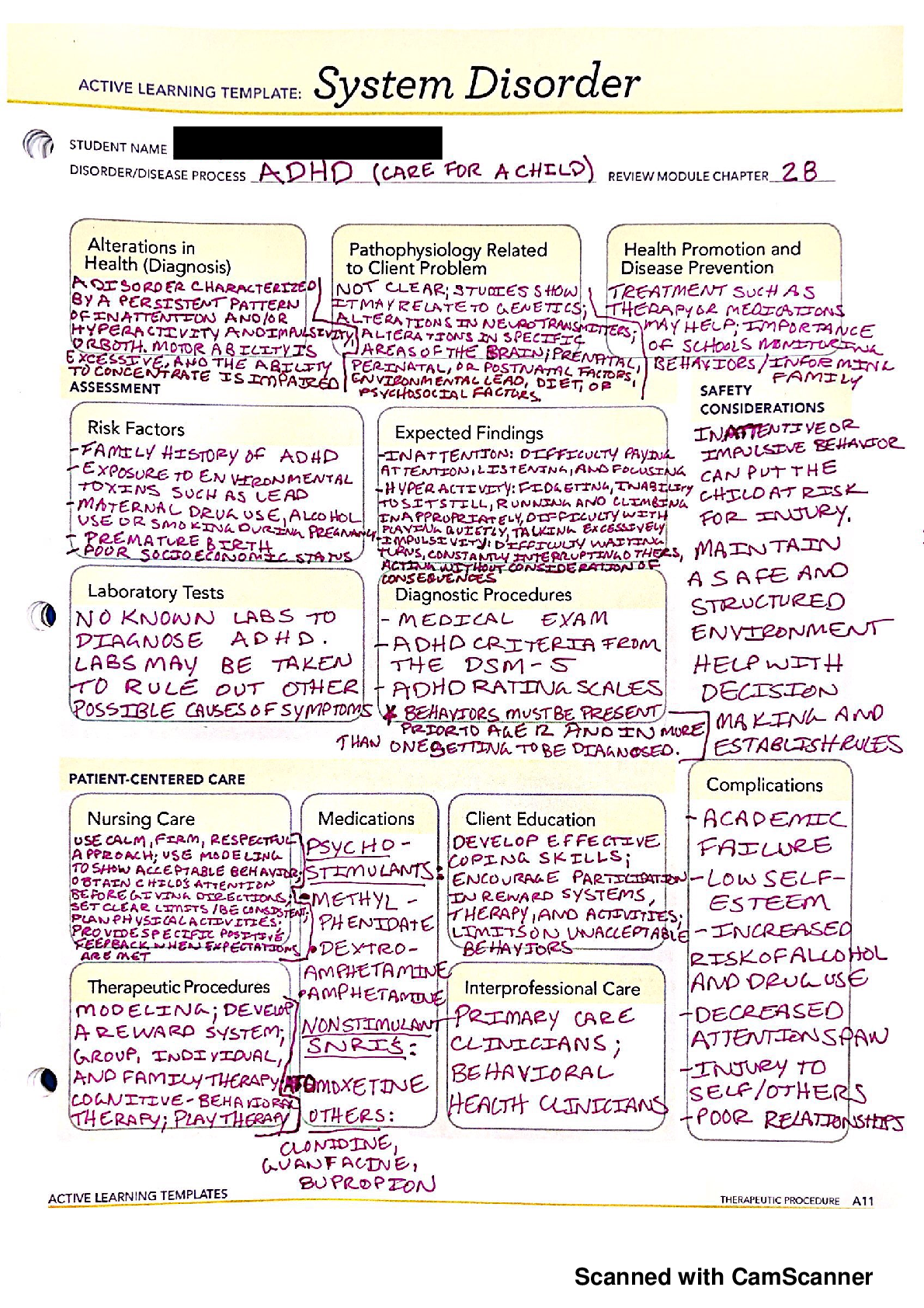
26. A nurse is providing teaching to the parents of a school-age child who has attention deficit
hyperactivity disorder (ADHD). Which of the following instructions should the nurse include in the
teaching?
a. "Ignore your child's attention-seeking behaviors that are not dangerous."
The nurse should instruct the parents about the use of planned ignoring. This technique
ignores attention-seeking behaviors that are not dangerous to the child or others. If the child
learns that the behavior will not elicit the desired response, then the behavior should decrease.
b. "Administer ADHD medications within 30 minutes of your child's bedtime."
The nurse should instruct the parents to administer medications in the morning to decrease
insomnia, which is a common adverse effect of ADHD medications.
c. "Continue with an activity as planned even if your child becomes frustrated."
The nurse should instruct the parents about the use of restructuring. This technique adjusts or
changes an activity based on the child’s level of frustration.
d. "Expect your child to gain weight after starting ADHD medications."
The nurse should instruct the parents that a decreased appetite and weight loss are common
adverse effects of ADHD medications.
27. The nurse is interviewing a client who has Anorexia Nervosa. Which if the following findings should
the nurse expect?
a. Poor personal hygiene habits
The nurse should not expect the client who has anorexia nervosa to have poor personal hygiene
habits. Clients who have anorexia nervosa often exhibit compulsive behaviors, such as frequent
hand washing, and are preoccupied with their appearance.
b. Strenuous exercise regimen
The nurse should expect the client who has anorexia nervosa to report a strenuous exercise
regimen. The client might participate in excessive physical activity due to the perceived need to
burn calories and lose weight.
c. Grandiose behaviors
The nurse should expect clients who have anorexia nervosa to have poor self-esteem and
negative feelings about themselves.
d. Intense fear of death
The nurse should expect the client who has anorexia nervosa to have an intense fear of gaining
weight. Clients who have anorexia nervosa exhibit behaviors that have negative health
consequences in order to prevent weight gain.
28. A nurse is caring for a client who has depression, the clients states, "I am too tired and depressed to
attend group therapy today." Which of the following responses should the nurse make?
a. "Attending group therapy, even if you're tired, is an important part of your treatment."
The nurse provides a therapeutic response by giving the client information to make an
informed decision. Group therapy is beneficial to the client who has depression by promoting peer
support and reducing social isolation.
b. "That's okay if you're too tired to attend group therapy today, but you will have to go tomorrow."
The nurse should recognize that a lack of energy is expected for a client who has depression.
There is no indication that the client will have more energy for group therapy in the future. The
nurse should also respect the client’s autonomy and avoid giving a directive about required
participation.
c. "It is normal to feel tired when you're feeling depressed. The others in group therapy also feel this way."
The nurse should avoid minimizing the client’s feelings by making a generalization about her
status in relation to others.
d. "I agree with your decision to wait for participation in group therapy until you begin to feel better."
The nurse should avoid giving approval to the client’s decision, which promotes the need for her
to please the nurse. The nurse should also encourage her to participate in group therapy to
promote improvement of her depression.
29. A nurse is performing an admission assessment for a client who has restricting type Anorexia
Nervosa. The nurse should expect which of the following findings?
a. Decreased caloric intake
The nurse should expect the client who has restricting type anorexia nervosa to have a
restricted and decreased caloric intake due to the client’s intense fear of weight gain.
b. Recurrent binging
Recurrent binging is an expected finding of binge-eating/purging type anorexia nervosa. Clients
who have restricting type anorexia nervosa are not expected to exhibit bulimic manifestations,
such as binge eating.
c. Compensatory vomiting
Compensatory vomiting is an expected finding of binge-eating/purging type anorexia nervosa.
Clients who have restricting type anorexia nervosa are not expected to exhibit bulimic
manifestations, such as compensatory vomiting.
d. Loss of appetite
Loss of appetite is not an expected finding of a client who has anorexia nervosa. Clients who
have restrictive type anorexia nervosa maintain an appetite; however, they have inadequate
intake due to fear of gaining weight.
30. A nurse in a substance abuse treatment facility is reviewing the medication records for a group of
clients. The nurse should expect to administer Methadone for a client who has a substance use disorder
for which of the following addictions?
a. Amphetamines
The nurse should recognize that the administration of methadone is not indicated for the
treatment of amphetamine use disorder.
b. Opiates
The nurse should recognize that the administration of methadone is indicated for the
treatment of opiate use disorder. Opiates include opium, morphine, codeine, methadone, and
heroin. Methadone is given as a substitute to prevent cravings and severe manifestations of
opiate withdrawal.
c. Barbiturates
The nurse should recognize that the administration of methadone is not indicated for the
treatment of barbiturate use disorder.
d. Hallucinogenics
The nurse should recognize that the administration of methadone is not indicated for the
treatment of hallucinogen use disorder.
31. A nurse is caring for a client who has just received a terminal diagnosis of cancer. Which of the
following initial reactions should the nurse expect?
a. Bargaining
The nurse should expect the client to exhibit bargaining during the grief process; however, there
is another response that is expected first.
b. Depression
The nurse should expect the client to exhibit depression during the grief process; however, there
is another response that is expected first.
c. Denial
The nurse should expect the client to initially deny the reality of the diagnosis. This is a
protective reaction that serves to protect the client from psychological pain.
d. Anger
The nurse should expect the client to exhibit anger during the grief process; however, there is
another response that is expected first.
32. A nurse is caring for a client with Alzheimer Disease and becomes agitated while refusing morning
hygiene care. Which of the following actions should the nurse take?
a. Talk to the client from two arm-lengths away.
The nurse should talk calmly and quietly to the client to decrease her agitation. The nurse
should remain one to two arm-lengths away to provide her with a sense of personal space and
maintain safety if she becomes aggressive.
b. Obtain assistance to restrain the client for safety.
The nurse should identify that the client’s refusal of care is not a justification for restraints. The
nurse should apply restraints only if her behavior becomes a threat to her safety or the safety of
others.
c. Firmly state to the client that morning care will be performed.
The nurse should recognize that the client has a right to refuse care. Telling her that care will be
performed, despite refusal, can increase her anxiety and agitation.
d. Call the provider to request a prescription for an antipsychotic medication.
The nurse should recognize that antipsychotic medications are used only with extreme caution
due to the increased risk of death for clients who have Alzheimer’s disease. Antipsychotic
medications are not indicated for the treatment of agitation.
33. A nurse is assessing a client who takes Phenelzine for the treatment of Depression. Which of the
following finding should the nurse report to the provider?
a. Elevated blood pressure
The nurse should identify that the greatest risk to the client is an elevated blood pressure,
which increases his risk for a hypertensive crisis that can result from taking an MAOI, such as
phenelzine. The nurse should apply the safety and risk reduction priority-setting framework when
assessing this client. This framework assigns priority to the factor or situation posing the greatest
safety risk to the client. When there are several risks to client safety, the one posing the greatest
threat is the highest priority. The nurse should use Maslow’s hierarchy of needs, the ABC prioritysetting framework, or nursing knowledge to identify which risk poses the greatest threat to the
client.
b. Weight gain
The nurse should identify weight gain as a common adverse effect of an MAOI, such as
phenelzine. The nurse should report the adverse effect to the provider; however, there is another
finding that is a greater risk to the client than weight gain.
c. Muscle twitching
The nurse should identify muscle twitching as a common adverse effect of an MAOI, such as
phenelzine. The nurse should report the adverse effect to the provider; however, there is another
finding that is a greater risk to the client than muscle twitching.
d. 2+ peripheral edema
The nurse should identify peripheral edema as a common adverse effect of an MAOI, such as
phenelzine. The nurse should report the adverse effect to the provider; however, there is another
finding that is a greater risk to the client than peripheral edema.
34. A nurse is assessing a client who experienced a sexual assault 6 months ago. Which of the following
findings should the nurse report to the provider as an indication of rape-trauma syndrome?
a. Flat affect
The nurse should expect the client who has rape-trauma syndrome to experience mood swings
and intense emotions.
b. Refusal to accept help from others
The nurse should expect the client who has rape-trauma syndrome to exhibit dependence toward
others.
c. Report of intense guilt
The nurse should expect the client who has rape-trauma syndrome to experience guilt about the
sexual assault. These feelings of guilt can delay the healing process and produce a sustained
and maladaptive response.
d. Denial of the sexual assault
The nurse should expect a client to have denial immediately following a sexual assault; however,
this is not a characteristic of rape-trauma syndrome.
35. A nurse in interviewing an older adult client about possible anger abuse by her caregiver. Which of the
following techniques should the nurse use?
a. Avoid directly asking the client if she has been abused.
The nurse should ask the client directly about possible abuse to identify the client’s physical,
emotional, and safety needs.
b. Use a confrontational approach.
The nurse should avoid a confrontational approach, which can raise the client’s defensive
barriers and potentially block further communication.
c. Maintain a nonjudgmental tone.
The nurse should use a nonjudgmental tone to promote trust and communication.
d. Avoid being in the room alone with the client.
The nurse should conduct the interview in private to provide a calm and safe environment.
36. A nurse is providing teaching for a family of a client who has Alzheimer Disease about Donepezil.
Which of the following statements should the nurse include in the teaching?
a. "Donepezil can improve cognitive functioning during the earlier stages of the disease."
The nurse should inform the family that donepezil is used to treat the manifestations of mild
to severe Alzheimer’s disease. Although donepezil does not prevent the progression of
Alzheimer’s disease, it is intended to prolong the client's ability to function in the early stages of
the disease.
b. "Donepezil cures the disease process if it is started upon first recognition of dementia."
The nurse should inform the family that donepezil is used to treat the manifestations of mild to
severe Alzheimer’s disease; however, donepezil does not prevent the progression of Alzheimer’s
disease.
c. "Donepezil provides long-term reversal of memory loss in the last phase of the disease."
The nurse should inform the family that donepezil is used to treat the manifestations of mild to
severe Alzheimer’s disease. Though donepezil can provide mild improvements in memory, it does
not reverse memory loss. Improvements in the client’s memory are usually short-term.
d. "Donepezil accelerates the breakdown of acetylcholine within the client's brain."
The nurse should inform the family that donepezil is used to treat the manifestations of mild to
severe Alzheimer’s disease. Donepezil works by preventing the breakdown of acetylcholine within
the client’s brain, increasing its availability at cholinergic synapses.
37. A nurse is obtaining a client's medical history prior to scheduling them for ECT. Which of the following
findings should the nurse identify as a potential complication for the procedure?
a. Severe depression
A client can receive ECT for treatment of severe depression.
b. Cardiac arrhythmia
A client who has cardiac arrhythmias needs further evaluation. The nurse should identify that
the greatest risk for death due to ECT is related to cardiac complications.
c. Bipolar disorder
A client can receive ECT for treatment of bipolar disorder.
d. Parkinson's disease
A client can receive ECT for treatment of Parkinson's disease.
38. A nurse is planning care for a client who had Bipolar Disorder and is experiencing a Manic Episode.
Which of the following interventions should the nurse include in a plan of care?
a. Discourage the client from taking naps during the day.
The nurse should encourage the client to take naps and frequent rest periods during the day to
avoid physical exhaustion due to mania.
b. Allow the client to choose which clothing to wear each day.
The nurse should closely supervise the client’s choice of clothing to maintain her dignity and
promote positive self-esteem during a manic episode.
c. Encourage the client to participate in group therapy.
The nurse should encourage one-on-one therapy during the manic phase. Group therapy can
cause anxiety and agitation in the client.
d. Provide the client frequently with high-calorie finger-foods.
The nurse should provide the client with frequent, high-calorie snacks and meals during a
manic episode to provide the calorie replacement needed due to excessive physical energy
and activity. Providing finger-foods increases the client’s intake by making it easier to eat when
mania makes it difficult for her to sit down and concentrate on a meal.
39. A nurse in an acute mental health facility is caring for a client who is experiencing an Acute Manic
Episode. Which of the following actions is the nurse's priority?
a. Maintain the client's contact with her family.
The nurse should assist all acute care clients in maintaining contact with family during treatment;
however, there is another action that is the priority.
b. Discourage the client's use of vulgar language.
The nurse should discourage behaviors that disrupt the therapeutic milieu; however, there is
another action that is the priority.
c. Protect the client from impulsive behavior.
The nurse should protect the client who is manic from impulsive behavior that puts the client
at risk for self-harm. The nurse should apply the safety and risk reduction priority-setting
framework. This framework assigns priority to the factor or situation posing the greatest safety
risk to the client. When there are several risks to client safety, the one posing the greatest threat
is the highest priority. The nurse should use Maslow’s hierarchy of needs, the ABC priority-setting
framework, or nursing knowledge to identify which risk poses the greatest threat to the client.
d. Redirect excessive energy to creative tasks.
The nurse should redirect the client’s energy into a calming and constructive activity; however,
there is another action that is the priority.
40. A nurse in an acute mental health facility is planning care for a client who has obsessive-compulsive
disorder (OCD). Which of the following actions should the nurse include in the plan?
a. Encourage the client to focus on personal hygiene.
Clients who have OCD are often obsessive about personal hygiene and might perform ritualistic
behaviors related to handwashing and grooming. The nurse should plan interventions to limit and
control these obsessive thoughts.
b. Limit the hours the client sleeps each day.
Clients who have OCD often have difficulty sleeping due to obsessive thoughts and ritualistic
behaviors. The nurse should plan interventions to promote sleep.
c. Instruct the client to practice thought stopping.
The nurse should teach the client who has OCD to use thought stopping. By saying "stop" out
loud, the client can learn to interrupt obsessive thoughts.
d. Make negative statements about the client's behavior.
Clients who have OCD often feel shame and humiliation about their obsessive thoughts and
ritualistic behavior. The nurse should plan interventions to decrease feelings of shame and
increase feelings of self-worth.
41. A nurse is caring for a client who has alcohol use disorder.Following alcohol withdrawal, which of the
following medications should the nurse expect to administer to the client during maintenance?
a. Methadone
The nurse should expect to administer methadone to the client who has opioid withdrawal.
b. Disulfiram
The nurse should expect to administer disulfiram as a deterrent to prevent future use of
alcohol. The nurse must ensure that the client has not had any alcohol intake for at least 12 hr
prior to administration.
c. Chlordiazepoxide
The nurse should expect to administer chlordiazepoxide during alcohol withdrawal.
Chloridiazepoxide is not a medication used to help with maintenance.
d. Naloxone
The nurse should expect to administer naloxone to the client who is experiencing a narcotic
overdose.
42. A nurse is caring for a client who attends family counseling with his partner and their children. The
client tells the nurse he isn't going to attend any further sessions and states, "I don't have time for all this
talking." Which of the following responses should the nurse make?
a. "It must be difficult for you to talk about family problems."
The nurse’s response indicates empathy for the client’s feelings and is an example of the
therapeutic communication technique of verbalizing what the client implied. With this technique,
the nurse helps him focus on the actual reason for not wanting to continue family therapy.
b. "You should continue attending the family counseling sessions until the therapist tells you to stop."
The nurse’s response is an example of the nurse giving advice, which is nontherapeutic and a
possible block to further communication.
c. "If you continue to go to family counseling, I'm sure you'll be able to resolve your family problems
soon."
The nurse’s response is an example of false reassurance. The client’s continued participation is
not an indication that problems will be resolved.
d. "I think you need to continue family therapy if your partner and children want to receive further
counseling."
The nurse’s response is an example of the nurse giving advice, which is nontherapeutic and a
possible block to further communication.
43. A nurse in an acute substance is assessing a client who received treatment in the Emergency
Department for a Heroin Overdose. Which of the following findings should the nurse anticipate during
Heroin Withdrawal?
a. Excessive sleeping
The nurse should expect the client to have insomnia during heroin withdrawal.
b. Muscle aches
The nurse should expect the client to have muscle aches during heroin withdrawal. The
nurse should expect this and other manifestations of withdrawal to begin within 6 to 8 hr following
the last dose of heroin.
c. Pupillary constriction
The nurse should expect the client to have pupillary dilation during heroin withdrawal.
d. Absent bowel sounds
The nurse should expect the client to have diarrhea during heroin withdrawal.
44. A nurse in an emergency room is assessing a client who has cocaine intoxication. Which of the
following findings should the nurse expect?
a. Low blood pressure
The nurse should expect a client who has cocaine intoxication to have an elevated blood
pressure.
b. Dilated pupils
Dilated pupils are associated with the use of cocaine.
c. Conjunctival redness
The nurse should expect a client who has cannabis intoxication to have conjunctival redness.
d. Decreased body temperature
The nurse should expect a client who has cocaine intoxication to have an elevated body
temperature.
45. A nurse is admitting a client who has antisocial personality disorder to an acute care unit. The client is
admitted under court order following the theft and destruction of a car. Which of the following behaviors
should the nurse expect the client to display?
a. Relief about finally receiving care for a problem for which he was previously afraid to ask for help
A client who has antisocial personality disorder exhibits a pattern of irresponsible behavior that
lacks morals and ethics and brings the client into conflict with society. The client views this
behavior as justified and does not perceive the need for help.
b. Anger with the nursing staff for hospitalizing him against his will.
A client who has antisocial personality disorder exhibits a low frustration level and can
quickly become angry and aggressive when the situation goes against his will or desires.
c. Withdrawal from others due to shame over his recent actions
Clients with antisocial behavior do not view their own behavior objectively and rarely experience
any anxiety or guilt over their actions.
d. Remorse for stealing and destroying the car
Clients who have antisocial behavior usually display a sense of entitlement and rarely express
any remorse for their illegal or unethical actions.
46. A nurse is developing a plan of care with a client who has Anorexia Nervosa. The nurse should
identify that which of the following actions is contraindicated for this client?
a. Explaining that tube feedings are necessary if the client refuses oral intake
The nurse should inform the client that he might require tube feedings to provide adequate
nutritional intake if oral intake is inadequate. This intervention is not intended to be punitive but to
ensure the client’s safety.
b. Weighing the client each day prior to any oral intake
The nurse should weigh the client each day prior to any oral intake to obtain accurate data and to
monitor his progress toward weight gain goals.
c. Permitting the client to spend some quiet time alone after each meal
The nurse should directly observe the client for a minimum of 1 hr following meals. This
intervention prevents the client from purging or discarding hidden food. Therefore, permitting the
client to have alone time following meals is contraindicated for his plan of care.
d. Refraining from commenting about the client's eating during meal times
The nurse should encourage conversation during meals to promote a pleasurable eating
environment; however, the nurse should avoid the topics of eating and food, which can increase
the client’s level of anxiety.
47. A nurse in the Emergency Department is assessing a client who has Heroin Intoxication. Which of the
following findings should the nurse expect?
a. Seizure activity
Heroin is an opioid, which can result in impaired coordination rather than seizure activity.
b. Respiratory depression
Heroin is an opioid; therefore, the nurse should expect the client who has heroin intoxication
to exhibit respiratory depression.
c. Hypersensitivity to pain
Heroin is an opioid, which can result in pain reduction rather than a hypersensitivity to pain.
d. Increased mental alertness
Heroin is an opioid, which can result in drowsiness and sedation rather than increased mental
alertness.
48. A nurse is caring for a client who has Alzheimer Disease and a new prescription for Donepezil. Which
of the following actions should the nurse take?
a. Monitor the client's liver function while taking this medication.
The nurse should monitor the liver function for a client who is taking the cholinesterase inhibitor
tacrine; however, donepezil is a medication in this category that is not hepatotoxic.
b. Increase the dosage of this medication every 72 hr.
The nurse should expect the provider to gradually increase the client’s dosage until a therapeutic
effect is achieved; however, an increase is not expected until the client has been taking the
medication for 4 to 6 weeks.
c. Offer the client a PRN NSAID while taking this medication.
The nurse should inform the client of the risk for gastrointestinal bleeding while taking this
medication. Taking donepezil concurrently with an NSAID increases this risk.
d. Administer the medication at bedtime.
Donepezil is used to treat the manifestations of mild to moderate Alzheimer’s disease. The
nurse should administer this medication at bedtime to reduce the risk for injury due to bradycardia
and syncope.
49. A nurse is caring for a client who has major depressive disorder and is severely withdrawn. Which of
the following techniques should the nurse use to facilitate communication with the client?
a. Continue to talk if the client does not provide an immediate verbal response.
The nurse should allow the client additional time to respond. Clients who are severely withdrawn
might take longer to comprehend what is being said and formulate a response.
b. Use platitudes when talking with the client.
The nurse should avoid the use of platitudes because this technique minimizes the client’s
feelings and promotes feelings of worthlessness in clients who are severely withdrawn.
c. Ask the client direct questions.
The nurse should avoid asking direct questions to a client who is severely withdrawn because this
technique can raise his level of anxiety.
d. Speak to the client using simple and concrete terminology.
The nurse should use simple and concrete terminology when communicating with this client.
The client who is severely withdrawn has impaired comprehension and difficulty concentrating;
therefore, this technique facilitates communication.
50. A nurse is caring for a client who has Wernicke-Korsakoff Syndrome due to Alcohol Use Disorder.
Which of the following findings should the nurse expect?
a. Increased arousal
The nurse should expect the client who has Wernicke-Korsakoff syndrome to exhibit somnolence
and stupor rather than increased arousal.
b. Arrhythmias
The nurse should expect the client who has cardiomyopathy due to alcohol use to have
arrhythmias. Cardiac manifestations are not expected findings of Wernicke-Korsakoff syndrome.
c. Confusion
The nurse should expect the client who has Wernicke-Korsakoff syndrome to exhibit
neurological and cognitive manifestations due to thiamine deficiency. Confusion, stupor,
diplopia, and memory loss are expected findings of this disorder.
d. Esophageal pain
The nurse should expect the client who has esophagitis due to alcohol use to have esophageal
pain. Gastrointestinal manifestations are not expected findings with Wernicke-Korsakoff
syndrome.
[Show More]








.png)




.png)