Key Terms: covered entity, acculturation, ombudsperson, people of color, simple consent, Institutional
Review Board (IRB), Human Subjects Review Boards, Community Based Participatory Research (CBPR),
HEW Guidelines, Mo
...
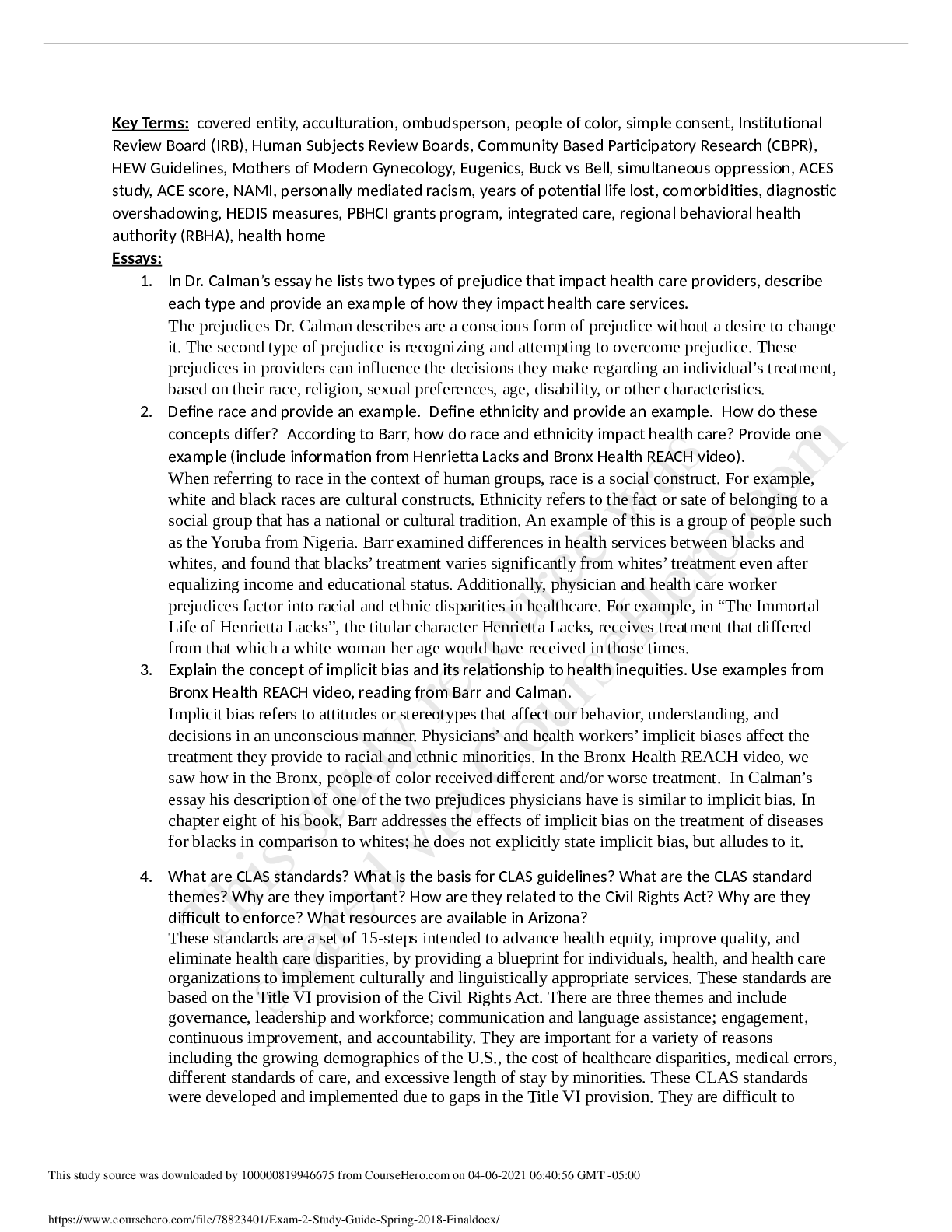
Key Terms: covered entity, acculturation, ombudsperson, people of color, simple consent, Institutional
Review Board (IRB), Human Subjects Review Boards, Community Based Participatory Research (CBPR),
HEW Guidelines, Mothers of Modern Gynecology, Eugenics, Buck vs Bell, simultaneous oppression, ACES
study, ACE score, NAMI, personally mediated racism, years of potential life lost, comorbidities, diagnostic
overshadowing, HEDIS measures, PBHCI grants program, integrated care, regional behavioral health
authority (RBHA), health home
Essays:
1. In Dr. Calman’s essay he lists two types of prejudice that impact health care providers, describe
each type and provide an example of how they impact health care services.
The prejudices Dr. Calman describes are a conscious form of prejudice without a desire to change
it. The second type of prejudice is recognizing and attempting to overcome prejudice. These
prejudices in providers can influence the decisions they make regarding an individual’s treatment,
based on their race, religion, sexual preferences, age, disability, or other characteristics.
2. Define race and provide an example. Define ethnicity and provide an example. How do these
concepts differ? According to Barr, how do race and ethnicity impact health care? Provide one
example (include information from Henrietta Lacks and Bronx Health REACH video).
When referring to race in the context of human groups, race is a social construct. For example,
white and black races are cultural constructs. Ethnicity refers to the fact or sate of belonging to a
social group that has a national or cultural tradition. An example of this is a group of people such
as the Yoruba from Nigeria. Barr examined differences in health services between blacks and
whites, and found that blacks’ treatment varies significantly from whites’ treatment even after
equalizing income and educational status. Additionally, physician and health care worker
prejudices factor into racial and ethnic disparities in healthcare. For example, in “The Immortal
Life of Henrietta Lacks”, the titular character Henrietta Lacks, receives treatment that differed
from that which a white woman her age would have received in those times.
3. Explain the concept of implicit bias and its relationship to health inequities. Use examples from
Bronx Health REACH video, reading from Barr and Calman.
Implicit bias refers to attitudes or stereotypes that affect our behavior, understanding, and
decisions in an unconscious manner. Physicians’ and health workers’ implicit biases affect the
treatment they provide to racial and ethnic minorities. In the Bronx Health REACH video, we
saw how in the Bronx, people of color received different and/or worse treatment. In Calman’s
essay his description of one of the two prejudices physicians have is similar to implicit bias. In
chapter eight of his book, Barr addresses the effects of implicit bias on the treatment of diseases
for blacks in comparison to whites; he does not explicitly state implicit bias, but alludes to it.
4. What are CLAS standards? What is the basis for CLAS guidelines? What are the CLAS standard
themes? Why are they important? How are they related to the Civil Rights Act? Why are they
difficult to enforce? What resources are available in Arizona?
These standards are a set of 15-steps intended to advance health equity, improve quality, and
eliminate health care disparities, by providing a blueprint for individuals, health, and health care
organizations to implement culturally and linguistically appropriate services. These standards are
based on the Title VI provision of the Civil Rights Act. There are three themes and include
governance, leadership and workforce; communication and language assistance; engagement,
continuous improvement, and accountability. They are important for a variety of reasons
including the growing demographics of the U.S., the cost of healthcare disparities, medical errors,
different standards of care, and excessive length of stay by minorities. These CLAS standards
were developed and implemented due to gaps in the Title VI provision. They are difficult to
[Show More]