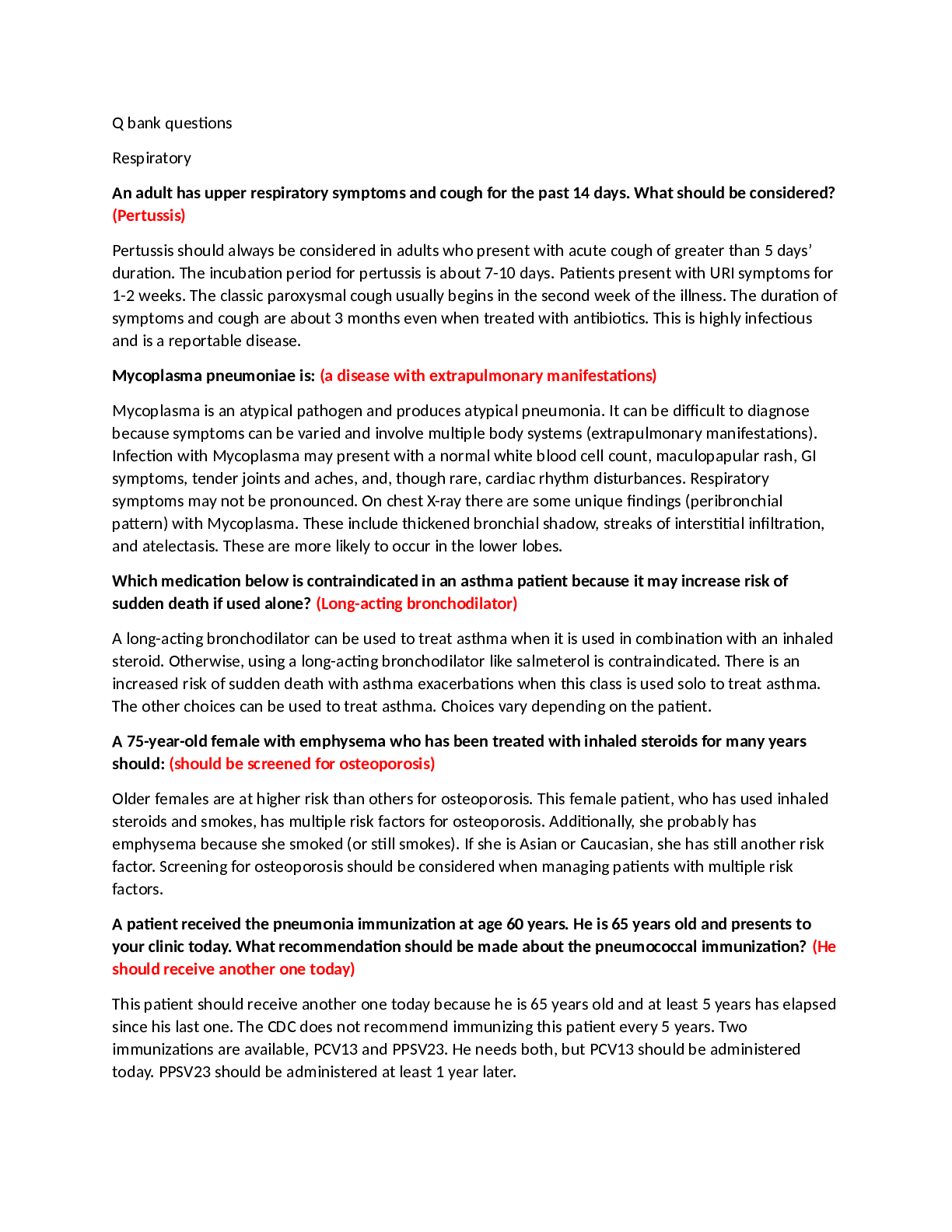
MULTIPLE CHOICE
1. The nurse interviews a patient during admission. Which observation by the nurse identifies
consistency between the patient’s verbal and nonverbal communication?
a. Asserts she is eager to answer que
...
MULTIPLE CHOICE
1. The nurse interviews a patient during admission. Which observation by the nurse identifies
consistency between the patient’s verbal and nonverbal communication?
a. Asserts she is eager to answer questions while reading a magazine.
b. States that he wants information while frequently changing the subject.
c. Asks the nurse to explain a surgical procedure while she listens intently.
d. Explains that he is relaxed while continuously shifting in his chair.
ANS: C
The patient demonstrates congruency, or consistency, between her verbal statement asking for
an explanation and her nonverbal cue of listening intently. The verbal and nonverbal messages
match; each indicates that the nurse’s response is important to her. If she is eager to answer
questions, the patient should focus on the nurse’s questions or note taking; reading a magazine
is a distraction and indicates a lack of interest. Changing the subject may indicate discomfort
or reluctance to address the issue. Continually shifting position may be an indication of
anxiety.
DIF: Cognitive Level: Applying OBJ: NCLEX: Safe and Effective Care Environment
TOP: Nursing Process: Assessment
2. The nurse is interviewing a newly admitted patient. Which statement by the nurse is most
likely to result in effective patient communication?
a. “I’m not sure why you’re here. Can you explain it to me?”
b. “Tell me about things and people that are important to you.”
c. “Tell me more about your pain. Where does it start?”
d. “If you think it’s important, I’ll try to notify the provider.”
ANS: C
The nurse communicates effectively by using focused questions. This encourages the patient
to give more information about the specific topic of concern. The remaining options are
ineffective communication techniques because each potentially impairs the exchange of
information between the nurse and the patient regarding care needs. The patient may be
unwilling to express concerns openly after the nurse expresses lack of understanding and
empathy. The patient will also likely lose confidence in the nurse if the nurse expresses
confusion about suitability of the patient’s presence. By asking what is important to the
patient, the nurse loses focus of the objective of the communication and is likely to confuse
the patient.
DIF: Cognitive Level: Applying OBJ: NCLEX: Safe and Effective Care Environment
TOP: Integrated Process: Communication and Documentation
3. After receiving a diagnosis of a fatal disease, the patient expresses sadness and states “I don’t
know what to do next”. Which action by the.......
MULTIPLE CHOICE
1. The nurse discovers a medication error on another nurse’s documentation, so the nurse
completes an incident report. Which statement should the nurse include in the report?
a. “Nurse mistakenly gave the wrong dose of medication for pain.”
b. “Nurse gave incorrect dose of pain medication, but patient is all right.”
c. “Morphine 10 mg IM given rather than morphine 5 mg IM as ordered.”
d. “Physician will be notified of error when he makes rounds tomorrow.”
ANS: C
Stating that the patient received morphine 10 mg instead of 5 mg is a factual statement to
include on an incident report because it is objective and provides no interpretation or
conjecture from the nurse. The remaining choices are incorrect statements that do not
accurately reflect what occurred. The physician needs to be notified as soon as the patient has
been assessed, not the following day.
DIF: Cognitive Level: Applying OBJ: NCLEX: Safe and Effective Care Environment
TOP: Integrated Process: Communication and Documentation
2. The nurse is documenting the care of a patient. Which entry would be characteristic of
charting by exception (CBE) as a documentation method?
a. The patient needed to be turned every hour because of increasing pain.
b. The patient’s vital signs are stable.
c. The patient’s gait was steady with assistance from physical therapy.
d. There was no odor when the dressing was removed.
ANS: A
CBE allows the nurse to specify exceptions to normal nursing assessments efficiently without
documenting the normal assessment data and reducing the amount of narrative writing in
patient documentation. The emphasis is on recording abnormal findings and trends in clinical
care. It is a shorthand method for documenting based on defined standards for normal nursing
assessments and interventions. CBE simply involves completing a flow sheet that incorporates
these standards, thus minimizing the need for lengthy narrative notes. Increasing pain would
not be expected and would be outside the “normal” or “expected.”
DIF: Cognitive Level: Understanding OBJ: NCLEX: Safe and Effective Care Environment
TOP: Integrated Process: Communication and Documentation
3. The nurse is documenting on a patient with a respiratory problem. Which patient datum
documented by the nurse is the least objective?
a. Cool and dusky skin
b. Low flow rate oxygen
c. 30 breaths per minute
d. Very restless and drowsy
ANS: B
TEST BANK FOR NURSING INTERVENTIONS AND CLINICAL SKILLS 7TH EDITION BY POTTER
TESTBANKWORLD.ORGN
Low flow rate oxygen is the least objective datum and the datum most subject to interpretation
because the quantity of oxygen is not as precise as “liters/minute” or the “percentage” of
oxygen. The remaining options provide more verifiable data.
DIF: Cognitive Level: Understanding OBJ: NCLEX: Safe and Effective Care Environment
TOP: Integrated Process: Communication and Documentation
4. The nurse runs into a co-worker whose family friend is a patient on the unit. The co-worker
asks about the friend’s health problems. Which is the correct response by the nurse?
a. “Your friend told us to say nothing.”
b. “Why don’t you ask your friend now?”
c. “You know I can’t talk about the patients.”
d. “Well, it was really a very difficult surgery.”
ANS: C
The nurse can’t talk about the co-worker’s friend or acknowledge the friend’s presence in the
agency without breaching the friend’s right to privacy, so the nurse reminds the co-worker
about confidentiality.
DIF: Cognitive Level: Applying OBJ: NCLEX: Safe and Effective Care Environment
TOP: Integrated Process: Communication and Do
[Show More]







.png)


.png)