FLAG
A nurse is caring for a client who has atopic dermatitis and a prescription for triamcinolone
ointment. The nurse should assess the client to monitor for which of the following adverse
effects?
Increased pigment
...
FLAG
A nurse is caring for a client who has atopic dermatitis and a prescription for triamcinolone
ointment. The nurse should assess the client to monitor for which of the following adverse
effects?
Increased pigmentation
Topical glucocorticoid therapy can cause the adverse effect of
hypopigmentation.
Localized hair loss
Long-term glucocorticoid therapy can cause hypertrichosis, or excessive hair
growth, especially on the facial area.
Thinning of the skin
MY ANSWER
Thinning of the skin and delayed healing are adverse effects of topical
glucocorticoid preparations. The client should only apply the ointment to dry
patches of the skin because topical steroids can cause atrophy of the dermis
and epidermis, which can result in thinning of the skin.
Increased sensitivity to the sun
The nurse should instruct the client to avoid excessive sun exposure when
taking topical fluticasone; however, triamcinolone ointment does not cause
photosensitivity.
RN VATI Adult Medical Surgical 2019
CLOSE Question 89 loaded rationals provided
Question: 89 of 90
CORRECT
Time Remaining: 00:37:45
Pause Remaining: 00:05:00
PAUSE
FLAG
A nurse is assessing a client who has left-sided heart failure. Which of the following findings
should the nurse identify as a manifestation of left-sided heart failure?
Dependent edema
The nurse should identify that dependent edema is a manifestation of rightsided heart failure due to right ventricular failure and fluid retention from
pressure building up in the venous system.
Jugular distention
The nurse should identify that jugular vein distention is a manifestation of
right-sided heart failure due to right ventricular failure and fluid retention
from pressure building up in the venous system.
Weight gain
The nurse should identify that weight gain is a manifestation of right-sided
heart failure due to right ventricular failure and fluid retention from pressure
building up in the venous system.
Frothy sputum
MY ANSWER
The nurse should identify that frothy sputum, dyspnea, and wheezing are
manifestations of left-sided heart failure. Treatment includes fluid restriction
and diuretics to decrease preload and reduce pulmonary congestion. Pinktinged frothy sputum can be an early indication of pulmonary edema and can
be life-threatening. Therefore, the nurse should notify the provider
immediately.
RN VATI Adult Medical Surgical 2019
CLOSE Question 88 loaded rationals provided
Question: 88 of 90
CORRECT
Time Remaining: 00:37:30
Pause Remaining: 00:05:00
PAUSE
FLAG
A nurse is caring for a client who is experiencing anxiety as well as numbness and tingling of the
lips and fingers. The client's ABGs are: pH 7.48, PCO2 30 mm Hg, HCO3
- 24 mEq/L, PaO2 85 mm
Hg. Which of the following acid-base imbalances should the nurse identify that the client is
experiencing?
Respiratory alkalosis
MY ANSWER
This pH is alkaline (increased) and the PCO2 is decreased, representing
alveolar hyperventilation and resultant respiratory alkalosis.
Respiratory acidosis
This pH is alkaline (increased) and the PCO2 is decreased. A decreased pH
and an increased PCO2 indicate respiratory acidosis.
Metabolic alkalosis
This HCO3
- 24 mEq/L is within the expected range of 21 to 28 mEq/L and the
pH is alkaline (increased). An increased pH and HCO3
- indicate metabolic
alkalosis.
Metabolic acidosis
This HCO3
- 24 mEq/L is within the expected range of 21 to 28 mEq/L and the
pH is alkaline (increased). A decreased pH and HCO3
- indicate metabolic
acidosis.
RN VATI Adult Medical Surgical 2019
CLOSE Question 87 loaded rationals provided
Question: 87 of 90
CORRECT
Time Remaining: 00:37:22
Pause Remaining: 00:05:00
PAUSE
FLAG
A nurse is assessing a client who has Cushing's syndrome. Which of the following findings
should the nurse expect?
Vitiligo
Vitiligo is the loss of pigment from areas of a client's skin, causing irregular,
white patches. Vitiligo is a manifestation of adrenal-gland hypofunction.
Osteoporosis
MY ANSWER
Osteoporosis is a common finding with Cushing's syndrome. Bones become
thinner as a result of mineral loss and nitrogen depletion, and the risk for
fractures increases.
Myxedema
A client who has hypothyroidism can develop myxedema that causes
mucinous cellular edema around the eyes, across the upper back, and in the
hands and feet.
Heat intolerance
A client who has hyperthyroidism can develop heat intolerance, along with
an increase in sweating.
RN VATI Adult Medical Surgical 2019
CLOSE Question 86 loaded rationals provided
Question: 86 of 90
CORRECT
Time Remaining: 00:37:13
Pause Remaining: 00:05:00
PAUSE
FLAG
A nurse is inspecting the skin of a client who has basal cell carcinoma. The nurse should identify
which of the following lesion characteristics on the client's skin?
A pearly, waxy nodule
MY ANSWER
A client who has basal cell carcinoma has a nodular lesion with well-defined
borders and a pearly or waxy appearance, resulting from overexposure to the
sun, especially on the face, head, and neck.
An irregular border on a variegated-colored lesion
A client who has melanoma has a lesion with irregular borders and
variegated colors of red, white, and blue, most often on the upper back or
lower legs.
A firm, nodular, crusty, or ulcerated lesion
A client who has squamous cell carcinoma has a firm, nodular, and crusty
lesion with an ulcerated center, resulting from sun exposure, chronic
irritation, burns, or irradiation to the skin.
A weeping vesicle
A client who has herpes zoster has weeping, blister-type lesions.
RN VATI Adult Medical Surgical 2019
CLOSE Question 85 loaded rationals provided
Question: 85 of 90
CORRECT
Time Remaining: 00:37:02
Pause Remaining: 00:05:00
PAUSE
FLAG
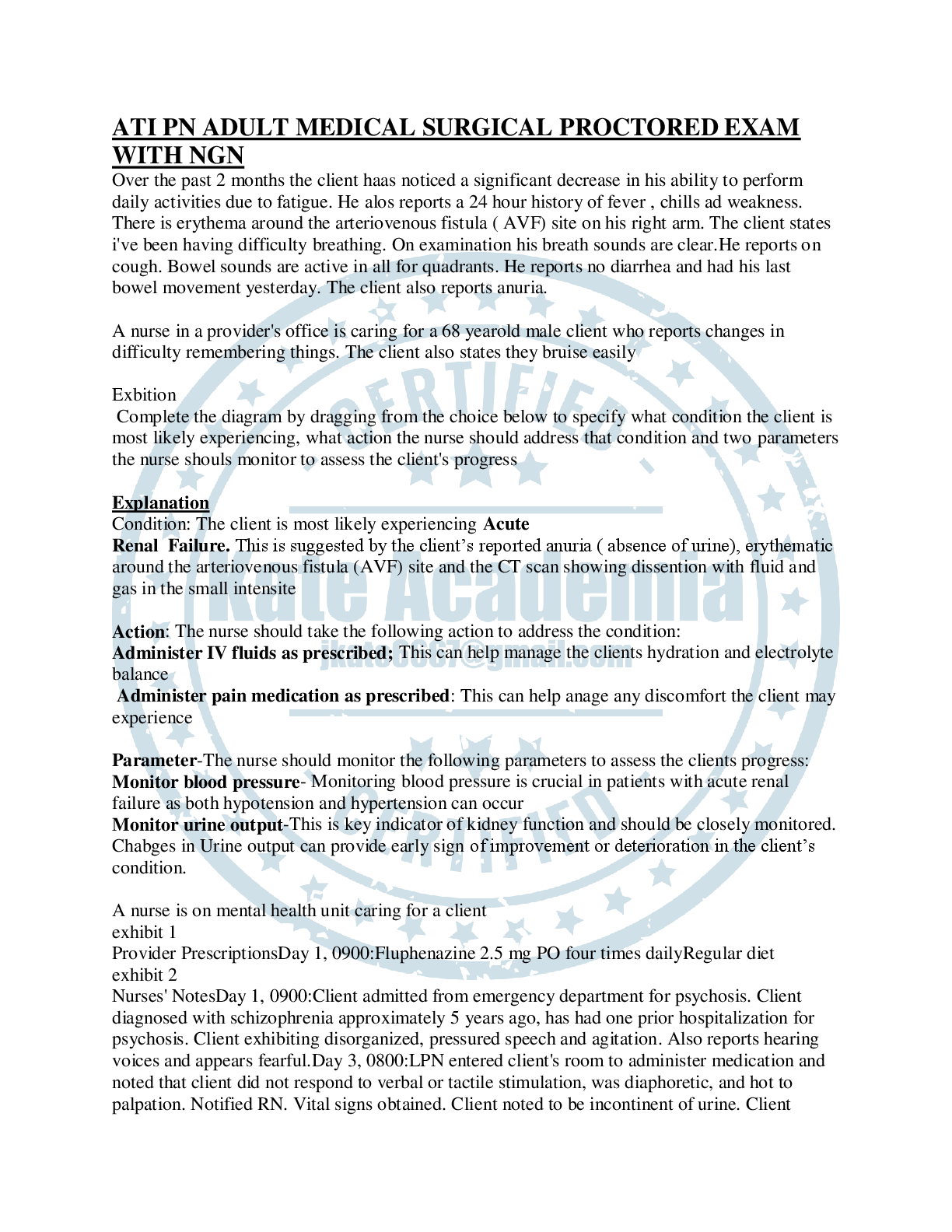
A nurse is assessing a client who has hypocalcemia. In which of the following areas should the
nurse tap on the client's face to detect the presence of Chvostek's sign? (You will find hot spots
to select in the artwork below. Select only the hot spot that corresponds to your answer.)
A is correct. The nurse should tap the client's cheek just in front of the ear
and below the zygomatic arch. The client who has hypocalcemia will display
a Chvostek's sign, which is a twitching of the facial muscle.
B is incorrect. The nurse should apply upward pressure at the supraorbital
ridge, below the eyebrow, to assess for tenderness and inflammation of the
frontal sinuses.
C is incorrect. The nurse should palpate the jaw and mastoid muscle of a
client who has temporomandibular joint dysfunction. This can be caused by
misaligned teeth, arthritis, or grinding of the teeth. With palpation, the nurse
[Show More]











.png)
.png)