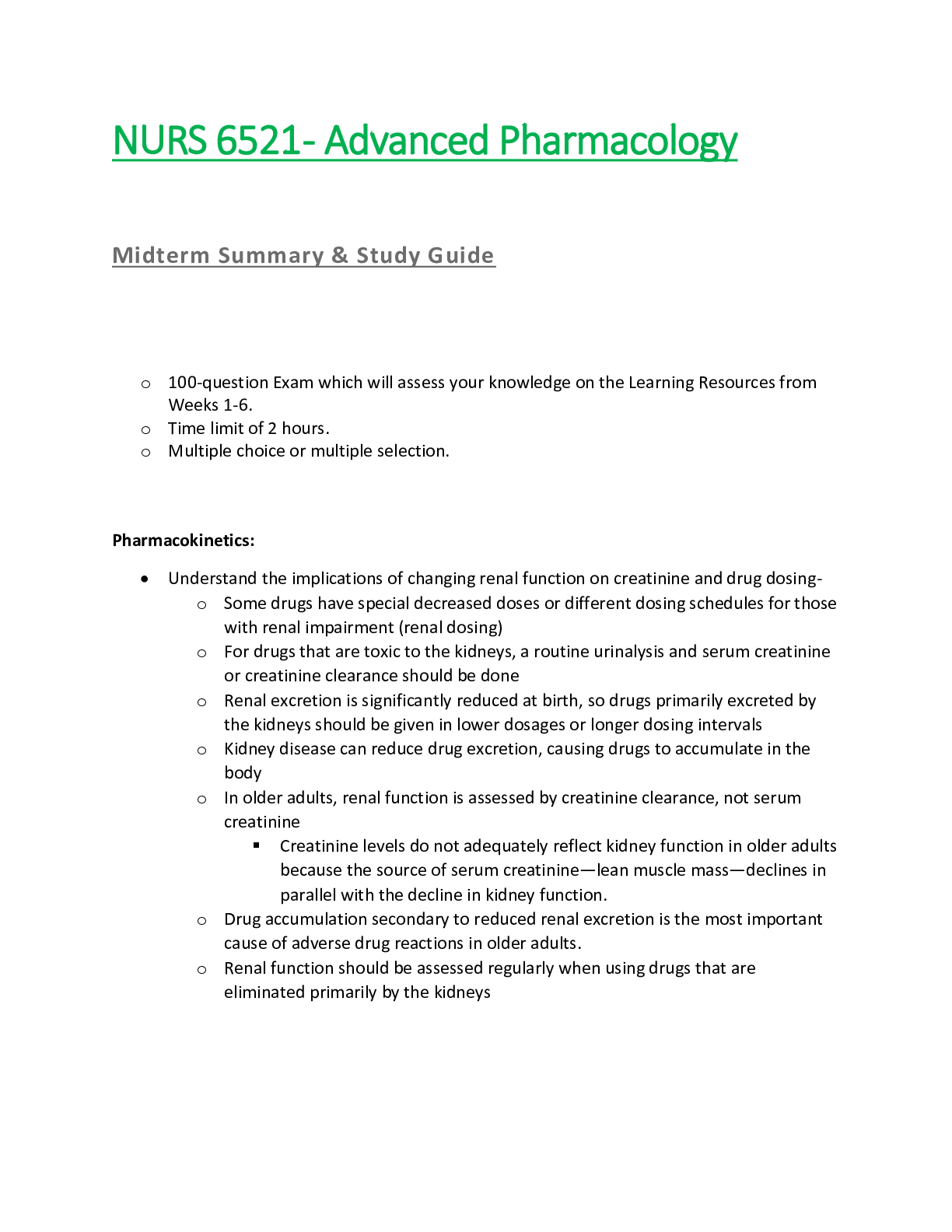
NURS 6521 - Advanced Pharmacology Midterm Summary & Study Guide
Pharmacokinetics:
• Understand the implications of changing renal function on creatinine and drug dosing-
o Some drugs have special decreased doses or
...
NURS 6521 - Advanced Pharmacology Midterm Summary & Study Guide
Pharmacokinetics:
• Understand the implications of changing renal function on creatinine and drug dosing-
o Some drugs have special decreased doses or different dosing schedules for those with renal impairment (renal dosing)
o For drugs that are toxic to the kidneys, a routine urinalysis and serum creatinine or creatinine clearance should be done
o Renal excretion is significantly reduced at birth, so drugs primarily excreted by the kidneys should be given in lower dosages or longer dosing intervals
o Kidney disease can reduce drug excretion, causing drugs to accumulate in the body
o In older adults, renal function is assessed by creatinine clearance, not serum creatinine
Creatinine levels do not adequately reflect kidney function in older adults because the source of serum creatinine—lean muscle mass—declines in parallel with the decline in kidney function.
o Drug accumulation secondary to reduced renal excretion is the most important cause of adverse drug reactions in older adults.
o Renal function should be assessed regularly when using drugs that are eliminated primarily by the kidneys
• What is the impact of the following on drug levels and dosing:
Cirrhosis- Liver disease can cause drugs to accumulate because the liver is the major site for drug metabolism
In patients with hepatic impairment, drug dosages need to be reduced or discontinued to prevent drug toxicity
Some drugs have special decreased doses or different dosing schedules for those with hepatic impairment (hepatic dosing)
Liver enzymes may need to be checked periodically for drugs that can cause liver damage
o Protein binding-
plasma albumin is the main protein that drugs can bind with
drug binding to albumin is reversible making drugs bound and unbound( free)
free means circulating in blood
the percentage of drug molecules that are bound determines the strength of the attraction between albumin and drug
• Example- coumadin creates a strong bond causing 99% of the drug to be bound and 1% to be free( unbound)
• Gentamycin and albumin creates a weak bond leaving 90% open 10% bound
• Consequences of bound drugs that they restrict the ability reach their site of actions or are metabolized because albumin is to large leave the bloodstream; once bind are broken the drug leaves the circulation.
• Albumin has minimal site that drugs can bind; drugs will compete for the receptors to bind with may causing an increased intensity of medication and depending on the medication cause toxicity
o Drug interactions-
Drugs produce effects by interacting with other chemicals( receptors) they produce the effects of the drugs- it is usually reversible
The binding to the receptor either blocks or mimics or increase/decrease the physiological activity of that receptor
Selectivity is the ability to elicit only the response for which a drug is given
The drug only reacts with one receptor type regulated a few processes and effects are limited.
Receptors are like a lock and key only certain drugs bind to specific receptors
Simple occupancy theory
The intensity of the drug is proportional to the number of receptors occupied by that drug
The maximal response will occur when all receptors have been occupied
[Show More]