Essential NCLEX Study Guide 2021 - Comprehensive MUST KNOW topics for passing
1. ABCs (Airway, Breathing, Circulation)
2. When in distress DO NOT ASSESS! Unless 2nd hand information is received.
3. Scenario
Expecte
...
Essential NCLEX Study Guide 2021 - Comprehensive MUST KNOW topics for passing
1. ABCs (Airway, Breathing, Circulation)
2. When in distress DO NOT ASSESS! Unless 2nd hand information is received.
3. Scenario
Expected outcome with Disease Process : Continue to monitor & Document finding
Unexpected finding with Disease Process : Nursing intervention that must make a difference & Call HCP
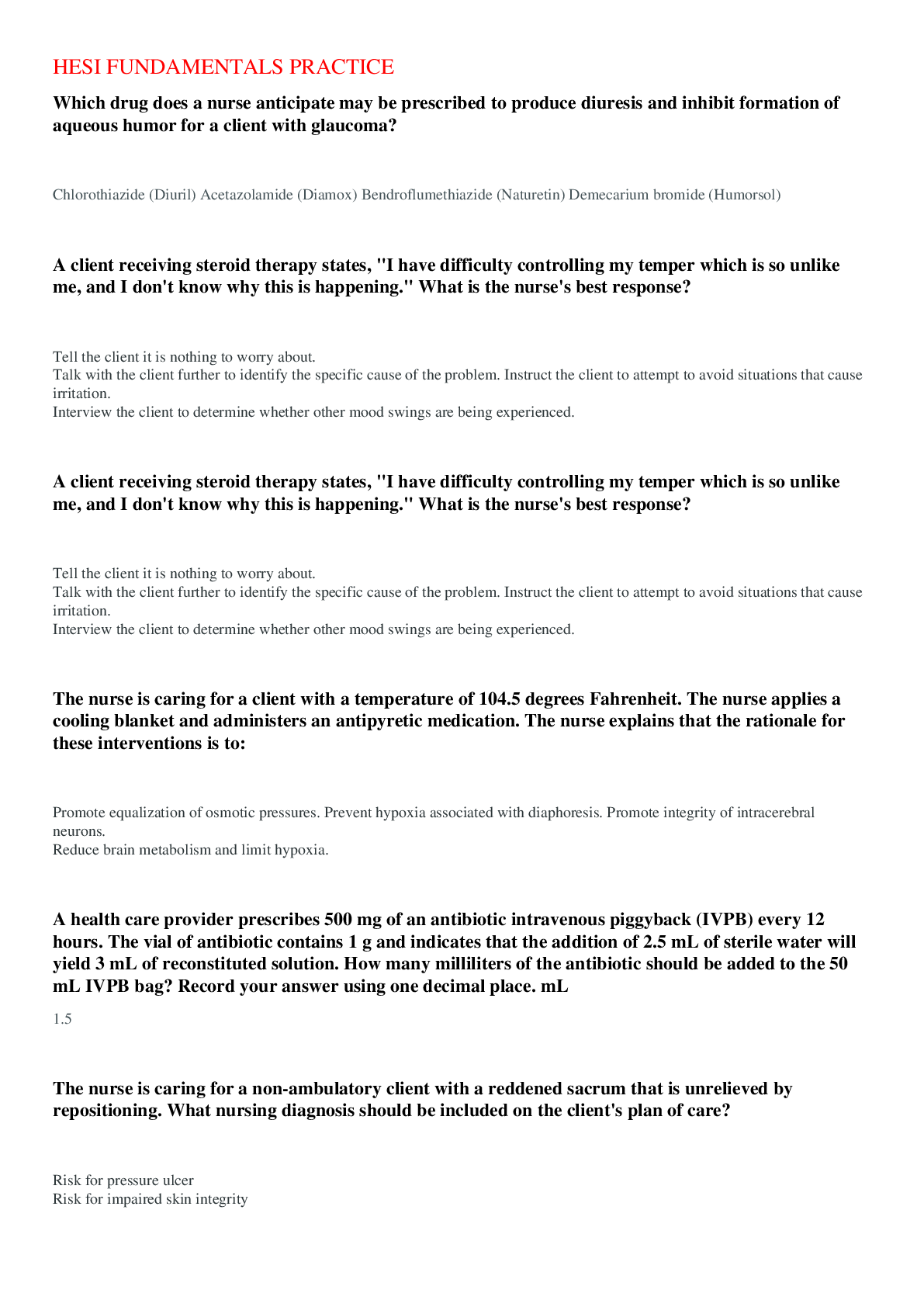
4. Mini Maslow’s
1) ABCs (& Pain unrelieved by meds)
2) Safety
3) Comfort (Pain)
4) Psychological
5) Social
6) Spiritual
5. ST AT words → Pick the answer that failing to do so will kill or cause great harm ● Highest Priority
Most Important
Immediate Action
*Least Invasive First*
Secondhand Info → Any time you have 2nd hand info, the right answer is ASSESS
∙ UAP ∙ Family
∙ Labs ∙ EMR
∙ EKG ∙ BP machine
Never ever take away the coping mechanism a patient uses during a crisis, except if the mechanism puts the patient or others @ risk
Eliminate answer choices & DNR
Never withhold Tx! If you’re left with two answer choices and the options are to Tx, or watch the patient, Pick Tx!
Anytime there’s a reversal from the norm, you must worry!
Assign Stable Patients to:
∙ UAP ∙ LPN ∙ New nurse
∙ Graduate Nurse ∙ Float Nurse ∙ Travel nurse
Anytime you see excessive findings, That’s not normal!
Always empower your patient
If a question has “ ”, pick an answer that has what they’re feeling & not what they’re
saying
3 R’s of Psych
Reality – Functional psych patient
Reassure – pt with Delirium
Redirect – pt with Dementia
Default Answers
Give meds either 1 hour before meal or 2 hours after meal
Give antacids 1 hour before med or 4 hours after med
When in doubt pick K (potassium)
2 – 3 L of fluids
When in doubt pick answer that has you stay with patient
Anytime you see restless & ↓ level of consciousness = early sign - PICK
Head of Bead → 30-45 degrees for any neuro patient
Elderly with acute onset confusion → UTI
Secretions will turn Orange/Red for meds
Anytime you have GI problem/exacerbation = NPO
All surgeries RISK:
1st 24 hrs – bleeding
48 hrs – infection
Check daily weights if it’s a fluid problem
Lateral position for maternity
Remove answer choices that are ‘absolutes’
Rules for Delegation
RN ASSIGNMENT == Do not delegate what you can E A T: Evaluate Assess Teach
Cannot delegate assessment, teaching, or nursing judgement
LPN/LVN ASSIGNMENT
Assign stable with expected outcomes
UAP ASSIGNMENT
Delegate standard, unchanging procedures
Five Rights of Delegation
RIGHT TASK – scope of practice, stable client
RIGHT CIRCUMSTANCES – workload
RIGHT PERSON – scope of practice
RIGHT COMMUNICATION – specific task to be performed, expected results, follow-up communication
RIGHT SUPERVISION – clear directions, intervene if necessary Therapeutic Communication Tips
DO: DO NOT:
Do respond to feeling tone ● Do not ask ‘why’ questions - NEVER pick WHY
Do provide information ● Do not ask ‘yes/no’ questions, except in the case of possible
Do focus on the client self-harm
Do use silence
● Do not focus on the nurse
Do use presence
● Do not explore
● Do not say, “Don’t worry!”
Who Do You See First?
Consider:
∙ Unstable vs. Stable ∙ Acute vs. Chronic
∙ Unexpected vs. Expected ∙ Actual vs. Potential
∙ ABCs
Common Traps
∙ Do not ask “Why?” ∙ Do not ‘do nothing.’
∙ Do not leave the client. ∙ Do not read into the question
∙ Do not persuade the client. ∙ Do not pass the buck.
∙ Do not say, “Don’t worry!”
Strategies
Only use textbook nursing – textbook knowledge
Pain is psychosocial, unless, it’s severe, acute, & unrelenting
If it’s a position question, is it going to prevent or promote something – position,
prevent, promote
Teaching/learning – use T/F on each answer – same strategy for SATA questions
Risk Questions – use Risk Factors
If the answers have an absolute in them, do not pick them
Question that have the phrase ‘And Then’ – did they miss something
Important Lab Values
WBC 4K – 11K
RBC 4 – 6
Hgb 12 – 16, 0r 12-18
Hct 36 – 48, or 37-52
Plt 150K – 400K
BUN 8 – 20, or 7-22
Cr/Lithiu
0.6 – 1.2
m
Urine 85 – 135,
Clearance (GFR)=maintain
above 60
Uric Acid 250 – 750 mg
Na 135 – 145
Cl 98 – 106
Ca 8.5 – 10.5
K 3.5 – 5.0
PO 2.5 – 4.5g
Mag 1.5 – 2.5, 4-7 if
pregnant and
receiving Toco
Warfari IN 2.0 – 3.5
n R
Hepari PT 10–13
n Seconds
PT 25–35
T Seconds
Therapeutic PTT: 1.5 – 2x the normal value (46 – 76 Seconds)
Cholesterol
HDL x > 50
LDL x < 100
Triglycerides x < 150
Total Cholesterol x < 200
Therapeutic Ranges
Dilantin 10–20
Theophylline
Acetaminophen
Digoxin 0.5 –
2.0
Albumin level 3.5 to 5.5
Acid-Base Balance
From the ass (diarrhea) –Metabolic Acidosis
From the mouth (vomitus) –Metabolic Alkalosis
Potassium & Alkalosis – ALKALOSIS: K is LOW
– Acidosis is just the opposite: K is High
Arterial Blood Gases
Prior to drawing an ABG, perform the Allen’s Test to check for sufficient blood flow
When drawing an ABG, the blood needs to be put in a heparinized tube.
Ensuring there are no bubbles.
Put on ice immediately after drawing, with a label.
The label should indicate if the pt was on room air, or how many liters of O2.
General Notes
The person who hyperventilates is most likely to experience respiratory alkalosis.
● Aspirin Antidotes
→ Activated Charcoal
● Coumadin (Warfarin) → Vitamin K
● Heparin → Protamine Sulfate
● Tylenol (Acetaminophen) → Mucomyst (acetylcysteine) – administered
orally
● Digoxin (Lanoxin) → Digibind (immune Fab)
● Opioids → Narcan
● Iron overdose → Deferoxamine
● PCP → Activated charcoal
● Magnesium Sulfate → Calcium Gluconate
● TPA → Aminocaproic acid
● Pancuronium Br (NM blocking agent) → Neostigmine/Atropine
Blood
For blood types:
"O" is the universal donor (remember "o" in donor)
"AB" is the universal recipient
3)Rashes
4)Fever
5)Chills
Blood transfusion – sign of allergies in
order:
1)Flank pain
2)Frequent swallowing
Thrombocytopenia – Bleeding precautions!
1)Soft bristled toothbrush
2)No insertion of anything! (c/i
suppositories, douche)
3)No IM meds as much as possible!
Sickle Cell Anemia
During sickle cell crisis there are two interventions to prioritize: fluids and pain relief. Iron deficiency anemia – easily fatigued
1)Fe PO (Iron) - give with Vitamin C or on an empty stomach
2)Fe via IM- Interferon via Z Track
-- Peds: Kids are at risk for iron deficiency anemia if they ingest too much milk; >24oz/ day.
Pernicious Anemia - s/s include pallor, tachycardia, and Sore Red, Beefy tongue; will take Vit . B12 for life!
Shilling Test – test for pernicious anemia/ how well one absorbs Vit b12
General Notes
A patient with a low hemoglobin and/or hematocrit should be evaluated for signs of bleeding, such as dark stools.
Burns
Rule of nines, 9 = head, 18 = arms, 36 = torso, 36 =legs, and 1= perineum = 100%
The Parkland formula is a formula used for calculation the total fluid requirement in 24 hours for a burn patient 4ml x TBSA % (Total Burn Surface Area) x body weight (kg) = Total amount of fluid the patient will receive in 24 hrs
50% given in first eight hours
50% given in next 16 hours.
The Number #1 Priority for Burn Patients is maintaining a patent airway
1st Degree – Red and Painful
2nd Degree – Blisters
3rd Degree – No Pain because of blocked and burned nerves
Cancer
A cancer patient is getting radiation. What should the nurse be most concerned about?
Skin irritation? No.
Infection kills cancer patients most because of the leukopenia caused by radiation.
General Notes
● A breast cancer patient treated with Tamoxifen should report changes in visual acuity,
because the adverse effect could be irreversible.
Common sites for metastasis include the liver, brain, lung, bone, and lymph.
Bence Jones protein in the urine confirms multiple myeloma (cancer of plasma cells)
Patients with leukemia may have epistaxis (nosebleeds) b/c of low platelets
Cardiac
All – Aortic Valve
Physicians – Pulmonary Valve
Earn – Erb’s Point
Their – Tricuspid Valve
Money – Mitral Valve (PMI)
Or APE To Man
Cardiac Catheter
Pre-Op – NPO 8-12hr prior, empty bladder, check pulses, tell pt they may feel heat, palpitations, or desire to cough with dye injection.
Post Op – V/S, & keep leg straight, bed rest 6-8 hrs, Sleep supine.
General Notes
Blood tests for MI: Myoglobin, CK and Troponin
Coarctation of the aorta causes increased blood flow and bounding pulses in the arms
Cor Pulmonale is right sided heart failure caused by left ventricular failure; (so pick edema, JVD, if it is a choice.)
Normal PCWP (pulmonary capillary wedge pressure) is 8-13. Readings of 18-20 are considered high.
Pulmonary sarcoidosis (an inflammatory disease) leads to right sided heart failure.
Anytime you see fluid retention. Think heart problems first.
Circulation
EleVate Veins; dAngle Arteries for better perfusion
For PVD remember DAVE (Legs are Dependent for Arterial & for Venous Elevated)
Virchow’s Triad → Risk Factors for DVT
–Vascular Trauma
–Increased Coagulability
–Reduced Blood Flow
–Definitive diagnosis for abdominal aortic aneurysm (AAA) → CT scan
Fat Embolism S/S
Blood tinged sputum (related to inflammation)
increased erthyro sedimentation rate (ESR)
Respiratory alkalosis (related to tachypnea)
Hypocalcemia, increased serum lipids
"Snow Storm" effect on Chest x-ray
General Notes
Hypotension and vasoconstriction meds may alter the accuracy of O2 sats.
A newly diagnosed hypertension patient should have BP assessed in both arms
Cranial Nerves
Sensory=S Motor=M Both=B
1. Oh (Olfactory I) Some
2. Oh (Optic II) Say
3. Oh (Oculomotor III) Marry
4. To (Trochlear IV) Money
5. Touch (Trigeminal V) But
6. And (Abducens VI) My
7. Feel (Facial VII) Brother
8. Very (Vestibulocochlear/Auditory VIII) Says
9. Good (Glossopharyngeal IX) Big
10. Velvet (Vagus X) Brains
11. Such (Spinal Accessory XI) Matter
12. Heaven (Hypoglossal XII) More
On Old Olympus Towering Top A Finn And German Viewed Some Hopes
Cultural
Greek heritage - they put an amulet or any other use of protective charms around their baby's neck to avoid "evil eye" or envy of others
Lyme Disease is found mostly in Connecticut
Jewish Folks: no meat and milk together
Diabetes
Blood Sugar ~ Hyperglycemia – Hot & Dry ~ Sugar High
Hypoglycemia – Cold & Clammy ~ Need some candy
To remember how to draw up INSULIN think:Nicole Richie RN is pulled in first>
Air into NPH, then air into Regular, draw up Regular insulin then draw up NPH Oral Hypoglycemics
Do not attempt to give an oral hypoglycemic to an unconscious pt, as this poses the risk of aspirations
A typical adverse reaction is rash, photosensitivity.
HbA1c – test to assess how well blood sugars have been controlled over the past 90-120 days. 4- 6 corresponds to a blood sugar of 70-110;
7 is ideal for a diabetic and corresponds to a blood sugar of 130
Fluids are the most important intervention with HHNS as well as DKA, so get fluids going first.
DKA
While treating DKA, bringing the glucose down too far and too fast can result in increased intracranial pressure due to water being pulled into the CSF.
Serum acetone and serum ketones rise in DKA.
As you treat the acidosis and dehydration expect the potassium to drop rapidly, so be ready, with potassium replacement.
HHNS
With HHNS there is no ketosis, and no acidosis.
Potassium is low in HHNS (d/t diuresis
General Notes
Extra insulin may be needed for a patient taking Prednisone (remember, steroids cause increased glucose).
Second voided urine most accurate when testing for ketones and glucose.
General Notes
Give NSAIDS, Corticosteroids, drugs for Bipolar, Cephalosporins, and Sulfonamides WITH food.
Best time to take Growth Hormone PM (Octreotide), Steroids AM, Diuretics AM, Aricept (Donepezil) AM - for Alzheimer’s disease.
Antacids are given after meals
Remember the action of vasopressin because it sounds like “press in”, or vasoconstrict.
If mixing antipsychotics (i.e. Haldol, Thorazine, Prolixin) with fluids, meds are incompatible with caffeine and apple juice
The main hypersensitivity reaction seen with antiplatelet drugs is bronchospasm (anaphylaxis) - “think NSAIDS causing bronchoconstriction in asthma patients”
Glucagon increases the effects of oral anticoagulants.
All psych meds' (except Lithium) side effects are the same as SNS but the BP is decreased
o SNS- Increase in BP, HR and RR (dilated bronchioles), dilated pupils (blurred vision), Decreased GUT (urinary retention), GIT (constipation), Constricted blood vessels and Dry mouth.
Anti-Anemics
Iron injections should be given Z-track, so they don't leak into SQ tissues.
Take iron elixir with juice or water.... never with milk
Antiarrhythmics
Verapamil: a calcium channel blocker, used to treat hypertension, angina; assess for constipation
Digoxin: Check pulse, if it’s less than 60, hold medication, prior to administration check both potassium and dig levels
o Pick ‘do vitals’ before administering that dig. (apical pulse for one full minute). o Making sure that patients on Digoxin and Lasix are getting enough potassium,
because low potassium potentiates Digoxin toxicity and can cause dysrhythmias.
Digitalis increases ventricular irritability and could convert a rhythm to v-fib following cardioversion.
Adenosine: is the treatment of choice for paroxysmal atrial tachycardia.
Flecainide (Tambocor): Antiarrhythmics med, limit fluids and sodium intake, because sodium increases water retention which could lead to heart failure.
Antianxiety
Diazepam is a commonly used tranquilizer given to reduce anxiety before OR
Midazolam: an anesthetic given for conscious sedation, watch out for respiratory depression and hypotension
Chlordiazepoxide: treatment of alcohol withdrawal; don’t take alcohol with this medication, causes nausea & vomiting
Hydroxyzine: treatment of anxiety as well as itching, commonly administered pre-op, watch out for dry mouth
Lorazepam: treatment of choice for status epilepticus
Anti-asthmatics
INtal : an inhaler used to treat allergy induced asthma may cause bronchospasm, think... INto the asthmatic lung
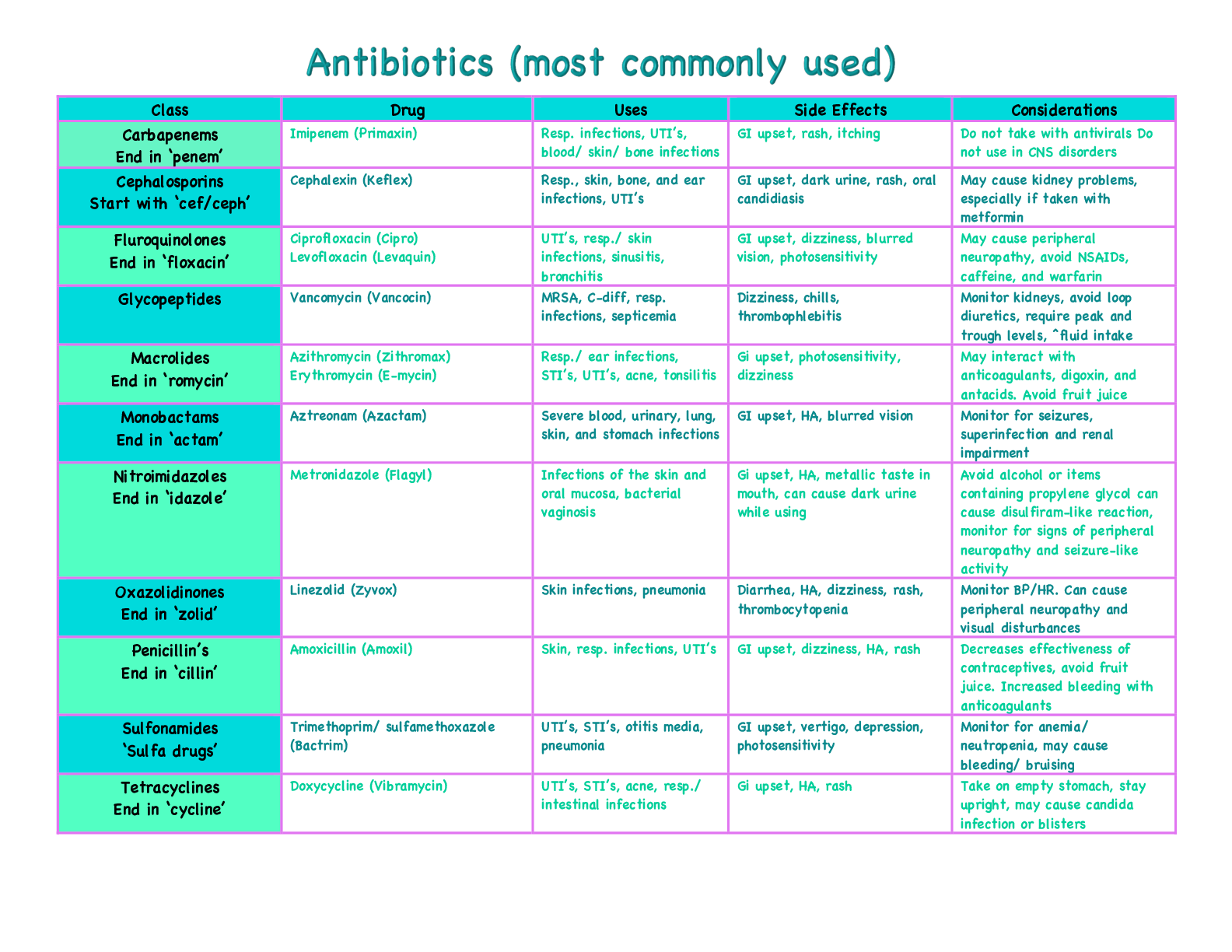
Antibiotic
Aminoglycocides: Adverse Effects are bean shaped - Nephrotoxic to Kidneys and Ototoxic to Ears
o __Mycin (drugs that end in or have in their name); except erythromycin (have
-thro- in drug name)
Sulfamethoxazole/trimethoprim : an antibiotic; common side effect is diarrhea (drink plenty of fluids); do not take if allergic to sulfa drugs
Anticholinergic---- INE ending**
Anticholinergic effects –– assessment o dry mouth – can't spit
o urinary retention – can't piss o constipated – can't shit
o blurred vision – can't see
Atropine used to decrease secretions & asystole
Atropine blocks acetylcholine (remember acetylcholine reduces secretions)
Atropine OD
Hot as a Hare (Temp) Mad as a Hatter (LOC) Red as a Beet (flushed face) Dry as a Bone (Thirsty)
Benztropine: Treats Parkinson as well as extrapyramidal side effects of other drugs
Anticonvulsants
Phenytoin : treatment of seizures; therapeutic drug level: 10-20; contraindicated during pregnancy; Side effects include rash (stop med if seen), gingival hyperplasia (can be prevented w/ good hygiene).
o Dilantin Toxicity → poor gait + coordination, slurred speech, nausea, lethargy,
diplopia
Phenobarbital: treatment of epilepsy; can be taken during pregnancy
Antidepressants
Zoloft/Sertraline: side effects include agitation, sleep disturb, and dry mouth (SSRI)
MAOI’s: antidepressant
An easy way to remember MAOI'S! think of PANAMA! PA – parnate- Tranylcypromine
NA – nardil- Phenelzine
MA – marplan- Isocarboxazid
MAOI's used for depression all have an arrr sound in the middle (Parnate, Marplan,
Nardil) – Remember that Pirates say arrr, so think “pirates take MAOI's when they're depressed”
They have metallic bitter taste
Antifungal
Amphotericin B: This medication causes hypokalemia (amongst many other side effects as well); patient will most likely get a fever; pre-medicate with acetaminophen and/or diphenhydramine (preferably both) before administering to a patient
Antiemetic should
Trimethobenzamide : Treatment of postop nausea and vomiting, and for nausea associated with gastroenteritis
Promethazine : an antiemetic used to reduce nausea
Anti-gout Agents
Probenecid, Colchicine, Allopurinol
Allopurinol: Push with fluids, in order to flush the uric acid out of system; DO NOT TAKE W/ VITAMIN C
Antihypertensives
hydralazine: treatment of HTN or CHF, Report flu-like symptoms, rise slowly from sitting/lying position; take with meals.
Antimanic
Lithium:
L-level of therapeutic effect is 0.5-1.5
I-indicate mania
T-toxic level is 2-3 - nausea & vomiting, diarrhea, tremors
H-hydrate 2-3L of water/day
I-increased Urinary output and dry mouth
U-uh oh; give Mannitol and Diamox if toxic signs and symptoms are present M-maintain Na intake of 2-3g/day*
Antimetabolites
Hydroxyurea: treatment of sickle cell & certain types of leukemia; when used to Tx sickle cell, report GI symptoms immediately, could be sign of toxicity
Antineoplastic
vincristine: treatment of leukemia; given IV ONLY
Asparaginase: treatment for acute lymphoblastic leukemia; Test for hypersensitivity prior to administration
Antiparkinsonian Agents
Car bidopa-Levodopa: treatment of Parkinson; side effects include drowsiness and the patient’s sweat, saliva, urine may occasionally turn reddish brown; contraindicated with MAOI's
Trihexyphenidyl treatment of Parkinson, causes sedation
Levodopa: Contraindicated in patients’ w/ glaucoma, avoid B6
Antipsychotics
● Risperidone: Doses over 6mg can cause tardive dyskinesia, this is a first line antipsychotic in children
● Clozapine: Side effects include agranulocytosis, tachycardia, and seizures, WATCH FOR INFECTION*
● Thiothixene: treatment of schizophrenia; assess for EPS
● Haloperidol: preferred antipsychotic in elderly, but it has a high risk of extrapyramidal side effects (dystonia, tardive dyskinesia, tightening of jaw, stiff neck, swollen tongue, later on swollen airway)
o The nurse must monitor for early signs of reaction and give IM Benadryl ● 1st generation antipsychotics are the leading cause of Akathisia
Akathisia is characterized by motor restlessness, i.e. a need to keep going
Can be mistaken for agitation
Treated with Anti Parkinson's meds
Anti-rheumatics
Indomethacin: an NSAID; treatment of arthritis (osteo, rheumatoid, gouty), bursitis, and tendonitis.
Antispasmodics
dicycl omine: treatment of irritable bowel; assess for anticholinergic side effects.
Antitubercular
Rifampin: Red orange tears and urine (b/c it dyes bodily fluid orange); contraceptives don't work as well
Ethambutol: messes with your Eyes
Isoniazid (INH): treatment & prevent TB; it can cause peripheral neuritis/neuropathy (nerve damage); do not give with Phenytoin → can cause phenytoin toxicity; monitor LFT's; give B6 along with; hypotension will occur initially, then resolve
TB drugs are liver toxic (hepatotoxic).
An adverse reaction is peripheral neuropathy
Ask patients if they have Hep B
Antithyroid
PTU and Tapazole: Tx of hyperthyroidism & prevention of thyroid storm
Lugol’s Solution: adjunct Tx for hyperthyroidism as well as radiation protectant. An
adverse reaction: Burning sensation in the mouth, and brassy taste. Report it to the doctor.
Antiulcer
Aluminum hydroxide : treatment of GERD and kidney stones, watch out for constipation.
o Long term use of amphogel (binds to phosphates, increases Ca, robs the bones...leads to increased Ca reabsorption from bones → WEAK BONES)
o Amphogel and Renegal should be taken with meals
Sucralfate: treatment of duodenal ulcers, this medication coats the ulcer by creating a mucosal barrier, so the patient should take this medication before meals; be aware of constipation as a potential side effect
Cimetidine: an H2 antagonist taken with food; use cautiously in the elderly population; interacts with a lot of other drugs
Peptic ulcers caused by H. pylori are treated with Flagyl, Prilosec and Biaxin. This treatment kills bacteria and stops production of stomach acid but does not heal ulcer.
Antiviral
Ganciclovir: used for retinitis caused by cytomegalovirus, patient will need regular eye exams, report dizziness, confusion, or seizures immediately
Anthelmintic/Anti-worm
Mebendazole: Administer this medication with a high fat diet as this increase’s absorption
Beta Blockers
Timolol: treatment of glaucoma
Bronchodilators
Theo phylline : Tx of asthma or COPD; therapeutic drug level is 10-20; increases the risk of digoxin toxicity and decreases the effects of lithium and Phenytoin; causes GI upset, give with food
CNS Stimulants
Dexedrine: treatment of ADHD; may alter insulin needs; avoid taking with MAOI's; take in morning (insomnia possible side effect)
Methylphenidate: Tx of ADHD; assess for heart related side effects, report them immediately; child may need a drug holiday b/c it stunts growth.
Digestive Agent
Pancre alipase: These are pancreatic enzymes, which are to be taken with each meal! Not before, not after, but W/ each meal.
Diuretics
● Mannitol (osmotic diuretic) : used for Head injuries; it crystallizes at room temp so ALWAYS use filter needle
● Acetazolamide: Tx of glaucoma, & high-altitude sickness; do not take if allergic to sulfa drugs; may cause hypokalemia
● Lasix: Tx of edema due to heart failure; can cause a patient to lose his appetite (anorexia) due to reduced potassium
o Patients receiving Lasix and Dig, need to be getting enough potassium, b/c low potassium potentiates Dig Toxicity and can cause dysrhythmias.
Hormones
● Levothyroxine: Tx of hypothyroidism, this medication may take several weeks to take effect; notify doctor of chest pain; take in the AM on empty stomach ; may cause hyperthyroidism
o Insomnia is a side effect of thyroid hormones (Ex: Synthroid) → Increases met. rate, your body is "too busy to sleep" as opposed to the folks with hypothyroidism who may report somnolence (dec. met rate, body is slow and sleepy).
● Conjugated estrogens: treatment occurs after menopause for estrogen replacement
Hypokalemic
Sodium Polystyrene Sulfonate: When giving administering this drug, we need to worry about dehydration (K has inverse relationship with Na)
o Don’t use this medication if patient has hypoactive bowel sounds.
Opioid Analgesics
Meperidine : Tx for moderate to severe pain; used for patients with pancreatitis (these patients could NOT receive morphine sulfate); Do not give Demerol to pts. with sickle cell crisis
Pediculocides
Lindane : Tx of scabies and lice;
Scabies ~ apply lotion once and leave on for 8-12 hours
Lice ~ use the shampoo and leave on for 4 minutes with hair uncovered then rinse with warm water and comb with a fine-tooth comb
Skeletal Muscle Relaxant
● Dantrolene: treatment for spasticity, associated w/ spinal cord injury, stroke, cerebral palsy, or MS; it may take a week or more to be effective.
● succinylcholine: is used for short-term neuromuscular blocking agent for procedures like intubation and ECT.
● Vecuronium Bromide: an adjunct medication for general anesthesia-induced muscle
relaxation for endotracheal intubation/mechanical ventilation, it’s used for intermediate or long-term.
Statins
Simvastatin’s: Treatment for hyperlipidemia; take on empty stomach to enhance absorption; report any unexplained muscle pain, especially if fever is present
Sympathomimetic
Dopamine (Intropine): Tx of hypotension, shock, low cardiac output, poor perfusion to vital organs; monitor EKG for arrhythmias, and BP
Vasodilators
Nitroprusside: When the patient is on this medication, monitor thiocyanate (cyanide). The normal value should be 1, >1 is heading toward toxicity
Endocrine Diseases
Addison’s: hypoNa, hyperK, hypoglycemia, dark pigmentation, decreased resistance to stress, fractures, alopecia, weight loss, GI distress – Addison's disease (need to "add" hormone)
Blood pressure is the most important assessment parameter in Addison’s, as it causes severe hypotension.
Addisonian Crisis: Nausea & vomiting, confusion, abdominal pain, extreme weakness, hypoglycemia, dehydration, decreased BP
Managing stress in a patient with adrenal insufficiency ( Addison’s) is paramount, because if the adrenal glands are stressed further it could result in Addisonian crisis.
Cushing’s : hyperNatremia, hypoKalemia, hyperglycemia, prone to infection, muscle wasting, weakness, edema, HTN, hirsutism, moon-face/buffalo hump – Cushing's syndrome (have extra "cushion" of hormones)
Sex Salt Sugar
Addison’s ↓ ↓ ↓
Cushing’s ↑ ↑ ↑
OR
Addison’s= down, down, down, up, down
Cushing’s= up, up, up, down, up
Addison’s= hyponatremia, hypotension, decreased blood vol, hyperkalemia, hypoglycemia Cushing’s= hypernatremia, hypertension, increased blood vol, hypokalemia, hyperglycemia
Addison's disease (need to "add" hormone)
Cushing's syndrome (have extra "cushion" of hormones)
Diabetes Insipidus (decreased ADH): excessive urine output and thirst, dehydration, weakness; administer Vasopressin
SIADH (increased ADH): change in LOC, decreased deep tendon reflexes, tachycardia, n/v/a, HA; administer Declomycin, diuretics
Hyper-parathyroid: fatigue, muscle weakness, renal calculi, back and joint pain (increased calcium); diet should consist of low Ca, & high phosphorus diet (Calcium and phosphorus has inverse relationship)
Polyuria is common with the hypercalcemia caused by hyperparathyroidism. Hypo-parathyroid: CATS – convulsions, arrhythmias, tetany, spasms, stridor, & decreased calcium; diet should consist of high Ca, & low phosphorus diet
Hyperthyroidism/Graves’ disease: accelerated physical and mental function; sensitivity to heat, fine/soft hair
For HYPERthyroidism think of MICHAEL JACKSON in THRILLER! SKINNY, NERVOUS, BULDGING EYES, up all night, heart beating fast
Thyroid Storm: is HOT (hyperthermia), ↑ HR, & HTN
Hypothyroidism/Myxedema: slowed physical and mental function, sensitivity to cold, hypothermia, dry skin and hair
Post-thyroidectomy: Must watch for hypercortisolism and temporary diabetes insipidus. Position the patient in semi-Fowler’s, prevent neck flexion/hyperextension, and have trach at bedside
Pheochromocytoma: hypersecretion of too much of epi/norepi, persistent HTN, increased HR, hyperglycemia, diaphoresis, tremor, pounding heart; avoid stress, frequent bating and rest breaks, avoid cold and stimulating foods, surgery to remove tumor
Pancreatitis: Pt is placed in fetal position, maintain NPO, gut rest, prepare antecubital site for PICC b/c will probably be receiving TPN/Lipids. After pain relief, cough and deep breathe is important because of fluid pushing up in the diaphragm.
Hepatitis
Hepatitis B = Blood and Bodily fluids
Anaphylactic reaction to baker's yeast is contraindication for Hep B vaccine. Hepatitis C = is just like B
During the acute stage of Hep-A gown and gloves are required.
In the convalescent stage it is no longer contagious.
Eyes & Ears
Ears
Pull pinna down and back for kids < 3 yrs. when instilling eardrops
Meniere's Disease
Tx: Admin diuretics to decrease endolymph in the cochlea
Nursing Care: restrict Na, lay on affected ear when in bed Triad:
1)Vertigo
2)Tinnitus
3)Nausea & vomiting
Strabismus Treatment is BOTOX
Patch the GOOD eye, so that the weaker eye can get stronger.
Botox can be used with strabismus to relax vocal cords in spasmodic dysphonia.
Eyes
OU – Both eyes
OS – Left eye
OD – Right eye (dominant Right eye – just a tip to remember)
General Notes for Eyes
Assessing extraocular eye movements check cranial nerves 3 (oculomotor), 4 (trochlear), and 6 (Abducens).
Glaucoma intraocular pressure is greater than the normal (22 mm Hg), give miotic to constrict (pilocarpine), NO ATROPINE
Apply eye drop to conjunctival sac and afterwards apply pressure to nasolacrimal duct / inner canthus
Fluid & Electrolyte Imbalances
Hypovolemia (FVD) – increased temp, rapid/weak pulse, increase respiration, hypotension, anxiety, urine specific gravity >1.030. (More U Specificity means urine more concentrated. More particles in urine and less dilution)
Hypervolemia (FVE) – bounding pulse, SOB, dyspnea, rales/crackles, peripheral edema, hypertension, urine specific gravity <1.010; Semi-Fowler’s
Fluid volume overload caused by IVC fluids infusing too quickly and CHF can cause an S3 heart sound.
Hyponatremia: nausea, muscle cramps, increased ICP, muscular twitching, convulsion; osmotic diuretics, fluids






.png)