Primary Care, A Collaborative Practice, 5th Ed.
Test Bank for Primary Care A Collaborative Practice,
5th Edition
Chapter 1: The Evolving Landscape of Collaborative Practice
Test Bank
Multiple Choice
1. Which assess
...
Primary Care, A Collaborative Practice, 5th Ed.
Test Bank for Primary Care A Collaborative Practice,
5th Edition
Chapter 1: The Evolving Landscape of Collaborative Practice
Test Bank
Multiple Choice
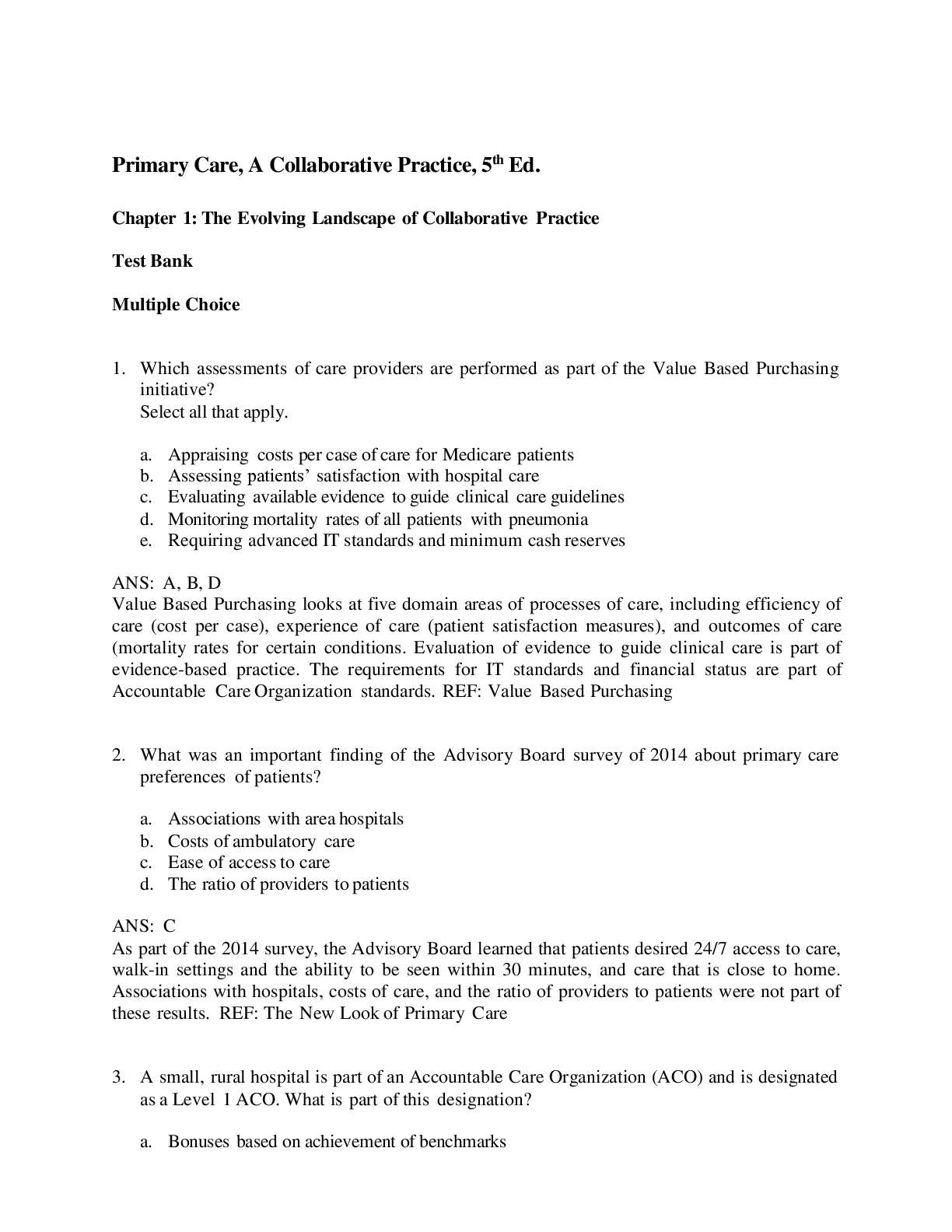
1. Which assessments of care providers are performed as part of the Value Based Purchasing
initiative?
Select all that apply.
a. Appraising costs per case of care for Medicare patients
b. Assessing patients’ satisfaction with hospital care
c. Evaluating available evidence to guide clinical care guidelines
d. Monitoring mortality rates of all patients with pneumonia
e. Requiring advanced IT standards and minimum cash reserves
ANS: A, B, D
Value Based Purchasing looks at five domain areas of processes of care, including efficiency of
care (cost per case), experience of care (patient satisfaction measures), and outcomes of care
(mortality rates for certain conditions. Evaluation of evidence to guide clinical care is part of
evidence-based practice. The requirements for IT standards and financial status are part of
Accountable Care Organization standards. REF: Value Based Purchasing
2. What was an important finding of the Advisory Board survey of 2014 about primary care
preferences of patients?
a. Associations with area hospitals
b. Costs of ambulatory care
c. Ease of access to care
d. The ratio of providers to patients
ANS: C
As part of the 2014 survey, the Advisory Board learned that patients desired 24/7 access to care,
walk-in settings and the ability to be seen within 30 minutes, and care that is close to home.
Associations with hospitals, costs of care, and the ratio of providers to patients were not part of
these results. REF: The New Look of Primary Care
3. A small, rural hospital is part of an Accountable Care Organization (ACO) and is designated
as a Level 1 ACO. What is part of this designation?Test Bank 2
a. Bonuses based on achievement of benchmarksButtaro: Primary Care, A Collaborative Practice, 5th Ed.
b. Care coordination for chronic diseases
c. Standards for minimum cash reserves
d. Strict requirements for financial reporting
ANS: A
A Level 1 ACO has the least amount of financial risk and requirements, but receives shared
savings bonuses based on achievement of benchmarks for quality measures and expenditures.
Care coordination and minimum cash reserves standards are part of Level 2 ACO requirements.
Level 3 ACOs have strict requirements for financial reporting. REF: Accountable Care
OrganizationsTest Bank 2
Chapter 2: Transitional Care
Test Bank
Multiple Choice
1. To reduce adverse events associated with care transitions, the Centers for Medicare and
Medicaid Service have implemented which policy?
a. Mandates for communication among primary caregivers and hospitalists
b. Penalties for failure to perform medication reconciliations at time of discharge
c. Reduction of payments for patients readmitted within 30 days after discharge
d. Requirements for written discharge instructions for patients and caregivers
ANS: C
As a component of the Affordable Care Act, the Centers for Medicare and Medicaid Service
developed the Readmissions Reduction Program reducing payments for certain patients
readmitted within 30 days of discharge. The CMS did not mandate communication, institute
penalties for failure to perform medication reconciliations, or require written discharge
instructions. REF: Transitional Care
2. According to Naylor’s transitional care model, which intervention has resulted in lower costs
and fewer rehospitalizations in high-risk older patients?
a. Coordination of post-hospital care by advanced practice nurses
b. Frequent post-hospital clinic visits with a primary care provider
c. Inclusion of extended family members in the outpatient plan of care
d. Telephone follow up by the pharmacist to assess medication compliance
ANS: A
Naylor’s transitional care model provided evidence that high risk older patients who had posthospital care coordinated by an APN had reduced rehospitalization rates. It did not include clinic
visits with a primary care provider, inclusion of extended family members in the plan of care, or
telephone follow up by a pharmacist. REF: Transitional Care
3. Which approaches are among those recommended by the Agency for Healthcare Research
and Quality to improve health literacy in patients?
Select all that apply.
a. Empowering patients and families
b. Giving written handouts for all teachingButtaro: Primary Care, A Collaborative Practice, 5th Ed.
c. Highlighting no more than 7 key points
d. Repeating the instructions
e. Supplementing teaching with visual aids
ANS: A, D, E
AHRQ recommends using clear, simple language, highlighting 3 to 5 key points, using pictures
or visual aids, repeating the instructions, using Teach Back, and empowering patients. Written
communication is not part of the recommendations. REF: Health LiteracyTest Bank 2
Chapter 3: Translating Research Into Clinical Practice
Test Bank
Multiple Choice
1. Which is the most appropriate research design for a Level III research study?
a. Epidemiological studies
b. Experimental design
c. Qualitative studies
d. Randomized clinical trials
ANS: B
The experimental design is the most appropriate design for a Level III study. Epidemiological
studies are appropriate for Level II studies. Qualitative designs are useful for Level I studies.
Randomized clinical trials are used for Level IV studies. REF: Level III Research/Experimental
Design
2. What is the purpose of clinical research trials in the spectrum of translational research?
a. Adoption of interventions and clinical practices into routine clinical care
b. Determination of the basis of disease and various treatment options
c. Examination of safety and effectiveness of various interventions
d. Exploration of fundamental mechanisms of biology, disease, or behavior
ANS: C
Clinical research trials are concerned with determining the safety and effectiveness of
interventions. Adoption of interventions and practices is part of clinical implementation.
Determination of the basis of disease and treatment options is part of the pre-clinical research
phase. Exploration of the fundamental mechanisms of biology, disease, or behavior is part of the
basic research stage. REF: Translational Science Spectrum
3. What is the purpose of Level II research?
a. To define characteristics of interest of groups of patients
b. To demonstrate the effectiveness of an intervention or treatment
c. To describe relationships among characteristics or variables
d. To evaluate the nature of relationships between two variables
ANS: CButtaro: Primary Care, A Collaborative Practice, 5th Ed.
Level II research is concerned with describing the relationships among characteristics or
variables. Level I research is conducted to define the characteristics of groups of patients. Level
II research evaluates the nature of the relationships between variables. Level IV research is
conducted to demonstrate the effectiveness of interventions or treatments. REF: Level II
ResearchTest Bank 2
Chapter 4: The Patient, the Provider, and Primary Care: An Integrated Perspective
Test Bank
Multiple Choice
1. A patient takes glucosamine chondroitin to help control osteoarthritis pain. Which
medications, taken in conjunction with this medication, are of concern?
a. Anticholinergic drugs
b. Beta blocker medications
c. Blood-thinning agents
d. Narcotic analgesics
ANS: C
Glucosamine chondroitin can prolong bleeding if taken with other blood-thinning agents. It does
not have anticholinergic effects, cardiac effects or analgesic effects. REF: Alternative Therapies
for Common Chronic Conditions/Joint Pain
2. The provider learns that a patient is taking herbal supplements for a variety of reasons. What
is an important point to discuss with this patient about taking such supplements?
a. Because they are not FDA approved, they are not safe
b. Dietary supplements are safer than most prescription medications
c. Many supplements lack clear clinical evidence of efficacy
d. Supplements should not be taken with prescription medications
ANS: C
Many dietary supplements lack clinical evidence to support their use. Even though they are not
FDA approved, federal law mandates that the products are safe and cannot make misleading
claims about use. Supplements are not necessarily safer than prescription drugs. Supplements
may be taken with prescription medications as long as the effects, side effects, and drug
interactions are known. REF: Alternative Therapies for Common Chronic Conditions
3. Which dietary supplements have shown some effectiveness in reducing blood pressure in
patients with hypertension?
Select all that apply.
a. Chromium picolinate
b. Cinnamon
c. CoQ10Buttaro: Primary Care, A Collaborative Practice, 5th Ed.
d. Garlic extract
e. L-arginine
ANS: C, D, E
CoQ10, garlic extract, and L-arginine have demonstrated effectiveness in reducing blood
pressure in some studies. Chromium picolinate and cinnamon have been studied for effects on
glucose tolerance and fasting glucose. REF: Alternative Therapies for Common Chronic
Conditions/Prehypertension and HypertensionTest Bank 2
Chapter 5: Population-Based Care for Primary Care Providers
Test Bank
Multiple Choice
1. Which are key components of the Patient-Centered Medical Home?
Select all that apply.
a. Access to care
b. Comprehensive care
c. Coordination of care
d. Provision of care by a single provider
e. Storage of medical records
ANS: A, B, C
The Patient-Centered Medical Home is a team-based approach to providing care that is
accessible, comprehensive, coordinated, longitudinal and high quality. It is not provided by a
single provider, but is managed as a team. The original concept had to do with where medical
records are stored, but this is not the working definition today. REF: The Patient-Centered
Medical Home
2. The chronic care model (CCM) was developed to manage patients with complicated chronic
conditions because the traditional acute care model
a. could not provide efficient and cost-effective chronic care.
b. did not meet longitudinal health care needs for this population.
c. did not offer ambulatory care services for these patients.
d. put patients and families at the center of care.
ANS: B
The chronic care model was developed based on the recognition that the traditional acute care
model did not meet longitudinal health care needs of patients with chronic and complicated
conditions, not because of inefficiencies or costs. The traditional model does include ambulatory
care, but that is not the focus. The traditional model does not typically place patients at the center
of care. REF: Chronic Care Model
3. What are functions of patient registries in the chronic care model?
Select all that apply.
a. Alerting providers to medication interactionsButtaro: Primary Care, A Collaborative Practice, 5th Ed.
b. Identifying appropriate specialists for referral
c. Recommending routine screenings
d. Reminding providers about immunizations
e. Transmitting clinical data about patients
ANS: A, C, D, E
Patient registries are used to help manage patients at risk and include alerting providers about
medication interactions, recommending routine screenings, reminders for immunizations, and
transmitting clinical data. They are not used to identify or recommend providers or specialists.
REF: Chronic Care Model/Clinical Information Systems
********************************** CONTINUED IN THE ATTACHMENT ***********************************
[Show More]


.png)










.png)