NR 508 Midterm Exam Consist of 50 Questions From a Random Test Bank of Questions from Chapters 1-4 (including Week 4 Content) and All Embedded Recorded Lectures.
Information is taken from the following Areas: Highlighte
...
NR 508 Midterm Exam Consist of 50 Questions From a Random Test Bank of Questions from Chapters 1-4 (including Week 4 Content) and All Embedded Recorded Lectures.
Information is taken from the following Areas: Highlighted areas are areas to help you understand the concepts better they are in NO way an indication of what you are guaranteed to see on the exam. Remember these are random some of your classmates may not have the same question that appear on your exam. PLEASE NOTE that this study guide may not be inclusive of all topics you may see on the exam
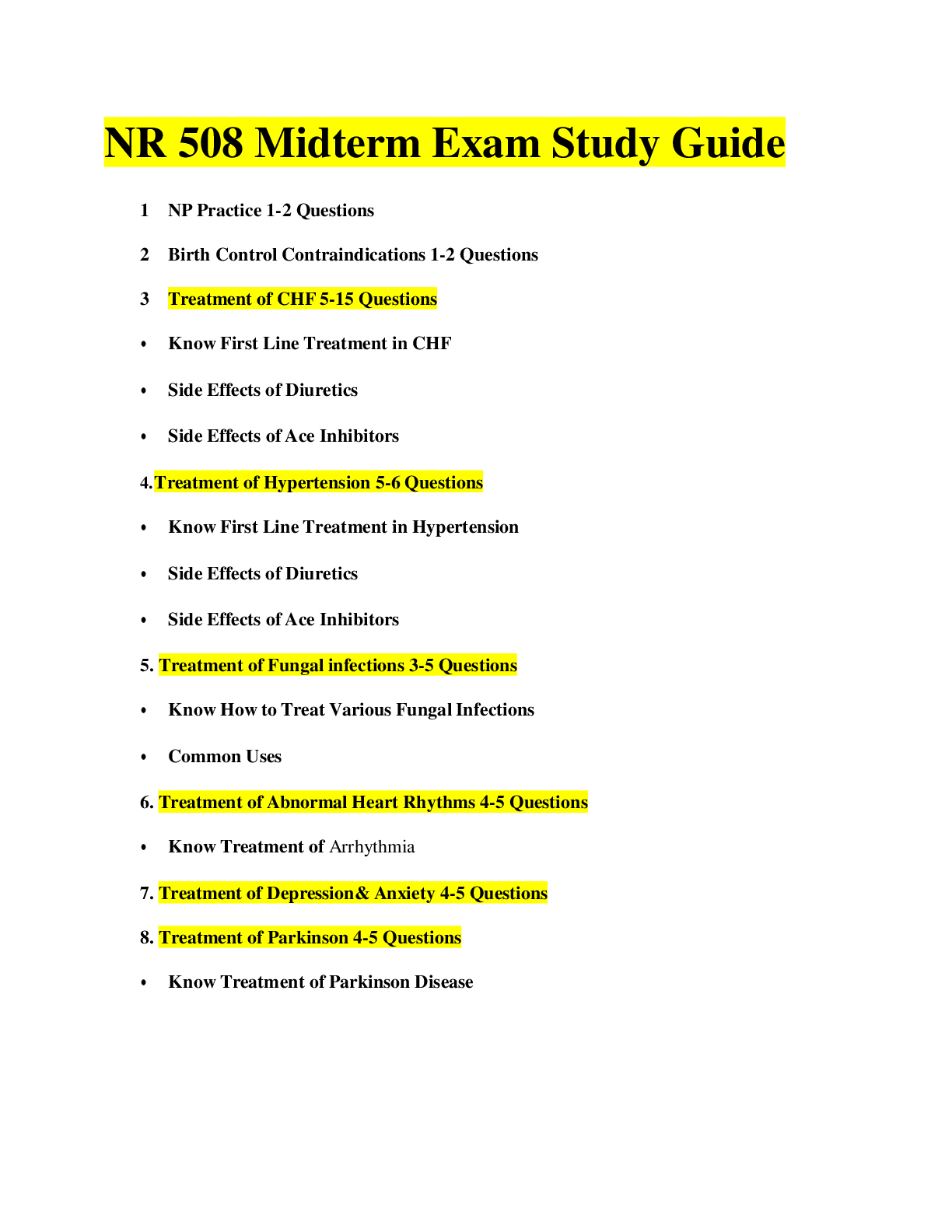
1 NP Practice 1-2 Questions
2 Birth Control Contraindications 1-2 Questions
3 Treatment of CHF 5-15 Questions
• Know First Line Treatment in CHF
• Side Effects of Diuretics
• Side Effects of Ace Inhibitors
4. Treatment of Hypertension 5-6 Questions
• Know First Line Treatment in Hypertension
• Side Effects of Diuretics
• Side Effects of Ace Inhibitors
5. Treatment of Fungal infections 3-5 Questions
• Know How to Treat Various Fungal Infections
• Common Uses
6. Treatment of Abnormal Heart Rhythms 4-5 Questions
• Know Treatment of Arrhythmia
7. Treatment of Depression& Anxiety 4-5 Questions
8. Treatment of Parkinson 4-5 Questions
• Know Treatment of Parkinson Disease
9. Treatment of Alzheimer’s 4-5 Questions
10. Treatment of Acne 1-2 Questions
11. Clotting Factor in Vitamin K1-2 Questions
CONGESTIVE HEART FAILURE (CHF): *Refer to your CHF PowerPoint Slides
• EPIDEMIOLOGY:
o Most common cause of hospitalization over 65 years of age.
o Afflicts more than 2 million Americans annually.
o 900,000 hospitalization per year.
o PROGNOSIS: Poor
▪ Untreated, 82% of men die within 6 years of onset.
▪ Untreated, 67% of women die within 6 years of onset.
▪ Treated, mortality was reduced to 40%
Causes: Myocardial Infarction, hypertension, coronary artery disease, Hyperthyroidism,
Beriberi, anemia, arteriovenous shunts.
• HEMODYNAMIC PROPERTIES: Consequences of CHF
o Subnormal Cardiac Output > decreased exercise tolerance, tachycardia,
pulmonary edema, cardiomegaly
o Neurohumoral Reflexes: Reflex tachycardia, increased sympathetics, increased Renin.
o Myocardial Hypertrophy occurs, to maintain cardiac performance.
▪ Ventricular dilation helps to maintain cardiac output to an extent (due to Starling's Law), but past a certain point it can no longer help.
o Factors affecting cardiac performance:
▪ Higher preload: due to increased blood volume and venous tone.
▪ Higher afterload: due to hypertension, increased arterial tone.
▪ Lower contractility > lower inotropic state
▪ Higher heart rate, due to reflex tachycardia
o Edema: Especially pulmonary edema, but also peripheral. Results from decreased Cardiac Output, by two mechanisms:
▪ Decreased CO ------> impaired venous return > higher capillary
hydrostatic pressure
▪ Decreased CO ------> decreased renal perfusion > activate renin
angiotensin system RAS > aldosterone causes higher Na+ and fluid
retention.
............................................................CONTINUED...............................................................
[Show More]