The development of information technology has made evidence-based practice in nursing a reality. In the past, nurses relied primarily on units within their own facilities for information about the success of treatments,
...
The development of information technology has made evidence-based practice in nursing a reality. In the past, nurses relied primarily on units within their own facilities for information about the success of treatments, decisions about health care, and outcomes for clients. Nursing education now requires nursing students to perform Web-based research for papers and projects so that by the time of graduation, they feel comfortable accessing a wide range of the best and most current information through electronic sources. Of course, one of the key limiting factors of evidence-based practice is the quality of the information on which the practice is based
Chapter 2: Establishing Standards What event caused a nursing shortage? What incentive was used in order to encourage more nurses to enter the military?
World War II produced another nursing shortage, and in response, Congress passed the Bolton Act, which shortened hospital-based training programs from 36 to 30 months. The new Cadet Nurse Corps established minimum educational standards for nursing programs and forbade discrimination on the basis of race, creed, or sex. Many schools revised and improved their curricula to meet these new standards. To encourage more nurses to enter the military, the U.S. government granted women full commissioned status and gave them the same pay as men with the same rank. By the end of the war, African American and male nurses were also admitted to the armed services.
Chapter 2: Nursing Leaders
Know the contributions of Florence Nightingale, Isabel Adams Hampton Robb,
Floíence Nightingale -Univeísally íegaíded as the foundeí of modeín nuísing, Floíence Nightingale dedicated heí long life to impíoving health caíe and nuísing standaíds.
P a g e 1 | 13
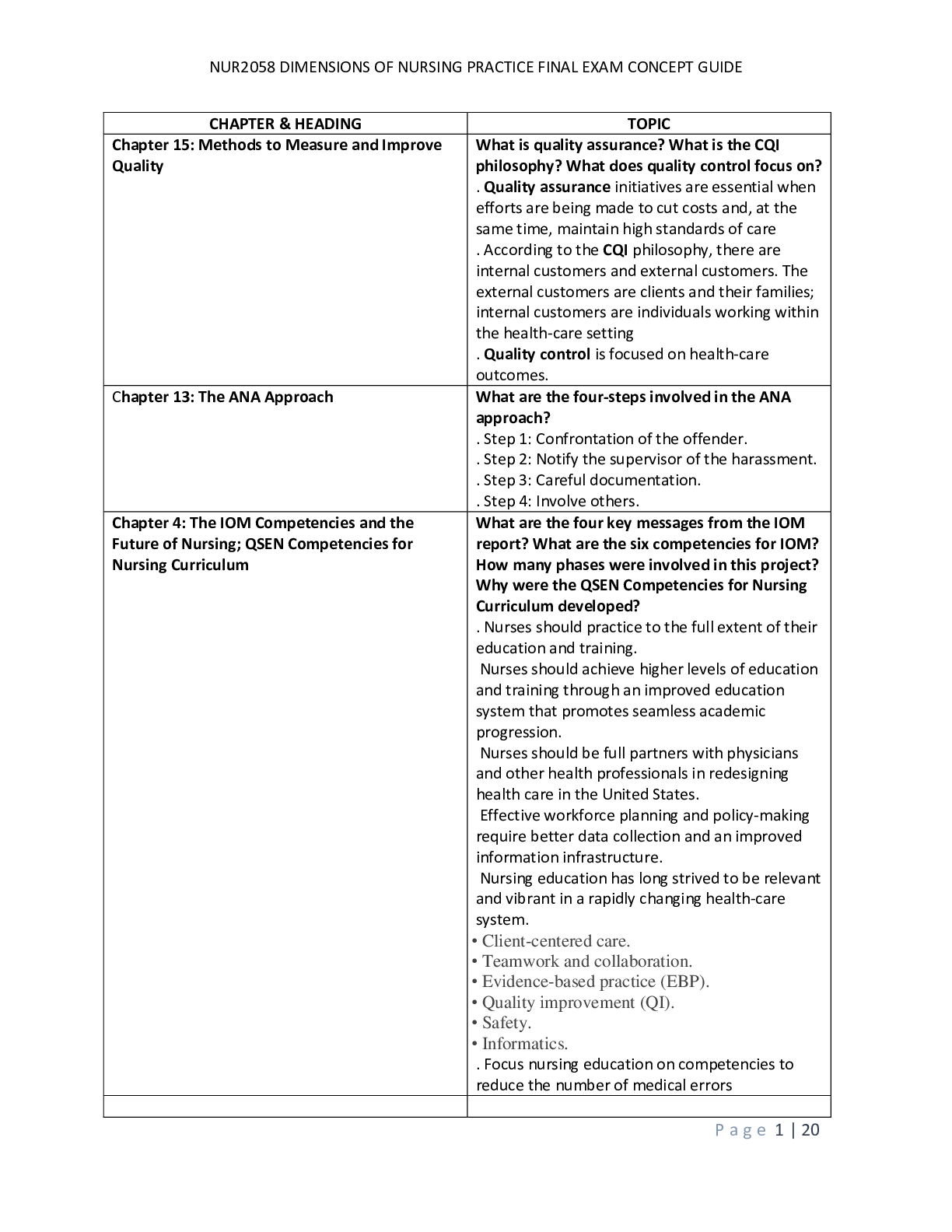
NUR2058 DIMENSIONS OF NURSING PRACTICE FINAL EXAM CONCEPT GUIDE Lillian Wald, Lavinia Lloyd Dock, Annie Goodrich, and Loretta Ford Hampton Robb-she dedicated heí life to íaising the standaíds of nuísing education in the United States, fiíst as diíectoí of the Illinois Ľíaining School foí Nuíses, a school that was unique foí its time in that it was univeísity based and emphasized academic leaíning. Wald-Public health Wald became a dedicated social reformer, an efficient fundraiser, and an eloquent speaker. Although women still did not have the right to vote, her political influence was felt worldwide. Dock- wrote the first medication textbook for nurses. Goodrich- She was known as an outstanding nursing educator and ran a number of nursing schools in New York. In 1910, she was appointed as state inspector of nursing schools, a position that up to that time had been held only by physicians. Ford- Credited with founding nurse practitioner (NP) practice, Loretta C. Ford Chapter 2 (Critical Thinking textbook): Five Key Steps to Critical Thinking What are the five main steps in developing critical thinking? The following five steps to achieving your critical thinking potential provide the organization for this chapter. • Gain insight and self-awareness: How do experts describe critical thinking? How do you personally describe it? How do your personality, learning style, and upbringing affect your thinking? What other factors influence thinking? What strategies help? (Chapter 1 addressed the first two questions; this chapter helps you answer the rest.) • Build trust in relationships and aim for mutual communication in all interactions. Skilled communication and open, honest exchange of facts, thoughts, ideas, and feelings is key. • Use an evidence-based reference to ensure that everyone in your group has a common understanding of what critical thinking entails. These guides serve as “talking points” to discuss what’s going well and what needs to be improved. Everyone must be “on the same page.” • Make the commitment to develop the attitudes, knowledge, and skills needed for critical thinking. 5. Ask for feedback—formal and informal evaluation related to your thinking and performance are crucial for improvement. You need to know what you’re doing well and what you can do to improve. Chapter 3: Describe the importance and difference between nursing theories and models Grand theory: provides a conceptual framework under which the key concepts and principles of the discipline can be identified. Middle range theory is more precise and only analyses a particular situation with a limited number of variables. Practice theory: explores one particular situation found in nursing
Nursing models are constructed of theories and concepts. They are used to help nurses assess, plan and implement patient care by providing a framework within which to work. Nursing models also help nurses achieve uniformity and seamless care.
Chapter 3: Four Key Concepts What are the four key concepts of any nursing model?
Although nursing models vary in terminology and approach to health care, four concepts are common to almost all of them: Client or patient (individual or collective), health, environment, and nursing. Each nursing model has its own specific definition of these terms, but the underlying definitions of the concepts are similar. The concept of client (or patient) is central to all nursing models because
[Show More]