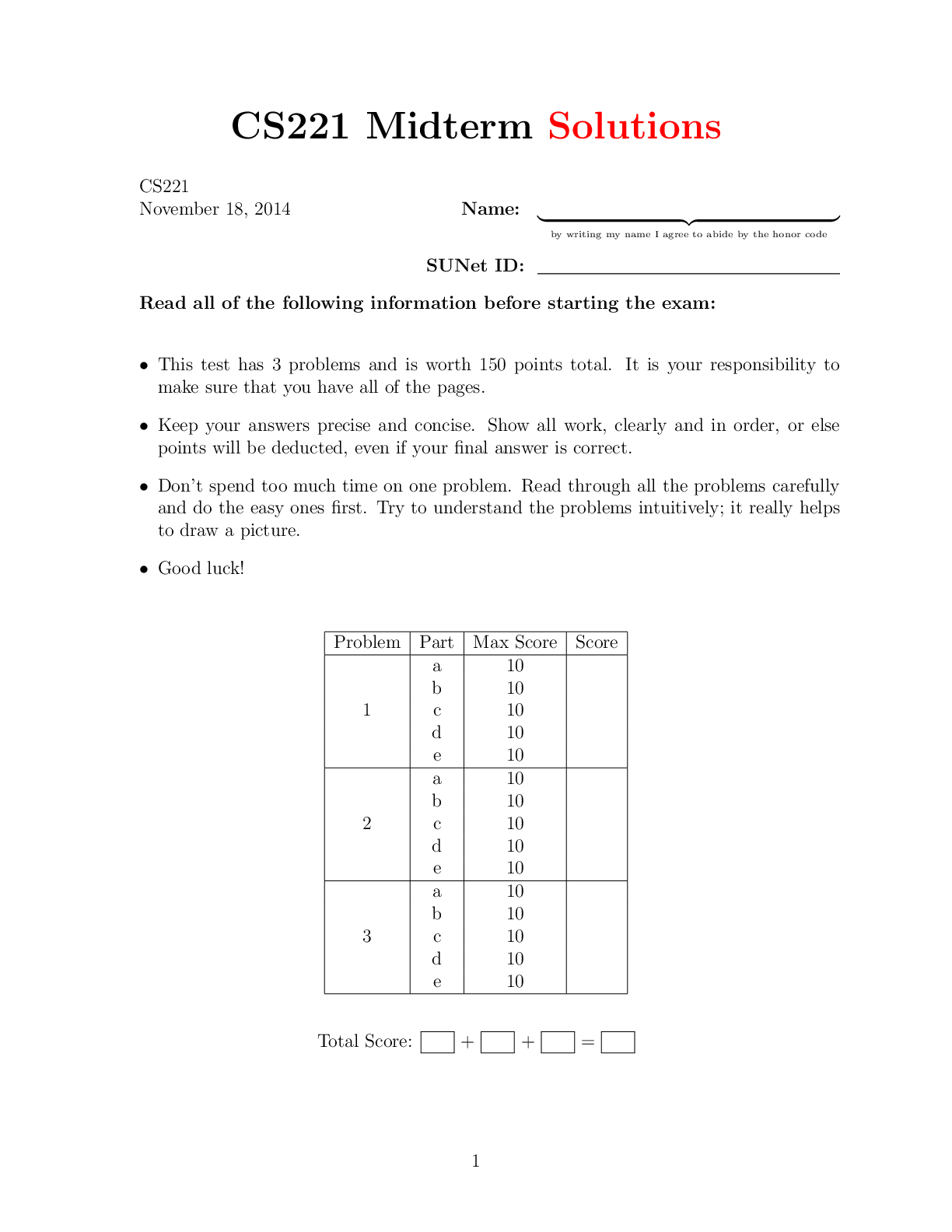
CS221 Midterm Solutions
CS221
November 18, 2014 Name:
| {z }
by writing my name I agree to abide by the honor code
SUNet ID:
Read all of the following information before starting the exam:
• This test has 3 proble
...
CS221 Midterm Solutions
CS221
November 18, 2014 Name:
| {z }
by writing my name I agree to abide by the honor code
SUNet ID:
Read all of the following information before starting the exam:
• This test has 3 problems and is worth 150 points total. It is your responsibility to
make sure that you have all of the pages.
• Keep your answers precise and concise. Show all work, clearly and in order, or else
points will be deducted, even if your final answer is correct.
• Don’t spend too much time on one problem. Read through all the problems carefully
and do the easy ones first. Try to understand the problems intuitively; it really helps
to draw a picture.
• Good luck!
Problem Part Max Score Score
1
a 10
b 10
c 10
d 10
e 10
2
a 10
b 10
c 10
d 10
e 10
3
a 10
b 10
c 10
d 10
e 10
Total Score: + + =
11. Enchaining Realm (50 points)
This problem is about machine learning.
a. (10 points)
Suppose we want to predict a real-valued output y 2 R given an input x = (x1; x2) 2 R2,
which is represented by a feature vector φ(x) = (x1; jx1 − x2j).
Consider the following training set of (x; y) pairs:
Dtrain = f((1; 2); 2); ((1; 1); 1); ((2; 1); 3)g: (1)
We use a modified squared loss function, which penalizes overshooting twice as much as
undershooting:
Loss(x; y; w) = ((12w(w· φ· φ(x(x) )−−y)y2)2 if otherwise w · φ(x) < y (2)
Using a fixed learning rate of η = 1, apply the stochastic gradient descent algorithm on
this training set starting from w = [0; 0] after looping through each example (x; y) in order
and performing the following update:
w w − η rwLoss(x; y; w): (3)
For each example in the training set, calculate the loss on that example and update the
weight vector w to fill in the table below:
x φ(x) Loss(x; y; w) rwLoss(x; y; w) weights w
Initialization n/a n/a n/a n/a [0; 0]
After example 1 (1,2)
After example 2 (1,1)
After example 3 (2,1)
Solution
x φ(x) Loss(x; y; w) rwLoss(x; y; w) weights w
Initialization n/a n/a n/a n/a [0; 0]
After example 1 (1,2) (1,1) 2 [−2; −2] [2; 2]
After example 2 (1,1) (1,0) 1 [2; 0] [0; 2]
After example 3 (2,1) (2,1) 0.5 [−2; −1] [2; 3]
2b. (10 points)
Consider the following set of 6 points in the plane:
fA = (0; 0); B = (1; 0); C = (0; 3); D = (1; 3); E = (5; 7); F = (8; 12)g (4)
You’d like to partition the points into two clusters, where each cluster is represented by a
centroid µk that is constrained to lie on the diagonal line; formally, µk = [ck; ck] for k 2 f1; 2g.
Recall that the reconstruction loss is the sum of squared distances from each point to
the centroid it is assigned to. Modify the K-means algorithm to minimize this loss while
respecting the diagonal constraint.
Suppose we have K = 2 clusters which are initialized with c1 = 3 and c2 = 11. Break ties,
if any, by assigning a point to the centroid farther away from the origin. Run two iterations
of K-means, filling out the values below:
Iteration Task Value
1. Assignment zi = 1: (i)
1. Assignment zi = 2: (ii)
1. New c1: (iii)
1. New c2: (iv)
1. Reconstruction loss after updating centroids: (v)
2. Assignment zi = 1: (vi)
2. Assignment zi = 2: (vii)
2. New c1: (viii)
2. New c2: (ix)
2. Reconstruction loss after updating centroids: (x)
3Solution
Iteration Task Value
1. Assignment zi = 1: (i) A, B, C, D, E
1. Assignment zi = 2: (ii) F
1. New c1: (iii) 2
1. New c2: (iv) 10
1. Reconstruction loss: (v) 62
2. Assignment zi = 1: (vi) A, B, C, D
2. Assignment zi = 2: (vii) E, F
2. New c1: (viii) 1
2. New c2: (ix) 8
2. Reconstruction loss: (x) 38
4c. (10 points)
Given two images x1 and x2, our goal is to predict whether they are of the same person
(y = 1) or not (y = −1).
We build the following model: We have a feature extractor that maps an image x to a
feature vector φ(x) 2 Rd. For each j = 1; : : : ; K, define hj(x) = vj · φ(x). Intuitively, each
parameter vj 2 Rd corresponds to a direction; hj(x) corresponds to the projection of φ(x)
along that direction.
[Show More]


.png)








.png)

.png)