CS221 Exam Solutions
CS221
Spring 2019 Name:
| {z }
by writing my name I agree to abide by the honor code
SUNet ID:
Read all of the following information before starting the exam:
• This test has 3 problems printe
...
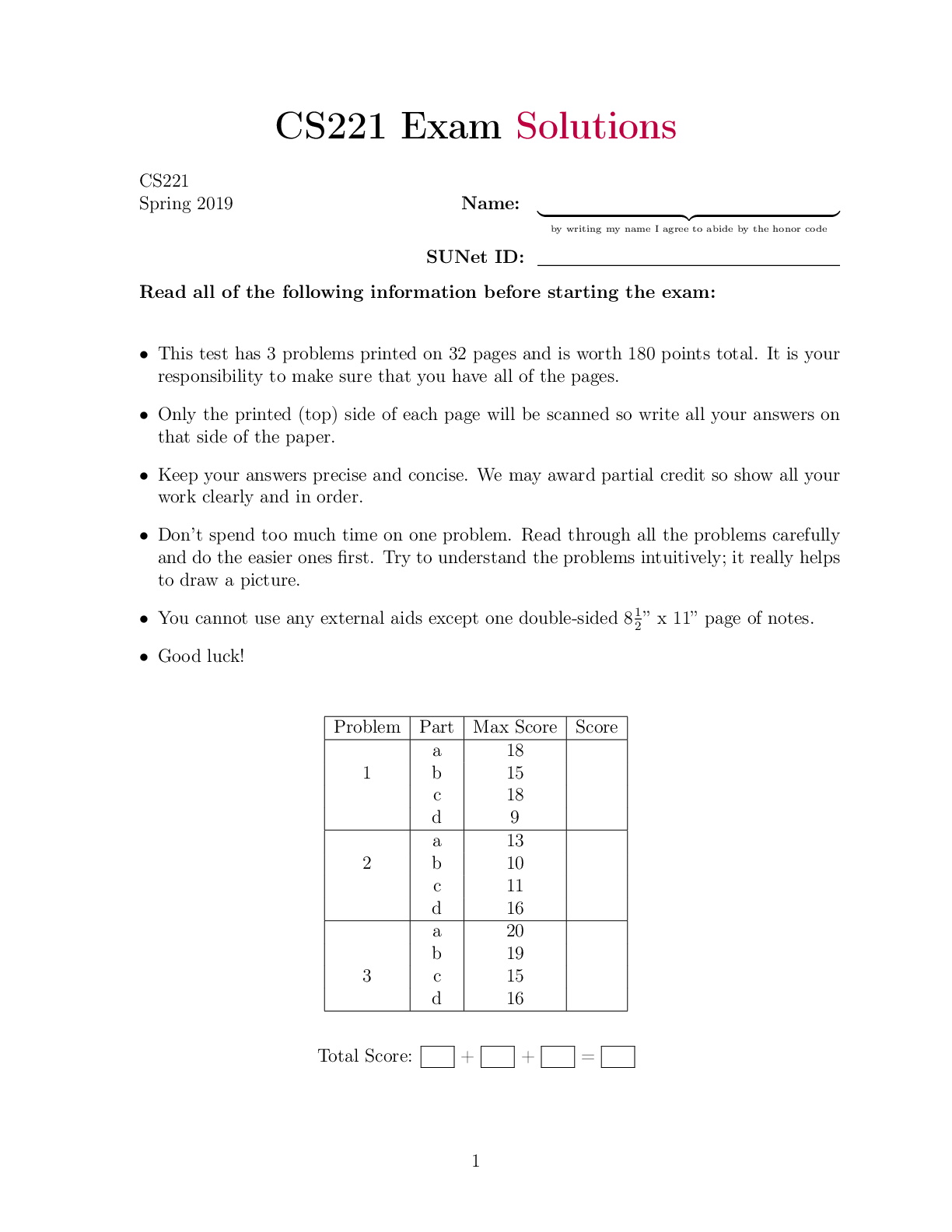
CS221 Exam Solutions
CS221
Spring 2019 Name:
| {z }
by writing my name I agree to abide by the honor code
SUNet ID:
Read all of the following information before starting the exam:
• This test has 3 problems printed on 32 pages and is worth 180 points total. It is your
responsibility to make sure that you have all of the pages.
• Only the printed (top) side of each page will be scanned so write all your answers on
that side of the paper.
• Keep your answers precise and concise. We may award partial credit so show all your
work clearly and in order.
• Don’t spend too much time on one problem. Read through all the problems carefully
and do the easier ones first. Try to understand the problems intuitively; it really helps
to draw a picture.
• You cannot use any external aids except one double-sided 81 2” x 11” page of notes.
• Good luck!
Problem Part Max Score Score
1
a 18
b 15
c 18
d 9
2
a 13
b 10
c 11
d 16
3
a 20
b 19
c 15
d 16
Total Score: + + =
11. Machine Learning (60 points) In an alternate universe, the course staff of CS 221
does not release the mechanism by which final grades are computed. As an enterprising
student, you decide to procrastinate by trying to predict final course grades.
You have obtained access to data points (x; y) for each person, where x 2 R6 gives 6
pieces of information about each student’s grades in previous classes and progress so far in
CS 221 (you don’t need to know what those are). You wish to design a model that predicts
the student’s final grade: A, B, C, D, or F.
(a) Binary classification. (18 points, 6 points each)
You start by trying to solve a simpler problem: only using the data x(i) = (x( 1i); x(2i))T 2
R2 for each person i in the historical database, you wish to predict whether student i
passes the class, label z. Thus, z = 1 when the student’s final grade is in fA; B; Cg
and they pass, and z = −1 when the student receives a fD; Fg and thus NC (no credit)
for the class. You have N training examples, x(1); : : : ; x(N) (viewing them in R2) with
associated pass/fail labels z(1); : : : ; z(N) 2 f−1; 1g.
(i) Before applying a machine learning algorithm, you plot x(1); : : : x(N) and observe
the following, where circle dots have label z = 1 and star dots have label z = −1:
Based on this plot, give an expression for one additional polynomial feature φ(x(i)),
you would add to the vector x(i) to train on, that would likely improve the performance of a machine learning model that used a linear predictor, so x(i) :=
(x( 1i); x( 2i); φ(x(i)))T.
Solution x2
1=49 + x2 2=9
2(ii) After playing around with the data, you realize you have many poorly classified
points where z and your prediction z^ = θT x are far from each other. Thus, you
wish to penalize large losses linearly, but wish to use a squared loss for non-outlier
data points. Given this background, construct a continuous, differentiable, loss
function ‘1 in the piecewise format below:
‘1(z; zb) = (? ? j otherwise z − zbj < 1
What loss function L(θ) (with respect to the penalty ‘1) do you minimize to find
the optimal predictor θ ?
Solution L(θ) = PN i=1 ‘1(z(i); θ>x(i)) where
‘1(z; zb) = (j12z(z−−zbj − zb)2 1 2 j otherwise z − zbj < 1
3(iii) With a step size of η = 0:1 and θ initialized to all zeros, manually compute one
step of a training update using stochastic gradient descent if you randomly select
data point x(1) = (0:9; 0:5); z(1) = 1 (you do not need to use the feature from (i)).
Solution We compute the gradient of ‘1(z(j); θ>x(j)) with respect to θ as
r‘1(z(j); θ>x(j)) = (− −x x( (j j) ) · · ( sign z(j)(−z(jθ)>−x(θjT))x(j)) j otherwise z(j) − θ>x(j)j < 1 :
Then we update θ := θ − η · r‘1(z(j); θ>x(j)), so θ = (0:09; 0:05)
[Show More]


.png)








.png)

.png)