APEA QUESTIONS
NEUROLOGY
The level of consciousness that refers to the ability of the patient to respond fully
and appropriately to stimuli is known as: alertness
When assessing the patient’s sense of position, i
...
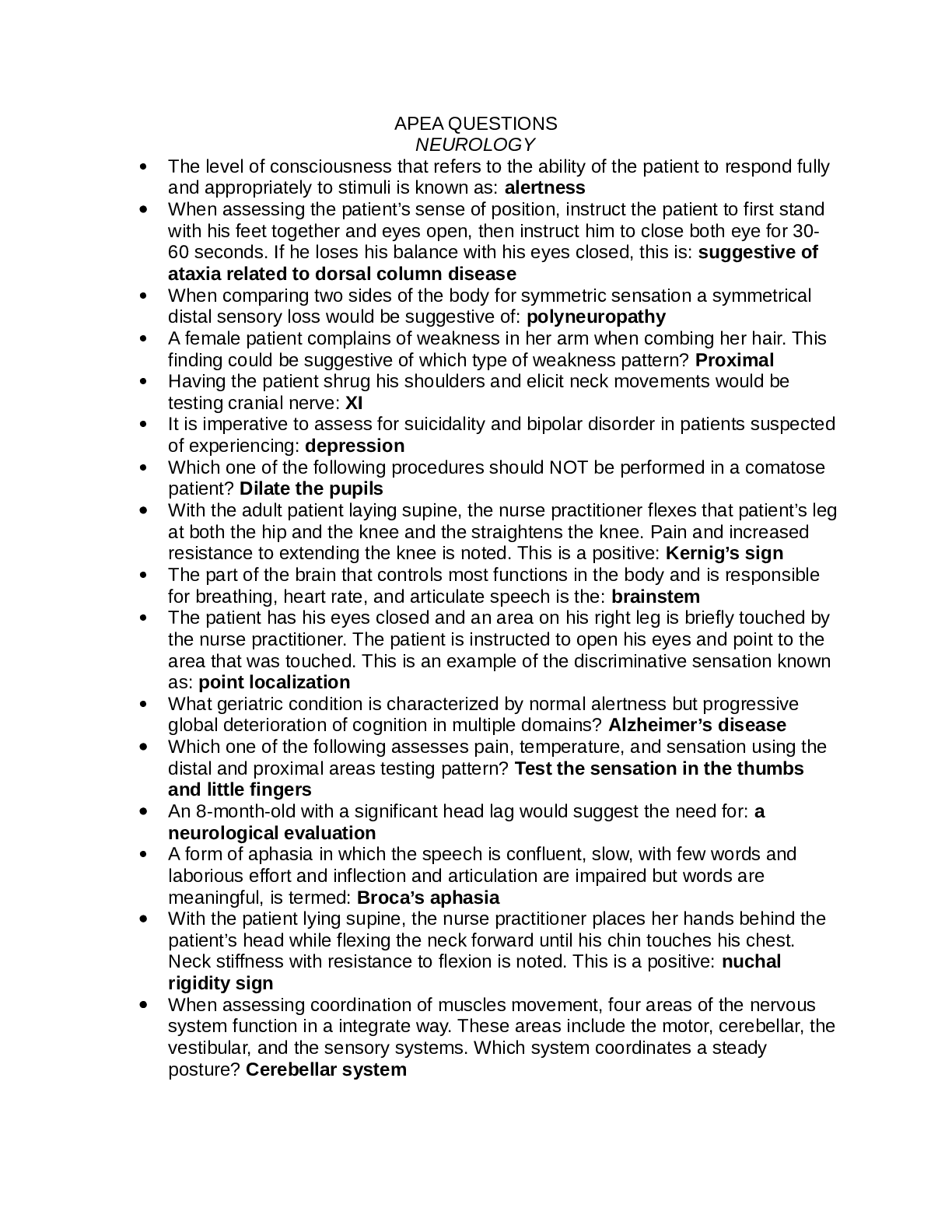
APEA QUESTIONS
NEUROLOGY
The level of consciousness that refers to the ability of the patient to respond fully
and appropriately to stimuli is known as: alertness
When assessing the patient’s sense of position, instruct the patient to first stand
with his feet together and eyes open, then instruct him to close both eye for 30-
60 seconds. If he loses his balance with his eyes closed, this is: suggestive of
ataxia related to dorsal column disease
When comparing two sides of the body for symmetric sensation a symmetrical
distal sensory loss would be suggestive of: polyneuropathy
A female patient complains of weakness in her arm when combing her hair. This
finding could be suggestive of which type of weakness pattern? Proximal
Having the patient shrug his shoulders and elicit neck movements would be
testing cranial nerve: XI
It is imperative to assess for suicidality and bipolar disorder in patients suspected
of experiencing: depression
Which one of the following procedures should NOT be performed in a comatose
patient? Dilate the pupils
With the adult patient laying supine, the nurse practitioner flexes that patient’s leg
at both the hip and the knee and the straightens the knee. Pain and increased
resistance to extending the knee is noted. This is a positive: Kernig’s sign
The part of the brain that controls most functions in the body and is responsible
for breathing, heart rate, and articulate speech is the: brainstem
The patient has his eyes closed and an area on his right leg is briefly touched by
the nurse practitioner. The patient is instructed to open his eyes and point to the
area that was touched. This is an example of the discriminative sensation known
as: point localization
What geriatric condition is characterized by normal alertness but progressive
global deterioration of cognition in multiple domains? Alzheimer’s disease
Which one of the following assesses pain, temperature, and sensation using the
distal and proximal areas testing pattern? Test the sensation in the thumbs
and little fingers
An 8-month-old with a significant head lag would suggest the need for: a
neurological evaluation
A form of aphasia in which the speech is confluent, slow, with few words and
laborious effort and inflection and articulation are impaired but words are
meaningful, is termed: Broca’s aphasia
With the patient lying supine, the nurse practitioner places her hands behind the
patient’s head while flexing the neck forward until his chin touches his chest.
Neck stiffness with resistance to flexion is noted. This is a positive: nuchal
rigidity sign
When assessing coordination of muscles movement, four areas of the nervous
system function in a integrate way. These areas include the motor, cerebellar, the
vestibular, and the sensory systems. Which system coordinates a steady
posture? Cerebellar system The level of consciousness that refers to the patient that remains unarousable
with eyes closed without evidence of response to inner need or external stimuli is
said to be in: a comatose state
Hypesthesia refers to: decreased sensitivity to touch
A female patient complaint of weakness in both arms when transferring the wet
clothes from the washer and placing them in the dryer. This finding could be
suggestive of which type of weakness pattern? Symmetric
A 80-year-old male visits the nurse practitioner for an annual well exam. History
reveals two falls in the prior 12 months and difficulty with balance. The next step
the nurse practitioner should take is: obtain cognitive and functional
assessment
Fasciculations in atrophic muscles suggests: a lower motor neuron disease
A tension headache presents with pain in the: frontotemporal region of the
head
An example of tandem walking is having the patient: walk heel-to-toe
By placing the patient in the supine position, the nurse practitioner raises the
patient’s relaxed and straightened leg while flexing the leg at the hip, and the
dorsiflexes the foot. This maneuver is known as: the straight-leg raise
A discriminative sensation that described that ability to identify an object by
feeling it is: stereognosis
The best method of detecting cognitive impairment or intellectual disability at an
early age is by: assessment of the achievement of development milestones
Symptoms of a subdural hematoma include: noticeable bleeding between the
dura and the cerebrum on x-ray
The part of the brain tissue that rims the surfaces of the cerebral hemispheres,
forming the cerebral cortex is known as the: gray matter
The patient experiences a sudden loss of consciousness with falling without
movements and injury may occur. This type of seizure is consistent with: a
myoclonic seizure
A patient is noted as lying supine with the jaws clenched and the neck extended
with the arms adducted and stiffly extended at the elbows. His forearms are
pronated, wrists and fingers flexed. The legs are extended at the knees and the
feet are plantar flexed. This position is consistent with: decerebrate rigidity
When assessing abdominal cutaneous reflexes, the nurse practitioner strokes
the lower abdomen, the localized twitch is absent. This finding could be
suggestive of a pathologic lesion in which segmented level of the spine?
Thoracic 10, 11, and 12
An older adult presenting with signs of undernourishment, slowed motor
performance, and loss of muscle mass or weakness suggests: frailty
Symmetric weakness of the proximal muscles of the legs suggests a: myopathy
Aphasia refers to: the inability to produce or understand language
The part of the peripheral nervous system that regulates muscle movement and
response to the sensations of pain and touch is the: soma
[Show More]