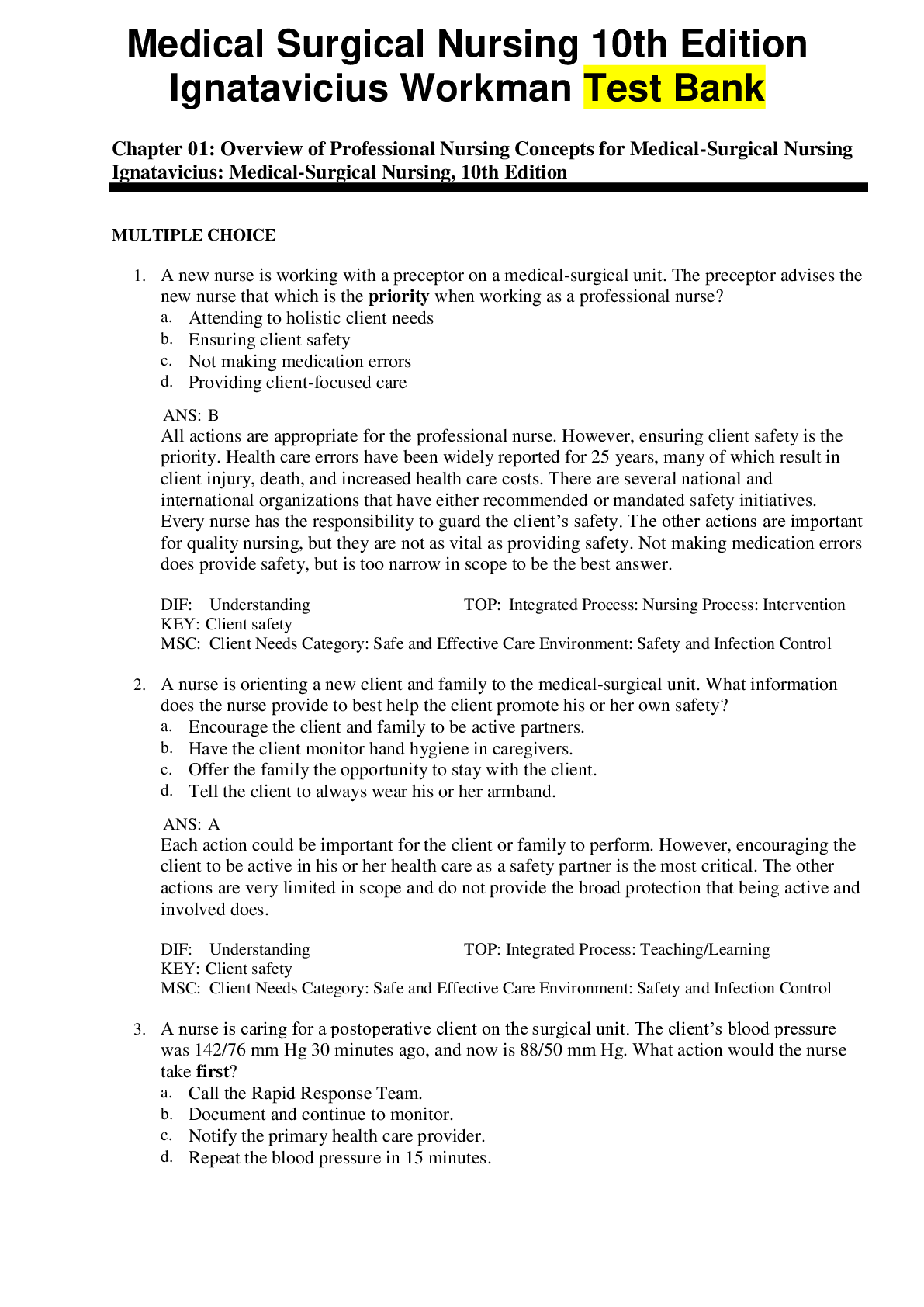
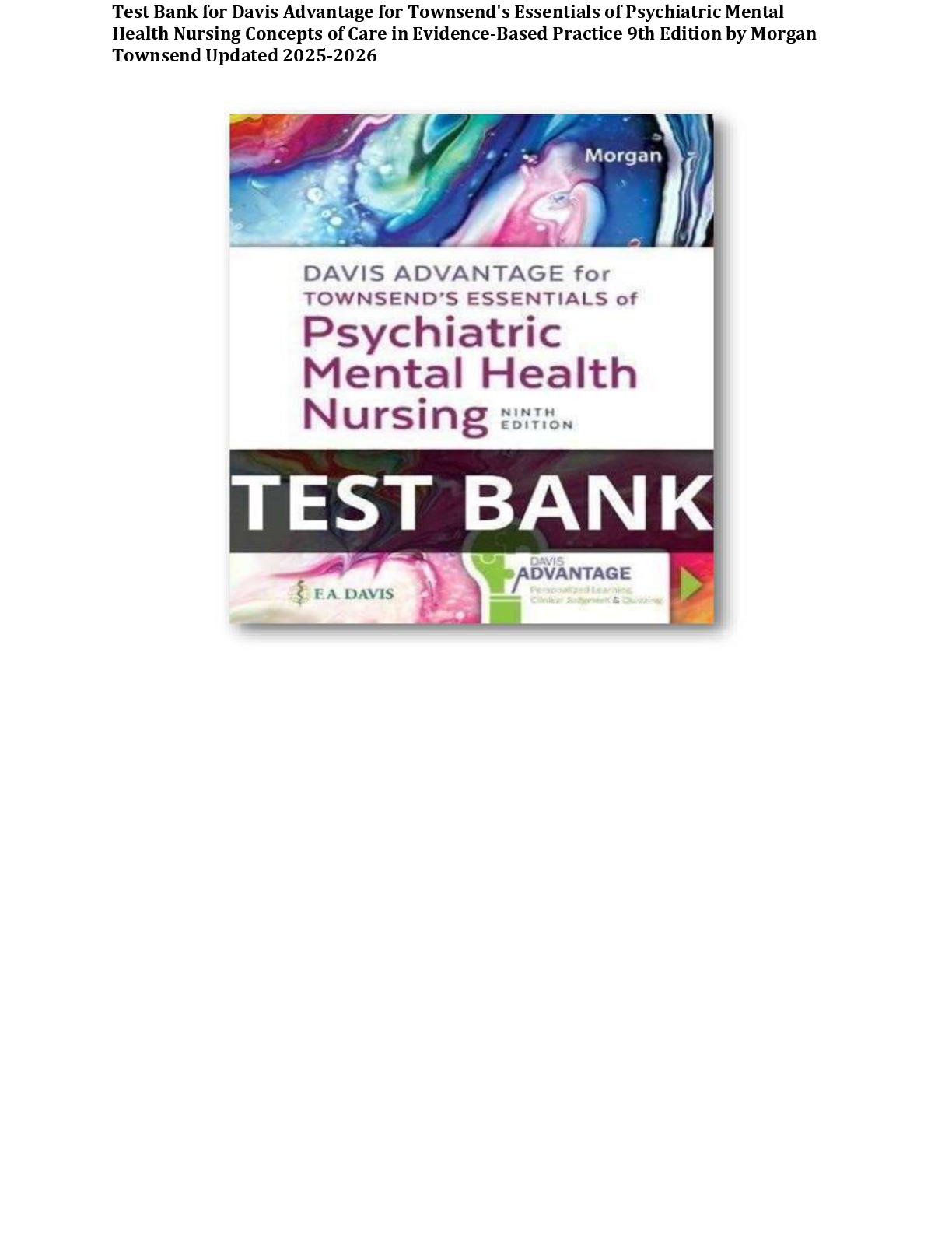
TESTBANK FOR MEDICAL SURGICAL NURSING 9TH
EDITION: CONCEPTS FOR INTERPROFESSIONAL
COLLABORATIVE CARE, 2-VOLUME SET 9TH EDITION BY
DONNA D. IGNATAVICIUS, M. LINDA WORKMAN AND
CHERIE R. REBAR FULL TESTBANK ALL CHAPTERS 1-7
...
TESTBANK FOR MEDICAL SURGICAL NURSING 9TH
EDITION: CONCEPTS FOR INTERPROFESSIONAL
COLLABORATIVE CARE, 2-VOLUME SET 9TH EDITION BY
DONNA D. IGNATAVICIUS, M. LINDA WORKMAN AND
CHERIE R. REBAR FULL TESTBANK ALL CHAPTERS 1-76
INCLUDED|| LATEST AND COMPLETE UPDATE GRADED A+
Chapter 01: Introduction to Medical-Surgical Nursing Test Bank
MULTIPLE CHOICE
1. Which action demonstrates that the nurse understands the purpose of the Rapid Response
Team?**
a. Monitoring the client for changes in postoperative status such as wound infection
b. Documenting all changes observed in the client and maintaining a postoperative flow sheet
c. **Notifying the physician of the client’s change in blood pressure from 140 to 88 mm Hg
systolic – correct**
d. Notifying the physician of the client’s increase in restlessness after medication change
2. The Joint Commission focuses on safety in health care. Which action by the nurse reflects The
Joint Commission’s main objective?**
a. Performing range-of-motion exercises on the client three times each day
b. Ensuring that the client is eating 100% of the meals served to him or her
c. **Assessing the client’s respirations when administering opioids – correct**
d. Delegating to the nursing assistant to give the client a complete bath daily
3. Which action by the nurse shows an understanding of the principle of self-determination?**
a. **Allowing a postoperative client to decide to take medication with fruit juice rather than
water – correct**
2 | P a g e
b. Allowing a teenager to decide not to go to a clinic when there is evidence that she is having
profuse vaginal bleeding
c. Allowing a parent to decide not to proceed with a lifesaving operation for a 12-year-old client
d. Allowing an older client with dementia to decide not to take cardiac medication throughout the
shift
**4. The nurse is initiating a series of teaching sessions with an older client. What is the nurse’s
highest-priority, client-centered action before beginning the session?**
a. Ensure that the client’s family is present and will participate.
b. **Make certain that the client is wearing his glasses – correct**
c. Have printed handouts ready to use during the session.
d. Schedule the session for early evening after the client’s meal.
5. Which action best demonstrates the nurse using client-centered care when planning a menu for
a Vietnamese client who is newly diagnosed with diabetes?**
a. **Asking the client what food he or she would eat on a standard diabetic menu – correct**
b. Asking family members to make selections for the client from a diabetic menu
c. Ordering a typical diabetic meal for the client and planning diet teaching
d. Researching the Vietnamese culture before discussing diabetic meal planning
6. The Institute for Healthcare Improvement (IHI) identified interventions to save client lives.
Which actions are within the scope of nursing practice to improve quality of care?**
a. Insert a central line to give intravenous fluid to a dehydrated client.
b. **Use sterile technique when changing dressings on a new surgical site – correct**
3 | P a g e
c. Intubate a client whose oxygen saturation is 92%.
d. Prescribe aspirin for a client who presents with an acute myocardial infarction
7. Which action by the nurse demonstrates the best practice for nursing documentation on a
computerized record?**
a. Deleting all documentation errors on the computerized record
b. Using red font to denote all significant events that have occurred
c. Waiting until the end of the shift to record a summary of information
d. **Documenting assessment data at the point of care – correct**
8. A client is scheduled for a mastectomy. As she is about to receive the preoperative medication,
she tells the nurse that she does not want to have her breast removed but wants a lumpectomy.
Which response indicates that the nurse is acting as a client advocate?**
a. Telling the client her surgeon is excellent and knows what is best for her condition
b. **Calling the surgeon to come and explain all treatment options to the client – correct**
c. Holding the client’s hand and offering to pray with her for a good outcome
d. Arranging for a postoperative visit from a cancer survivor
9. What priority assessment data should be shared with the interdisciplinary team from a client
admitted to the emergency department with a lacerated artery?**
a. Information regarding next of kin to notify in case the client dies
b. History about what medications the client is currently taking
c. **Measurement of blood pressure and pulse – correct**
d. Assessment of rate and depth of respirations
4 | P a g e
10. Which intervention can the client expect to receive from a medical-surgical nurse in an
ambulatory care setting?**
a. Drawing blood for routine or preoperative testing
b. **Teaching the client how to change a dressing on an incision – correct**
c. Obtaining the client’s signature on a surgical consent form
d. Performing a comprehensive physical examination
11. An emergency department (ED) nurse gives report on a client who is being transferred to the
medical-surgical floor. Because of an identified risk for suicide, the ED nurse suggests that the
floor nurse contact a sitter and behavioral health. This statement represents which part of the
SBAR hand-off?**
a. Situation
b. Background
c. Assessment
d. **Recommendation – correct**
12. The nurse is present when the physician discusses the potential effects of a chemotherapy
regimen for a client with cancer. Weighing the benefits of the chemotherapy against possible
side effects is an example of which ethical principle?**
a. Paternalism
b. **Beneficence – correct**
c. Justice
d. Autonomy
5 | P a g e
13. The physician prescribes warfarin (Coumadin) 15 mg daily. The nurse notes that this is three
times the normal dose for this client based on the client’s medication profile and laboratory
work. What does the nurse do first?**
a. Give the dose and document the concern.
b. Call the pharmacy for a consultation.
c. **Call the physician to question the order – correct**
d. Hold the medication for that day.
14. Which statement best describes the process of nursing case management?**
a. The coordination of care services to at-risk populations
b. **A collaborative process to promote quality and cost-effective care – correct**
c. The implementation of care to acutely ill, underserved populations
d. A cost-effective care delivery model meeting the needs of specially defined groups
15. Which client is best served by a case manager?**
a. An older woman with chronic cystitis
b. A middle-aged man with moderate hypertension
c. **An older woman with chronic heart failure and diabetes mellitus – correct**
d. A young adult with a fractured ankle from a sports injury
6 | P a g e
16. The client with a stroke was admitted to a medical-surgical unit. Which tasks does the nurse
delegate to the unlicensed assistive personnel?**
a. Complete the nursing care plan.
b. **Assist the client with meals – correct**
c. Evaluate the pulse oximetry reading.
d. Assess level of consciousness.
[Show More]
Preview 5 out of 1076 pages