Directions: The following two questions have been designed for you to practice what the FRQs on the AP Exam will look
like. They have “Design an investigation” components and “Propose a solution” components. Complete th
...
Directions: The following two questions have been designed for you to practice what the FRQs on the AP Exam will look
like. They have “Design an investigation” components and “Propose a solution” components. Complete the questions as a
part of your choice board - a review video will be made to review the questions once your assignments are turned in.
Question 1
Scientists Charles and Hap have studied estuaries most of their careers. Over time they noticed a serious decline in estuary health
worldwide. The health of their local estuary, Plum Island Estuary in Massachusetts, appeared to be declining over time as well.
They noticed a loss of salt marsh habitats, and that the remaining salt marshes had fewer fish. They thought that urbanization
nearby might be causing these losses. Charles and Hap set out to test if the loss of salt marshes in Plum Island Estuary was
occurring because of eutrophication from large amounts of excess nutrients entering the estuary in runoff from the nearby urban
areas.
(a) Describe ONE ecological service that is provided by salt marsh.
(b) Explain how urbanization can lead to large amounts of excess nutrients entering the estuary in runoff from
nearby urban areas.
(c) Explain how the measurement of dissolved oxygen can verify the occurrence of eutrophication.
(d) The level of dissolved oxygen would fluctuate throughout the day based on the producers and users of dissolved
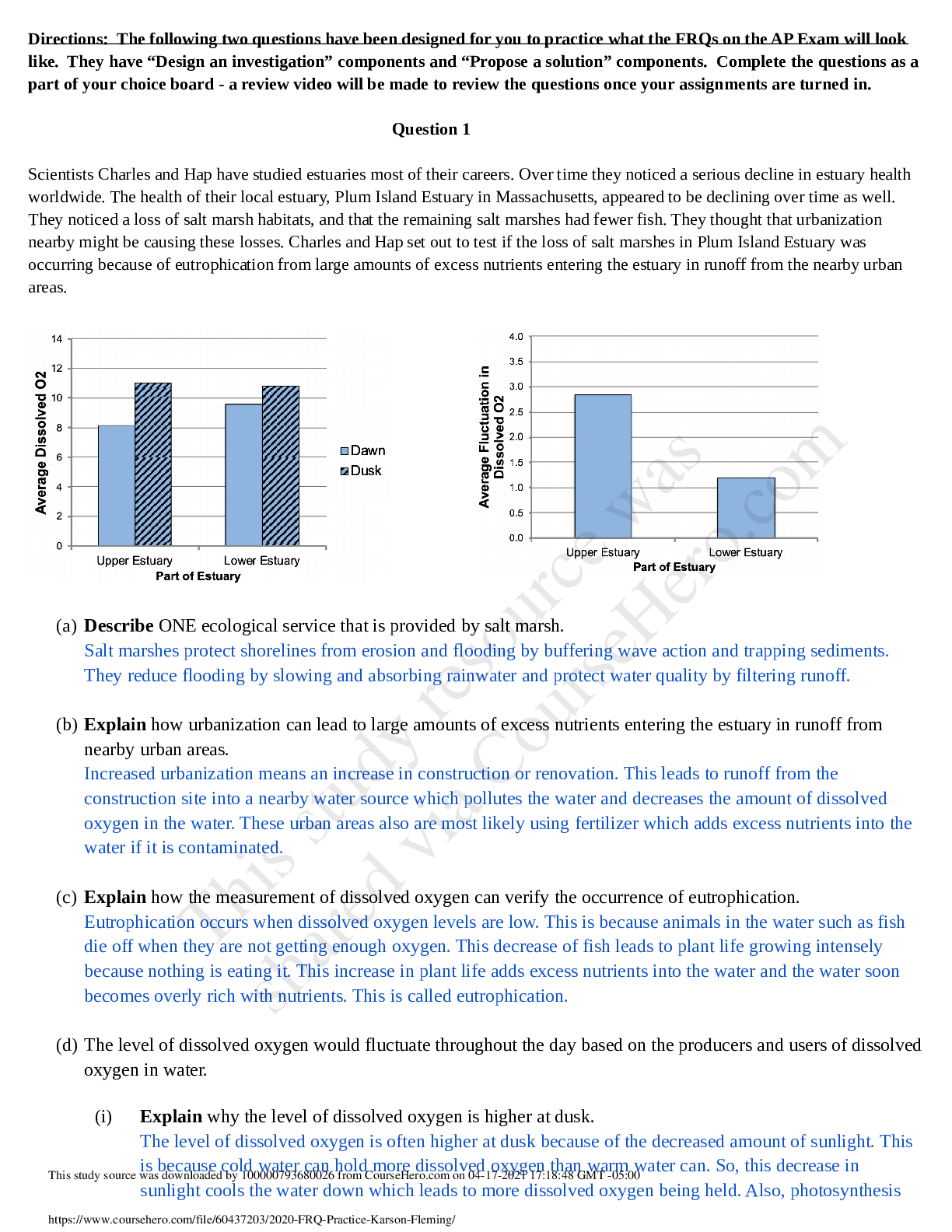
(i) Explain why the level of dissolved oxygen is higher at dusk.
(ii) Predict which part of the estuary (upper or lower) is located closer to urban areas. Explain your
reasoning by using the data provided above.
(e) Propose a solution to reduce the input of nutrients into local estuary from urban areas.
(F) The scientists observed a decrease in numbers of fish. Describe in detail an investigation that would produce data to
support this claim.
Question 2
With rising seas, one important feature of the Florida Everglades may change. There are currently large amounts of carbon stored
in the wetland’s muddy soils. By holding carbon in the mud, coastal wetlands are able to help in the fight against climate change.
However, under stressful conditions like being submerged in seawater, soil microbes increase respiration. During respiration,
carbon stored in the soil is released as carbon dioxide (CO2), a greenhouse gas.
Shelby and John are ecologists who work in southern Florida. John and Shelby thought the collapse of wetland at the Everglades
might have something to do with the loss of carbon due to sea level rise. They wanted to test whether the collapsing soils were the
result of increased microbial respiration, leading to loss of carbon from the soil, due to stressful conditions from sea level rise.
They set out to test two particular aspects of seawater that might be stressful to microbes – salt and phosphorus.
To test their hypotheses, a team of ecologists in John’s lab
developed an experiment using soils from the Everglades.
They collected soil from areas where the soil had collapsed and
brought it into the lab. These soils had the microbes from the
Everglades in them. Once in the lab, they put their soil and microbes
into small vials and exposed them to 5 different concentrations of salt,
and 5 different concentrations of phosphorus. The experiment crossed
each level of the two treatments. This means they had soil in every
possible combination of treatments – some with high salt and low
phosphorus, some in low salt and high phosphorus, and so on. Their
experiment ran for 5 weeks. At the end of the 5 weeks they measured
the amount of CO2 released from the soils.
The data table on the left is translated to the following two graphs
(next page) so that we can observe the impact of the independent
variables onto the release of CO2.
(Question 2 continues on the next page.)
Amount of CO2 Released in Response to Salt Concentration and Phosphorus Concentration
a. Explain how the emission of CO2 will induce a positive feedback loop that results in rising sea level.
b. Phosphorus is considered as a limiting factor for vegetation growth.
ii. Propose ONE strategy to reduce the input of excessive phosphorus.
d. Suppose you are going to expand this investigation by considering other possible stressors, in addition to
salinity and phosphorus concentration.
i. Suggest ONE possible stressor that would lead to wetland degradation.
ii. Justify your suggestion in relation to wetland degradation.
[Show More]