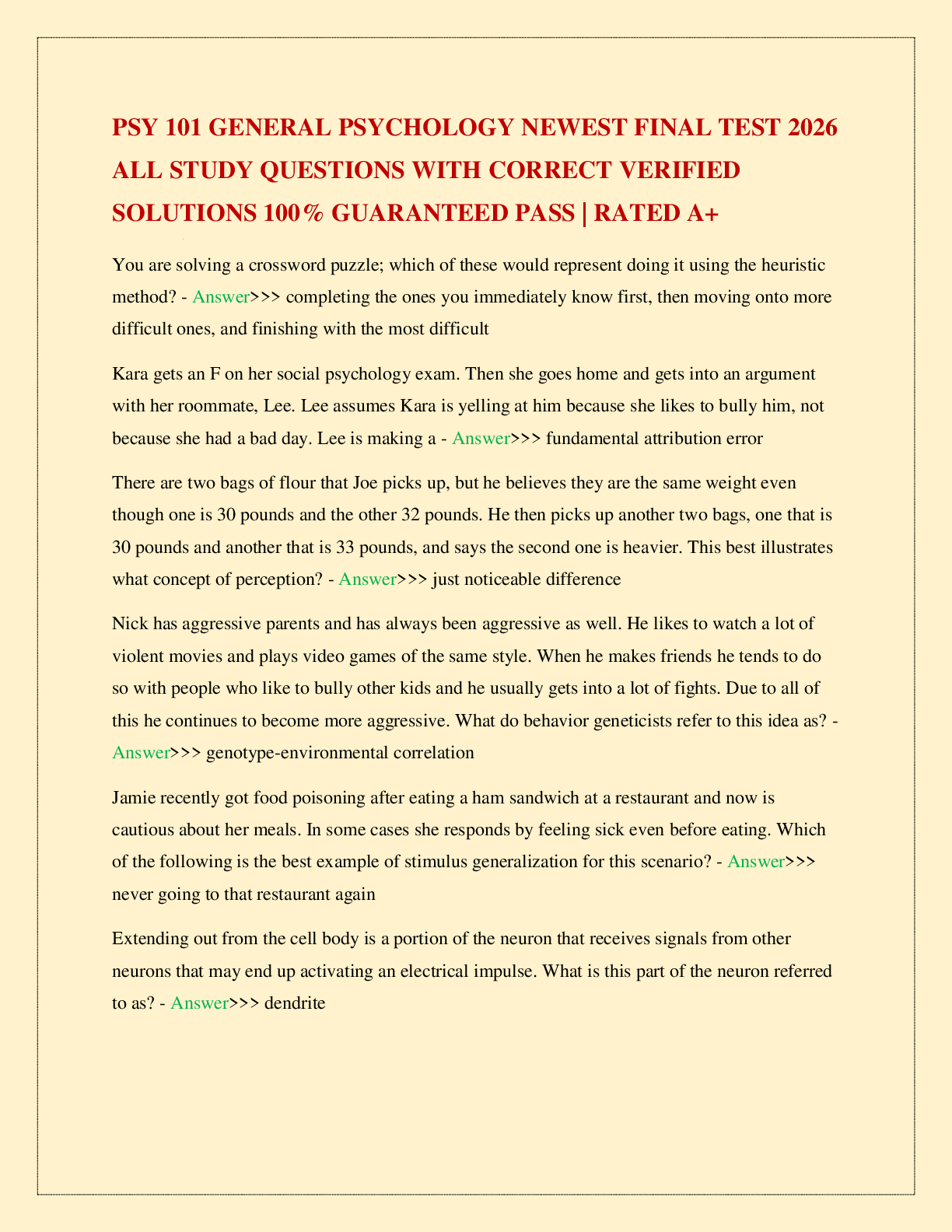
MOT 536 Midterm Exam | Questions and Answers Trauma an external threat that overwhelms a persons coping resources Types of Trauma physical/emotional/sexual abuse, neglect, DV, incarceration, community violence, natura
...
MOT 536 Midterm Exam | Questions and Answers Trauma an external threat that overwhelms a persons coping resources Types of Trauma physical/emotional/sexual abuse, neglect, DV, incarceration, community violence, natural disaster Effects of Trauma difficulty with sensory modulation, emotional regulation, managing arousal systems (fight/flight/freeze), conflict, and behavior management Common Behaviors in People with Trauma unhealthy attachments, psychological distress, anxiety, difficulty communicating, difficulty concentrating, hypersensitivity, risk taking, paranoia ACEs adverse childhood experiences Relevance of ACEs research shows a relationship between ACEs and increase in disease 11 ACEs physical/emotional/sexual abuse, physical/emotional neglect, parental mental illness, incarcerated family member, DV, parental substance abuse, divorced parents 4+ ACEs Outcomes 4-12x more likely to be drug/alcohol dependent, have depression & attempt suicide 2-4x more likely to smoke & have 50+ sexual partners 1.4-1.6x more likely to be obese Trauma Informed Care understands trauma, recognizes impact of trauma, recognizes sigs and symptoms, aims to avoid retraumatization Environment for Trauma Informed Care safe, inclusive, private, welcoming, empowering, foster peer support Trauma Informed Care Strategies empowerment, validation, positive language, summary statements, active listening, clarifying, enrichment questions Group Roles behavior patterns or ways of behaving in groups Task Roles initiator-contributor, information seeker, opinion seeker, opinion giver, elaborator, coordinator, evaluator-critic, energizer, procedural tech, recorder Effect of Task Roles help group get work done Group Building and Maintenance Roles encouragers, harmonizer, compromiser, gatekeeper, standard setter, observer, follower Effect of Group Building and Maintenance Roles supportive roles that keep the group functioning together Individual Roles aggressor, blocker, recognition-seeker, self confessor, playboy, dominator, help seeker, special interest pleader Effect of Individual Roles interfere with group function 7 Steps of Group Sessions intro, activity, sharing, processing, generalizing, application, summary Intro Purpose say names, purpose of group, and set expectations Activity Purpose bulk of session, chosen by therapist to meet group goal Sharing Purpose each member contributes, may be part of the activity, acknowledge after sharing Generalizing Purpose therapist sums up common themes that were shared Application Purpose therapist helps relate principles of the group to every day life Summary review goals of the group and what was accomplished Types of Leadership Styles directive, facilitative, advisor Directive Leadership direct supervision with clear goals, used for lower functioning clients Facilitative Leadership collaborative leadership style where the leader is on the participants side Advisor Leadership offers expertise as needed, used for professionals and when acting as a consultant Mental Health Settings homes, consumer operated services, afterschool, forensic, state hospitals, psychosocial clubhouses, community based, hospital bases, homeless/women’s shelters, wraparound Intervention Approaches create/promote, establish/restore, maintain, modify, prevent Create/Promote provide enriched contextual and activity experiences that will enhance performance for all people Establish/Restore change client variables to establish a skill or ability that has not been established yet or was impaired Maintain provide therapy to clients to preserve performance skills they have regained Modify revise context or environment to support performance in a natural settings Prevent prevent the evolution of barriers to occupational performance OT Outcomes occupational performance, prevention, health and wellness, QOL, participation, role competency, well-being, occupational justice 4 Dimensions of Recovery home, health, purpose, community 10 Principles of Recovery hope, person-driven, many pathways, holistic, peer support, relational, culture, address trauma, strengths, respect How can an OT become a qualified mental health provider? graduate from an accredited university, become licensed as an OTR/L, and work in a mental health setting for one year COTA Supervision < 1 Year 5% face to face supervision per month COTA Supervision > 1 Year 2% face to face supervision and 3% indirect supervision per month COTA Role in Evaluation COTA's may administer evaluations and assessments, but cannot interpret results OT Aides not licensed, cannot evaluate or make recommendations, may provide supportive services that do not require the knowledge, skill, or judgment of an OTP Discharge Documentation CLOF, assist level, home program, safety concerns, DME, client/caregiver education, referrals, resources Crisis an acute emotional disequilibrium where one cannot use their typical coping resources How to determine the severity of a crisis? intensity, duration, frequency Intensity physical vs verbal Duration how long it lasts Frequency how often its happening Low Urgency person is likely to use their own resources to address the situation eventually, intervention required but not immediately Moderate Urgency threat of escalation possible without an intervention High Urgency life threatening WRAP Wellness Recovery Action Plan What is WRAP? wellness oriented prevention and wellness process to change how one feels and reaction to life WRAP Principles hope, personal responsibility, education, self advocacy, support CPI crisis prevention intervention Physical management is the ___ last resort Principles of Descalation/CPI clear and calm communication, non threatening body language, awareness of self in relation to aggressor/exits, respect, avoid power struggle, environmental controls, 1 staff member takes lead, remove target if possible Memory active system that stores, organizes, alters, and retrieves info Encoding converting info to a usable form through recall and recognition Storage holding info in memory Retrieval taking memories out of storage Sensory Memory storing an exact copy of info for less than one second, the first stage of memory Echos and Icons parts of sensory memory, seeing a picture or hearing a phrase in your mind immediately after learning it Working Memory manipulating information, can hold up to 7 words/#s Long Term Memory storing info permanently Semantic Memory
[Show More]


![Preview of eBook [PDF] Abnormal Psychology 6th Edition By Gordon L. Flett, Nancy L. Kocovski, Gerald](https://scholarfriends.com/storage/Abnormal Physcology.png)
![Preview of Educational Psychology 8th Edition by John W. Santrock | eBook [PDF]](https://scholarfriends.com/storage/8BYyNJBH2025-01-30-09-00679bbe33eb6d6.png)

![Preview of eBook [PDF] Psychology of Success 8th Edition By Denis Waitley](https://browseimages.nyc3.digitaloceanspaces.com/paper-images/2024/Aug/29/1Z6F4tnd2024-08-29-08-3766d00924d3776.png)