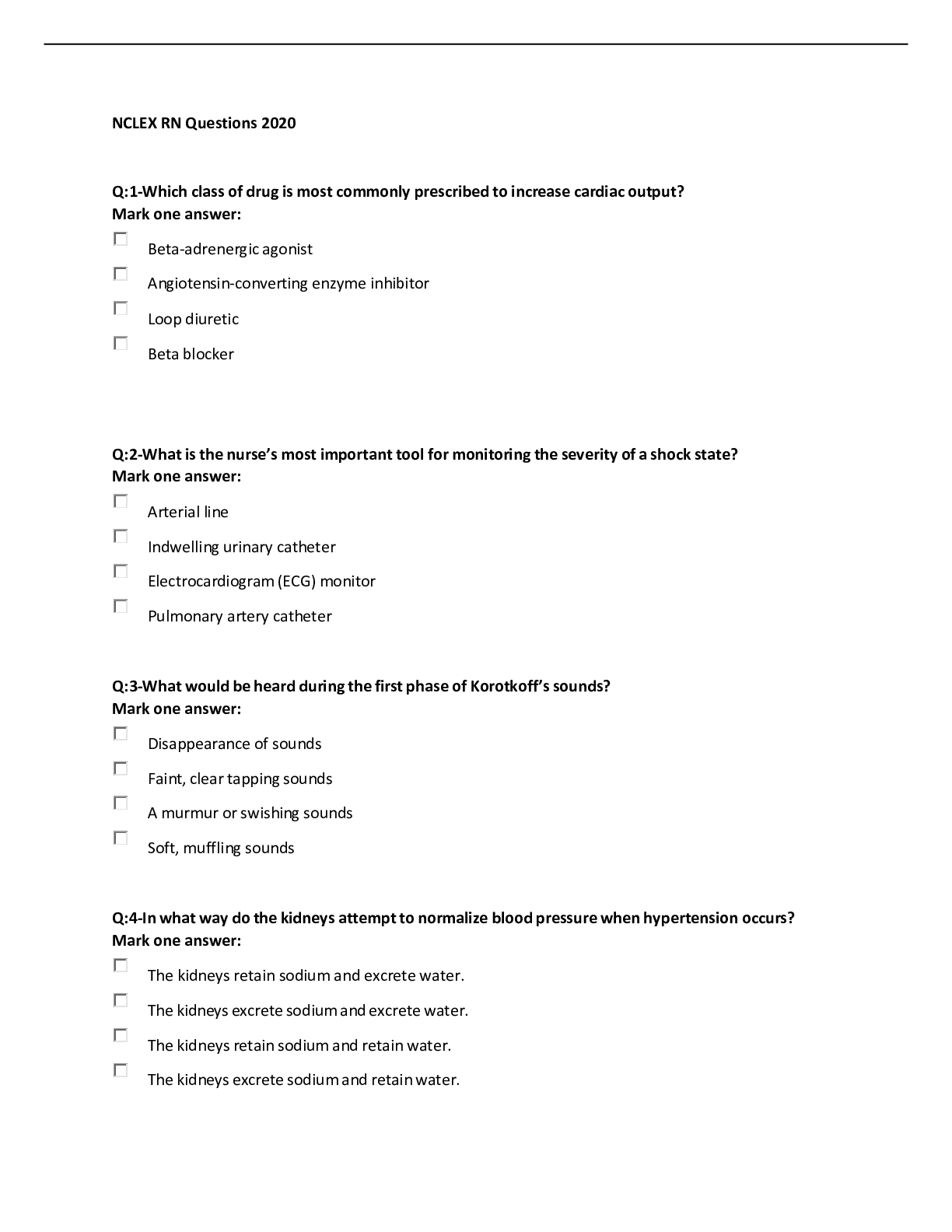
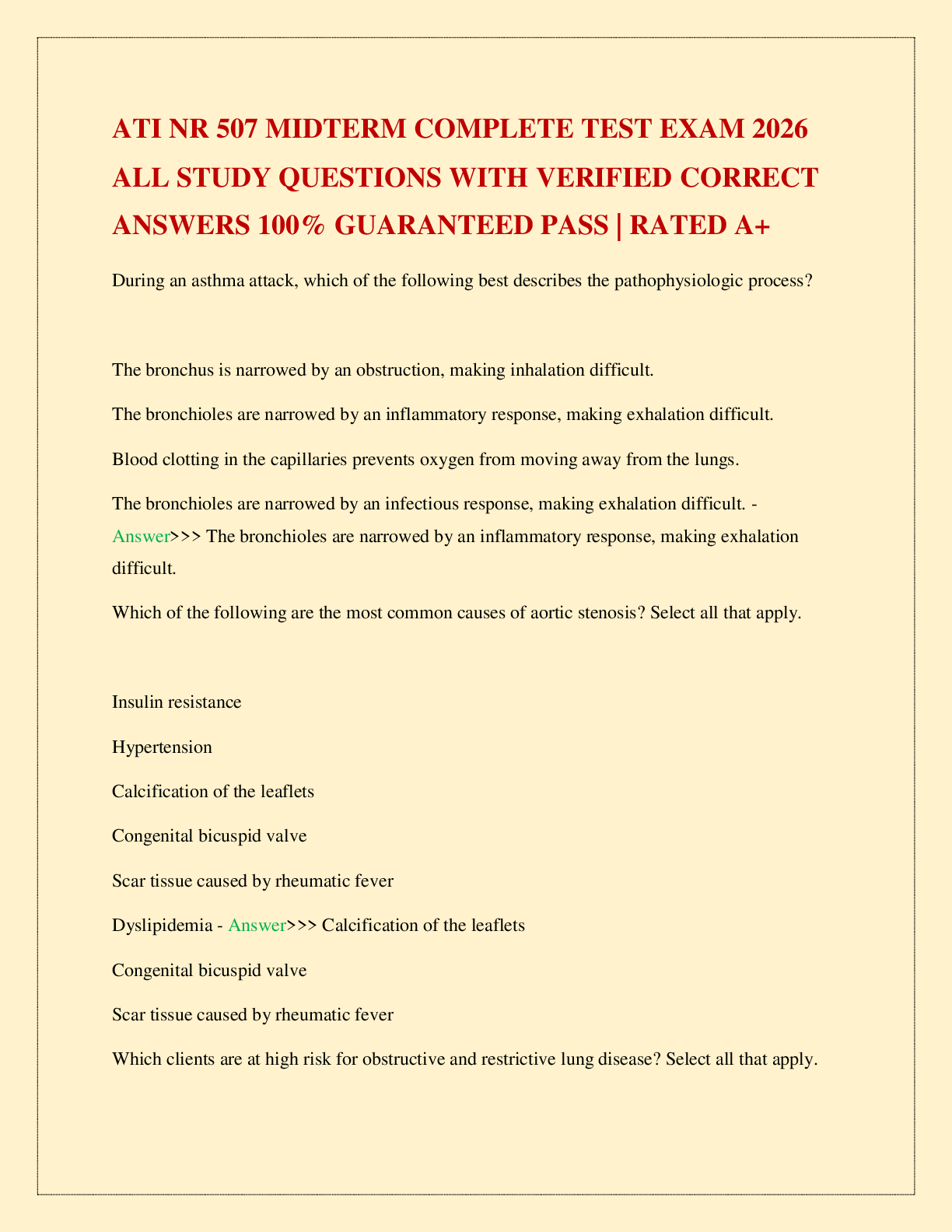
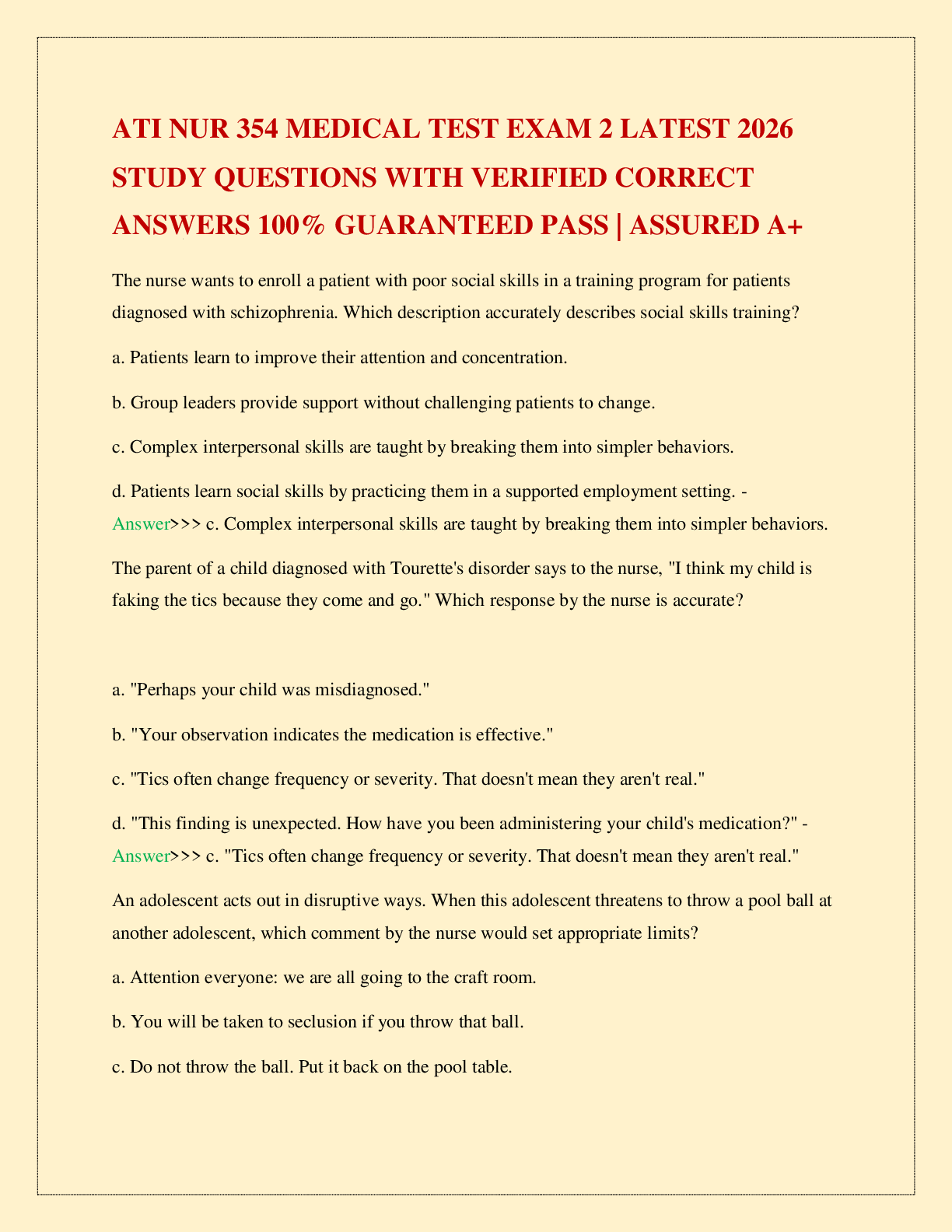
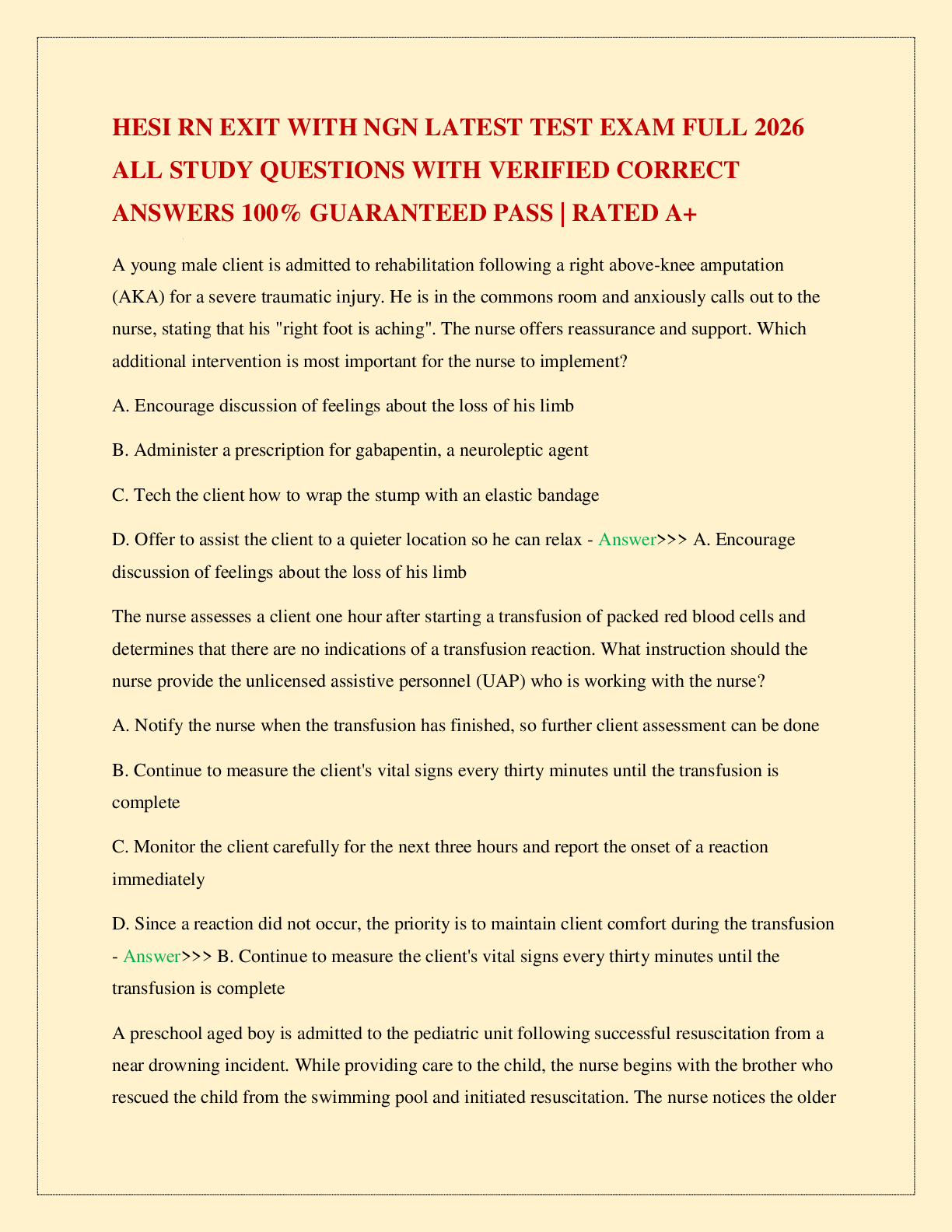
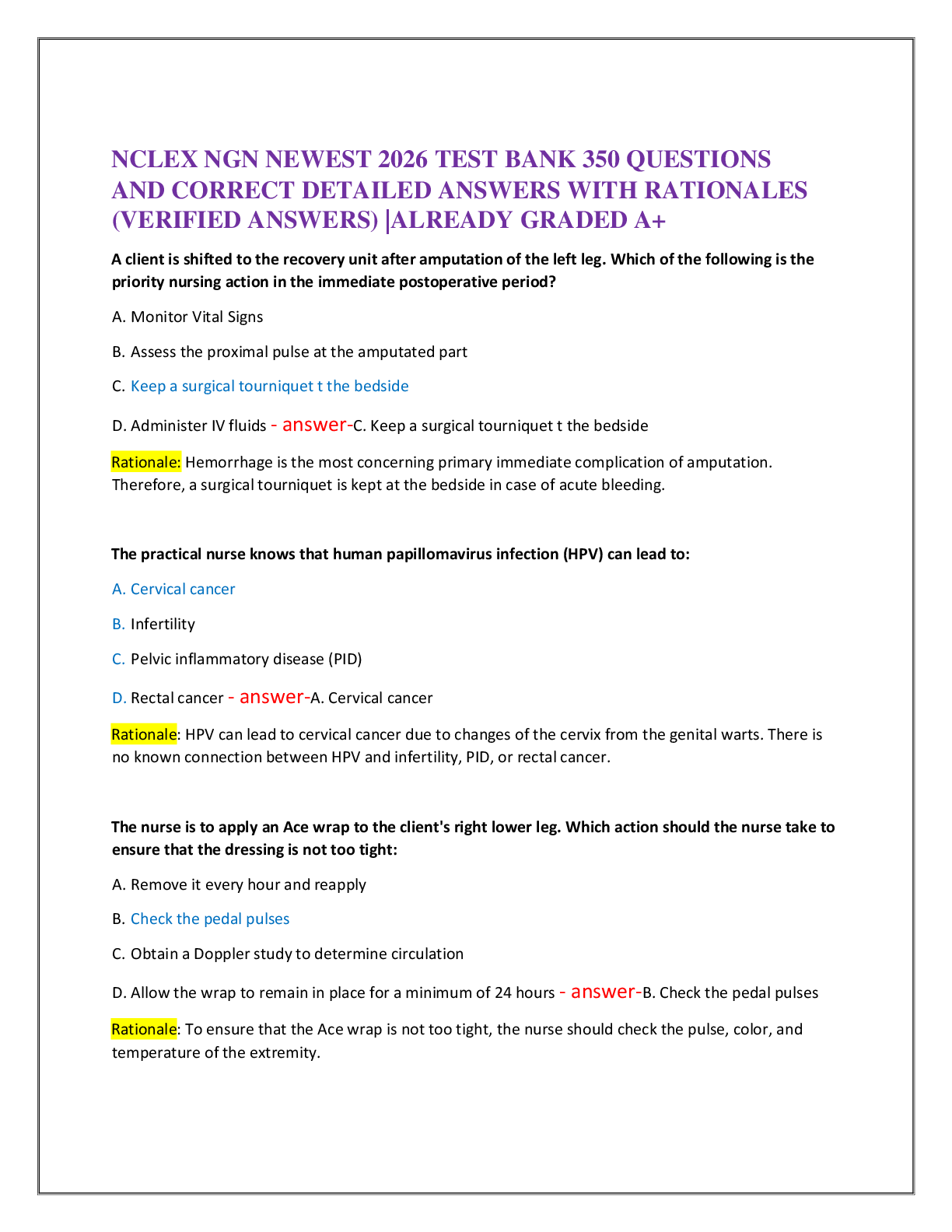
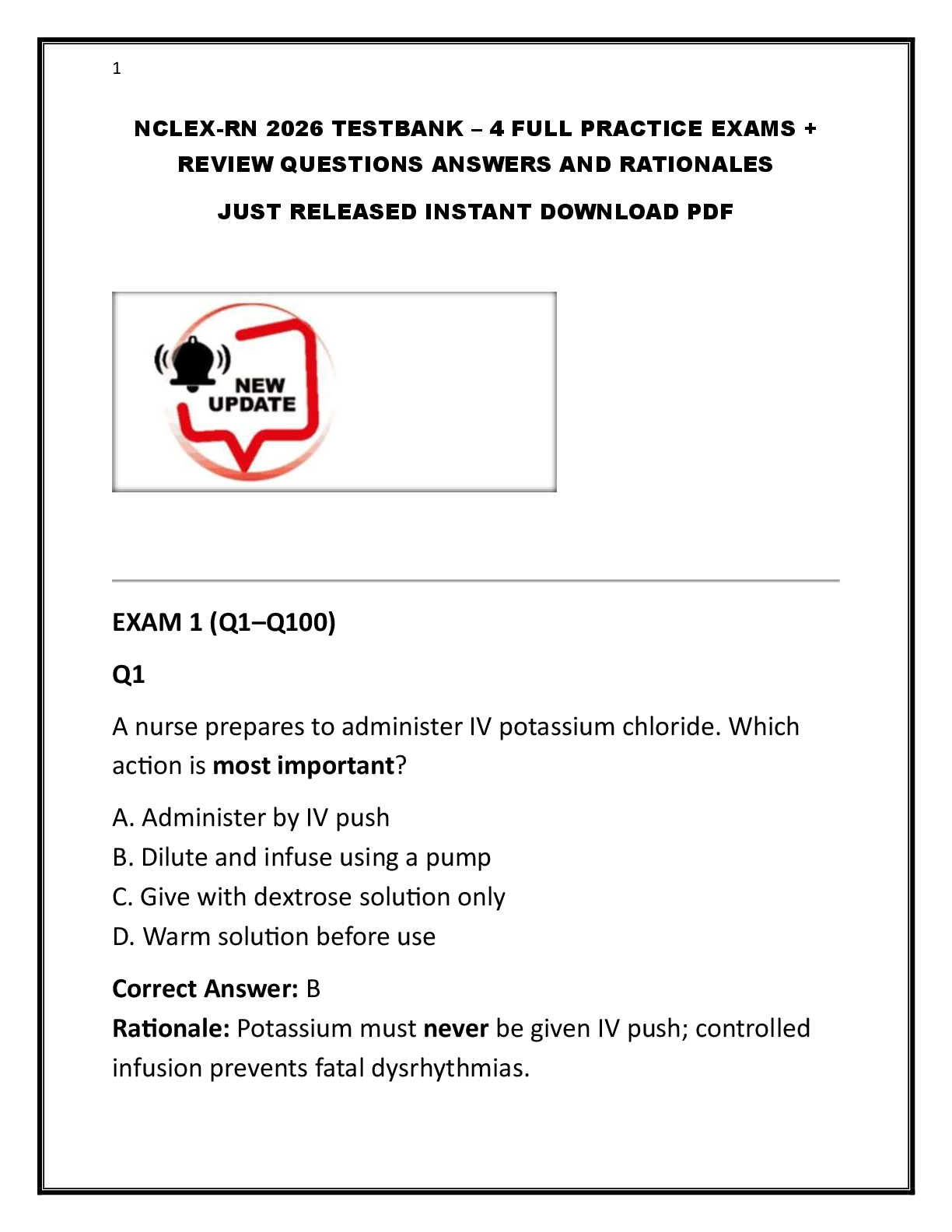
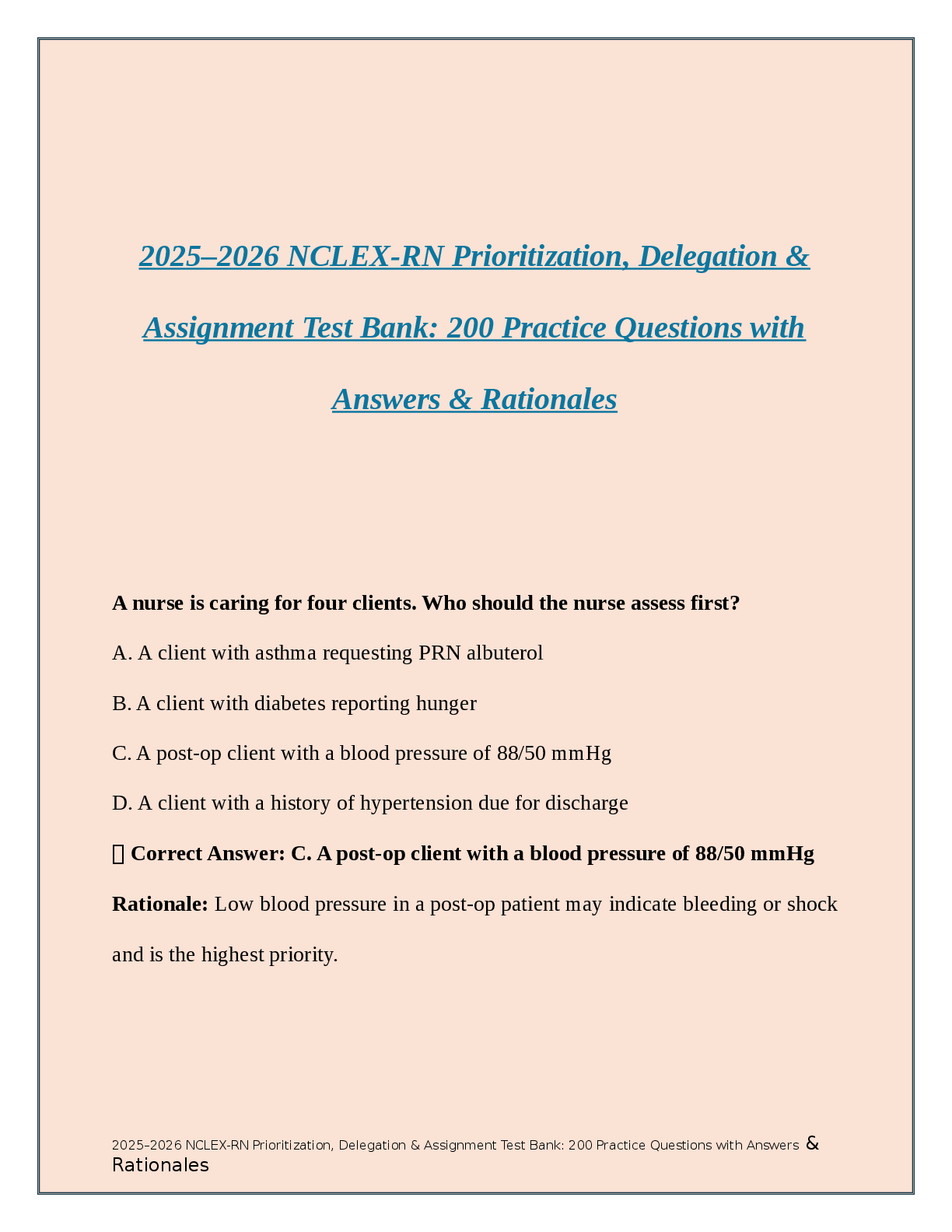
NCLEX RN Questions 2020 Q:1-Which class of drug is most commonly prescribed to increase cardiac output? Mark one answer: Beta-adrenergic agonist Angiotensin-converting enzyme inhibitor Loop diure ... tic Beta blocker Q:2-What is the nurse’s most important tool for monitoring the severity of a shock state? Mark one answer: Arterial line Indwelling urinary catheter Electrocardiogram (ECG) monitor Pulmonary artery catheter Q:3-What would be heard during the first phase of Korotkoff’s sounds? Mark one answer: Disappearance of sounds Faint, clear tapping sounds A murmur or swishing sounds Soft, muffling sounds Q:4-In what way do the kidneys attempt to normalize blood pressure when hypertension occurs? Mark one answer: The kidneys retain sodium and excrete water. The kidneys excrete sodium and excrete water. The kidneys retain sodium and retain water. The kidneys excrete sodium and retain water. This study source was downloaded by 100000823857721 from CourseHero.com on 04-17-2021 21:39:35 GMT -05:00 https://www.coursehero.com/file/53139904/NCLEX-RN-Questions-2020docx/ This study resource was shared via CourseHero.com Q:5-A nurse is teaching a client about the effects of angiotensin II on blood pressure. The nurse knows that teaching has been effective when the client states: Mark one answer: "It is a powerful vasodilator." "It increases aldosterone secretion." "It brings about a diuretic effect." "It stimulates the parasympathetic nervous system." Q:6-How would the nurse best describe the characteristics of primary hypertension to a client? Mark one answer: It is uncontrollable, and has a rapid onset of complications. It is a rapidly progressive increase in blood pressure. It is a gradual and asymptomatic increase in blood pressure. It can be corrected by treating the underlying conditions. Q:7-Which statement best describes the action of furosemide for the treatment of hypertension? Mark one answer: It dilates peripheral blood vessels. It decreases sympathetic cardioacceleration. It inhibits the angiotensin-converting enzyme. It inhibits reabsorption of sodium and water in the loop of Henle. Q:8-Which statement, by a client with a history of hypertension, indicates that teaching regarding an annual eye exam has been effective? Mark one answer: "By examining your corneas, an ophthalmologist can visualize microvascular hemorrhages in your eyes." "By examining the fovea in your eyes, an ophthalmologist can visualize microvascular venous occlusions in your eyes." "By examining the retina in your eyes, an ophthalmologist can detect changes in the arteries in your This study source was downloaded by 100000823857721 from CourseHero.com on 04-17-2021 21:39:35 GMT -05:00 https://www.coursehero.com/file/53139904/NCLEX-RN-Questions-2020docx/ This study resource was shared via CourseHero.com eyes." "By examining the sclera of your eyes, an ophthalmologist can detect changes in the arteries in your eyes." Q:9-A nurse determines that a client understands the cause of primary varicose veins when the client states: Mark one answer: "Hypertension." "Pregnancy." "Thrombosis." "Trauma." Q:10-Which condition is caused by increased hydrostatic pressure and chronic venous stasis? Mark one answer: Venous occlusion Cool extremities Nocturnal calf muscle cramps Diminished blood supply to the feet [Show More]
Last updated: 3 years ago
Preview 1 out of 3 pages
Buy this document to get the full access instantly
Instant Download Access after purchase
Buy NowInstant download
We Accept:
Can't find what you want? Try our AI powered Search
Connected school, study & course
About the document
Uploaded On
Apr 18, 2021
Number of pages
3
Written in
All
This document has been written for:
Uploaded
Apr 18, 2021
Downloads
0
Views
94
Scholarfriends.com Online Platform by Browsegrades Inc. 651N South Broad St, Middletown DE. United States.
We're available through e-mail, Twitter, Facebook, and live chat.
FAQ
Questions? Leave a message!
Copyright © Scholarfriends · High quality services·