HUMAN BIOLOGY UNIT 4 MILESTONE
How do blood vessels maintain homeostasis when blood pressure increases?
•
Vasoconstriction
•
Hypotension
•
Hypertension
•
Vasodilation
CONCEPT
Blood
...
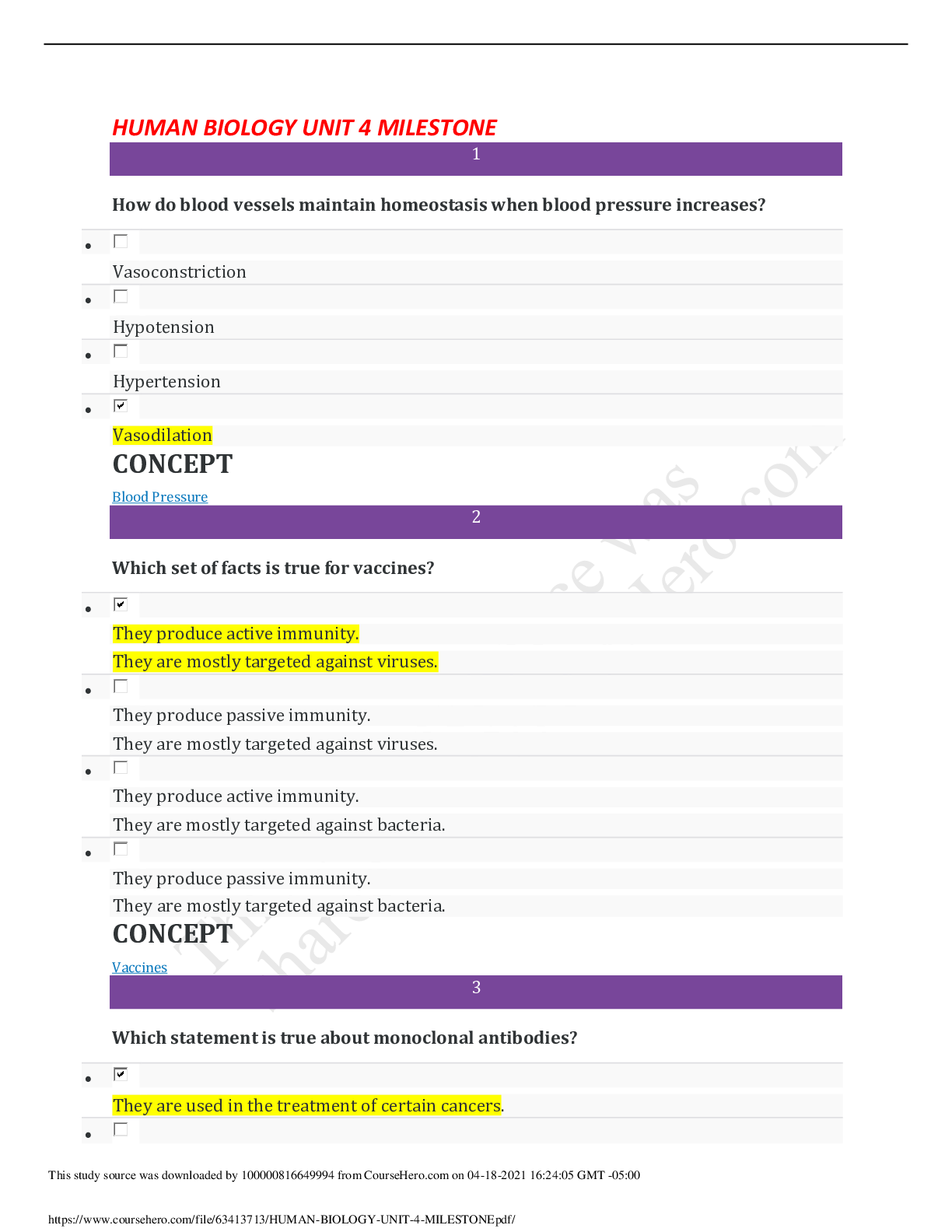
HUMAN BIOLOGY UNIT 4 MILESTONE
How do blood vessels maintain homeostasis when blood pressure increases?
•
Vasoconstriction
•
Hypotension
•
Hypertension
•
Vasodilation
CONCEPT
Blood Pressure
Which set of facts is true for vaccines?
•
They produce active immunity.
They are mostly targeted against viruses.
•
They produce passive immunity.
They are mostly targeted against viruses.
•
They produce active immunity.
They are mostly targeted against bacteria.
•
They produce passive immunity.
They are mostly targeted against bacteria.
CONCEPT
Vaccines
Which statement is true about monoclonal antibodies?
•
They are used in the treatment of certain cancers.
•
They are used in the treatment of viral infections.
•
They are used in the treatment of bacterial infections.
•
They are used in the treatment of fungal infections.
CONCEPT
Organ Transplant and Immunotherapy
Which of the following statements about immunodeficiency is true?
•
It only occurs when the immune system has been intentionally compromised as part of
treatment for diseases like cancer.
•
It means the immune system attacks a person's own cells and organs.
•
It means the immune system is overactive and targets harmless things like pollen or
dander.
•
It means the immune system is weak or nonexistent.
CONCEPT
Immune System Disorders and HIV/AIDS
The diagram shows the structure of the human heart.
What is the importance of the part labeled X?
•
It provides lubrication to the heart by secreting fluids.
•
It separates oxygenated blood from deoxygenated blood.
•
It prevents the backflow of blood from the pulmonary artery.
•
It prevents the backflow of blood from the systemic circuit.
CONCEPT
Heart and Blood Flow
Which type of white blood cell attacks other unhealthy cells?
•
Eosinophils
•
Monocytes
•
Lymphocytes
•
Basophils
CONCEPT
White Blood Cells
Which set of facts is true for the lymphatic system?
•
It works together with the circulatory and immune systems.
It returns tissue fluid back to the cardiovascular system.
•
It works together with the circulatory and immune systems.
It carries blood to the excretory system.
•
It works together with the respiratory and immune systems.
It returns tissue fluid back to the cardiovascular system.
•
It works together with the circulatory and respiratory systems.
It transports blood to the central nervous system.
CONCEPT
Lymphatic System
What is "vital capacity?"
•
The maximum amount of air that moves out of the lungs after taking the deepest breath
•
The maximum amount of air that moves into the lungs after taking the deepest breath
•
The minimum amount of air that moves into the lungs after taking the deepest breath
•
The minimum amount of air that moves out of the lungs after taking the deepest breath
CONCEPT
Respiration and the Respiratory Cycle
What muscular tubes, not supported by cartilage, help regulate airflow into and out of the lungs?
•
Diaphragm
•
Trachea
•
Alveoli
•
Bronchioles
CONCEPT
Lower Respiratory Tract
A person with blood type A can donate blood to individuals with which blood types?
•
A, B
•
A, O, AB
•
A, AB
•
A, O
CONCEPT
Blood Types
Which of the following is the contraction phase of the cardiac cycle?
•
Diastole
•
Cardiac output
•
Cardiac input
•
Systole
CONCEPT
Cardiac Cycle and Cardiac Conduction System
Which accurately represents bloodflow through the cardiovascular system?
•
Heart → Arteries → Arterioles → Capillaries → Venules → Veins → Heart
•
Heart → Arterioles or Venules → Capillaries → Arteries or Veins → Heart
•
Heart → Arteries or Veins → Capillaries → Arterioles or Venules → Heart
•
Heart → Veins → Venules → Capillaries → Arterioles → Arteries → Heart
CONCEPT
Cardiovascular System
Which statement correctly identifies the role of IgE, the membrane-bound antibody that anchors to a variety of different white blood cells?
This antibody is a B-cell receptor that clusters into a structure with many binding sites in
response to a pathogen.
Found in tears and saliva, this antibody inhibits invading pathogens from binding to the
body's cells.
When this antibody binds to an antigen, it induces the attached cell to release histamines.
Located in the blood, this antibody is the most prevalent in the human body.
CONCEPT
Humoral Immunity
14
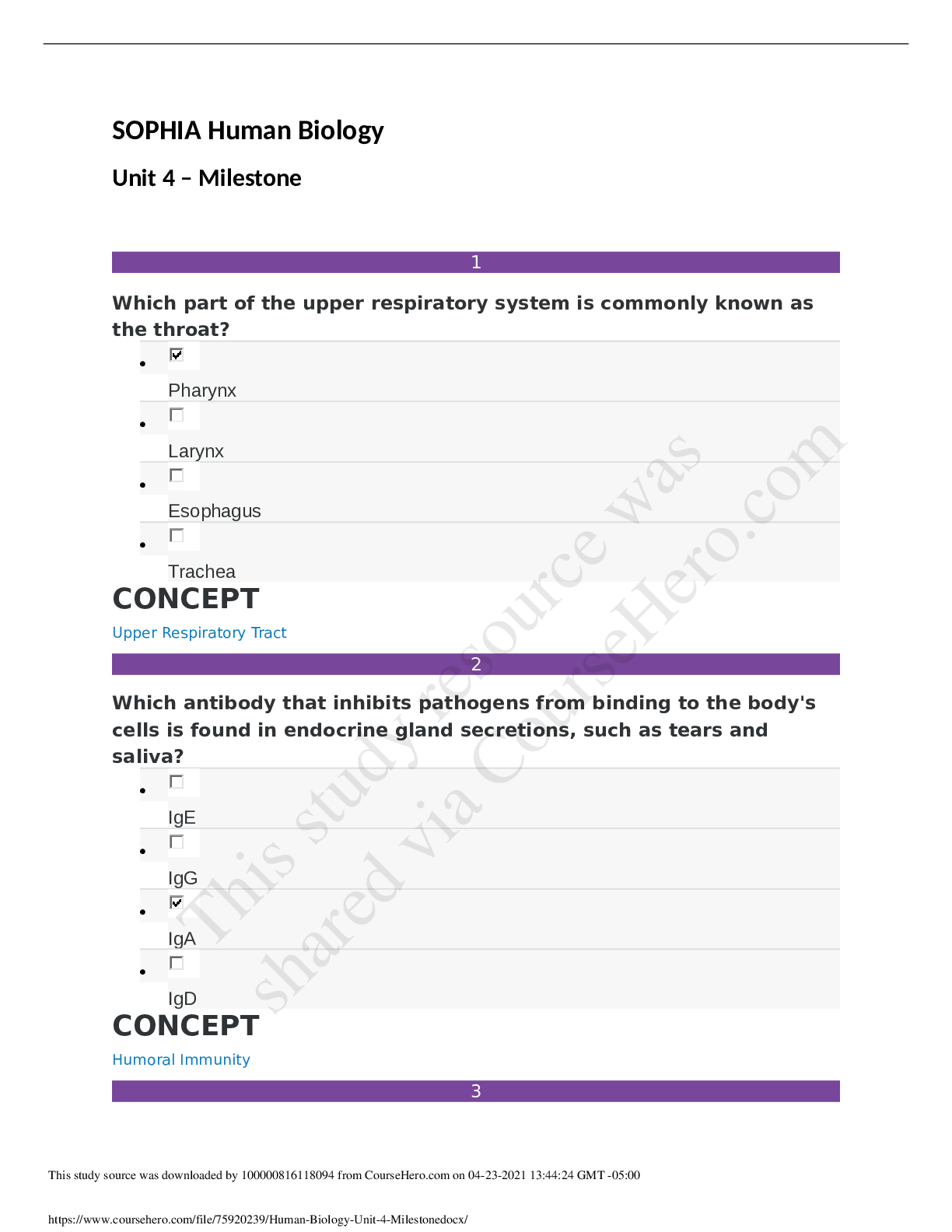
Which part of the upper respiratory system is commonly known as the throat?
Trachea
Larynx
Esophagus
Pharynx
CONCEPT
Upper Respiratory Tract
15
What are the two types of effector T-cells?
Helper T-cells and mediator T-cells
Cytotoxic T-cells and phagocytic T-cells
Helper T-cells and phagocytic T-cells
Cytotoxic T-cells and helper T-cells
CONCEPT
Cell-Mediated Response
16
Which of these is a characteristic of adaptive immunity?
It produces memory cells.
•
It is the first line of defense.
•
It does not recognize MHC.
•
It is non-specific.
CONCEPT
Adaptive Immunity
What is "leukocyte" the technical term for?
•
Plasma
•
White blood cells
•
Red blood cells
•
Platelets
CONCEPT
Blood
Which cells are triggered by our immune system to destroy certain types of cancer cells?
•
Plasma cells
•
Myeloma cells
•
Natural killer cells
•
Spleen cells
CONCEPT
Cancer and Homeostasis
Which kind of immunity does mucus play a role in?
•
Innate
•
Physical barriers
•
General
•
Adaptive
CONCEPT
Pathogens
In which of the following does the blood clot appropriately to prevent major blood loss?
•
Hemophilia
•
Hemostasis
•
Embolism
•
Thrombosis
CONCEPT
Platelets
[Show More]