D099 / Sales Management – Module 12 Notes (Western Governors University) (Latest 2025): Complete Study Guide Notes | Verified Correct Answers | 100% Accurate | Grade A
BioChemistry > TEST BANKS > Test Bank For Lehninger Principles Of Biochemistry 5th Edition By David L. Nelson (All)
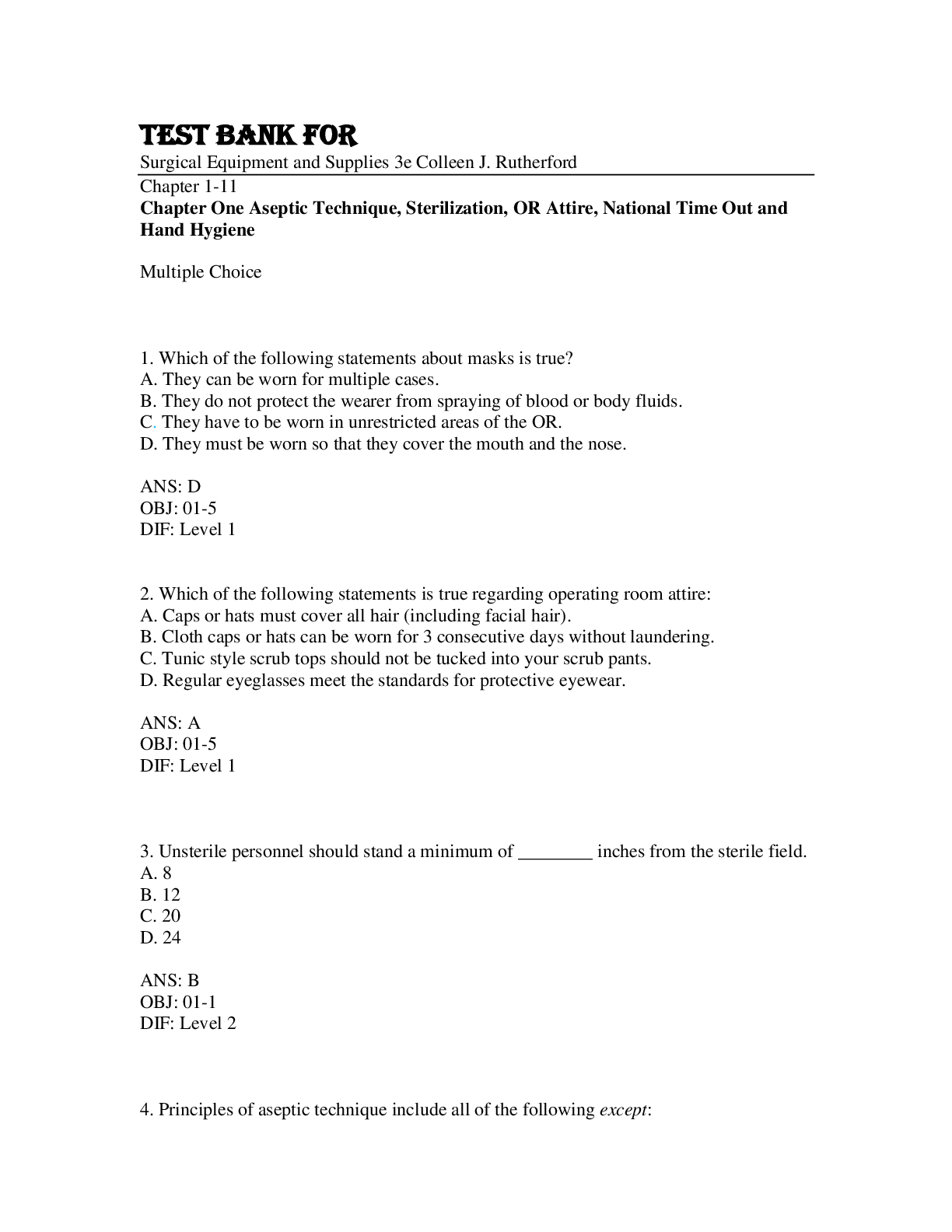
Test Bank For Lehninger Principles Of Biochemistry 5th Edition By David L. Nelson Chapter 1 The Foundations of Biochemistry Multiple Choice Questions 1. Cellular foundations Pages: 2-4 Difficulty: 1 A ... ns: C In a bacterial cell, the DNA is in the: A) cell envelope. B) cell membrane. C) nucleoid. D) nucleus. E) ribosomes. 2. Cellular foundations Page: 3 Difficulty: 1 Ans: E A major change occurring in the evolution of eukaryotes from prokaryotes was the development of: A) DNA. B) photosynthetic capability. C) plasma membranes. D) ribosomes. E) the nucleus. 3. Cellular foundations Page: 3 Difficulty: 1 Ans: B In eukaryotes, the nucleus is enclosed by a double membrane called the: A) cell membrane. B) nuclear envelope. C) nucleolus. D) nucleoplasm. E) nucleosome. 4. Cellular foundations Page: 4 Difficulty: 1 Ans: C The dimensions of living cells are limited, on the lower end by the minimum number of biomolecules necessary for function, and on the upper end by the rate of diffusion of solutes such as oxygen. Except for highly elongated cells, they usually have lengths and diameters in the range of: A) 0.1 m to 10 m. B) 0.3 m to 30 m. C) 0.3 m to 100 m. D) 1 m to 100 m. E) 1 m to 300 m. 2 Chapter 1 The Foundations of Biochemistry 5. Cellular foundations Page: 4 Difficulty: 2 Ans: B Which group of single-celled micro-organisms has many members found growing in extreme environments? A) bacteria. B) archaea. C) eukaryotes. D) heterotrophs. E) none of the above. 6. Cellular foundations Page: 5 Difficulty: 2 Ans: B The bacterium E. coli requires simple organic molecules for growth and energy—it is therefore a: F) chemoautotroph. G) chemoheterotroph. H) lithotroph. I) photoautotroph. J) photoheterotroph. 7. Cellular foundations Page: 6-8 Difficulty: 2 Ans: B Which one of the following has the cellular components arranged in order of increasing size? A) Amino acid < protein < mitochondrion < ribosome B) Amino acid < protein < ribosome < mitochondrion C) Amino acid < ribosome < protein < mitochondrion D) Protein < amino acid < mitochondrion < ribosome E) Protein < ribosome < mitochondrion < amino acid 8. Cellular foundations Page: 10 Difficulty: 2 Ans: A The three-dimensional structure of macromolecules is formed and maintained primarily through noncovalent interactions. Which one of the following is not considered a noncovalent interaction? A) carbon-carbon bonds B) hydrogen bonds C) hydrophobic interactions D) ionic interactions E) van der Waals interactions 9. Chemical foundations Page: 11 Difficulty: 2 Ans: E Which one of the following is not among the four most abundant elements in living organisms? A) Carbon B) Hydrogen C) Nitrogen D) Oxygen E) Phosphorus Chapter 1 The Foundations of Biochemistry 3 10. Chemical foundations Page: 12-13 Difficulty: 1 Ans: B The four covalent bonds in methane (CH4) are arranged around carbon to give which one of the following geometries? A) linear B) tetrahedral C) trigonal bipyramidal D) trigonal planar E) trigonal pyramidal. [Show More]
Last updated: 2 weeks ago
Preview 5 out of 390 pages

Loading document previews ...
Buy this document to get the full access instantly
Instant Download Access after purchase
Buy NowInstant download
We Accept:

Can't find what you want? Try our AI powered Search
Connected school, study & course
About the document
Uploaded On
Dec 01, 2025
Number of pages
390
Written in
All
This document has been written for:
Uploaded
Dec 01, 2025
Downloads
0
Views
39
Scholarfriends.com Online Platform by Browsegrades Inc. 651N South Broad St, Middletown DE. United States.
We're available through e-mail, Twitter, Facebook, and live chat.
FAQ
Questions? Leave a message!
Copyright © Scholarfriends · High quality services·