NR 509 Immersion – Physical Assessment Steps
1) Greet patient
2) Inspect face – no discoloration or lesions present
3) Inspect head – midline, symmetrical
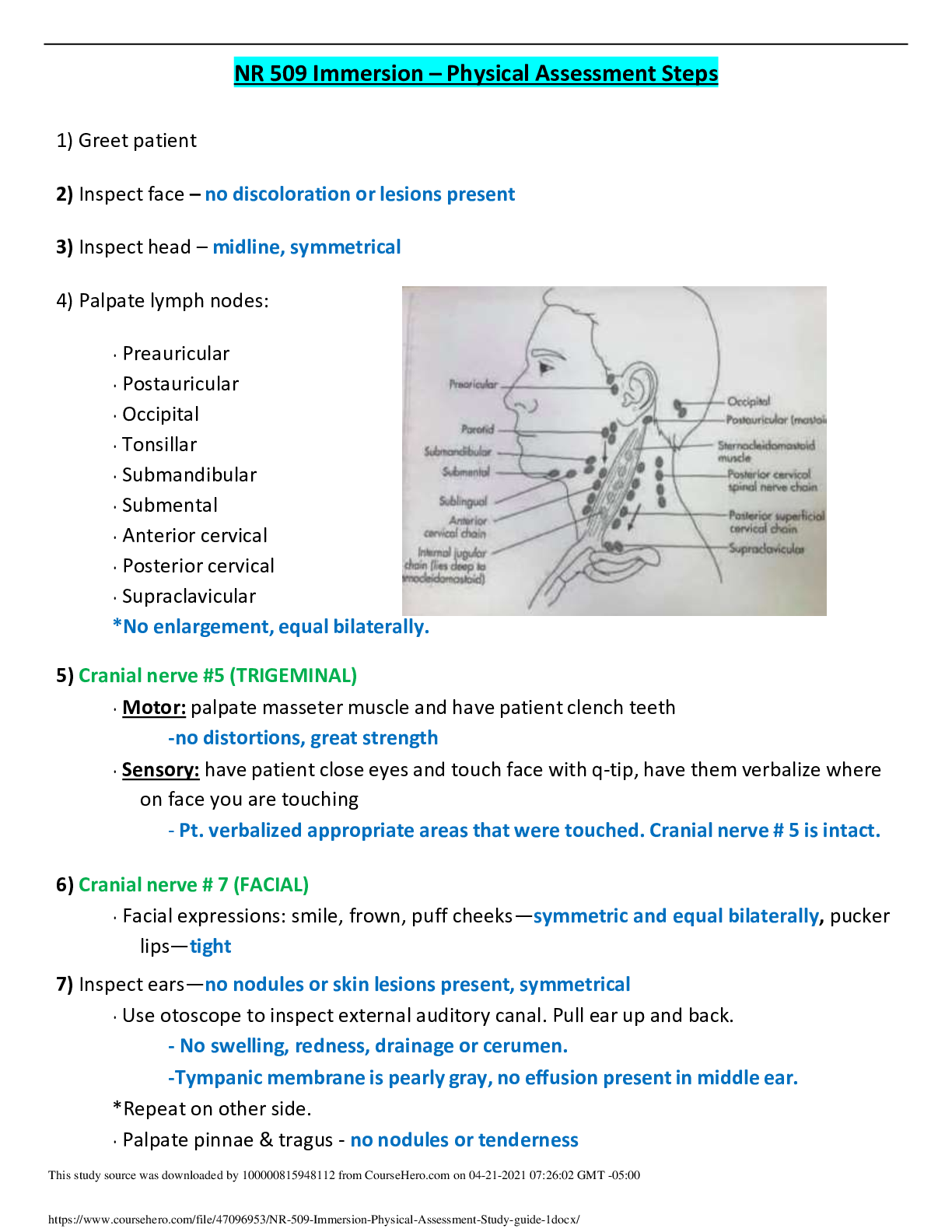
4) Palpate lymph nodes:
• Preauricular
• Postau
...
NR 509 Immersion – Physical Assessment Steps
1) Greet patient
2) Inspect face – no discoloration or lesions present
3) Inspect head – midline, symmetrical
4) Palpate lymph nodes:
• Preauricular
• Postauricular
• Occipital
• Tonsillar
• Submandibular
• Submental
• Anterior cervical
• Posterior cervical
• Supraclavicular
*No enlargement, equal bilaterally.
5) Cranial nerve #5 (TRIGEMINAL)
• Motor: palpate masseter muscle and have patient clench teeth
-no distortions, great strength
• Sensory: have patient close eyes and touch face with q-tip, have them verbalize where on face you are touching
- Pt. verbalized appropriate areas that were touched. Cranial nerve # 5 is intact.
6) Cranial nerve # 7 (FACIAL)
• Facial expressions: smile, frown, puff cheeks—symmetric and equal bilaterally, pucker lips—tight
7) Inspect ears—no nodules or skin lesions present, symmetrical
• Use otoscope to inspect external auditory canal. Pull ear up and back.
- No swelling, redness, drainage or cerumen.
-Tympanic membrane is pearly gray, no effusion present in middle ear.
*Repeat on other side.
• Palpate pinnae & tragus - no nodules or tenderness
8) Cranial nerve # 8 (ACOUSTIC)
• Whisper test
- Have patient cover one ear
- Whisper 3 words
- Repeat on other side
*Hearing intact bilaterally.
9) Inspect eyes—conjunctiva clear and pink, no drainage or lesions present; sclera white and clear.
10) Cranial nerve #2 (OPTIC)
• Snellen eye chart—tests central vision
-Stand 6 feet away from patient.
-Have patient cover 1 eye and read smallest line.
-Repeat with other eye.
-Repeat with both eyes.
*Report as 20/20 vision in R eye, L eye, and both eyes.
• Continuing assessment of cranial nerve # 2—test peripheral vision.
- Stand at eye level with patient and have patient look straight ahead.
- Test peripheral vision from behind shoulders, above head, and from below at
waist.
• Continuing assessment of cranial nerve # 2—test pupillary response.
- Use light on ophthalmoscope and ask patient to stare at your nose.
- Come from side of eye to front.
• Both pupils constrict, 2 to 3 cm in diameter, respond to light.
11) Cranial nerves #3 (OCULOMOTOR), #4 (TROCHLEAR), & #6 (ABDUCENS)
• Star or “H” pattern—checking extraocular muscles of the eye
• All extraocular movements are intact equally.
12) Inspect nose—midline, no obstructions, swelling or visible fractures
- Use otoscope— tip nose up with thumb.
• Inspect left turbinate—pink & moist
• Angle inward to inspect septum—midline, no swelling or bogginess
• Repeat on other side.
13) Palpate frontal and maxillary sinuses—assess for tenderness
14) Inspect throat and mouth:
• Lips—pink and moist
• Open mouth:
- Inspect teeth—no signs of decay or cracks
- Inspect gums—pink and healthy, no redness or swelling
- Inspect buccal mucosa—pink and moist
- Inspect palate—hard & soft palates healthy, pink and moist
- Inspect tongue— smooth, healthy, pink and moist
*Lift tongue:
- Inspect floor of mouth—no nodules or drainage, healthy, pink and moist
- Inspect posterior pharynx—healthy pink, no postnasal
...............................................CONTINUED..........................................................
[Show More]