South University - NSG 5003 QUIZZES
W6-10 MID TERM EXAM
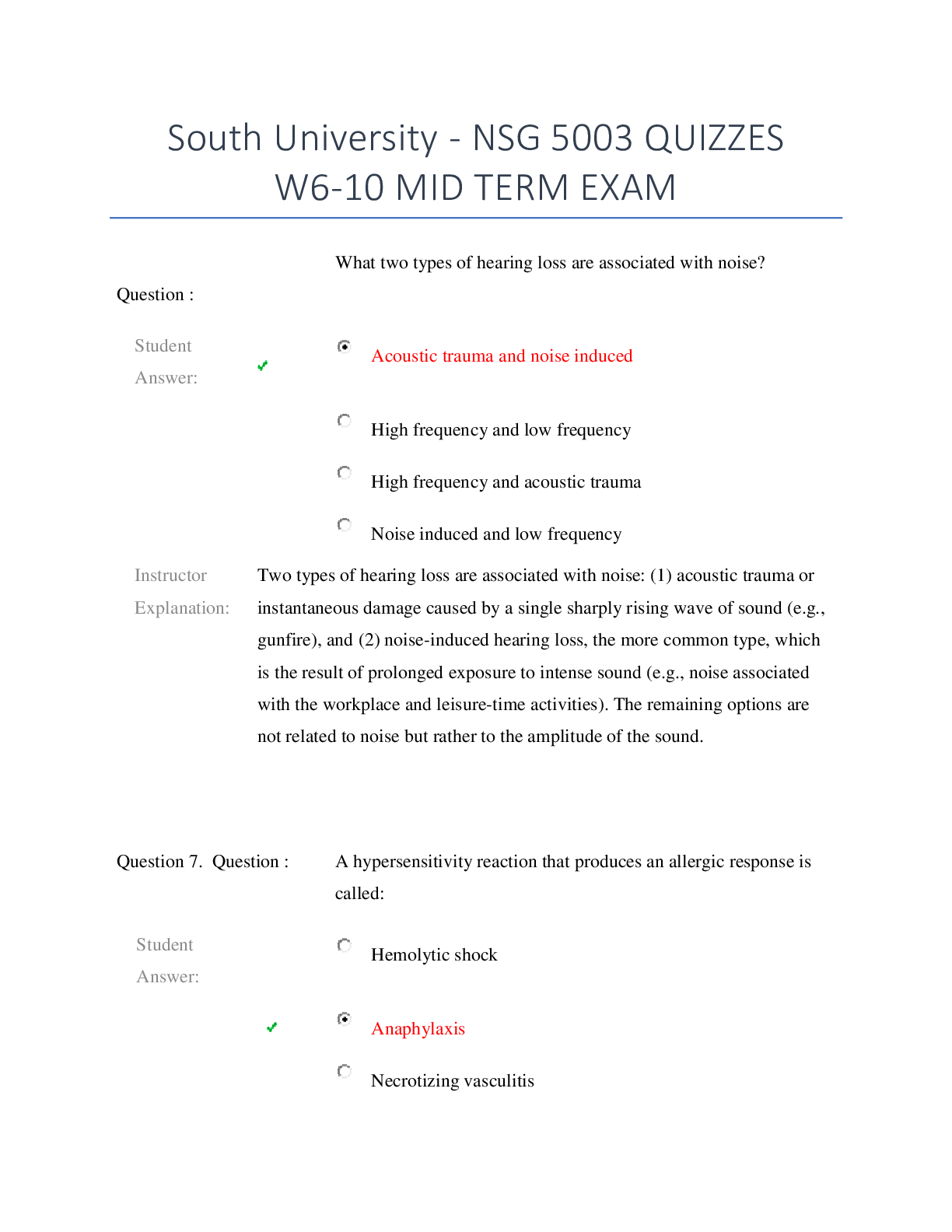
Question : What two types of hearing loss are associated with noise?
Student Answer: Acoustic trauma and noise induced
High frequency and low
...
South University - NSG 5003 QUIZZES
W6-10 MID TERM EXAM
Question : What two types of hearing loss are associated with noise?
Student Answer: Acoustic trauma and noise induced
High frequency and low frequency
High frequency and acoustic trauma
Noise induced and low frequency
Question 7. Question : A hypersensitivity reaction that produces an allergic response is called:
Student Answer: Hemolytic shock
Anaphylaxis
Necrotizing vasculitis
Systemic erythematosus
Question 8. Question : Which cytokine is produced and released from virally infected host cells?
Student Answer: IL-1
IL-10
Tumor necrosis factor–alpha (TNF-α)
Interferon-alpha (IFN-α)
Question 10. Question : Which T-lymphocyte phenotype is the key determinant of childhood asthma?
Student Answer: CD4 helper T 1 (Th1) lymphocytes
CD4 helper T 2 (Th2) lymphocytes
CD8 cytotoxic T (Tc) lymphocytes
Memory T lymphocytes
Question 12. Question : Some older adults have impaired inflammation and wound healing because of which problem?
Student Answer: The circulatory system cannot adequately perfuse tissues.
Complement and chemotaxis are deficient.
Underlying chronic illnesses exist.
The number of mast cells is insufficient.
Question 13. Question : The role of cytokines in cell reproduction is that they:
Student Answer: Provide growth factor for tissue growth and development.
Block the progress of cell reproduction through the cell cycle.
Restrain cell growth and development.
Provide nutrients for cell growth and development.
Question 15. Question : Which characteristic is the most important determinant of immunogenicity when considering the antigen?
Student Answer: Size
Foreignness
Complexity
Quantity
Question 16. Question : How do cells receive communication from the extracellular fluid surrounding them?
Student Answer: Through the protein channel (gap junction)
Via the plasma membrane–bound signaling molecules (involving receptors)
Through hormone secretion such as neurotransmitters
By chemical messengers such as ligands
Question 17. Question : In a normal, nonmutant state, an oncogene is referred to as a:
Student Answer: Basal cell
Target cell
Caretaker gene
Proto-oncogene
Question 19. Question : What is the primary cause of respiratory distress syndrome (RDS) of the newborn?
Student Answer: Immature immune system
Small alveoli
Surfactant deficiency
Anemia
Question 20. Question : Which mode of chemical signaling uses blood to transport communication to cells some distance away?
Student Answer: Paracrine
Autocrine
Neurotransmitter
Hormonal
Question 22. Question : Which component of the plasma protein system tags pathogenic microorganisms for destruction by neutrophils and macrophages?
Student Answer: Complement cascade
Coagulation system
Kinin system
Immune system
Question 23. Question : In a type III hypersensitivity reaction, the harmful effects after the immune complexes are deposited in tissues are a result of:
Student Answer: Cytotoxic T (Tc) cells
Natural killer (NK) cells
Complement activation
Degranulation of mast cells
Question 24. Question : Which statement about exotoxins is true?
Student Answer: Exotoxins are contained in cell walls of gram-negative bacteria.
Exotoxins are released during the lysis of bacteria.
Exotoxins are able to initiate the complement and coagulation cascades.
Exotoxins are released during bacterial growth.
Question 25. Question : Which intracardiac pressure is generated by atrial contraction?
Student Answer: A wave
C wave
Y descent
X descent
Question 28. Question : Research supports the premise that exercise has a probable impact on reducing the risk of:
Student Answer: Liver cancer
Endometrial cancer
Stomach cancer
Colon cancer
Question 33. Question : Increased capillary hydrostatic pressure results in edema because of:
Student Answer: Losses or diminished production of plasma albumin
Inflammation resulting from an immune response
Blockage within the lymphatic channel system
Sodium and water retention
Question 34. Question : What is an example of compensatory hyperplasia?
Student Answer: Hepatic cells increase cell division after part of the liver is excised.
Skeletal muscle cells atrophy as a result of paralysis.
The heart muscle enlarges as a result of hypertension.
The size of the uterus increases during pregnancy.
Question 35. Question : Which factor contributes to the production of mucus associated with chronic bronchitis?
Student Answer: Airway injury
Pulmonary infection
Increased goblet cell size
Bronchospasms
Question 36. Question : During which phase of the cell cycle is deoxyribonucleic acid (DNA) synthesized?
Student Answer: G1
S
G2
M
Question 37. Question : What is the single most common cause of cellular injury?
Student Answer: Hypoxic injury
Chemical injury
Infectious injury
Genetic injury
Question 38. Question : Considering the hypothalamus, a fever is produced by:
Student Answer: Endogenous pyrogens acting directly on the hypothalamus
Exogenous pyrogens acting directly on the hypothalamus
Immune complexes acting indirectly on the hypothalamus
Cytokines acting indirectly on the hypothalamus
Question 39. Question : Which statement is true regarding hypoxemia?
Student Answer: Hypoxemia results in the increased oxygenation of arterial blood.
Respiratory alterations cause hypoxemia.
Hypoxemia results in the decreased oxygenation of tissue cells.
Various system changes cause hypoxemia.
Question 40. Question : Which hormone prompts increased anxiety, vigilance, and arousal during a stress response?
Student Answer: Norepinephrine
Epinephrine
Cortisol
Adrenocorticotropic hormone (ACTH)
FINAL EXAM
What is the purpose of administering ibuprofen to individuals being treated for frostbite?
Student Answer: Treating fever
Preventing platelet aggregation
Reducing pain
Inhibiting prostaglandins
Question 3. Question : Which statement is incorrect regarding gallbladder function?
Student Answer: Within thirty minutes of eating, the gallbladder forces bile into the stomach.
Cholinergic branches of the vagus nerve mediate gallbladder contraction.
Cholecystokinin provides hormonal regulation of gallbladder contraction.
The sphincter of Oddi controls the flow of bile from the gallbladder.
Question 6. Question : What is the cause of functional dysphagia?
Student Answer: Intrinsic mechanical obstruction
Extrinsic mechanical obstruction
Tumor
Neural or muscular disorders
Question 8. Question : Which clinical manifestations of a urinary tract infection may be demonstrated in an eighty-five-year-old individual?
Student Answer: Confusion and poorly localized abdominal discomfort
Dysuria, frequency, and suprapubic pain
Hematuria and flank pain
Pyuria, urgency, and frequency
Question 16. Question : Exposure to what protects the mucosal barrier of the stomach?
Student Answer: Prostaglandins
Aspirin
Helicobacter pylori
Regurgitated bile
Question 17. Question : After puberty, the epiphyseal plate calcifies and the epiphysis merges with the:
Student Answer: Epiphyseal line
Epiphyseal plate
Metaphysis
Articular cartilage
Question 18. Question : Hepatic fat accumulation is observed in which form of cirrhosis?
Student Answer: Biliary
Metabolic
Postnecrotic
Alcoholic
question 27. Question : Which glycoprotein protects against urolithiasis and is a ligand for lymphokines?
Student Answer: Uromodulin
Nephrin
Urodilatin
Cystatin
[Show More]