Random Section 1
Question 1 2 / 2 points
The clinician should question the patient with suspected gout about use of which of these medications?
Question options:
a) Low-dose aspirin
b) Thiazide diuretics
c) Ethambu
...
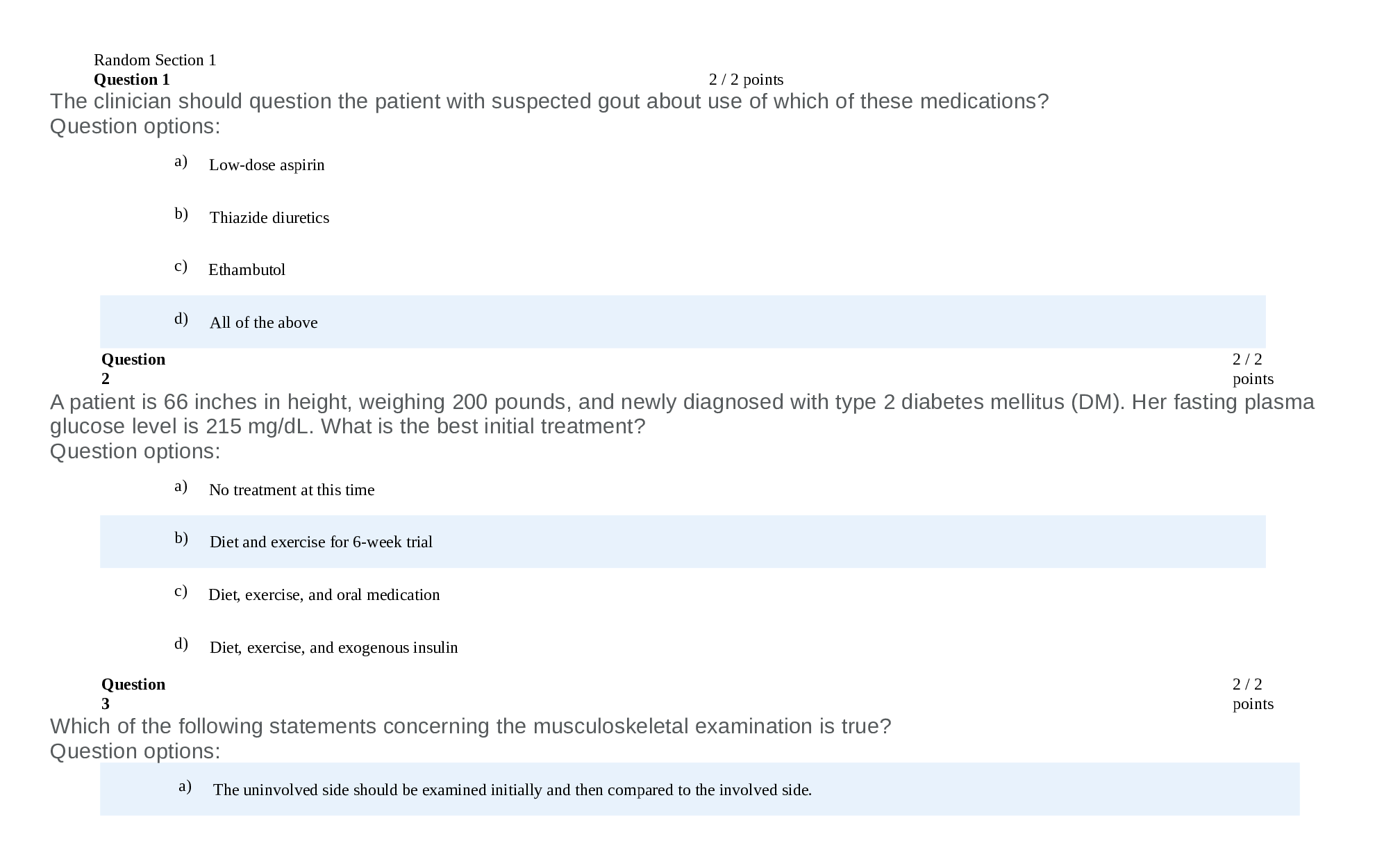
Random Section 1
Question 1 2 / 2 points
The clinician should question the patient with suspected gout about use of which of these medications?
Question options:
a) Low-dose aspirin
b) Thiazide diuretics
c) Ethambutol
d) All of the above
Question2
2 / 2
points
A patient is 66 inches in height, weighing 200 pounds, and newly diagnosed with type 2 diabetes mellitus (DM). Her fasting plasma
glucose level is 215 mg/dL. What is the best initial treatment?
Question options:
a) No treatment at this time
b) Diet and exercise for 6-week trial
c) Diet, exercise, and oral medication
d) Diet, exercise, and exogenous insulin
Question3
2 / 2
points
Which of the following statements concerning the musculoskeletal examination is true?
Question options:
a) The uninvolved side should be examined initially and then compared to the involved side.
b) The part of the body that is causing the patient pain should be examined first.
c) When possible, the patient should not be asked to perform active range-of-motion (ROM) exercises to avoid causing pain.
d) Radiographs should always be obtained prior to examination so as not to cause further injury to the patient.
Question4
2 / 2
points
The clinician prescribes glipizide (Glucotrol) for a diabetic patient. Which statement made by the patient would indicate that your
teaching has been effective?
Question options:
a) “I’ll take my pill at least 30 minutes before breakfast.”
b) “I’ll take my Glucotrol before bedtime.”
c) “It is important to take my medication right after I eat.”
d) “Since I only like to eat two meals a day, I can take the pill between my meals.”
Question5
2 / 2
points
Jennifer is an 18-year-old who comes to the emergency room after a fall during a soccer game. Jennifer explains that she fell on her
left side and kept her arm out straight to break her fall. She has been experiencing severe pain and limited ROM in her left shoulder.
The clinician has diagnosed Jennifer with a dislocated shoulder. Which of the following statements are true concerning shoulder
dislocation?
Question options:
a) Posterior dislocations are more common than anterior dislocations.
b) There is a risk of neurovascular and neurosensory trauma, so the clinician should check for distal pulses.
c) Recurrent dislocations are uncommon and would require great force to result in injury.
d) Surgery is most commonly the treatment of choice.
Question6
2 / 2
points
Which of the following is diagnostic for diabetes mellitus?
Question options:
a) A1C 7.0 on one occasion
b) Fasting blood sugar (FBS) of 100 mg/dL on two occasions
c) Random plasma glucose greater than or equal to 200 in a person with symptoms of hyperglycemia
d) Two-hour post-load plasma glucose of 300 mg/dL on one occasion
Question7
2 / 2
points
Mrs. Allen is a 60-year-old woman who has been diagnosed with osteoporosis. She is very concerned about the risk of breast cancer
associated with hormone replacement therapy and is wondering what other treatments are available to her. The clinician explains that
bisphosphonates are another class of drugs used in the prevention and treatment of osteoporosis. What teaching should the clinician
give Mrs. Allen in regard to taking bisphosphonates?
Question options:
a) Taking bisphosphonates can result in hypercalcemia, so calcium intake should be decreased while taking this class of drugs.
b) There is potential for upper GI irritation, so these medications are contraindicated in people with abnormalities of the esophagus or delayed esophageal emptying.
c) This class of drugs can be taken at any time of the day without regard to meals.
d) None of the above
Question8
2 / 2
points
A patient is diagnosed with hypothyroidism. Which of the following electrocardiogram changes should the clinician expect as a
manifestation of the disease?
Question options:
a) Sinus bradycardia
b) Atrial fibrillation
c) Supraventricular tachycardia
d) U waves
Question9
0 / 2
points
A 35-year-old woman presents with symptoms of hypoglycemia. There is no history of diabetes mellitus. Which of the following should
be included in the differential diagnosis?
Question options:
a) Anxiety disorder
b) Pheochromocytoma
c) Psychosis
d) All of the above
Question10
2 / 2
points
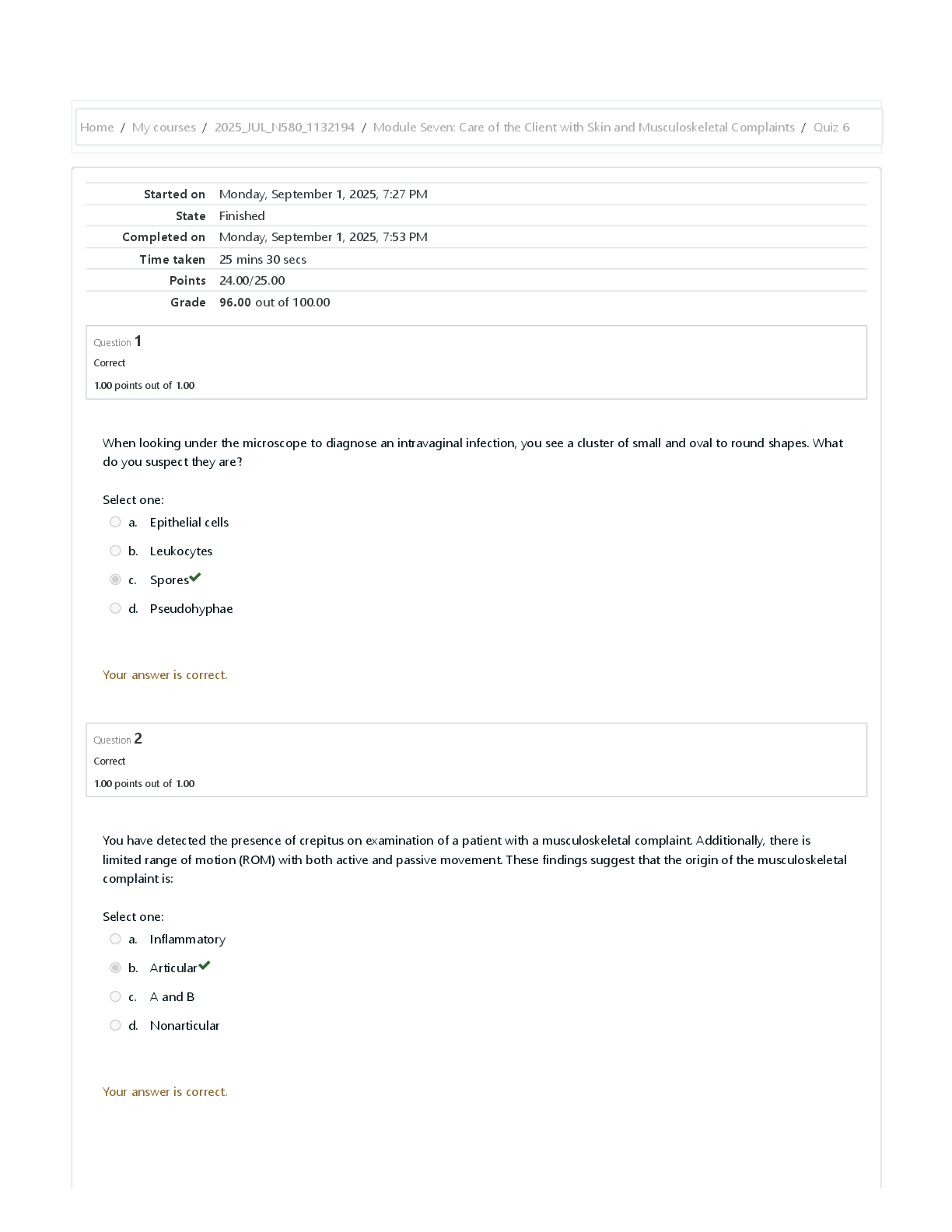
You have detected the presence of crepitus on examination of a patient with a musculoskeletal complaint. Additionally, there is limited
range of motion (ROM) with both active and passive movement. These findings suggest that the origin of the musculoskeletal
complaint is:
Question options:
a) Articular
b) Inflammatory
c) Nonarticular
d) A and B
Question11
2 / 2
points
Janet is a 30-year-old who has recently been diagnosed with a herniated disc at the level of L5-S1. She is currently in the emergency
room with suspicion of cauda equina compression. Which of the following is a sign or symptom of cauda equina compression?
Question options:
a) Gastrocnemius weakness
b) A reduced or absent ankle reflex
c) Numbness in the lateral foot
d) Paresthesia of the perineum and buttocks
Question12
2 / 2
points
Mrs. Thomas was seen in the office complaining of pain and point tenderness in the area of her elbow. The pain has increased
following a day of gardening one week ago. A physical finding that differentiates the diagnosis and is most consistent with lateral
epicondylitis (tennis elbow) is:
Question options:
a) Ecchymosis, edema, and erythema over the lateral epicondyle
b) Pain at the elbow with resisted movements at the wrist and forearm
c) Inability to supinate and pronate the arm
d) Inability to flex or extend the elbow against resistance
Question13
2 / 2
points
The clinician suspects that a client seen in the office has hyperthyroidism. Which of the following tests should the clinician order on
the initial visit?
Question options:
a) High sensitivity thyroid-stimulating hormone (TSH) and free T4
b) Free T4 and serum calcium
c) Free T3 and T4
d) TSH and thyroxin antibodies
Question14
0 / 2
points
The clinician sees a patient who is 5 feet tall and weighs 150 pounds. How would the clinician classify this patient?
Question options:
a) Overweight
b) Mild obesity
c) Moderate obesity
d) Morbid obesity
Question15
2 / 2
points
Which of the following statements is true concerning the management of the client with a herniated disc?
Question options:
a) Muscle relaxants and narcotics can be used to control moderate pain but should be discontinued after 3 weeks of use.
b) An epidural injection is helpful in reducing leg pain that has persisted for at least 3 weeks after the herniation occurred.
c) Intolerable pain for more than a 3-month period is an indication for surgical intervention.
d) All of the above
Question16
2 / 2
points
Sam is a 25-year-old who has been diagnosed with low back strain based on his history of localized low back pain and muscle spasm
along with a normal neurological examination. As the clinician, you explain to Sam that low back pain is a diagnosis of exclusion.
Which of the following symptoms would alert the clinician to the more serious finding of a herniated nucleus pulposus or ruptured
disc?
Question options:
a) Morning stiffness and limited mobility of the lumbar spine
b) Unilateral radicular pain symptoms that extend below the knee and are equal to or greater than the back pain
c) Fever, chills, and elevated erythrocyte sedimentation rate
d) Pathologic fractures, severe night pain, weight loss, and fatigue
Question17
2 / 2
points
The clinician suspects that a client has patellar instability. In order to test for this, the client is seated with the quadriceps relaxed, and
the knee is placed in extension. Next the patella is displaced laterally, and the knee flexed to 30°. If instability is present, this
maneuver displaces the patella to an abnormal position on the lateral femoral condyle, and the client will perceive pain. Testing for
patellar instability in this way is known as:
Question options:
a) Apprehension sign
b) Bulge sign
c) Thumb sign
d) None of the above
Question18
2 / 2
points
Which of the following medications for type 2 diabetes mellitus should not be prescribed during pregnancy?
Question options:
a) Insulin
b) Metformin
c) Glucotrol
d) Precose
Question19
2 / 2
points
Which stage of Paget’s disease is characterized by elevated numbers of osteoblasts, resulting in abnormal increases in bone
remodeling and leading to an irregular deposition of collagen fibers?
Question options:
a) Lytic
b) Mixed
c) Sclerotic
d) All of the above
Question20
2 / 2
points
A 70-year-old female has fallen 2 weeks ago and developed immediate pain in her left wrist. She thought she just bruised it but is
worried because it has not improved. She has used Tylenol® and ice at home, and that has helped slightly. You examine her and find
she has moderate swelling and ecchymosis but no overtly obvious deformity. Her ROM is uncomfortable and severely diminished due
to the pain. No crepitus is heard or felt. Her fingers are warm; her pulse is strong; and capillary refill is less than 2 seconds. What
should you do?
Question options:
a) Make an immediate referral for an orthopedic evaluation without further assessment.
b) Tell her that it takes time for these bruises to improve, so she should be patient.
c) Obtain a wrist x-ray and place her wrist in a splint or prescribe a splint.
d) Send her to the emergency room for reduction of this obvious wrist fracture.
Question21
2 / 2
points
Mr. S presents in the clinic with pain, tenderness, erythema, and swelling of his left great toe. The clinician suspects acute gout.
Which of the following should the clinician expect in the initial test results for this patient?
Question options:
a) Elevated uric acid level
b) Elevated blood urea nitrogen
c) Decreased urine pH
d) Decreased C-reactive protein
Question22
2 / 2
points
Urine-free cortisol is one of four diagnostic tests recommended for Cushing’s syndrome.
Question options:
a) True
b) False
Question23
2 / 2
points
You are performing muscle strength testing on a patient presenting with musculoskeletal pain and find that the patient has complete
ROM with gravity eliminated. Which numeric grade of muscle strength would you give this patient?
Question options:
a) 1
b) 2
c) 3
d) 4
e) 5
Question24
2 / 2
points
After 6 months of Synthroid therapy, the clinician should expect which of the following in the repeat thyroid studies?
Question options:
a) Elevated TSH
b) Normal TSH
c) Low TSH
d) Undetectable TSH
Question25
2 / 2
points
Metformin is the first line of pharmacologic treatment for type 2 DM.
Question options:
a) True
b) False
Question26
2 / 2
points
A patient with type 2 diabetes comes to the clinic after reading about metformin in a magazine. Which of the following conditions that
the patient also has would be a contraindication to taking metformin?
Question options:
a) Ketoacidosis
b) Cirrhosis
c) Hypoglycemic episodes
d) All of the above
Question27
2 / 2
points
Which of the following are common signs of type 2 DM?
Question options:
a) Anorexia
b) Recurrent yeast infection
c) Weight gain
d) Elevated HDL cholesterol
Question28
2 / 2
points
Mrs. Gray is a 55-year-old woman who presents with tightness, pain, and limited movement in her right shoulder. She denies any
history of trauma. Her examination reveals a 75% reduction in both active and passive ROM of the right shoulder. Mrs. Gray also is
experiencing tenderness with motion and pain at the deltoid insertion. Her medical history is significant for type 1 diabetes mellitus
and hypertension. Her social history reveals that she is a secretary and that she is right-handed. Based on her examination and
medical history, you suspect adhesive capsulitis, or “frozen shoulder.” Which clue in Mrs. Gray’s history supports this diagnosis?
Question options:
a) History of hypertension
b) Her affected shoulder is also her dominant arm.
c) Her history of diabetes mellitus
d) Her work as a secretary predisposes her to repetitive motions.
Question29
2 / 2
points
The clinician has been doing diabetic teaching for a patient with type 1 diabetes. Which of the following statements by the patient
would indicate that teaching has been effective?
Question options:
a) “As long as I don’t need glasses, I don’t have to worry about going blind.”
b) “I know I need to have my eyes checked every year.”
c) “My optometrist checks my eyes.”
d) “I will see my eye doctor when my vision gets blurry.”
Question30
0 / 2
points
How often should the clinician examine the feet of a person with diabetes?
Question options:
a) Once a year
b) Every 6 months
c) Every 3 months
d) Every visit
Question31
2 / 2
points
Osteoarthritis is primarily a noninflammatory condition.
Question options:
a) True
b) False
Question32
2 / 2
points
The clinician has instructed Sam, a 25-year-old patient with low back strain, to use NSAIDs to manage his symptoms of pain and
discomfort. Which of the following statements would be most appropriate when teaching Sam about the use of NSAIDs?
Question options:
a) “You should start with the lowest dose that is effective in managing your pain, because long-term use of NSAIDs can result in gastrointestinal (GI) disorders such as
ulcers and hemorrhage.”
b) “You should start with the lowest dose that is effective in managing your pain to avoid developing tolerance to the medication.”
c) “You should take the maximum recommended dose of NSAIDs so that you will not need to take narcotics to control your pain.”
d) “It is important to take NSAIDs on an empty stomach in order to increase absorption.”
Question33
2 / 2
points
Normal estrogen function is important for preventing osteoporosis in both men and women. Estrogen works to prevent osteoporosis in
which of the following ways?
Question options:
a) By decreasing the erosive activity of osteoclasts
b) By promoting osteoclastogenesis
c) By inhibiting osteoclast apoptosis
d) All of the above
Question34
2 / 2
points
A diabetic patient asks the clinician why he needs to check his blood sugar at home even when he feels good. Which of the following
responses would be most appropriate?
Question options:
a) “Control of glucose will help postpone or delay complications.”
b) “Regularly checking blood sugar will help establish a routine.”
c) “Monitoring glucose will promote a sense of control.”
d) All of the above
Question35
2 / 2
points
Which of the following tests should you order to confirm Mr. W’s diagnosis?
Question options:
a) Bone scan
b) Computed tomography (CT) scan
c) X-ray of the foot
d) Culture of the ulcer
Question 36
2 / 2 points
One of the initial steps in assessing patients with musculoskeletal complaints is to determine whether the complaint is articular or
nonarticular in origin. Which of the following is an example of an articular structure?
Question options:
a) Bone
b) Synovium
c) Tendons
d) Fascia
Question37
2 / 2
points
Which of the following statements is true regarding the treatment of carpal tunnel syndrome?
Question options:
a) The goal of treatment is to prevent flexion and extension movements of the wrist.
b) Splints are used in carpal tunnel syndrome, because they allow for free movement of the fingers and thumb while maintaining the wrist in a neutral position.
c) Corticosteroid injections are discouraged in the treatment of carpal tunnel syndrome because of the risks for median nerve damage, scarring, and infection.
d) All of the above
Question38
2 / 2
points
A patient with type 1 diabetes comes to the clinic complaining of feeling nervous and clammy. He states that he took his insulin this
morning but was late for work and did not eat breakfast. Which action should the clinician take first?
Question options:
a) Check his blood sugar.
b) Have him drink 4 ounces of juice.
c) Call 911.
d) Ask him about his usual eating habits.
Question39
2 / 2
points
What is the recommended daily calcium intake for adults over the age of 50 with low bone mass?
Question options:
a) 1,200 mg/day
b) 1,000 mg/day
c) 1,300 mg/day
d) 1,500 mg/day
Question40
2 / 2
points
Which of the following statements concerning the treatment of fibromyalgia syndrome is true?
Question options:
a) There is currently no cure for the disorder; however, patients should be made aware that symptom relief is possible.
b) Treatment is directed toward controlling discomfort, improving sleep, and maintaining function.
c) Fibromyalgia syndrome can be difficult to manage, requiring a variety of approaches and multiple medications.
d) All of the above
Question41
2 / 2
points
Mr. Jackson is a 65-year-old man recently diagnosed with osteoarthritis. The clinician has explained to Mr. Jackson that the goals for
managing osteoarthritis include controlling pain, maximizing functional independence and mobility, minimizing disability, and
preserving quality of life. Mr. Jackson explains to the clinician that his first choice would be to use complementary therapies to control
his condition and asks what therapies are most effective in treating osteoarthritis. What would be the most appropriate response from
the clinician?
Question options:
a) “Complementary therapies should be considered only if surgical interventions are not successful.”
b) “I am unfamiliar with the available complementary therapies for osteoarthritis and prefer to discuss more mainstream treatments, such as NSAIDs and physical therapy,
to manage your condition.”
c) “I would be happy to discuss all the treatment options available to you. Complementary therapies, such as acupuncture, acupressure, and tai-chi, are being studied for
use in the treatment of osteoarthritis and have shown promise when used with standard medical therapy.”
d) “It would be crazy to use complementary therapies to treat such a serious condition.”
Question42
2 / 2
points
Mr. W, 53 years old, is seen in the clinic with concerns about his left foot. He has a 40-year history of type 1 diabetes with “fairly good”
control on twice-daily insulin. He denies injury but states that he tripped a few months ago and that his foot is sore when he walks.
Physical examination reveals an edematous, erythremic, and warm foot. There is a superficial ulcer on the plantar surface. Which of
the following is the most likely diagnosis?
Question options:
a) Fallen arch
b) Arthritis
c) Charcot joint
d) Sprained ankle
Question43
2 / 2
points
One of the most frequent presenting signs/symptoms of osteoporosis is:
Question options:
a) Goiter
b) Abnormal serum calcium
c) Elevated urine biochemical markers
d) Bony fracture
Question44
2 / 2
points
Lifestyle modification is the treatment of choice for metabolic syndrome.
Question options:
a) True
b) False
Question45
2 / 2
points
Which of the following is essential for diagnosing thyroid cancer?
Question options:
a) Fine needle aspiration
b) Thyroid ultrasound
c) CT scan
d) Magnetic resonance imaging
Question46
2 / 2
points
Fruit juice with added sugar is the treatment of choice for anyone experiencing hypoglycemia.
Question options:
a) True
b) False
Question47
2 / 2
points
Joyce is seen in the clinic complaining of vague symptoms of nervousness and irritability. She says that her hair will not hold a
permanent wave anymore. On physical examination, the clinician finds an irregular heartbeat and brisk reflexes. The differential
diagnosis should include which of the following conditions?
Question options:
a) Myxedema
b) Thyrotoxicosis
c) Cushing’s syndrome
d) Pan-hypopituitarism
Question48
2 / 2
points
A BMI of 29 kg/m2 is considered obesity.
Question options:
a) True
b) False
Question 2 / 2 49 points
Mrs. Anderson is a 35-year-old woman who has been recently diagnosed with carpal tunnel syndrome. She has two young children
and asks the clinician what the chances are that they also will develop carpal tunnel syndrome. Which of the following responses
would be correct regarding the risk of developing carpal tunnel syndrome?
Question options:
a) Carpal tunnel syndrome commonly occurs in families. Genetic factors are thought to account for about one-half the risk of developing carpal tunnel.
b) Only people with occupations that require repeated flexion extension of the wrist, use of hand tools that require forceful gripping, or use of hand tools that vibrate are at
risk for developing carpal tunnel.
c) An underlying musculoskeletal disorder must be present for a person to develop carpal tunnel.
d) Carpal tunnel syndrome only occurs in the presence of a hormonal imbalance.
Question50
2 / 2
points
A 64-year-old man with type 2 diabetes presents to the clinic with the complaint of “my feet feel like they are on fire.” He has a loss of
vibratory sense, +1 Achilles reflex, and a tack embedded in his left heel. Which of the following would be an appropriate treatment?
Question options:
a) Tricyclic antidepressants
b) Capsaicin cream
c) Vitamin B12 injections
d) Insulin
Attempt Score:
94 / 100 - 94 %
Overall Grade (highest attempt):
94 / 100 - 94 %
Done
70 year old female has gone two weeks ago and developed immediate pain in her left wrist. She thought she had just bruised it but is
worried because it has not improved. She is used Tylenol and ice that has helped slightly. You examined her and find moderate
sweating and bruising but no obvious defer me her range motion is uncomfortable and severely diminished due to pain what should
you do?
Obtain an x-ray and placed her wrist splints
Make an immediate referral for orthopedic evaluation
Sanderson emergency for reduction of this obvious wrist fracture
Tell her to take time for these bruises to improve and she should be patient
Osteoarthritis is a primary noninflammatory condition
True
False
The presence of a positive effect factor is always indicative of rheumatoid arthritis
True
False
Which of the following are common signs of type to DM?
Anorexia
Weight gain
Read current yeast infection
Elevated HDL
Which of the following medications can cause hyperglycemia
Prednisone
Synthroid
Metformin
Cephalexin
Which of the following is a diagnostic for diabetes mellitus
Fasting blood sugar of 100 on two occasions
A1 C7 .0 on one occasion
To our posterior glucose 300 on one occasion
Random glucose of 200 on two occasions
Which of the following medications for type to DM should not be prescribed during pregnancy
Insulin
Metformin
Precose
Glucotrol
A 35-year-old woman presents for symptoms of hypoglycemia. There is no history of diabetes. Which of the following should be included in the differential diagnosis?
Anxiety
Pheochromocytoma
Psychosis
All the above
MetForeman is the first line formal agent for DM
True
Saul’s
Fruit juice with added sugar is the treatment of choice for anyone having a hypoglycemia
True
False
Lifestyle medication is the treatment trays for metabolic syndrome
True
false
BMI of 29 is considered obese
False
Urine free cortisol is one of four diagnostic tests recommended for Cushing’s syndrome
True
false
[Show More]


![Preview of eBook [PDF] Barash, Cullen, and Stoelting's Clinical Anesthesia 9th Edition By Bruce F. Cu](https://browseimages.nyc3.digitaloceanspaces.com/paper-images/2024/Aug/29/8DF2QRTq2024-08-29-10-3966d0259b7c4b5.png)
![Preview of eBook [PDF] Fundamentals of Nursing 3rd Edition By Joanne Tollefson, Sue C. DeLaune, Patri](https://browseimages.nyc3.digitaloceanspaces.com/paper-images/2024/Aug/26/U6SQ8mmq2024-08-26-01-4766cc5d40d7385.png)
![Preview of eBook [PDF] Burns' Pediatric Primary Care 7th Edition BY Dawn Lee Garzon Maaks,, Nancy Bar](https://browseimages.nyc3.digitaloceanspaces.com/paper-images/2024/Aug/26/WR2rowXX2024-08-26-02-0966cc625bea839.png)





![Preview of [eTextbook] [PDF] Labor Economics 9th Edition By George Borjas](https://browseimages.nyc3.digitaloceanspaces.com/paper-images/2025/Jan/13/JcsHZtUb2025-01-13-07-42678542822cb77.png)

![Preview of [eTextbook] [PDF] Our Sexuality Enhanced Edition, Loose-leaf Version 14 Edition By Robert](https://browseimages.nyc3.digitaloceanspaces.com/paper-images/2025/Jan/11/dWqGQ6Ng2025-01-11-11-566782db1b759b0.png)
 HESI VI EXIT EXAM.png)
.png)