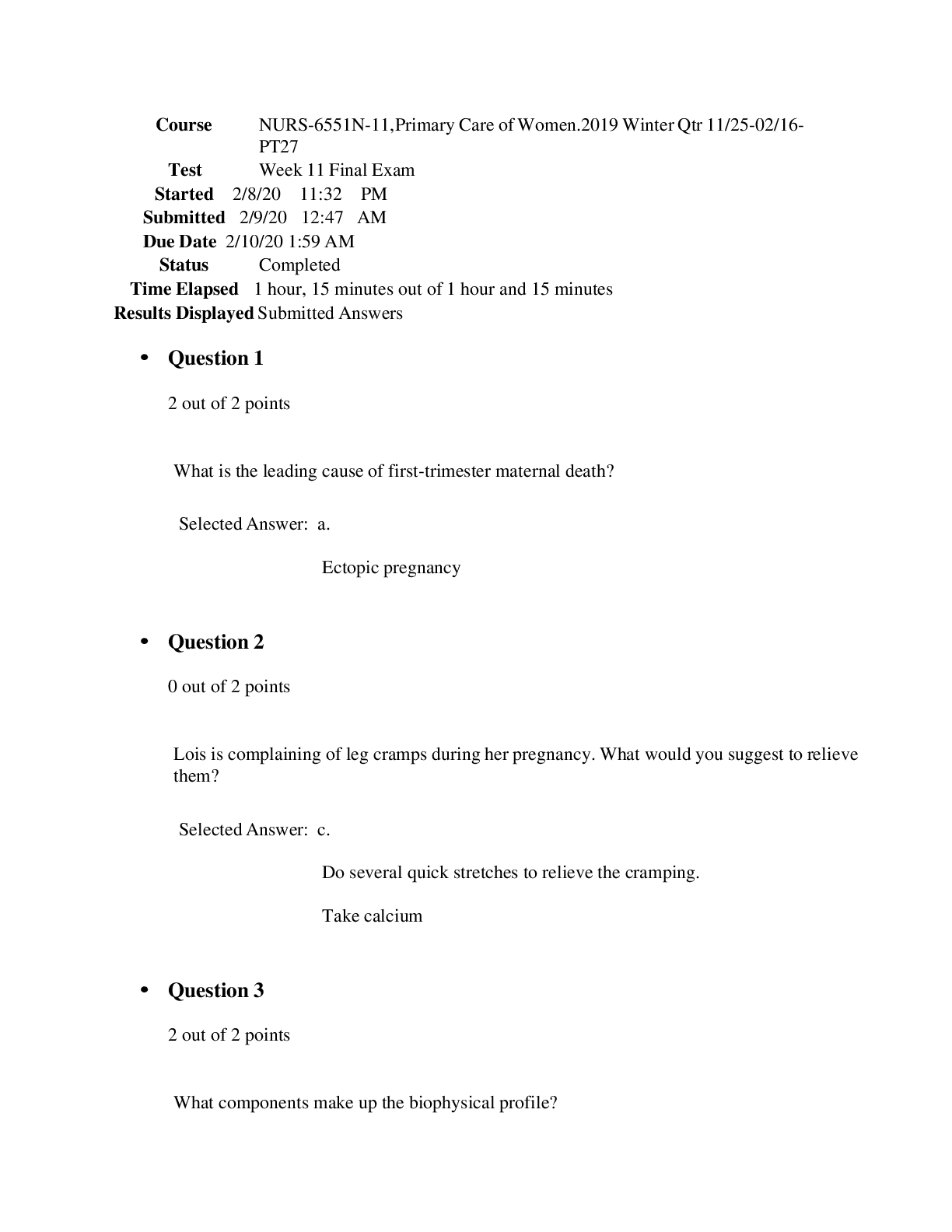
Course G150/PHA1500 Section 13 Structure and Function of the Human Body - Online Plus - 2017 Summer Quarter Term 1
Test Module 06 Final Exam
Started 8/8/17 1:26 AM Submitted 8/8/17 3:48 AM Status Completed
Attempt
...
Course G150/PHA1500 Section 13 Structure and Function of the Human Body - Online Plus - 2017 Summer Quarter Term 1
Test Module 06 Final Exam
Started 8/8/17 1:26 AM Submitted 8/8/17 3:48 AM Status Completed
Attempt Score
71 out of 75 points
Time Elapsed 2 hours, 22 minutes out of 2 hours and 30 minutes
Results Displayed
Submitted Answers, Feedback
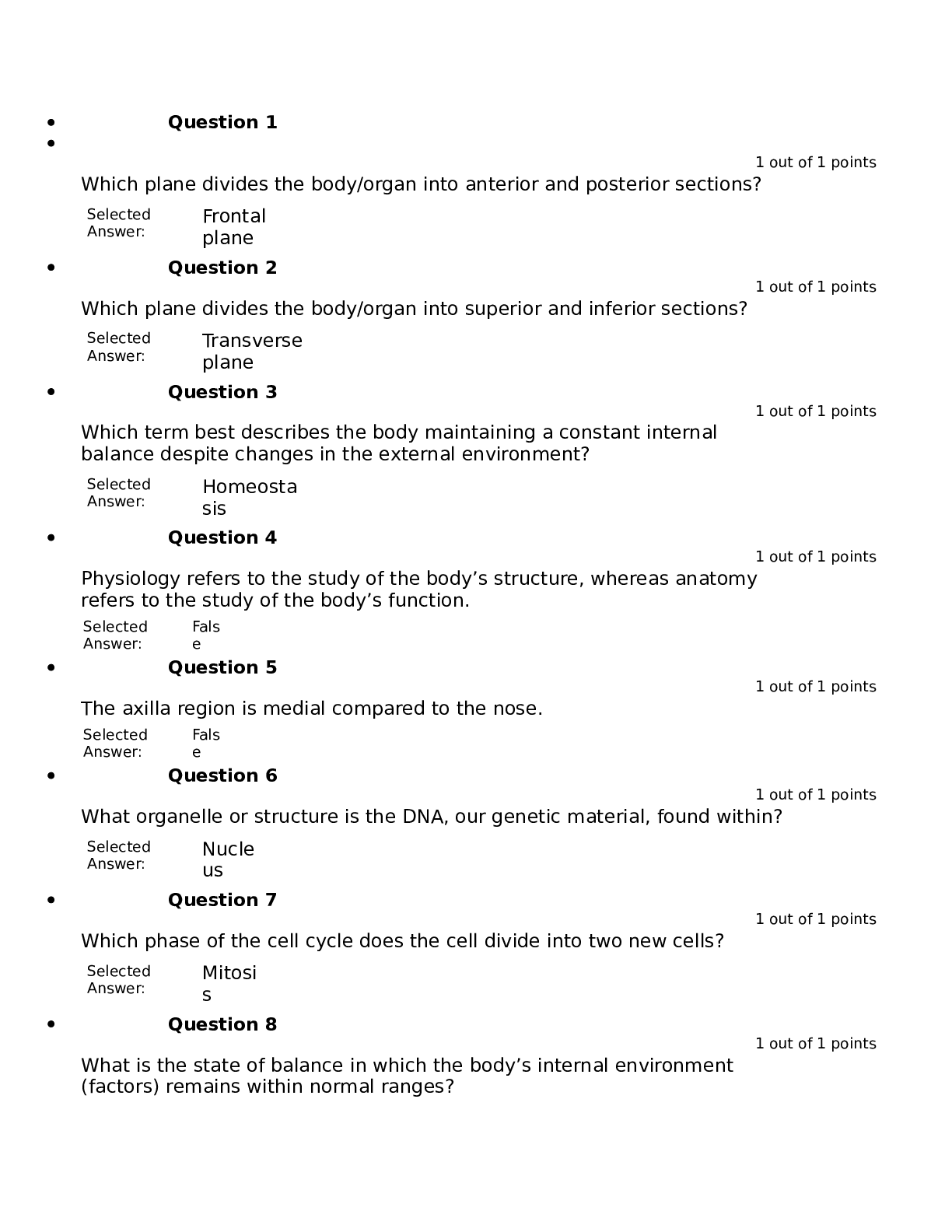
• Question 1
1 out of 1 points
Which plane divides the body/organ into anterior and posterior sections?
• Question 2
Which plane divides the body/organ into superior and inferior sections?
1 out of 1 points
• Question 3
Which term best describes the body maintaining a constant internal balance despite changes in the external environment?
1 out of 1 points
• Question 4
1 out of 1 points
Physiology refers to the study of the body’s structure, whereas anatomy refers to the study of the body’s function.
• Question 5
The axilla region is medial compared to the nose.
1 out of 1 points
• Question 6
1 out of 1 points
What organelle or structure is the DNA, our genetic material, found within?
• Question 7
Which phase of the cell cycle does the cell divide into two new cells?
1 out of 1 points
• Question 8
What is the state of balance in which the body’s internal environment (factors) remains within normal ranges?
1 out of 1 points
• Question 9
Which organelle is responsible for producing our body’s energy source, ATP?
1 out of 1 points
• Question 10
Where is our body’s DNA, genetic material, located?
1 out of 1 points
• Question 11
Which cellular structure is selectively permeable for specific items to freely pass through it?
1 out of 1 points
• Question 12
1 out of 1 points
The processes of diffusion and osmosis require energy, ATP, for it to occur.
• Question 13
1 out of 1 points
Cells have to replicate, or make a copy of, their DNA prior to going through mitosis and dividing into two new cells.
• Question 14
Which type of tissue allows for allows for the transmission of electrical impulses that provide communication signals with the body?
1 out of 1 points
• Question 15
1 out of 1 points
Which type of tissues lines hollow organs, covers the outer surface of the skin and functions to provide protection or allow for absorption and secretion of substances?
• Question 16
What statement is true of the skin?
1 out of 1 points
• Question 17
A permanent tattoo will have ink in which layer or layers of the skin?
1 out of 1 points
• Question 18
1 out of 1 points
Which type of skin cell is involved in regulating our overall skin tone and color?
• Question 19
Blood cell production is a function of the skeletal system.
1 out of 1 points
• Question 20
A sarcomere stores calcium within the muscle cell.
1 out of 1 points
• Question 21
What term is given to the end of long bones?
1 out of 1 points
• Question 22
Which section of the vertebral column contains seven vertebrae?
1 out of 1 points
• Question 23
Calcium is a vital component for muscle contraction to occur.
1 out of 1 points
• Question 24
1 out of 1 points
Osteoporosis is a bone disease that occurs when bone tissue loses enough mass to become extremely brittle.
• Question 25
What best describes a muscle fascicle?
...........................................................CONTINUED....................................................................
[Show More]