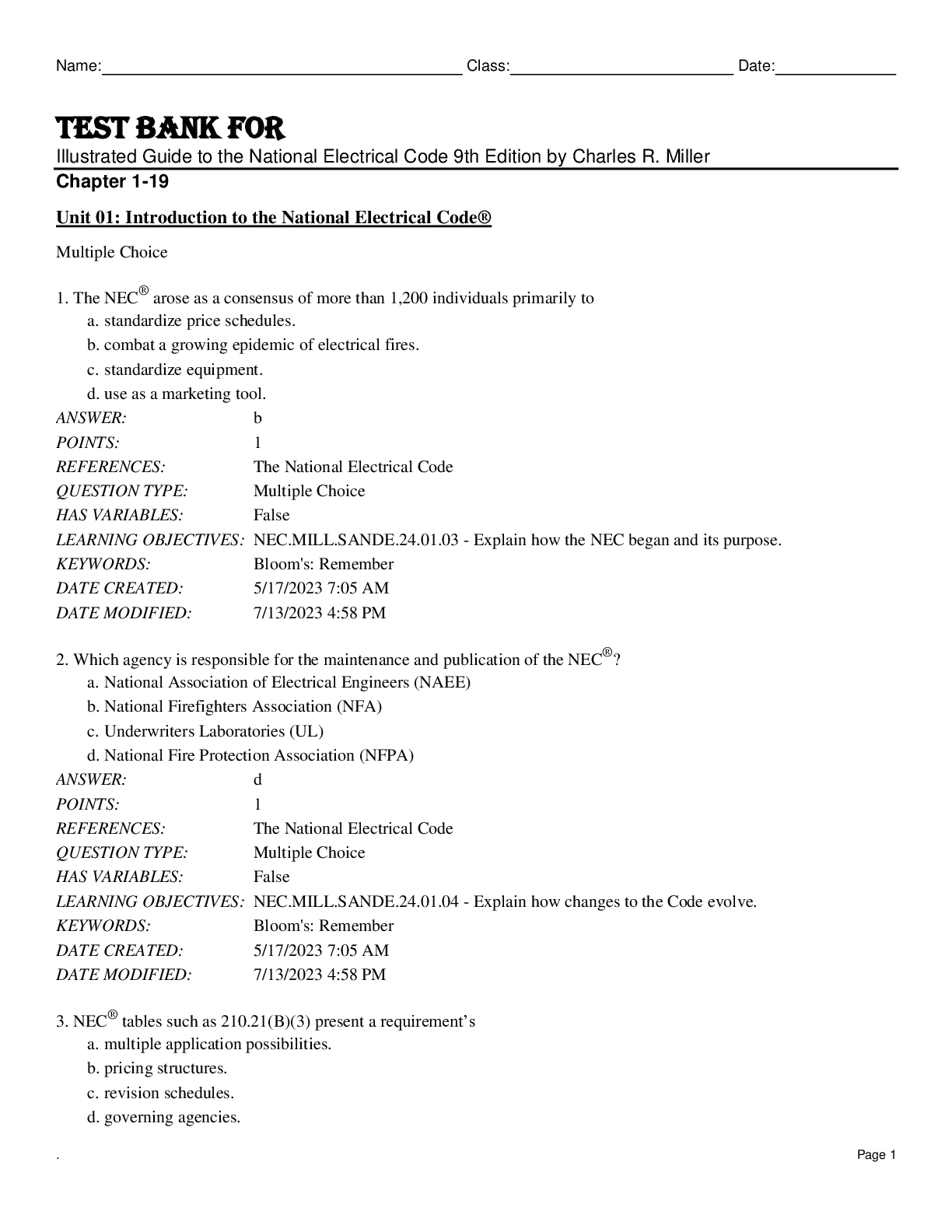
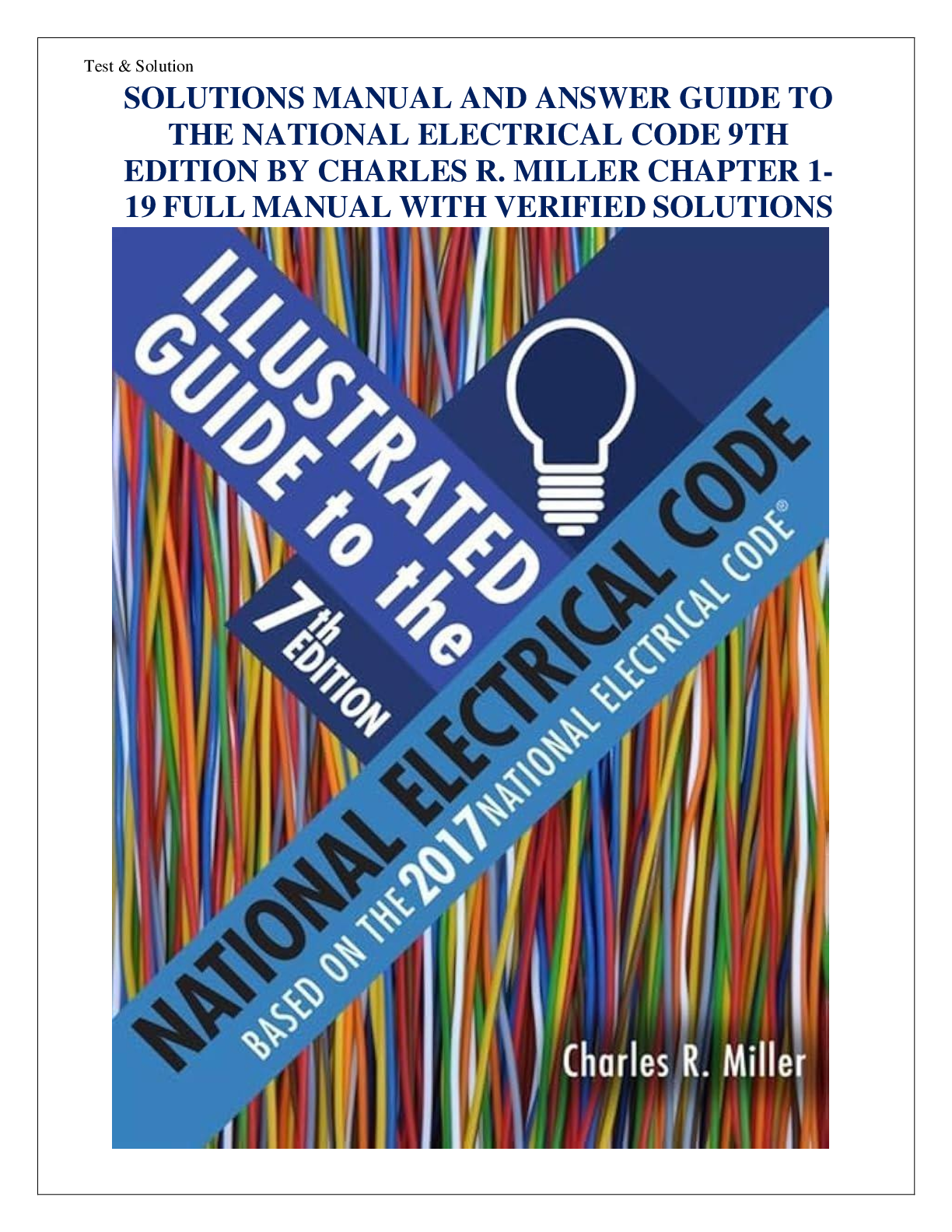
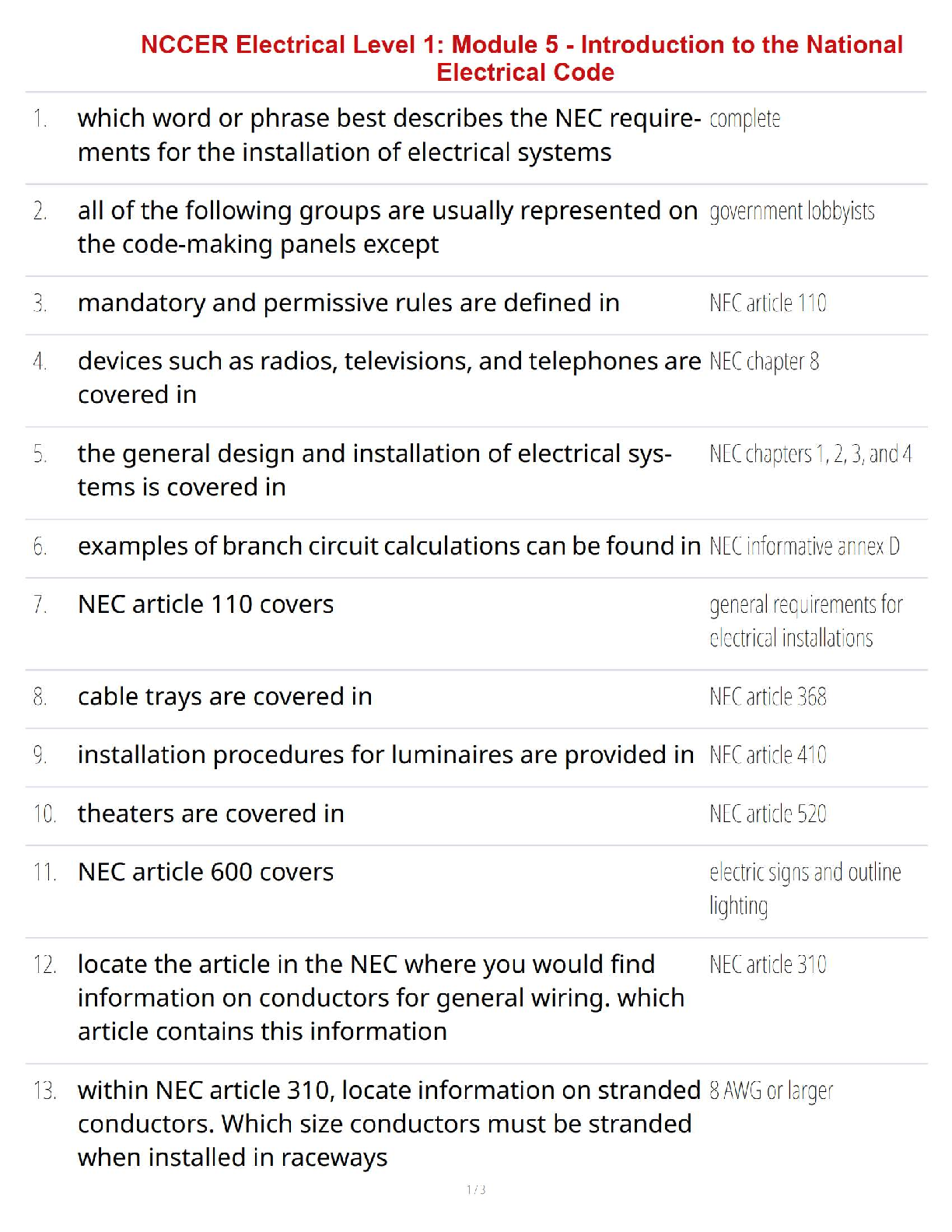
SOLUTIONS MANUAL AND ANSWER GUIDE TO
THE NATIONAL ELECTRICAL CODE 9TH
EDITION BY CHARLES R. MILLER CHAPTER 1-
19 FULL MANUAL WITH VERIFIED SOLUTIONS
Unit 1 Introduction to the National Electrical Code Unit 2 Definiti
...
SOLUTIONS MANUAL AND ANSWER GUIDE TO
THE NATIONAL ELECTRICAL CODE 9TH
EDITION BY CHARLES R. MILLER CHAPTER 1-
19 FULL MANUAL WITH VERIFIED SOLUTIONS
Unit 1 Introduction to the National Electrical Code Unit 2 Definitions
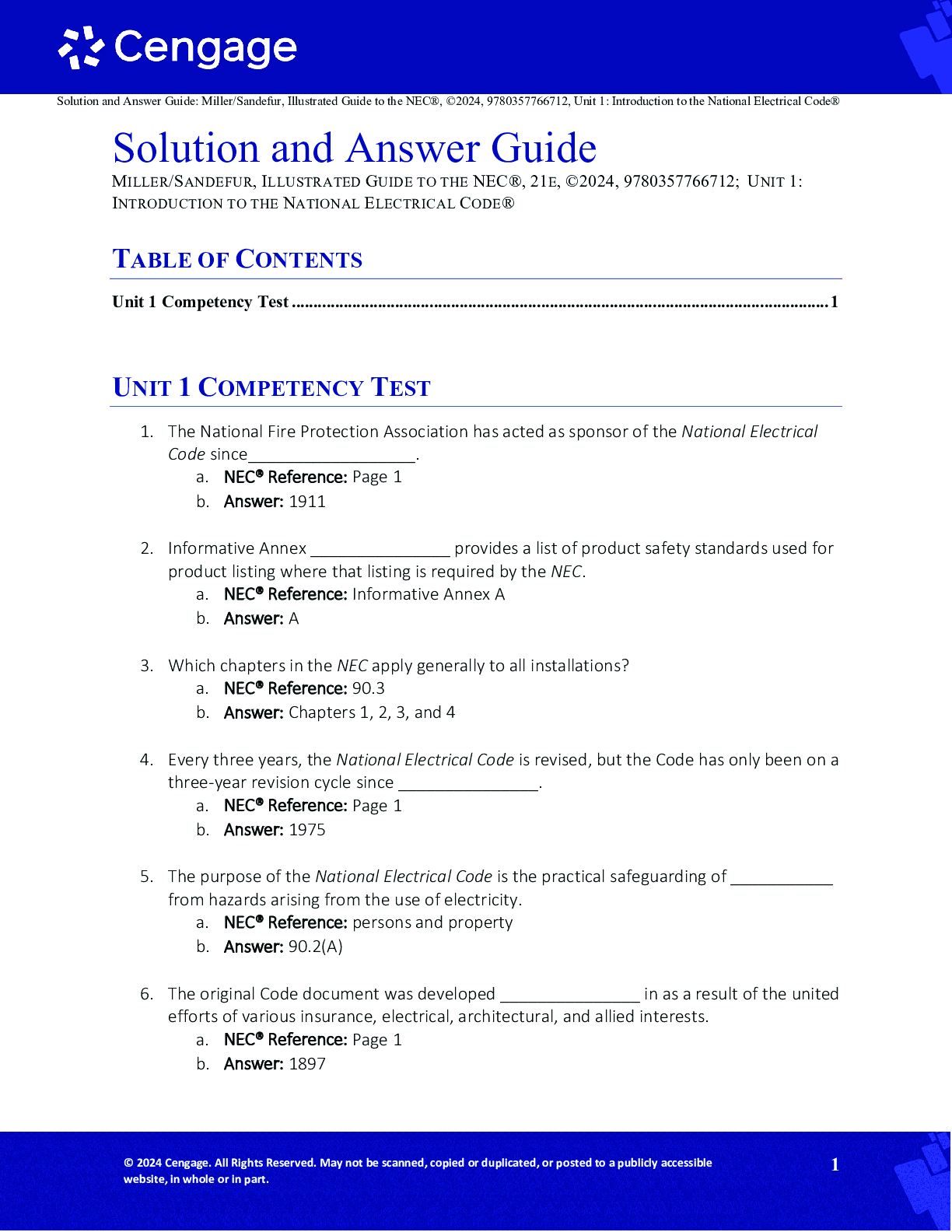
1. The National Fire Protection Association has acted as sponsor of the National Electrical
Code since .
1911 (Pg.2)
2. Informative Annex provides a list of product safety standards used for product listing
where that listing is required by the NEC.
Informative Annex A (NEC 70-710)
3. Which chapters in the NEC apply generally to all installations?
Chapter 1 through 4 apply to all electrical installations (Pg.5)
4. Every three years, the National Electrical code is revised, but the Code has only been on a
three-year cycle since .
1975 (Pg.2)
5. The purpose of the National Electrical Code is the practical safeguarding of
form hazards arising from the use of electricity.
Persons and Property (Pg.2)
6. The original Code document was developed in as a result of the united efforts of
various insurance, electrical, architectural, and allied interests.
1897 (Pg.2)
7. Informative annexes are not part of the requirements of the NEC but are included for
only.
Informational Notes (Pg.5)
8. What city was home to the first central-station electric generating plant developed by
Thomas A. Edison?
New York City (Pg. 2)
3 | P a g e
9. Chapter consists of tables that are applicable as referenced.
9 (Pg.5)
10. In the NEC, UL is the abbreviation for .
Underwriters Laboratories, Inc. (Pg.7)
11. Listed or labeled equipment shall be installed and used in accordance with any
included in the listing or labeling.
Instructions (Pg. 6) (NEC 110.3 (B)).
Unit 2
1. An branch circuit supplies two or more receptacles or outlets for lighting and
appliances.
General Purpose (Pg. 16)
2. is the largest amount of current capable of being delivered at a point on the electrical
system during a shout-circuit condition.
Available fault current (Pg.20)
3. An branch circuit consists of two or more ungrounded conductors having a
potential difference between them, and a grounded conductor having equal potential
difference between it and each ungrounded conductor of the circuit and that is connected
to the neutral or grounded conductor of the system.
Multiwire (Pg.16)
4. An intermittent operation in which load conditions are regularly recurrent is the definition
of .
Periodic Duty (NEC 70-34)
5. The is the connection between the grounded-circuit conductor and the equipment
grounding conductor at the service.
Main bonding jumper (Pg.14)
4 | P a g e
6. An is used to connect the system grounded conductor or the equipment to a
grounding electrode or to a point on the grounding electrode system.
Grounding electrode conductor (Pg. 22)
7. Rainproof, raintight, or watertight equipment can fulfill the requirements for where
varying weather conditions other than wetness, such as snow, ice, dust, or temperature
extremes, are not a factor.
Weatherproof (NEC 70-41)
8. An is an intentionally constructed, low-impedance electrically conductive path
designed and intended to carry current underground-fault condition from the point of a
ground fault on a wiring system to the electrical supply source and that facilitates the
operation of the overcurrent protective device or ground-fault detectors.
Effective Ground-Fault Current Path (Pg. 19)
9. An is a manually operated device used in conjunction with a transfer switch to
provide a means directly connecting load conductors to a power source and of
disconnecting the transfer switch.
Bypass Isolation Switch (NEC 70-40) (Definition is updated and different in NEC 2020)
10. A type of surface, flush, or freestanding raceway, designed to hold conductors and
receptacles, assembled in the field or at the factory is called a
.
Multioutlet assembly (Pg. 25).
[Show More]