Study Guide for the mid-term exam – NSG6420 Winter 2021—All multiple choice
1. Definition of endemic and pandemic: (Kat) (Mohammed)
Endemic: Presence of an illness/disease constantly present or present at a rate th
...
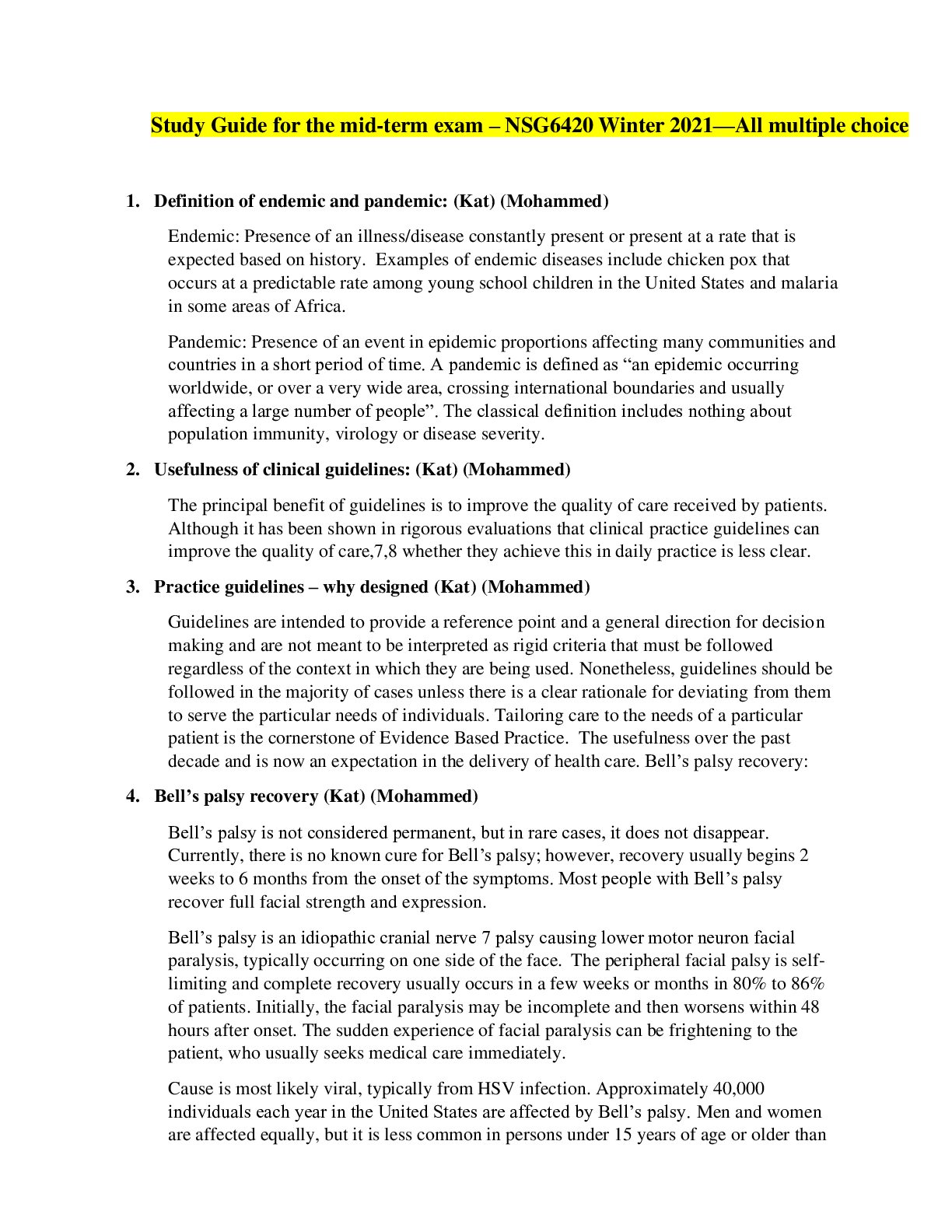
Study Guide for the mid-term exam – NSG6420 Winter 2021—All multiple choice
1. Definition of endemic and pandemic: (Kat) (Mohammed)
Endemic: Presence of an illness/disease constantly present or present at a rate that is expected based on history. Examples of endemic diseases include chicken pox that occurs at a predictable rate among young school children in the United States and malaria in some areas of Africa.
Pandemic: Presence of an event in epidemic proportions affecting many communities and countries in a short period of time. A pandemic is defined as “an epidemic occurring worldwide, or over a very wide area, crossing international boundaries and usually affecting a large number of people”. The classical definition includes nothing about population immunity, virology or disease severity.
2. Usefulness of clinical guidelines: (Kat) (Mohammed)
The principal benefit of guidelines is to improve the quality of care received by patients. Although it has been shown in rigorous evaluations that clinical practice guidelines can improve the quality of care,7,8 whether they achieve this in daily practice is less clear.
3. Practice guidelines – why designed (Kat) (Mohammed)
Guidelines are intended to provide a reference point and a general direction for decision making and are not meant to be interpreted as rigid criteria that must be followed regardless of the context in which they are being used. Nonetheless, guidelines should be followed in the majority of cases unless there is a clear rationale for deviating from them to serve the particular needs of individuals. Tailoring care to the needs of a particular patient is the cornerstone of Evidence Based Practice. The usefulness over the past decade and is now an expectation in the delivery of health care. Bell’s palsy recovery:
4. Bell’s palsy recovery (Kat) (Mohammed)
Bell’s palsy is not considered permanent, but in rare cases, it does not disappear. Currently, there is no known cure for Bell’s palsy; however, recovery usually begins 2 weeks to 6 months from the onset of the symptoms. Most people with Bell’s palsy recover full facial strength and expression.
Bell’s palsy is an idiopathic cranial nerve 7 palsy causing lower motor neuron facial paralysis, typically occurring on one side of the face. The peripheral facial palsy is self- limiting and complete recovery usually occurs in a few weeks or months in 80% to 86% of patients. Initially, the facial paralysis may be incomplete and then worsens within 48 hours after onset. The sudden experience of facial paralysis can be frightening to the patient, who usually seeks medical care immediately.
Cause is most likely viral, typically from HSV infection. Approximately 40,000 individuals each year in the United States are affected by Bell’s palsy. Men and women are affected equally, but it is less common in persons under 15 years of age or older than
age 45. A higher incidence is seen in individuals with DM, HTN, trauma, toxin exposure, Lyme disease, HIV, pregnancy, and those with upper respiratory ailments.
Recovery from facial paralysis usually occurs over 3 to 6 months. Persons at risk for incomplete recovery are those older than age 55 or who have HTN, experience pain other than ear pain, have complete facial paralysis, or changes in lacrimation.
5. Confusion: (Kat) (Mohammed)
Confusion is a symptom that makes you feel as if you can’t think clearly. You might feel disoriented and have a hard time focusing or making decisions. Confusion is also referred to as disorientation. In its extreme state, it’s referred to as delirium.
Confusion is a key sign of neurological disorders. The clinician must be diligent in determining its cause. The physical examination will provide clues. One major difficulty lies in differentiating symptoms of delirium from dementia
[Show More]