Nursing Care of Children with Alterations in Perception and Coordination
Document Content and Description Below
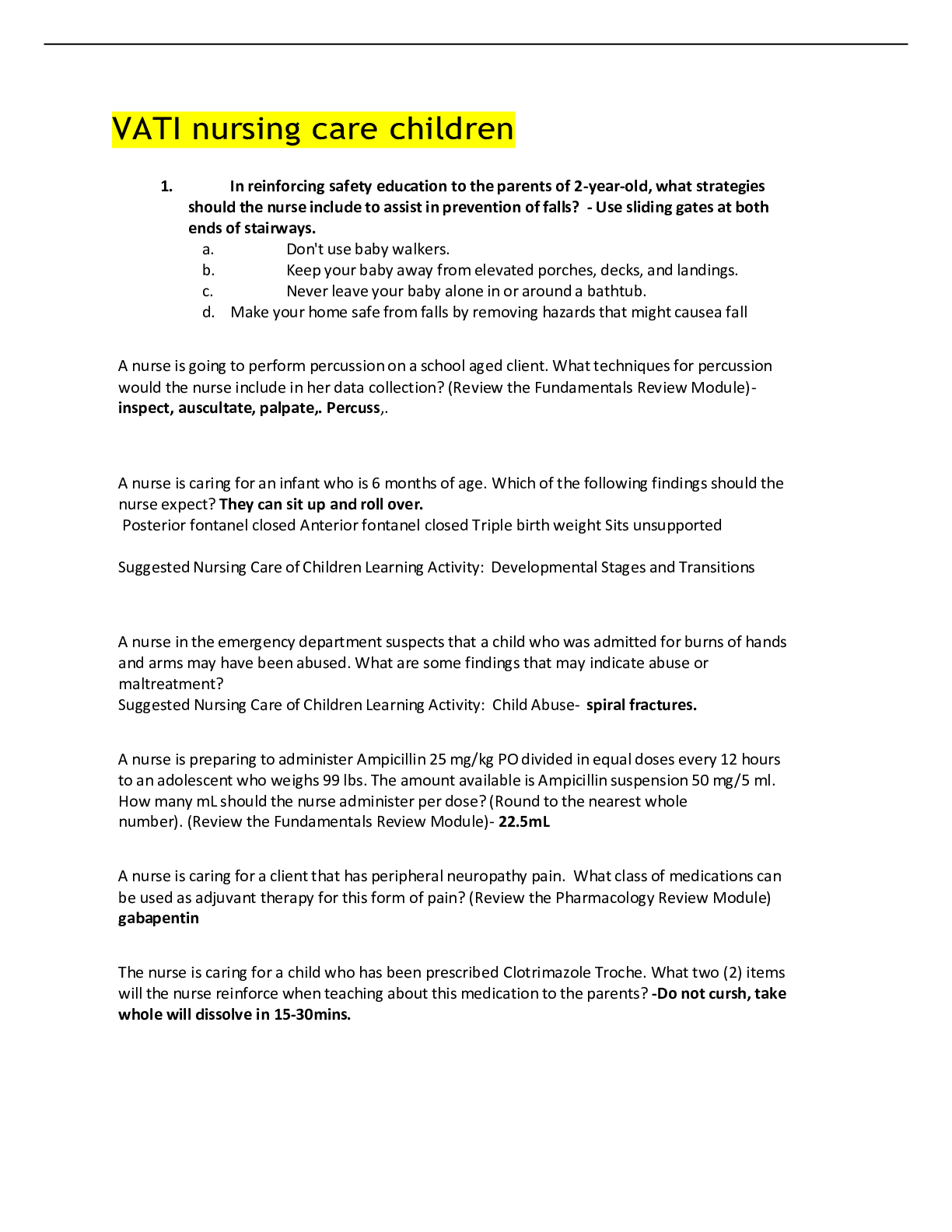
Perception • is defined as the perception and awareness of sensory stimuli. • it is a mental act involving memory and the intellectual interpretation of new sensory data in terms of previously encountered information.
...
[Show More]
Last updated: 4 years ago
Preview 1 out of 37 pages
Instant download

Buy this Document to get the Full Access Instantly
Provided by Students Who Aced it
We Verify Document Content to Gurantee Accuracy
Reviews( 0 )
Document information
Connected school, study & course
About the document
Uploaded On
Apr 25, 2021
Number of pages
37
Written in
All

Additional information
This document has been written for:
Uploaded
Apr 25, 2021
Downloads
0
Views
276
Topic Tags
Recommended For You
Get more on HESI »
$17
444 Pages
MED SURG HESI EXIT EXAM Compilation Test Bank - QUESTIONS AND...
$16
223 Pages
MED SURG HESI EXIT EXAM Compilation of highly tested Questions...
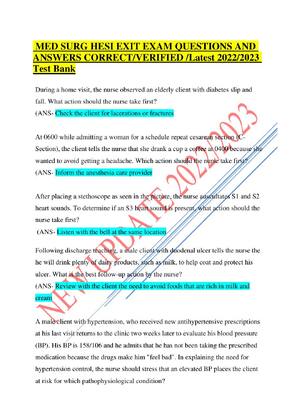
$26
444 Pages
MED SURG HESI EXIT EXAM QUESTIONS AND ANSWERS CORRECT/VERIFIED...
 Questions, Answers & Rationale, A+ Guide.png)
$15
61 Pages
HESI DOSAGE CALCULATIONS QUIZ 150 QUESTIONS AND CORRECT SOVLED...

$19
1119 Pages
Solutions Manual for Organic Chemistry 9th Edition by John McM...
$29
961 Pages
HESI RN COMPREHENSIVE EXIT EXAM Compiled 14 Versions Answers...
$19
41 Pages
HESI LPN Medical-Surgical Nursing I & II Exam LPN/LVN Comprehe...
$70
103 Pages
2026 HESI RN Exit Exam | NGN Nursing Questions | 2026 HESI Nur...

$25
137 Pages
Instructor Manual(Lecture Notes Only) for Principles of Pediat...

$25
81 Pages
Instructor's Manual (Lecture Notes) For Health & Physical Asse...
More related documents below


