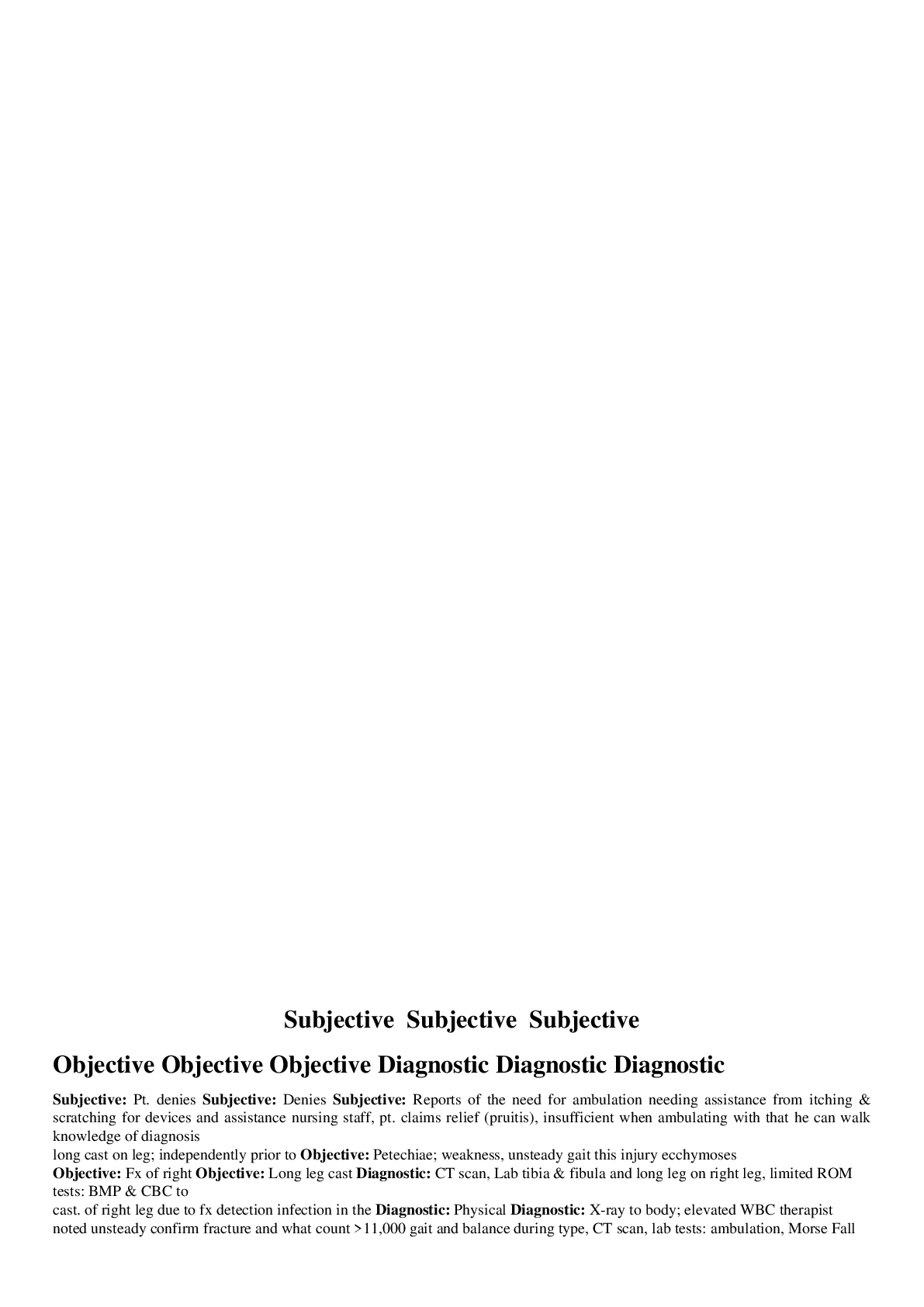
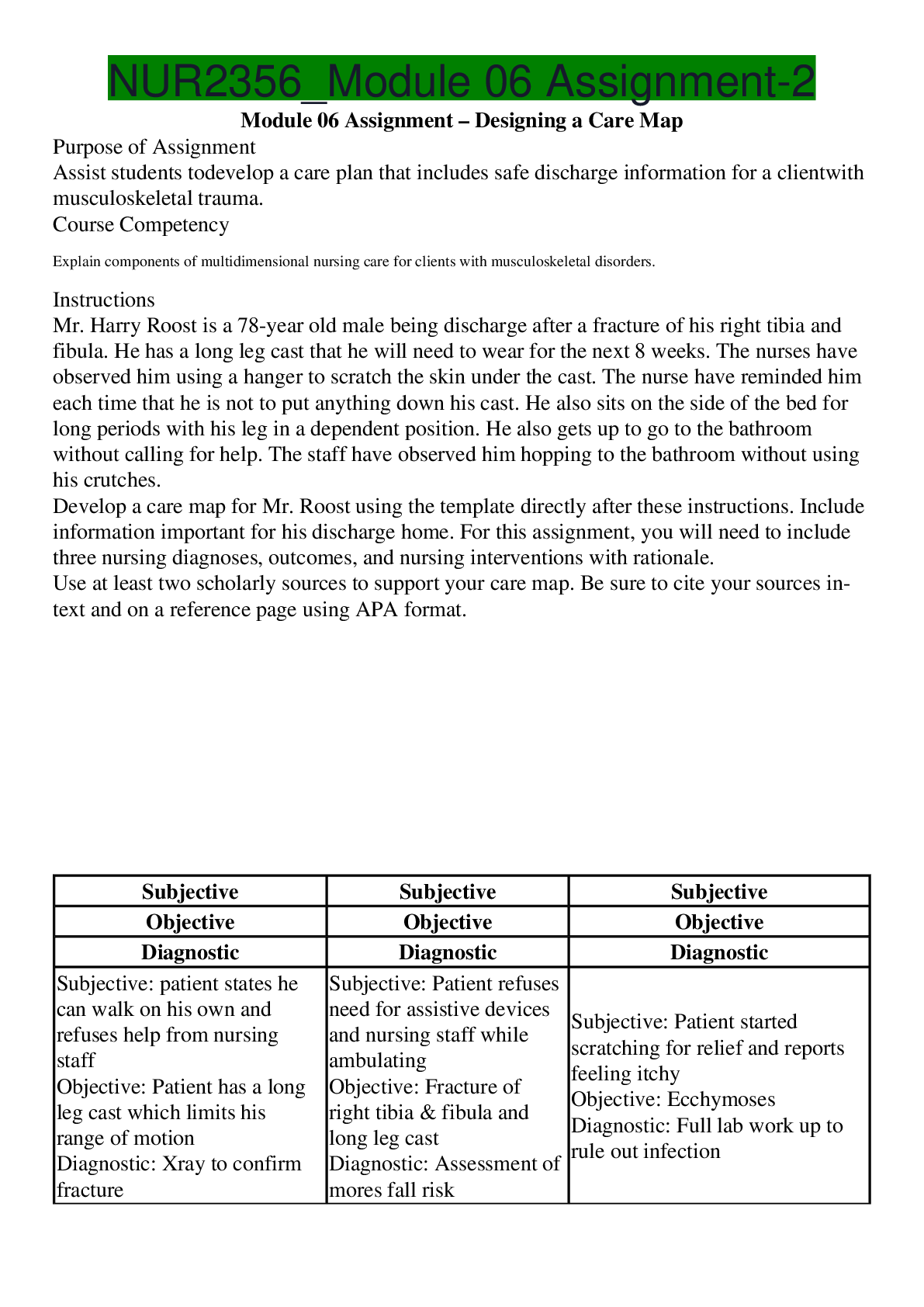
Subjective Subjective Subjective Mr Roost describes his home Mr Roost describes his Mr Roost asks “why do I environment with having activity at home he typically have to use crutches, I get throw ... rugs, and he typically “sits on the side of the bed to the bathroom just fine “uses furniture to lean on” while watching TV.” without them.” He also while getting around. displayed lack of understanding as to why he can’t scratch his leg if it is itchy. Objective Objective Objective Mr. Roost is a 78 y.o. Male Due to Fracture of his right tibia and fibula he will be in a cast for 8-weeks. The staff have observed him hopping to the bathroom without using his crutches. Mr. Roost has been prescribed use of crutches while in a cast for 8-weeks due to Fracture of his right tibia and fibula. He is a 78 y.o. Male. Mr. Roost gets up to go to the bathroom without calling for help. Despite clear instruction, he displays inaccurate follow-through by continuing to use a hanger to scratch the skin under the cast. Diagnostic Diagnostic Diagnostic Older age (especially ≥ 65 X-ray imaging- Fracture of Absence of cognitive years) his right tibia and fibula information related to Limited mobility condition. Sedentary lifestyle Nursing Diagnosis Nursing Diagnosis Nursing Diagnosis Risk for Falls Impaired physical mobility Deficient knowledge related to: related to: related to: Improper use of crutches, risky behavior, and impaired Fracture of his right tibia and fibula (musculoskeletal Physical limitation as evidenced by: physical mobility. impairment) Incorrect task performance as evidenced by: and Inaccurate follow-through of instruction. Imposed restrictions by cast. SMART Goal SMART Goal SMART Goal Prior to discharge, Mr Roost will relate the intent to use safety measures to prevent falls as evidenced by demonstration and verbal understanding of prevention measures. While Mr Roost is in a cast, he will perform physical activity with assistive devices as needed as evidenced by repeated demonstration using crutches. After 1 hour of teching, Mr Roost will demonstrates how to incorporate treatment regimen into lifestyle and exhibits his ability to deal with health situation. Nursing Interventions Nursing Interventions Nursing Interventions Teach client how to safely ambulate at home, including using safety measures such as handrails in bathroom. RATIONALE: Educating the patient can decreases the risk of falls during ambulation. Guarantee appropriate room lighting, especially during the night. RATIONALE: Patients, especially older adults, has reduced visual capacity. Lighting an unfamiliar environment helps increase visibility if the patient must get up at night. Allow the patient to participate in a program of regular exercise and gait training. RATIONALE: Increased physical conditioning reduces the risk for falls and limits injury that is sustained when fall transpires. Collaborate with the healthcare team to evaluate home safety. Consult physical and occupational therapy to determine if home-health services would be beneficial. RATIONALE: PT and OT can assess whether he is can be discharged home safely, or if additional support should be arranged. Improve home supports. RATIONALE: There are Encourage appropriate use of assistive devices in the home setting. RATIONALE: Mobility aids can increase level of safe mobility Assess patient's ability to perform ADLs effectively and safely on a daily basis. RATIONALE: Restricted movement affects the ability to perform most ADLs. Safety with ambulation is an important concern. Initiate supplemental high- protein feedings as appropriate. RATIONALE: Proper nutrition is required to maintain adequate energy level. Evaluate the safety of the immediate environment. RATIONALE:Obstacles such as throw rugs, children's toys, pets, and others can further impede one's ability to ambulate safely. Use the teach-back technique to determine the patient’s understanding of what was taught: RATIONALE: “The teach- back technique consists of specific steps in a repetitive order to evaluate the patients knowledge of the content discussed. Patients who are not able to do this method after multiple cycles is considered cognitively impaired.” (Leslie, 2015) Explore reactions and feelings about changes. RATIONALE: Assessment helps the nurse in understanding how the patient may respond to the information and possibly how successful the patient may be with the expected changes. Help patient in integrating information into daily life. RATIONALE: This technique aids the learner make adjustments in daily life that will result in the desired change in behavior. Support self-directed, self- designed learning. RATIONALE: Patients know what difficulties will transpire in their own environments, and they must be encouraged to approach learning activities from their priority needs. ....................Continued........................... [Show More]
Last updated: 3 years ago
Preview 1 out of 14 pages
Buy this document to get the full access instantly
Instant Download Access after purchase
Buy NowInstant download
We Accept:
Can't find what you want? Try our AI powered Search
Connected school, study & course
About the document
Uploaded On
Apr 26, 2021
Number of pages
14
Written in
All
This document has been written for:
Uploaded
Apr 26, 2021
Downloads
0
Views
76
Scholarfriends.com Online Platform by Browsegrades Inc. 651N South Broad St, Middletown DE. United States.
We're available through e-mail, Twitter, and live chat.
FAQ
Questions? Leave a message!
Copyright © Scholarfriends · High quality services·