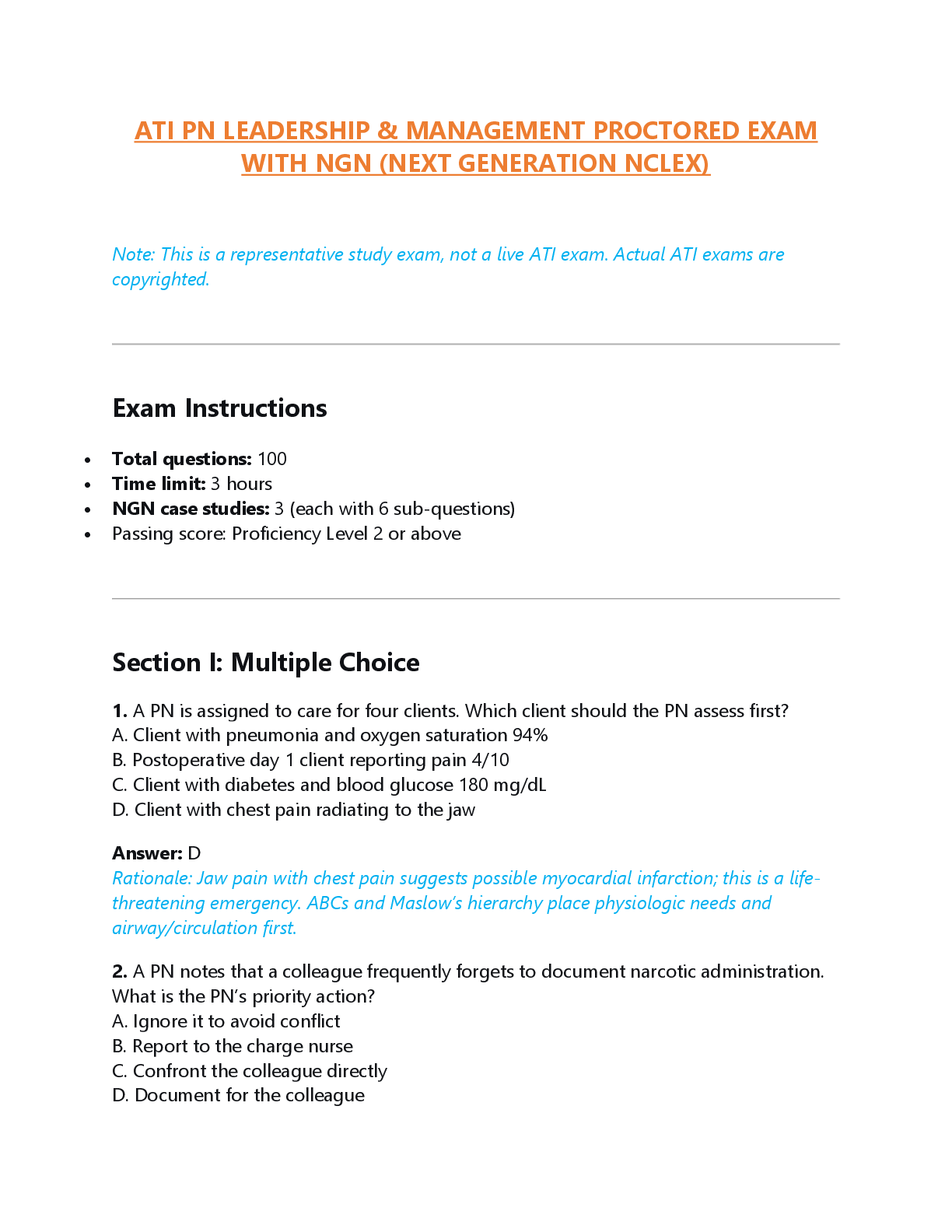
Exam Instructions
Format: Multiple-choice, single best answer.
Number of Questions: 75
Time: You should allow approximately 90 minutes to complete all sections.
Scoring: Each question is worth one mark. T
...
Exam Instructions
Format: Multiple-choice, single best answer.
Number of Questions: 75
Time: You should allow approximately 90 minutes to complete all sections.
Scoring: Each question is worth one mark. There is no negative marking.
Goal: To assess clinical knowledge, diagnostic reasoning, and understanding of
clinical procedures and communication.
Section 1: History Taking & Communication Skills
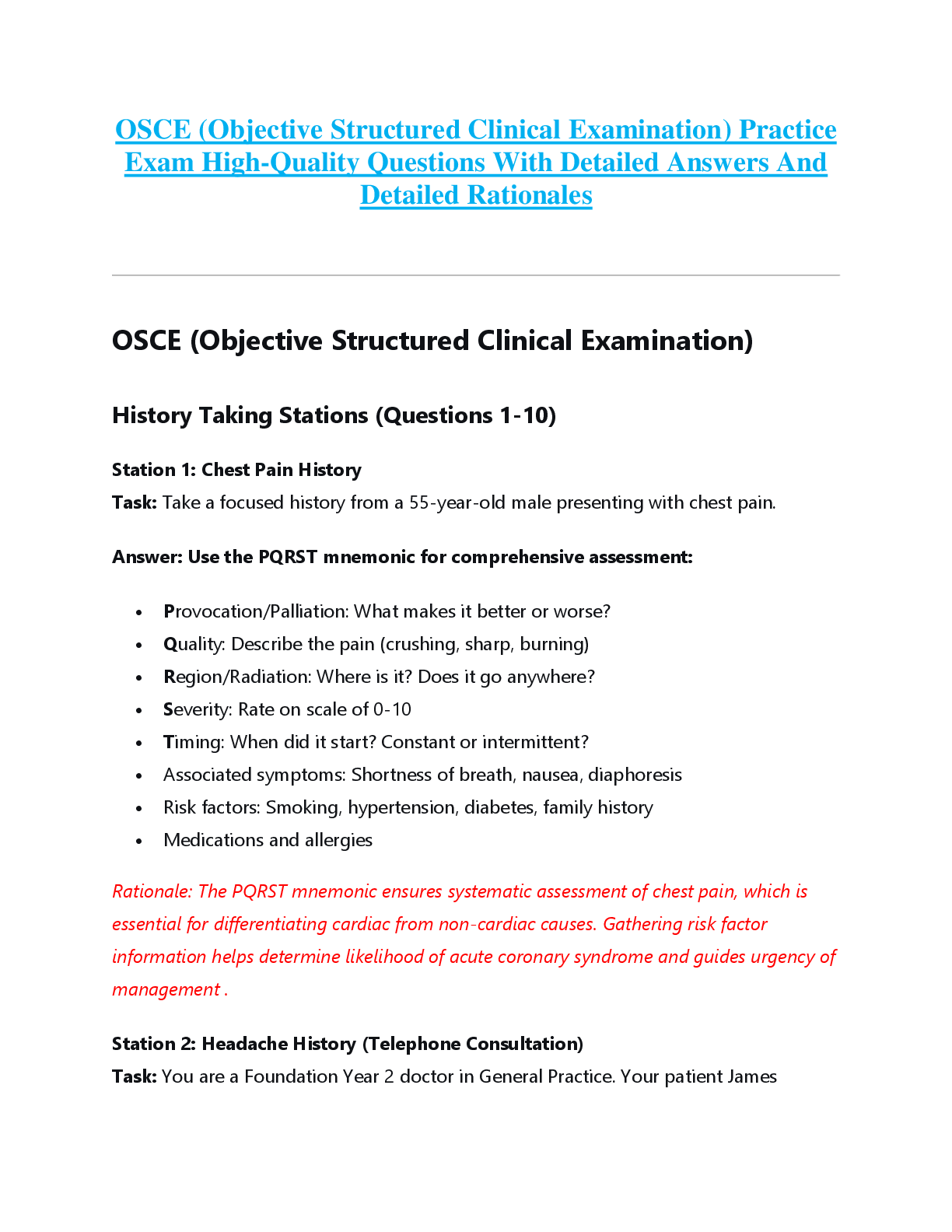
1. A 58-year-old man presents with acute central chest pain that started 1 hour
ago while he was gardening. He describes it as a "heavy pressure." What is the
most important initial step in your assessment?
A. Order an immediate ECG
B. Administer aspirin 300mg
C. Take a brief, focused history
D. Check his blood pressure in both arms
Correct Answer: C
Rationale: While all actions are critical in the management of a potential myocardial
infarction, assessment always begins with a focused history. Characterizing the pain
(onset, quality, radiation, associated symptoms) is essential for differential diagnosis and
guiding subsequent immediate actions like giving aspirin and performing an ECG .
2. You are seeing a 32-year-old woman with a new diagnosis of multiple sclerosis.
She is visibly upset and asks, "Am I going to end up in a wheelchair?" What is the
most appropriate initial response?
A. "Let's not worry about that right now; we'll focus on your current treatment."
B. "It's impossible to predict the future, but research is advancing every day."
C. "It sounds like you are really frightened about what the future holds. Can you tell me
more about your concerns?"
D. "Many people with MS live full lives without ever needing a wheelchair."
Correct Answer: C
Rationale: This response uses active listening and empathy, acknowledging the patient's
emotion and opening a dialogue. It is crucial to explore the patient's specific fears and
understanding before providing information or reassurance, which can otherwise seem
dismissive.
3. A 75-year-old woman is brought in by her son because of confusion. When
taking a history, the son answers most of the questions for her. What should you
do?
[Show More]