Student Exploration: Refraction
Vocabulary: angle of incidence, angle of refraction, frequency, index of refraction, medium,
refraction, Snell’s law, total internal reflection, wave front, wavelength, wave speed
Pri
...
Student Exploration: Refraction
Vocabulary: angle of incidence, angle of refraction, frequency, index of refraction, medium,
refraction, Snell’s law, total internal reflection, wave front, wavelength, wave speed
Prior Knowledge Questions (Do these BEFORE using the Gizmo.)
Two runners ran side by side, each holding one end of a horizontal pole.
1. What would most likely happen if one of the runners began jogging in knee-deep water?
The jogger would slow down because when one of your body parts are under water they
are slower the water basically pulls your body down just like the jogger if he was in the
water.
2. How would this affect the direction of the runners? Explain. For me whenever I run in the
water I really dont move directions it depends on the wave the waves can be moving
my body and I dont knotice it.
Gizmo Warm-up
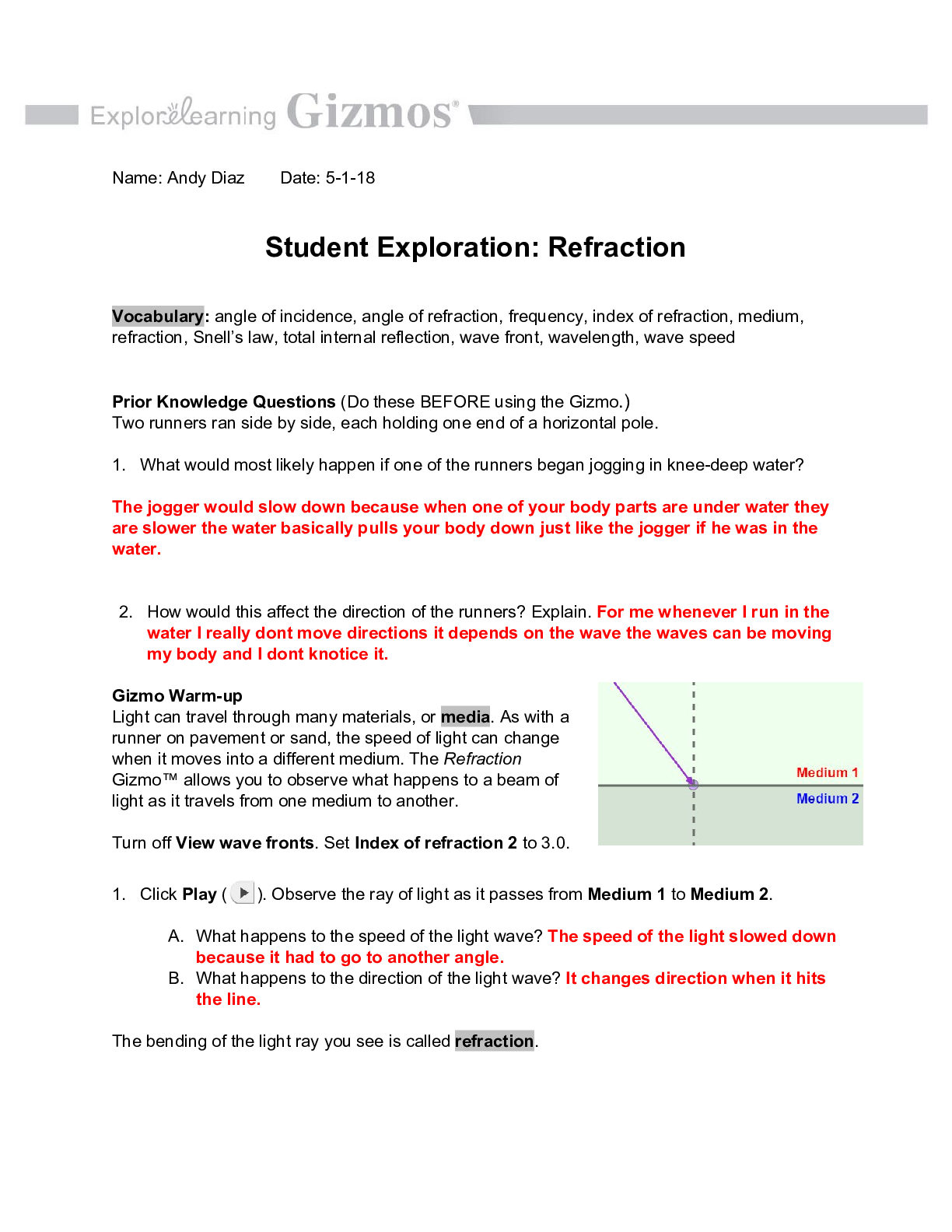
Light can travel through many materials, or media. As with a
runner on pavement or sand, the speed of light can change
when it moves into a different medium. The Refraction
Gizmo™ allows you to observe what happens to a beam of
light as it travels from one medium to another.
Turn off View wave fronts. Set Index of refraction 2 to 3.0.
1. Click Play ( ). Observe the ray of light as it passes from Medium 1 to Medium 2.
A. What happens to the speed of the light wave? The speed of the light slowed down
because it had to go to another angle.
B. What happens to the direction of the light wave? It changes direction when it hits
the line.
The bending of the light ray you see is called refraction.2. Click Reset ( ) and turn on View wave fronts. A wave front is an imaginary line that
connects the crests or troughs of a wave. The wavelength of a wave is the distance
between wave fronts.
Click Play. What happens to the wavelength of the wave as it passes into Medium 2?
When the wavelegnth passes medium 2 it slows down to change direction/angle its
going.Activity A:
Angle of
refraction
Get the Gizmo ready:
● Click Reset. Turn off View wave fronts.
● Make sure View normal is selected.
● Make sure Index of refraction 1 is 1.0 and Angle
of incidence is 45°.
● Set Index of refraction 2 to 2.0.
Introduction: The normal is an imaginary line perpendicular to the boundary between two
media. The angle of incidence is the angle between the light ray in medium 1 and the normal.
The angle of refraction is the angle between the ray in medium 2 and the normal.
Question: What affects how much light waves refract?
1. Measure: Click Play. To measure the angle of refraction, turn on Click to
measure angles. Drag the protractor’s vertex to the intersection of the
ray and the normal. Align the protractor’s legs to the ray and the normal in
Medium 2.
What is the angle of refraction? 33.05
2. Gather data: For each angle of incidence listed in the table below, use the Gizmo to find the
angle of refraction. Then, fill in the “Change of direction” column by subtracting the angle of
refraction from the angle of incidence
[Show More]