Friction is the resistance of motion which is experienced when one body moves tangentially over another in which it is in
contact.
Friction is not a material property! It’s a system response in the form of a reaction f
...
Friction is the resistance of motion which is experienced when one body moves tangentially over another in which it is in
contact.
Friction is not a material property! It’s a system response in the form of a reaction force.
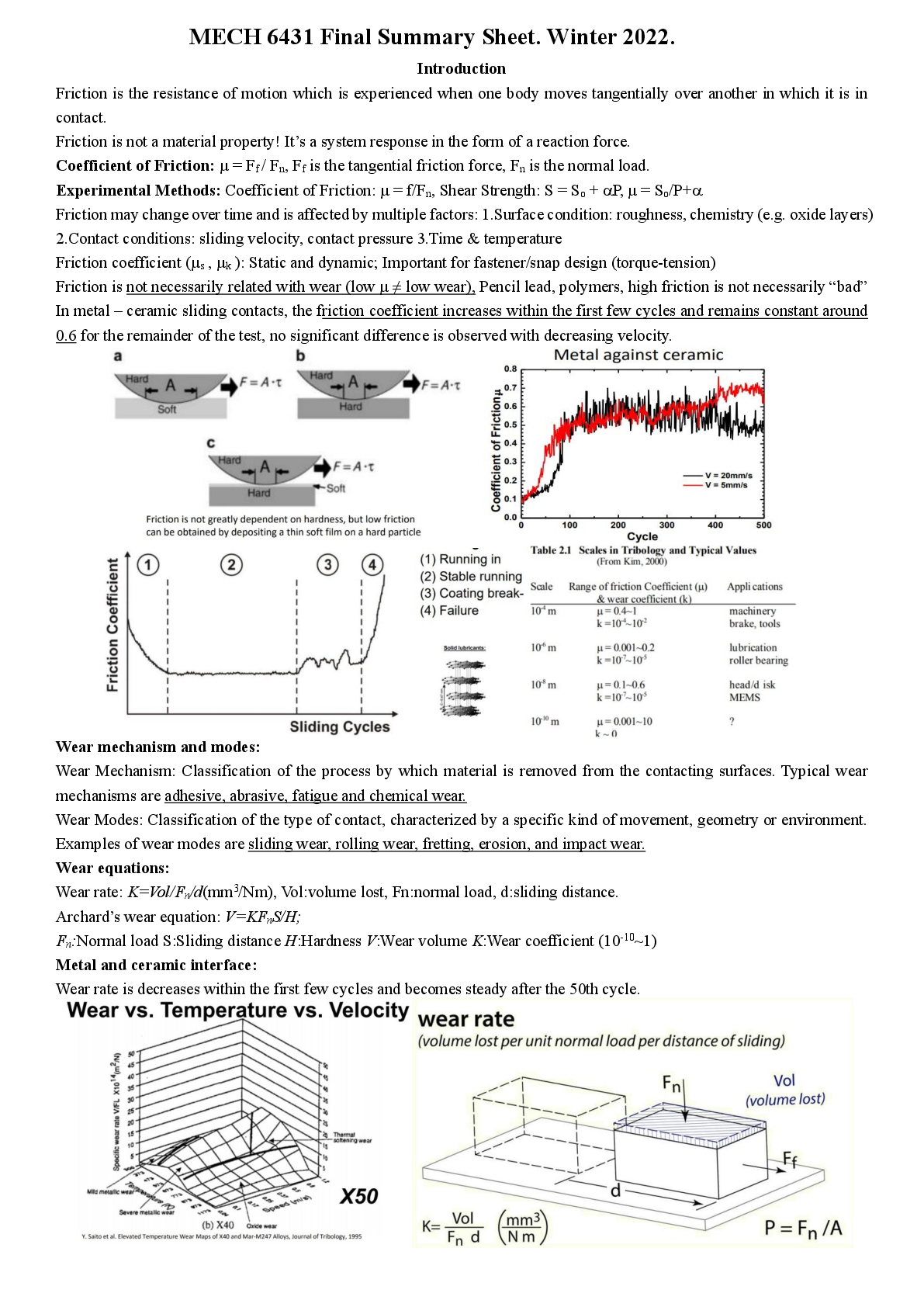
Coefficient of Friction: µ = Ff / Fn, Ff is the tangential friction force, Fn is the normal load.
Experimental Methods: Coefficient of Friction: µ = f/Fn, Shear Strength: S = So + P, μ = So/P+
Friction may change over time and is affected by multiple factors: 1.Surface condition: roughness, chemistry (e.g. oxide layers)
2.Contact conditions: sliding velocity, contact pressure 3.Time & temperature
Friction coefficient (µs , µk ): Static and dynamic; Important for fastener/snap design (torque-tension)
Friction is not necessarily related with wear (low µ ≠ low wear), Pencil lead, polymers, high friction is not necessarily “bad”
In metal – ceramic sliding contacts, the friction coefficient increases within the first few cycles and remains constant around
0.6 for the remainder of the test, no significant difference is observed with decreasing velocity.
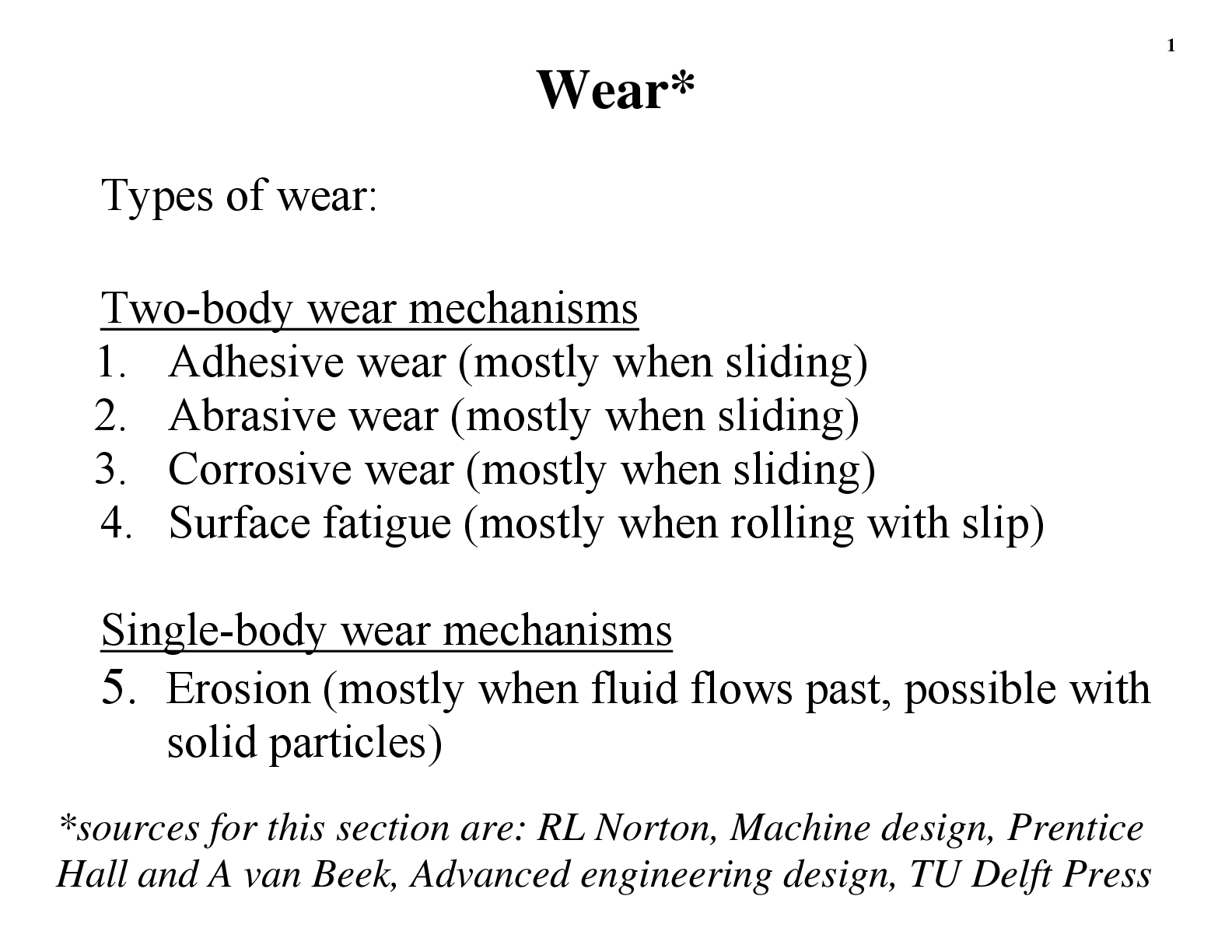
Wear mechanism and modes:
Wear Mechanism: Classification of the process by which material is removed from the contacting surfaces. Typical wear
mechanisms are adhesive, abrasive, fatigue and chemical wear.
Wear Modes: Classification of the type of contact, characterized by a specific kind of movement, geometry or environment.
Examples of wear modes are sliding wear, rolling wear, fretting, erosion, and impact wear.
Wear equations:
Wear rate: K=Vol/Fn/d(mm3/Nm), Vol:volume lost, Fn:normal load, d:sliding distance.
Archard’s wear equation: V=KFnS/H;
Fn:Normal load S:Sliding distance H:Hardness V:Wear volume K:Wear coefficient (10-10~1)
Metal and ceramic interface:
Wear rate is decreases within the first few cycles and becomes steady after the 50th cycle.
MECH 6431 Final Summary Sheet. Winter 2022.Third body formation:
Third body=tribofilm+Transferfilm+wear debris
Today’s understanding of metallic friction and wear comes from ‘blind tests’ and exsitu analysis
– Crime Scene Investigator “CSI”
No universal conclusive correlation between third bodies and tribological properties have been reported.
Coating strategies for tribological interfaces:
Challenges with design for tribology:
Non-induced cyclical random (NCR) is typically not considered in lab tribology testing.
Tribology approaches for testing and design:Surfaces
The Tribo-system: (i) Solid body, (ii) counterbody, (iii) interfacial element and (iv) environment
The random components of the surface profiles look very much the same whatever their source, irrespectively of the absolute
scale of size involved. If repeatedly magnified, increasing details of the surface features are observed.
Surface texture includes: (1) Roughness (nano- and microroughness) (2) Waviness (macroroughness) (3) Lay (4) Flaw
[Show More]