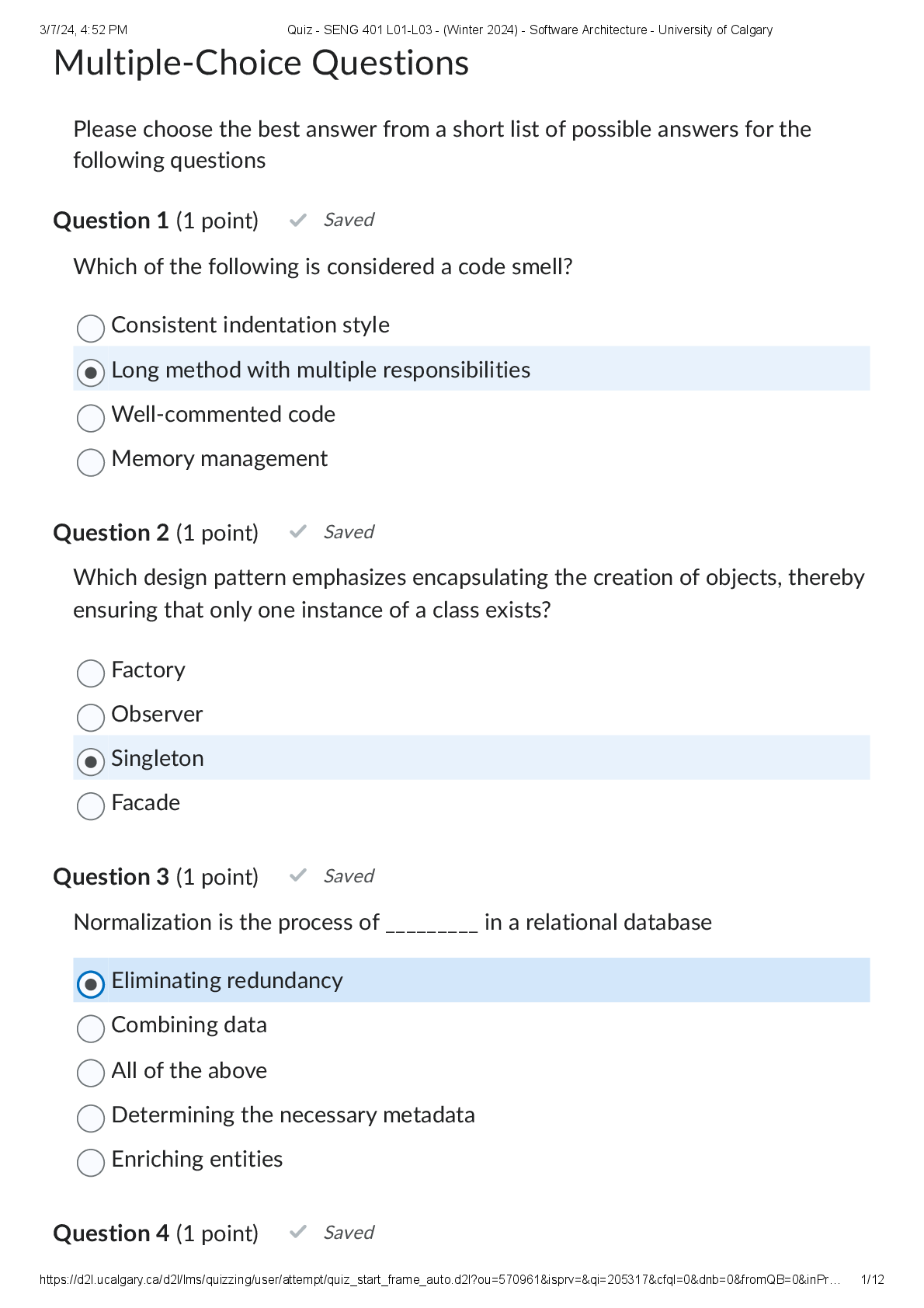
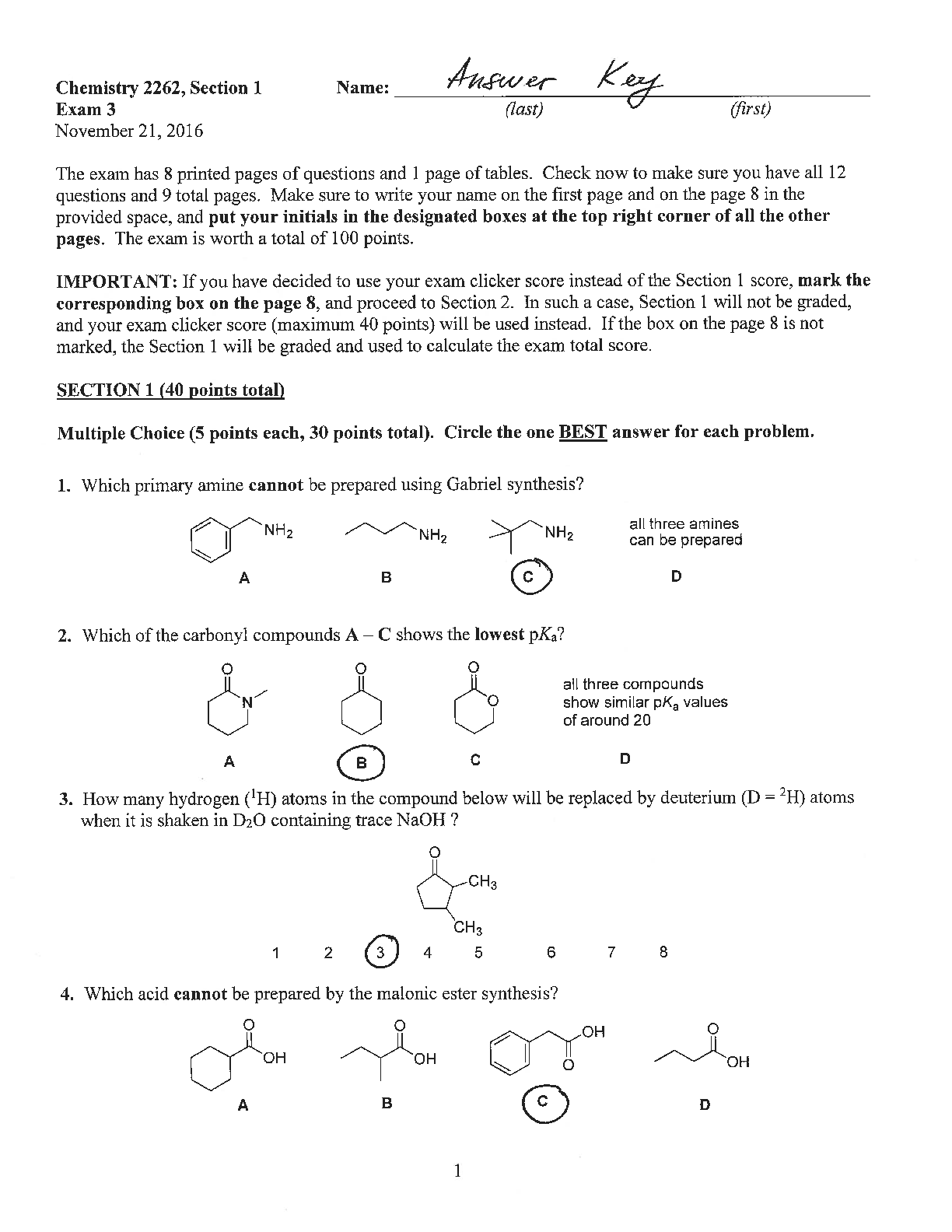
PSYB30 Midterm Test Bank Answers Combined
c1 Key
1. Features of personality that differentiate one person from another usually
take the form of _____ in
language.
A. differential pronouns
B. trait-descriptive adjec
...
PSYB30 Midterm Test Bank Answers Combined
c1 Key
1. Features of personality that differentiate one person from another usually
take the form of _____ in
language.
A. differential pronouns
B. trait-descriptive adjectives
C. action-descriptive verbs
D. trait-differentiating adverbs
Larsen - Chapter 01 #1
2. If I describe Juan as "possessive" or Anita as "friendly," I am employing the
use of
A. trait-descriptive adjectives.
B. inner psychological states.
C. strategies to attain goals.
D. inner qualities of personality.
Larsen - Chapter 01 #2
3. How many trait-descriptive adjectives are there in the English language?
A. More than 500
B. More than 1,800
C. More than 5,000
D. More than 20,000
Larsen - Chapter 01 #3
4. Psychologists have found it difficult to define personality because
A. psychologists are not smart enough to determine the boundaries of
human personality.
B. personality has a common sense definition that psychologists find hard to
falsify.
C. the idea of studying human personality is a rather new concept in
psychology.
D. any definition of personality needs to be sufficiently comprehensive to
include a multitude of concepts.
Larsen - Chapter 01 #4
5. Research on personality traits asks all of these questions EXCEPT
A. how many fundamental personality traits there are.
B. how personality traits are organized.
C. where personality traits come from.
D. which cues cause behavior in a situation.
Larsen - Chapter 01 #5
6. Immanuel walks the same path every day at the same time. To state that
he will most likely take the same
route at the same time next Wednesday is using the _____ nature ofpersonality traits.
A. descriptive
B. explanatory
C. predictive
D. individualistic
Larsen - Chapter 01 #6
7. Mike makes several social errors at a party. He calls the host by the wrong
name, spills his red wine on the
carpet, and insults the guest of honor. We label Mike's behavior as "socially
inept." This labeling of Mike's
behavior utilizes the _____ research approach to personality traits.
A. explanatory
B. descriptive
C. intuitive
D. presumptive
Larsen - Chapter 01 #7
8. Traits define the __________ tendencies of an individual person.
A. central
B. average
C. overt
D. outlying
Larsen - Chapter 01 #8
9. A talkative person will
A. always talk more than a quiet person.
B. never shut up.
C. talk more than a quiet person in theaters.
D. talk more, on average, than a quiet person.
Larsen - Chapter 01 #9
10. To say that someone will tend to display a trait with regularity is to say
that the person has a(n)
A. average tendency.
B. obsessive-compulsive disorder.
C. adaptation.
D. social-cognitive approach.
Larsen - Chapter 01 #10
11. Which of the following questions does research on personality traits NOT
emphasize?
A. How many fundamental traits are there?
B. How are traits organized within individuals?
C. What are the origins of traits?
D. How are all persons similar?
Larsen - Chapter 01 #11
12. Psychological mechanisms differ from traits in that mechanisms
A. are less stable.
B. refer more to processes.C. do not have decision rules.
D. are biologically "hard wired."
Larsen - Chapter 01 #12
13. Which of the following is NOT part of most personality mechanisms?
A. Access codes
B. Decision rules
C. Inputs
D. Outputs
Larsen - Chapter 01 #13
14. (p. 6) The trait of courageousness is an especially good example of
A. an adaptive trait.
B. how traits are consistent.
C. how traits are activated only under certain conditions.
D. how traits change over time.
Larsen - Chapter 01 #14
15. Personality is
A. outside the person.
B. inside the person.
C. both outside and inside the person.
D. inside or outside, depending on the person.
Larsen - Chapter 01 #15
16. To say that someone has the trait of happiness, you need to know that
the person
A. is happy at a given moment.
B. is frequently happy.
C. remembers being happy.
D. makes others happy.
Larsen - Chapter 01 #16
17. Which of the following is NOT defined as part of the person-environment
interaction?
A. Serializations
B. Perceptions
C. Manipulations
D. Selection
Larsen - Chapter 01 #17
18. Responses to an ink-blot test can demonstrate which part of the personenvironment interaction?
A. Perceptions
B. Manipulations
C. Evocations
D. Selections
[Show More]