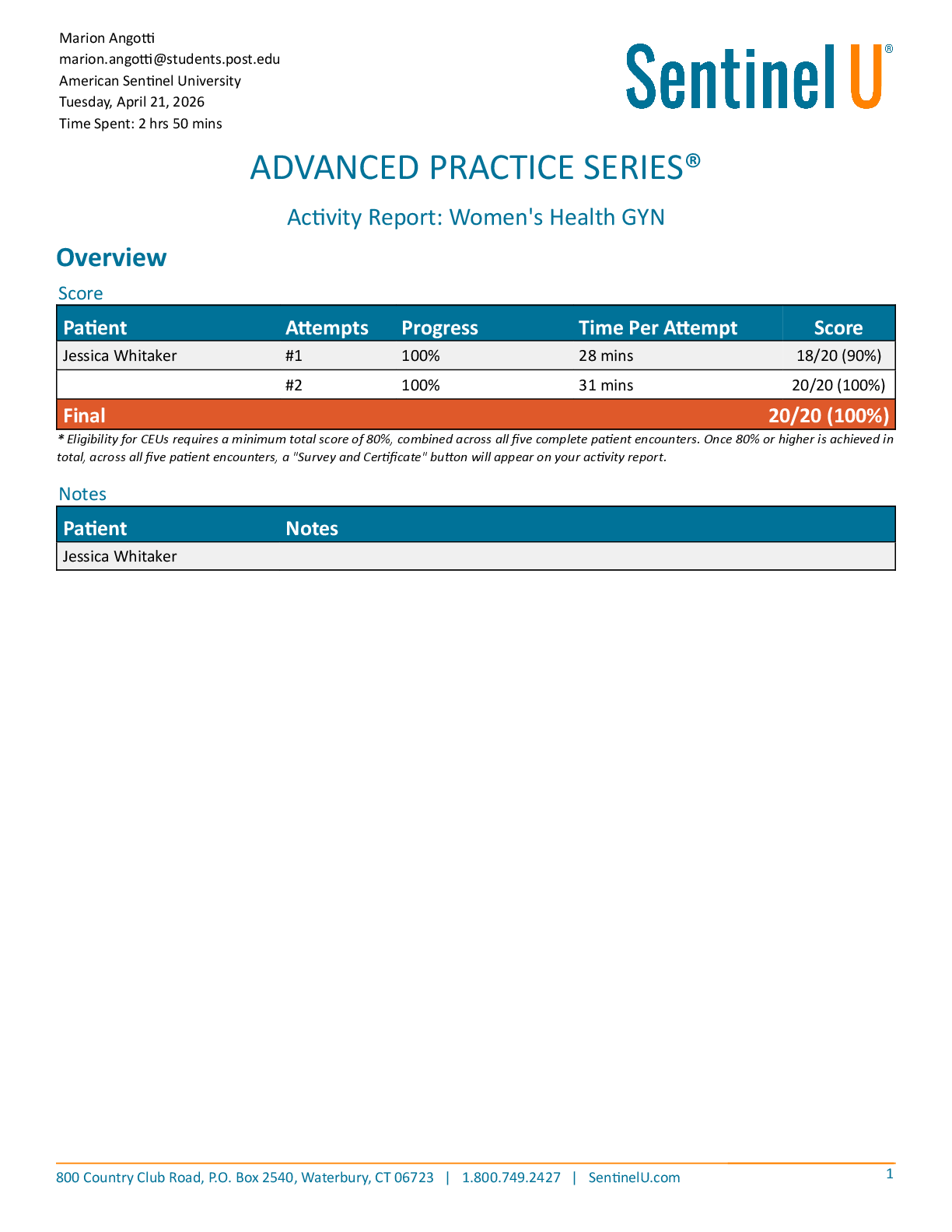
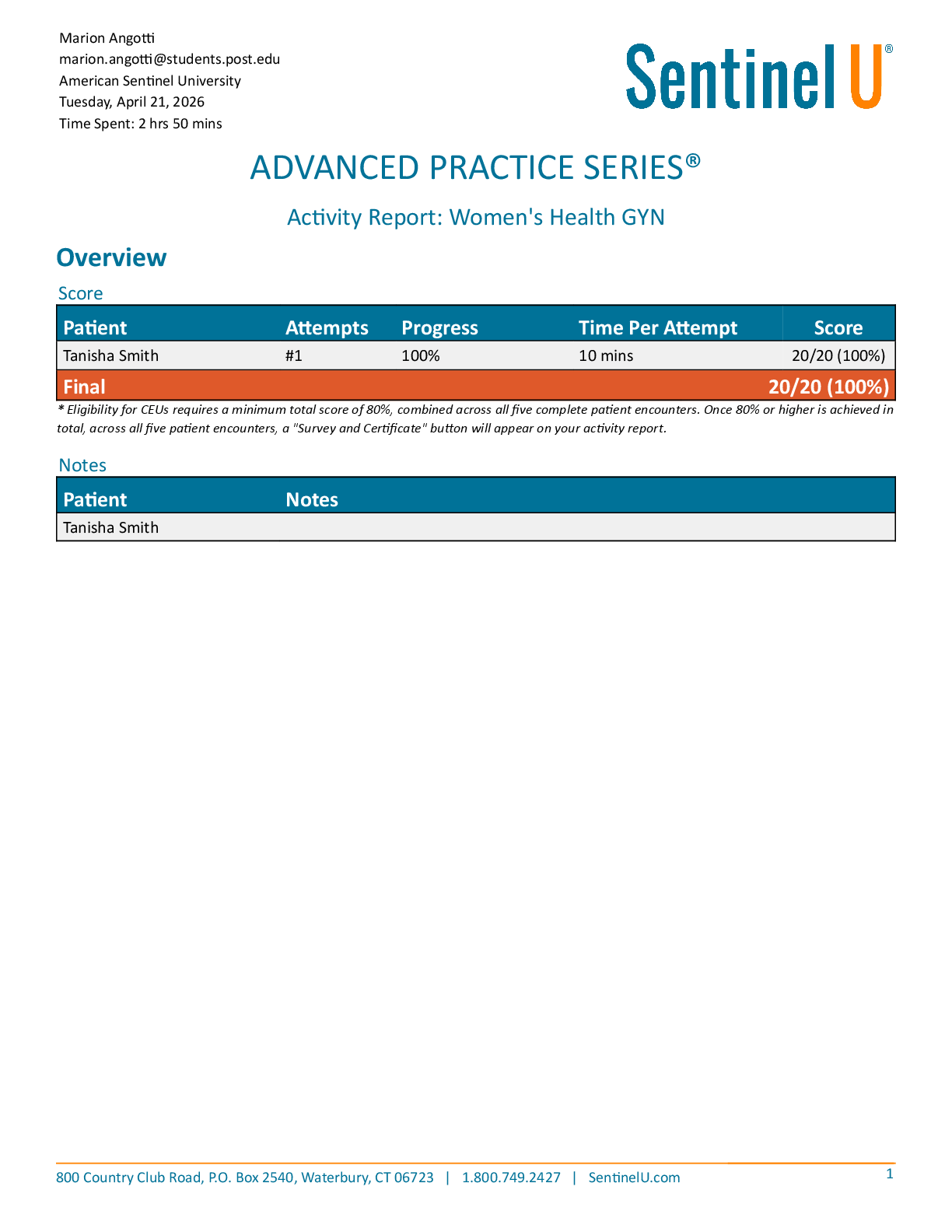
ADVANCED PRACTICE SERIES®
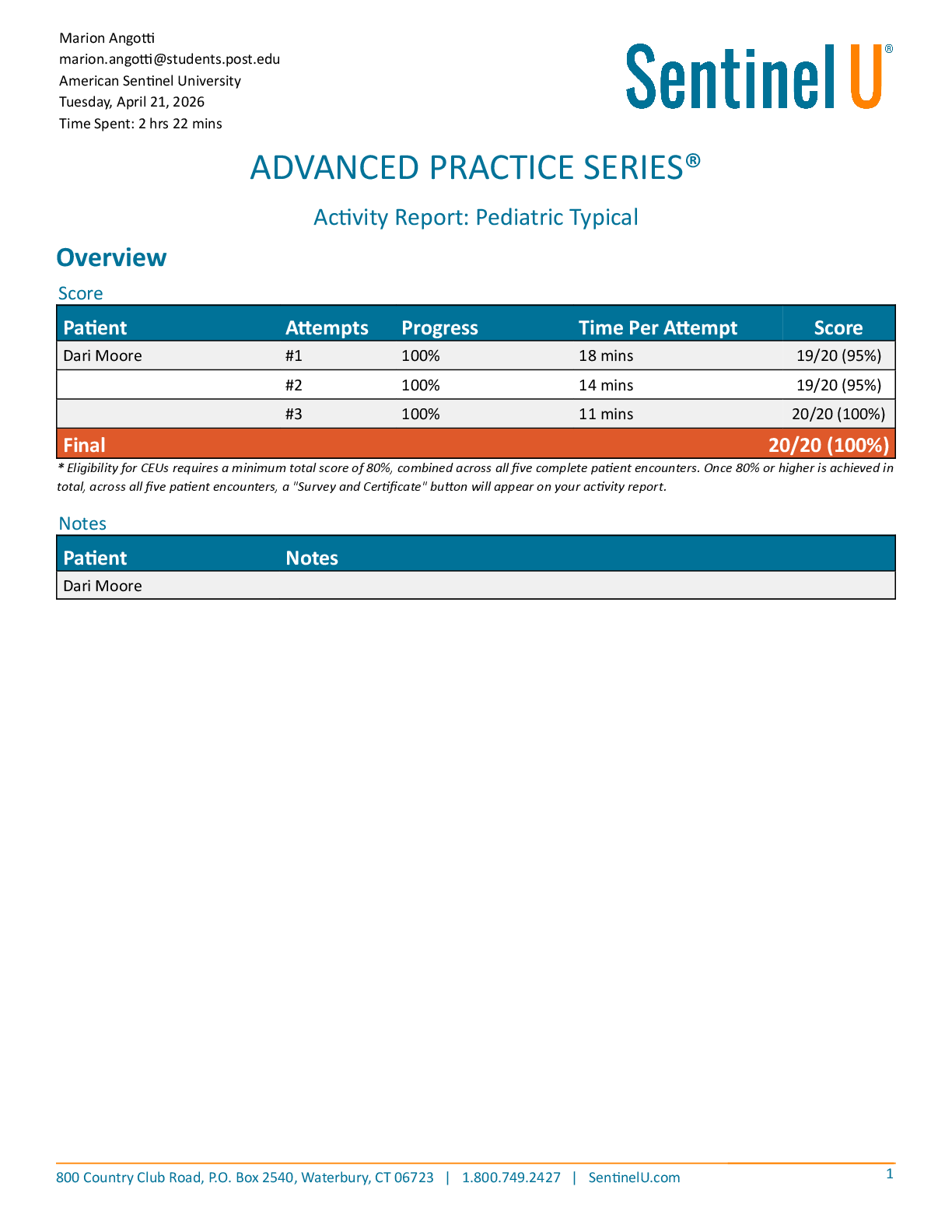
Activity Report: Pediatric Typical
Overview
Score
Patient Attempts Progress Time Per Attempt Score
Abisai Dixson #1 100% 26 mins 11/20 (55%)
#2 99% 11 mins 20/20 (100%)
Final 20/20 (100%)
...
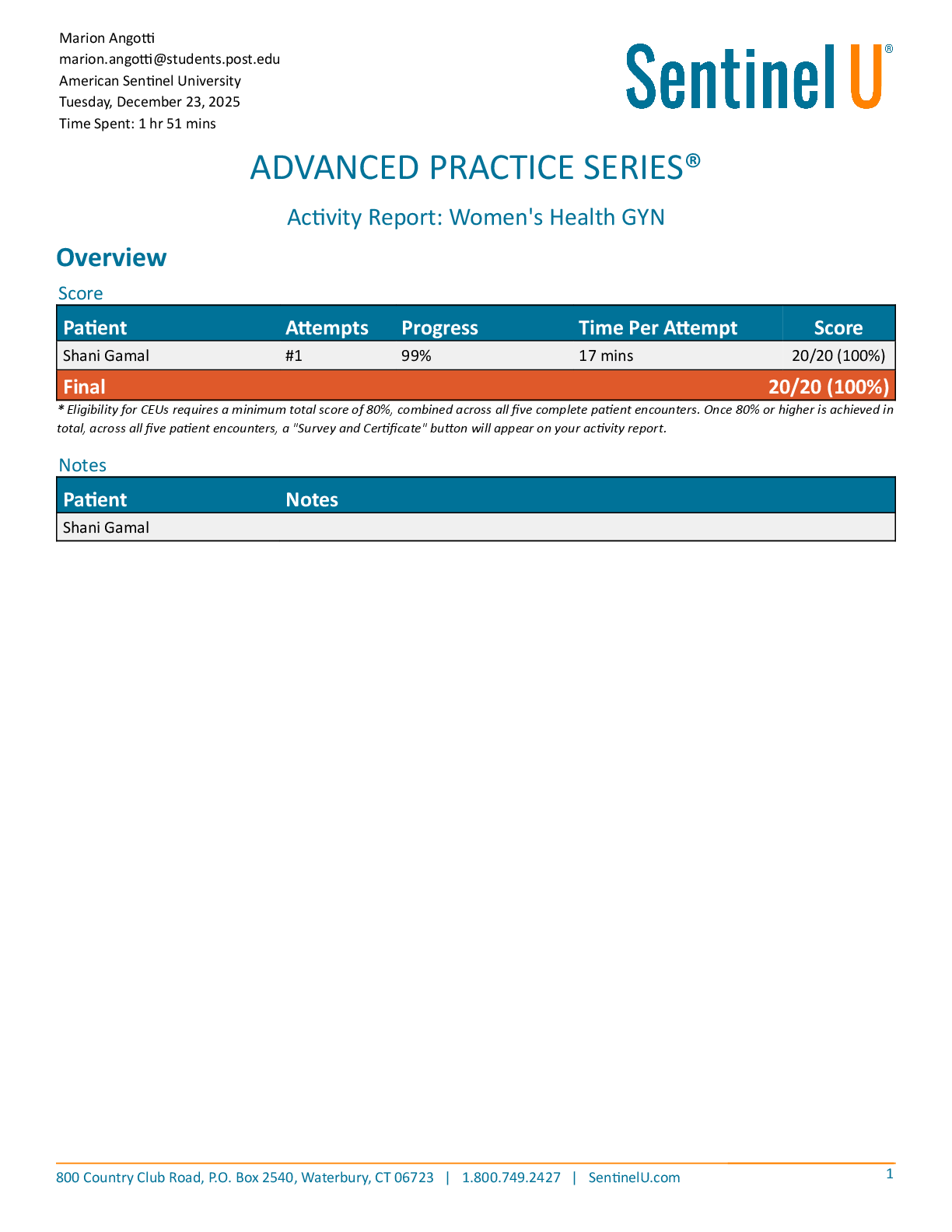
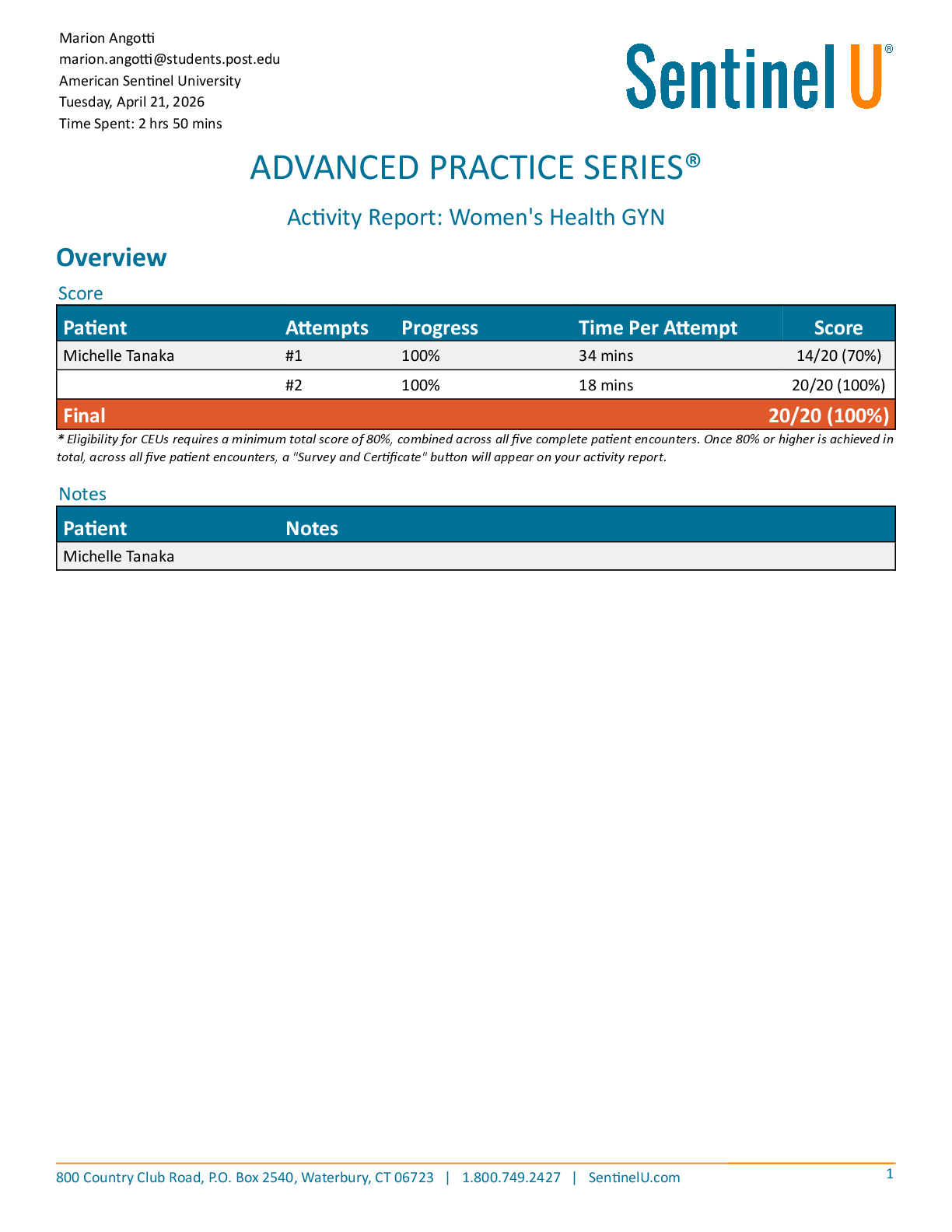
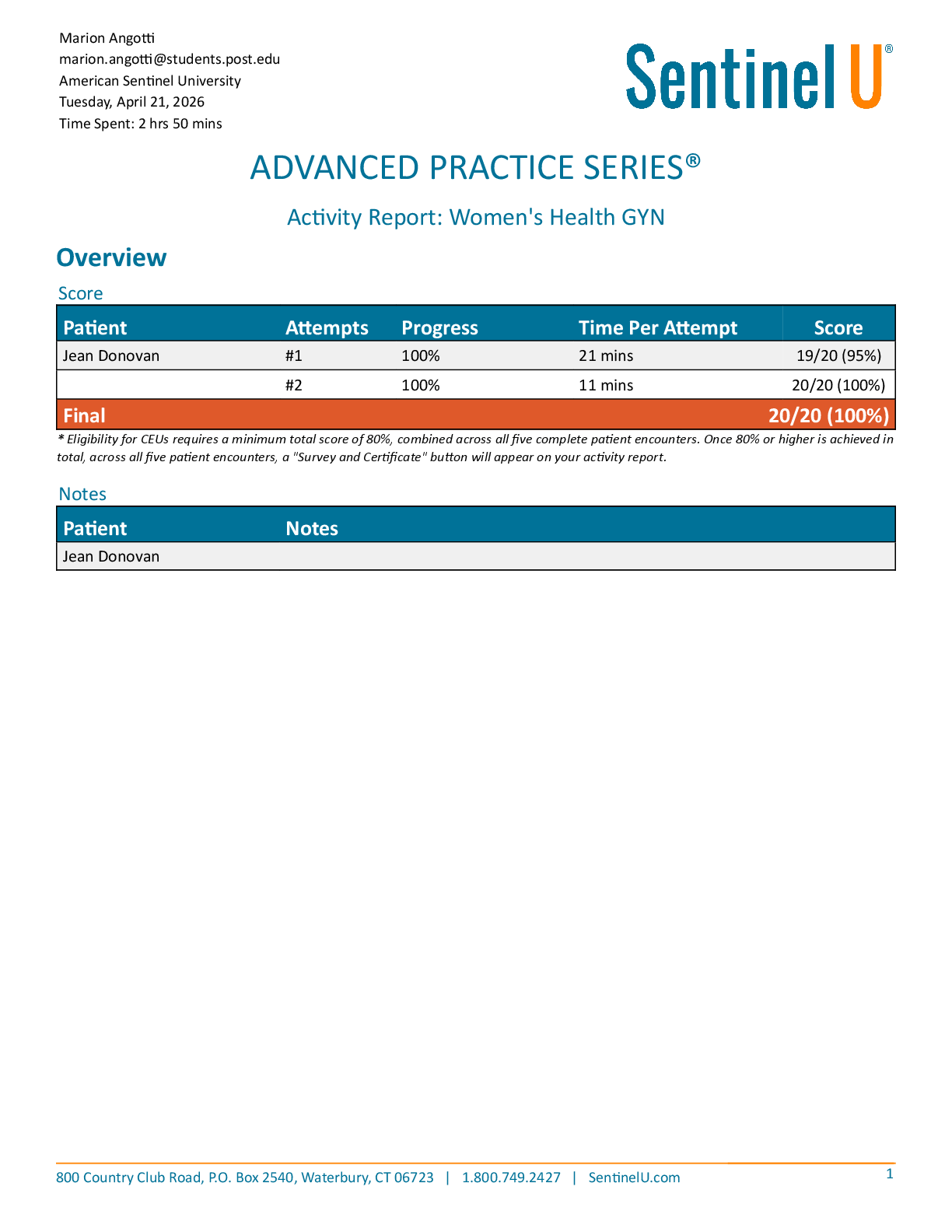
ADVANCED PRACTICE SERIES®
Activity Report: Pediatric Typical
Overview
Score
Patient Attempts Progress Time Per Attempt Score
Abisai Dixson #1 100% 26 mins 11/20 (55%)
#2 99% 11 mins 20/20 (100%)
Final 20/20 (100%)
* Eligibility for CEUs requires a minimum total score of 80%, combined across all five complete patient encounters. Once 80% or higher is achieved in
total, across all five patient encounters, a "Survey and Certificate" button will appear on your activity report.
Notes
Patient Notes
Abisai Dixson
800 Country Club Road, P.O. Box 2540, Waterbury, CT 06723 | 1.800.749.2427 | SentinelU.com 1
Marion Angotti
[email protected]
American Sentinel University
Tuesday, April 21, 2026
Time Spent: 2 hrs 22 mins
NONPF Core Behaviors
Your performance has been mapped to the NONPF Nurse Practitioner Core Competencies. An overview of your strongest and
weakest Core Behaviors has been included below, calculated from all completed patients within the simulation (up to 5).
Top 3 Behaviors Demonstrating Competence
100% Collaborates in interprofessional teams discussions regarding ethical risks, benefits, and outcomes, as
indicated.
100% Student expresses integration of physiologic, behavioral, social, and diagnostic data to justify clinical
reasoning and decision making.
100% Analyses pharmacological interventions for adverse, contraindicated, and synergistic effects.
Top 3 Behaviors Needing Attention
20% Orders correct diagnostic and screening tests as indicated by clinical presentation.
0% Identifies evidenced based practice tools to apply in the clinical setting.
0% Uses appropriate screening tools for actual and potential problems appropriate to care environment.
NONPF Subcompetencies
Code SubCompetency Score
1.2 Apply theory and research-based knowledge from nursing, the arts, humanities, and other sciences. 80%
1.2l Translate science-based theories and concepts to guide one’s overall NP practice. 60%
1.2m Employ ethical decision making to manage and evaluate patient care and population health. 100%
1.3 Demonstrate clinical judgment founded on a broad knowledge base. 57%
1.3f Demonstrate clinical judgment using a systematic approach to inform, improve, and advance NP practice
processes and outcomes. 60%
800 Country Club Road, P.O. Box 2540, Waterbury, CT 06723 | 1.800.749.2427 | SentinelU.com 2
Marion Angotti
[email protected]
American Sentinel University
Tuesday, April 21, 2026
Time Spent: 2 hrs 22 mins
Code SubCompetency Score
1.3g Demonstrate clinical judgment to inform and improve NP practice based on the foundational knowledge of
advanced physiology/pathophysiology, advanced health assessment and advanced pharmacology 61%
1.3h Synthesize current and emerging evidence to influence NP practice 50%
2.1 Engage with individuals and/or caregivers in establishing a caring relationship. 100%
2.1f Practice holistic person-centered care to include confidentiality, privacy, comfort, emotional support, mutual
trust, and respect. 100%
2.1g Engage in shared decision making with consideration of determinants of health. 100%
2.2 Communicate effectively with individuals. 100%
2.2k Utilize communication tools and techniques to promote therapeutic relationships with individuals and/or
caregiver. 100%
2.3 Integrate advanced assessment in NP practice. 76%
2.3i Utilize advanced critical thinking to determine the appropriate focused or comprehensive relevant patient
history. 100%
2.3k Apply advanced assessment skills to perform a focused patient physical assessment utilizing appropriate
techniques. 60%
2.3l Order the appropriate diagnostic and screening tests based on patient’s risk factors and chief complaint. 30%
2.3m Identify health risk factors. 67%
2.3n Evaluate determinants of health that may influence the patient’s well-being. 100%
2.3o Utilize appropriate evidence-based screening tools. 100%
2.4 Diagnose actual or potential health problems and needs 88%
2.4h Analyze physical findings to differentiate between normal, variations of normal, and signs of pathology to
formulate actual and differential diagnoses. 83%
2.4i Utilize diagnostic reasoning to formulate actual and differential diagnoses. 92%
2.5 Manage care of individuals 98%
2.5k Provide holistic person-centered care by developing a mutually acceptable, cost-conscious, and evidencebased plan of care. 100%
2.5l Synthesize data to develop and initiate a person-centered plan of care. 100%
2.5m Prescribe medications safely and accurately using patient data and following legal and regulatory guidelines. 100%
2.5n Order appropriate nonpharmacological interventions. 100%
2.5o Anticipate risks and take action to mitigate adverse events. 88%
2.5p Incorporate health promotion, maintenance and restoration of health into plan of care. 100%
2.6 Demonstrate accountability for care delivery 100%
2.6l Collaborate with the interprofessional team to formulate a plan of care. 100%
2.6m Order consultations or referrals based on evidence and standards of professional care. 100%
2.7 Evaluate outcomes of care. 100%
2.7g Evaluate individual outcomes based on evidence-based interventions. 100%
2.7i Analyze data to evaluate interventions, inequities, and gaps in care. 100%
2.8 Promote self-care management. 100%
800 Country Club Road, P.O. Box 2540, Waterbury, CT 06723 | 1.800.749.2427 | SentinelU.com 3
Marion Angotti